When “I” Speaks After Awakening

After a nondual recognition, language returns before identity does. Words reappear, grammar resumes, and the pronoun “I” steps back into the conversation—not as proof of separation, but as a functional bridge. Speech requires a subject. Silence does not.

Many misunderstand this moment. Hearing someone say “I experienced awakening,” the listener assumes a reinstalled ego, a self reclaiming authorship. Yet what actually occurs is translation. Experience moves through the narrow gate of language, and language has only a few handles to grab reality with. “I” becomes one of them.

Avoiding the word altogether often creates greater confusion. Saying “nothing happened” suggests absence rather than transcendence. It implies insignificance, when the opposite is true. Something fell away so completely that no object remained to point at. Language struggles most where realization is most total.

A distinction helps here.

Turiya refers to the formless witness; the ever-present awareness that observes waking, dreaming, and deep sleep without entering any of them. It is silent, empty, untouched. This is not an experience in time but the condition in which time appears. Many awakenings stabilize here, and rightly so.

Turiyatitta goes further. Even the stance of witnessing dissolves. No observer remains to stand apart from what is observed. Awareness recognizes itself as the only reality there is. No inside, no outside, no vantage point left. This is nonduality without remainder.

When speech arises from this recognition, “I” no longer refers to a psychological centre. It does not point to a thinker, a chooser, or a personal narrative. It points to the Self; Para Brahman—without division. Atman, ego, witness, world collapse into a single field, not blended, not unified, but revealed as never having been separate.

The same word is used. The referent has changed.

Confusion arises when listeners assume the old meaning still applies. The word “I” sounds familiar, so it is treated as familiar. Yet meaning does not live in the word. Meaning lives in the depth from which the word emerges.

A realized individual does not abandon language. Language is abandoned as identity. What remains is utility. Communication happens. Teaching happens. Relationship happens. None of it reinstates separation.

The paradox resolves itself quietly: the ego can say “I,” and the Absolute can say “I.” Only one of them believes it is something.

Silence knows the difference. Speech borrows it.

Morgan O. Smith

Get Your Free Copy of My Book, Bodhi in the Brain!

https://subscribepage.io/oTSZQu

The Proton’s Revelation

When Consciousness Collapses and Expands as One

What if enlightenment is not a personal event, but a cosmic remembrance? A moment when every proton in the body awakens to its true nature, not as matter, but as the still point where creation and annihilation converge. The mystics have always spoken of an inner collapse and expansion, a simultaneous implosion into nothingness and explosion into infinity. Modern physics mirrors this riddle through the black hole and the Big Bang; two extremes that may, in essence, be the same gesture of reality folding through itself.

When awareness reaches its highest clarity, the boundaries that separate the subatomic from the cosmic begin to blur. A single breath becomes indistinguishable from the pulse of galaxies. The enlightened state might then be described as the universe turning itself inside out through human consciousness; each proton realizing it has never been separate from the gravitational core of all being.

At that point, perception no longer divides between what is collapsing and what is being born. The same force that draws the universe inward through gravity propels it outward through radiance. It is the eternal inhale and exhale of existence, experienced directly. To awaken fully may therefore mean to feel every particle of one’s body as both the black hole and the Big Bang; one endless continuum of creation rediscovering itself as “so-called” light.

Such an experience does not inflate the ego; it dissolves it. The seeker disappears into the singularity of pure awareness. The self that once grasped for transcendence becomes the spacetime curvature through which the infinite moves. Nothing is gained, yet everything is realized.

Morgan O. Smith

Get Your Free Copy of My Book, Bodhi in the Brain!

https://subscribepage.io/oTSZQu

Beyond the Quadrants

Direct Encounter with the Supreme Identity

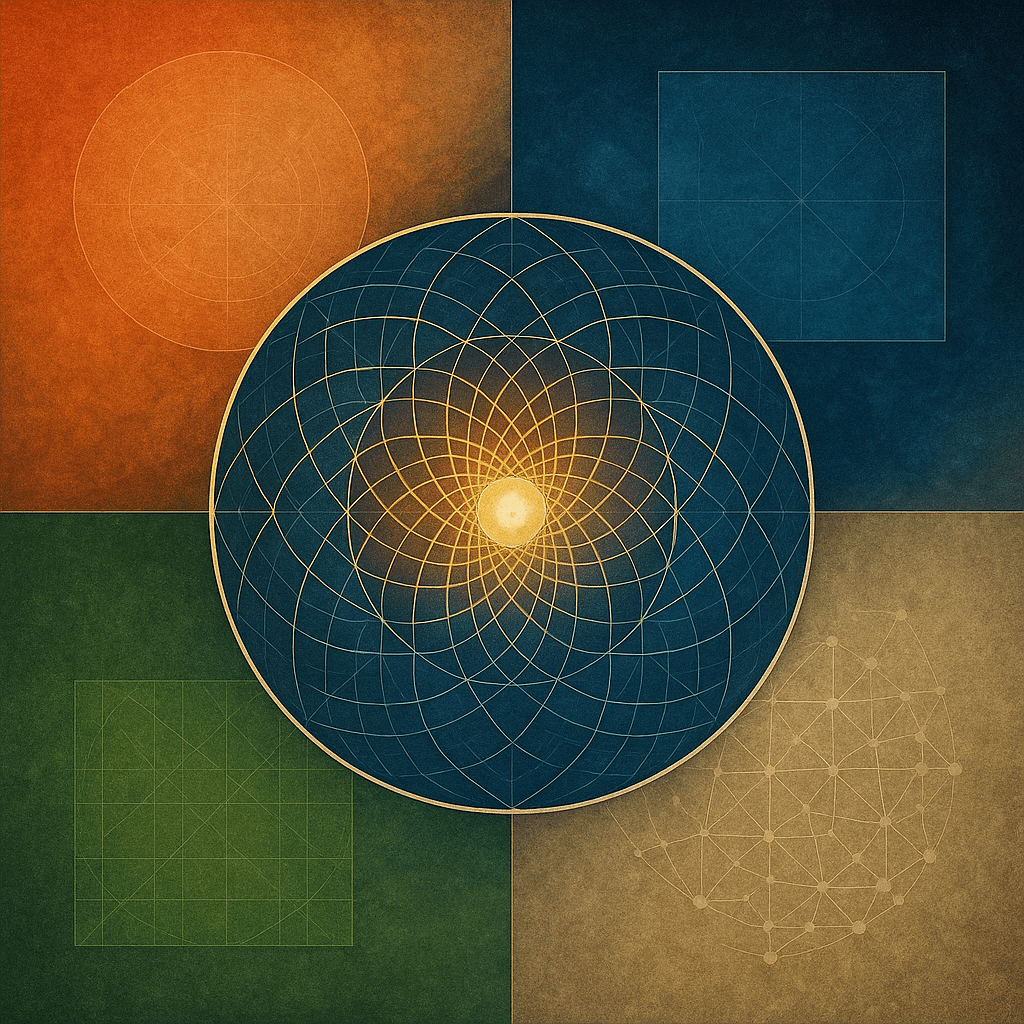
The quadrants—I, We, It, and Its—are not just theoretical maps of experience. They can be lived, felt, and directly known in ways that reveal both their necessity and their ultimate transparency. Each quadrant opens as a doorway, and when entered deeply, each dissolves into the same ground that holds them all.

The “I” – Subjective Interior

The first-person self, the one who says “I,” often feels like the most fundamental reference point of life. Yet, in moments of profound awareness, this identity begins to unravel. The familiar sense of a centre collapses into boundless subjectivity that no longer belongs to a person. Awareness remains, but it is no longer tethered to the small self. The “I” is recognized as inseparable from the infinite.

The “WE” – Intersubjective Communion

Beyond the personal lies the shared field of relationship. Here, connection is no longer about agreement or dialogue but about an unspoken resonance. Every being, every presence, becomes part of a silent communion. The walls between self and other fall away, revealing a unity that feels more intimate than words could ever capture.

The “IT” – Objective Reality

The external world, seen through clear perception, ceases to be “out there.” Light, form, and movement are no longer divided from the one who sees. Reality appears luminous, alive, inseparable from the awareness that beholds it. Object and subject reveal themselves as two sides of the same indivisible presence.

The “ITS” – Systems and Networks

The interwoven fabric of existence discloses itself as a living system. Breath, heartbeat, ecosystems, and galaxies are perceived not as separate mechanisms but as one movement—an intricate symphony without a conductor. The interconnections are not abstractions but a direct felt sense of everything breathing together.

Beyond Quadrants – The Supreme Identity

As each quadrant is seen through, they collapse into the unbroken ground of Being. This cannot be named as “I,” “We,” “It,” or “Its.” It is the source that gives rise to them all while remaining untouched by their distinctions. This is the Supreme Identity—timeless, boundless, indivisible.

When lived from this recognition, the quadrants are not discarded but liberated. They no longer bind perception to fixed standpoints. Instead, they shine as transparent facets of a jewel that was never fractured. Every act, every relationship, every perception becomes a clear expression of the ground itself.

The Supreme Identity is not somewhere else, waiting to be found. It is what was always here—before the quadrants, within them, and beyond them.

Morgan O. Smith

Get Your Free Copy of My Book, Bodhi in the Brain!
https://subscribepage.io/oTSZQu

Beyond Quadrants

The Supreme Identity

The quadrants of experience—I, We, It, and Its—have long been a lens through which consciousness organizes reality. Each provides a vital perspective: the subjective interior of the self, the shared intersubjective domain, the objective forms of matter, and the interobjective systems of the whole. These lenses do not compete; they illuminate the multiple dimensions of existence. Yet, any frame cannot contain the essence of reality, no matter how inclusive or comprehensive it may be.

What reveals itself when awareness no longer clings to a particular quadrant? A vastness appears that cannot be named solely as an “I,” nor reduced to the communion of “We.” It is not confined to the world of objects, nor to the vast interplay of systems. The Supreme Identity both transcends and enfolds these domains, existing as their ground and source.

This Identity is not separate from the quadrants; it is their silent witness and animating force. Just as light contains within it every visible colour yet is itself colourless, the Supreme Identity contains every possible perspective while remaining free of perspective altogether. When seen clearly, the quadrants dissolve into expressions of a singular field that cannot be divided.

What makes this recognition so profound is that it shatters the tendency of consciousness to fixate. The mind grasps for a standpoint—self, relationship, object, or system—but here, every standpoint is unmasked as a partial gesture of the whole. The Supreme Identity does not stand against them; it whispers through them. The “I” speaking, the “We” sharing, the “It” observed, the “Its” interlinked—all are nothing other than its unfolding.

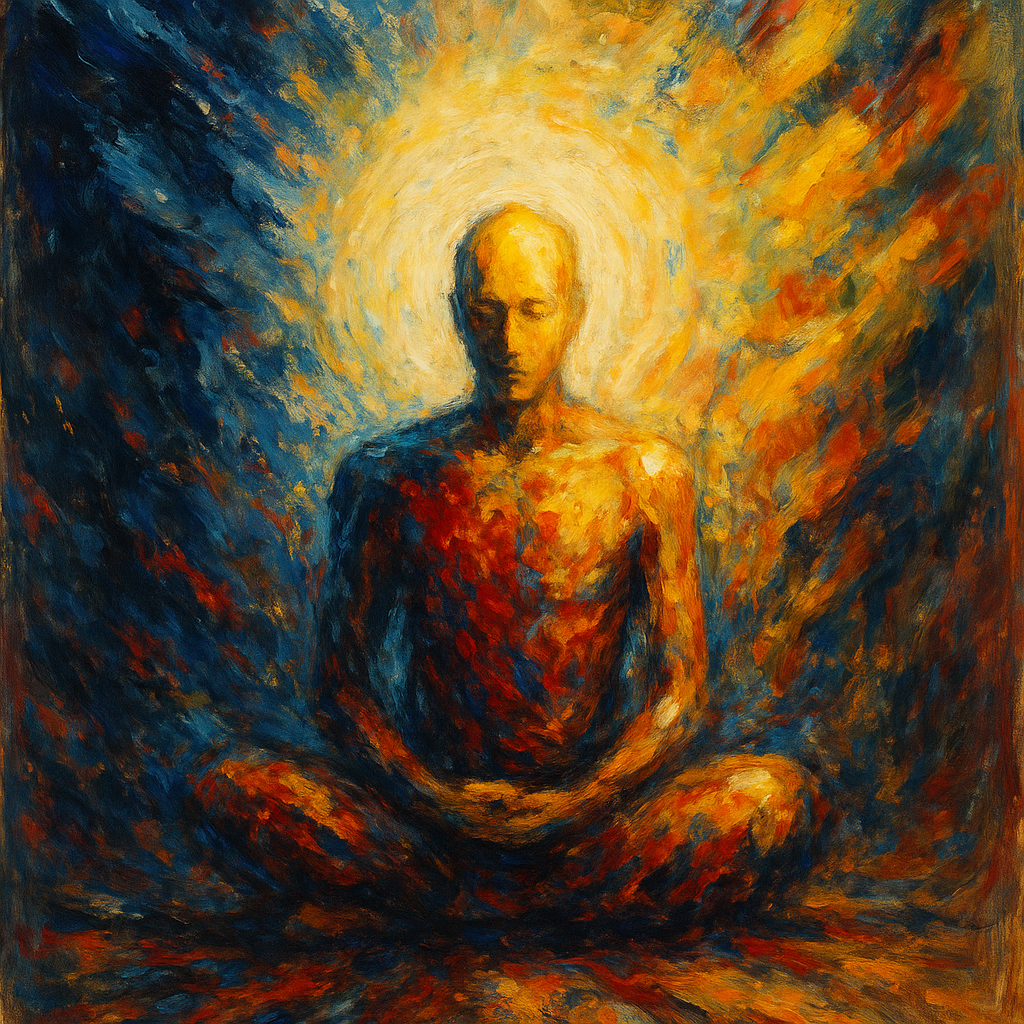
Realizing this does not negate the quadrants. Rather, it liberates them. Each becomes transparent, shining as a clear facet of a jewel that was never fractured to begin with. The Supreme Identity calls forth a recognition: the One is never elsewhere. It is already present, before all perspectives, yet manifesting as each.

To live from this recognition is not to abandon life’s frameworks but to embody their ground. Every conversation, every act, every encounter reveals the unbroken presence that cannot be named yet pervades all. The quadrants remain as tools of navigation, but the navigator is no longer lost.

Morgan O. Smith

Get Your Free Copy of My Book, Bodhi in the Brain!
https://subscribepage.io/oTSZQu

The Final Disappearance

What happens at the moment of death?

Not from the standpoint of biochemistry or theology, but from the lived silence of awakened seeing—the vantage where death and self are no longer two.

At the summit of awakening—whether called Moksha, Nirvana, Turiyatitta, or Nirvikalpa Samadhi—the idea of death unthreads itself. What dies never truly lived, and what lives has never been touched by time. The dissolution of the body is not the end, nor is it a doorway. It is the falling away of questions that were never yours.

There is no climactic revelation at that edge. There is only this. The suchness that never began, never moved, and never faded. At peak realization, death ceases to be an event. It is not an exit. It is the unspeaking of form—a gentle vanishing into what was always here.

This is not metaphor.

Consciousness, unfragmented and clear, neither resists death nor awaits it. It has already passed through it, endlessly. Not as a journey from point A to point B, but as a revelation that neither point exists.

You don’t meet death. You realize you were never separate from it.

At this depth, what we call life no longer hangs from a timeline. What we call death no longer casts a shadow. No more witness is watching the last breath. Only the unnameable recognizes itself through the temporary flicker of form.

The body may fall away, but the body was never the one who knew. The breath may stop, but the breath was never yours. That which remains doesn’t remain—it is. Before and after mean nothing to it.

Some call this realization peace. Others call it extinction. But it’s neither stillness nor silence nor bliss. It’s before all that. It’s the absence of absence. The presence of presence. Not two.

When the last ripple of self dissolves, what’s left is not a person merging with eternity. There is no one to merge. There is only what was always whole.

This is death at the level of freedom. This is life without division.

Not a conclusion.

A cessation of seeking.

Morgan O. Smith

Get Your Free Copy of My Book, Bodhi in the Brain!

https://subscribepage.io/oTSZQu

Turiyatitta

The Singularity of All That Is

Turiyatitta, often referred to as the state beyond the fourth, is an experience that defies conventional understanding. While Turiya encompasses the witness state within waking, dreaming, and deep dreamless sleep, Turiyatitta transcends even this. It represents the complete dissolution of the witness, where all states merge into an indivisible, absolute singularity. Here, the boundaries that once defined waking, dreaming, and deep dreamless sleep no longer exist—everything and nothing become one.

In Turiyatitta, consciousness no longer stands apart, observing. The very notion of a witness dissolves into an awareness so expansive and complete that there is nothing left to observe. There is no division between subject and object, no experience of separation because nothing exists outside of this infinite awareness. This state is considered the final stage of enlightenment—where the full nondual awareness of absolute Monism is realized.

Imagine being both everything and nothing at the same time. Not merely perceiving this intellectually, but embodying the paradox in a way that no words can fully express. The divine empty witness, once perceived as separate, fully dissolves within itself. All distinctions—between time and space, self and other—collapse into the infinite. What remains is not emptiness in the typical sense, but a fullness so complete that it transcends all concepts of existence or non-existence.

Turiyatitta feels like the ultimate convergence of all possible experiences into one absolute awareness. It is a state where nothing is hidden, nothing is separate, and there is no need for perception because everything is known in its essence. There is no longer a “seer,” for there is nothing to see. The divine once thought of as a distant force or presence, is realized as the very fabric of existence.


This stage is not about attaining something new but about shedding the final layers of illusion, revealing the inherent truth that has always been. The mind quiets, the heart stills, and what remains is the simple, silent, all-encompassing awareness that is beyond all states, yet contains them all.

Morgan O. Smith

Yinnergy Meditation, Spiritual Life Coaching & My Book, Bodhi in the Brain…Available Now!

https://linktr.ee/morganosmith

Turiyatitta and the One-Electron Universe

A Journey into Nondual Oneness

As proposed by physicist John Archibald Wheeler, the concept of the one-electron universe suggests that every electron in the universe might be the same particle, traversing back and forth through time. This radical idea blurs the boundaries between individuality and unity, inviting profound contemplation on the nature of existence and consciousness.

Electrons, as identical entities, lack distinguishing features beyond their position and momentum, mirroring the fundamental principle of nonduality—the essence that underlies all forms is the same. The notion of a singular electron moving through time, creating the illusion of multiplicity, parallels the experience of Turiyatitta, the state of nondual suchness where the distinctions between self and other, subject and object, dissolve into a unified whole.

Turiyatitta, the fourth state of consciousness beyond waking, dreaming, and deep sleep, represents a transcendence of dualistic perception. This state aligns with the idea of the one-electron universe, where what appears as many is, in essence, one. The perceived separation between particles, events, and experiences collapses when viewed from the standpoint of timelessness, revealing a reality where all is interconnected and indivisible.

The spiritual peak experience of nondual suchness is akin to glimpsing the one-electron universe—an awareness that what seems fragmented and diverse is a manifestation of a singular, timeless presence. This insight challenges the ordinary perception of reality, encouraging a shift from seeing the world as a collection of separate entities to recognizing the seamless flow of existence.

Contemplating the one-electron universe invites a deeper understanding of Turiyatitta. It prompts reflection on the possibility that all experiences, all states of consciousness, are expressions of a single, underlying reality. Just as the electron moves through time, creating the appearance of multiplicity, consciousness flows through the spectrum of awareness, giving rise to the illusion of duality. Yet, at the core of this illusion lies the truth of oneness—a truth that becomes evident in the state of Turiyatitta.

Exploring the one-electron universe and its connection to nondual suchness encourages a re-evaluation of the boundaries between science and spirituality. Both realms point toward a deeper understanding of reality, one that transcends the limitations of time, space, and individual identity. Through this lens, the spiritual journey toward Turiyatitta can be seen as a movement toward recognizing the singular nature of existence, where all distinctions dissolve, and only the undivided whole remains.

Morgan O. Smith

Yinnergy Meditation, Spiritual Life Coaching & My Book, Bodhi in the Brain…Available Now!

https://linktr.ee/morganosmith

The Convergence of Quadrants

A Journey from Relative to Ultimate Reality

In the realms of Integral Theory, our perception of reality is intricately divided into four primary dimensions or perspectives: the subjective (‘I’), the intersubjective (‘We’), the objective (‘It’), and the interobjective (‘Its’). These perspectives serve as the foundational pillars through which we navigate our relative existence, framing our experiences, relationships, and understanding of the world around us. These quadrants, when represented graphically, are not just abstract concepts but are reflective of the comprehensive ways in which we engage with reality.

However, the journey toward spiritual awakening introduces a profound transformation in this perception. As one advance towards the state of Turiyatitta, a term deeply rooted in Eastern philosophy signifying a state beyond the waking, dreaming, and deep sleep states, a remarkable unification occurs. In Turiyatitta, the boundaries that once separated the ‘I’ from ‘We’, the ‘We’ from ‘It’, and the ‘It’ from ‘Its’, dissolve into a seamless oneness. This state transcends the distinctions between the subjective and the objective, the individual and the collective, and the observer and the observed.


The exploration of Turiyatitta challenges the compartmentalized view of reality presented by Integral Theory. It invites us into a realm where the delineations between the upper-left (I), lower-left (We), upper-right (It), and lower-right (Its) quadrants blur, suggesting that these divisions are merely constructs of a relative reality. In the ultimate reality experienced through Turiyatitta, these quadrants converge, revealing that at the most profound level, there is no distinction between ‘I’ and ‘We’, ‘We’ and ‘It’, ‘It’ and ‘Its’—everything becomes interconnected, a unified whole.

This revelation has significant implications for our spiritual and philosophical journeys. It suggests that the ultimate truth lies not in the separation and analysis of reality into distinct quadrants but in the recognition of the inherent oneness that underlies all existence. The experience of Turiyatitta offers a direct encounter with this oneness, an experiential understanding that transcends intellectual comprehension and invites us into a direct, immediate experience of unity.


Engaging with this perspective does not invalidate the usefulness of the four quadrants in navigating our relative reality. Instead, it enriches our understanding by adding depth to our perception, allowing us to see beyond the surface distinctions and appreciate the underlying unity that connects all aspects of existence. This holistic view fosters a deeper sense of empathy, interconnectedness, and a profound appreciation for the mystery that is life itself.

As we navigate our spiritual path, the exploration of Turiyatitta and the convergence of the four quadrants invite us to reconsider our understanding of reality. It encourages us to look beyond the apparent separations and to embrace the unity that encompasses all aspects of our existence. In doing so, we open ourselves to a more profound, interconnected, and unified experience of reality, one that transcends the limitations of our conventional perspectives and guides us toward a deeper realization of the ultimate truth.

Morgan O. Smith

Yinnergy Meditation, Spiritual Life Coaching & My Book, Bodhi in the Brain…Available Now!

https://linktr.ee/morganosmith

Turiyatitta

The Dual Dimensions of Consciousness and Developmental Progression

In the realm of spiritual exploration, few concepts are as enigmatic and yet profoundly significant as Turiyatitta. Derived from ancient Eastern philosophies, Turiyatitta is often perceived through two distinct lenses: as a state of consciousness and as a stage of developmental progression. This dichotomy offers a multifaceted understanding of the journey toward enlightenment, allowing us to unravel its mysteries with a deeper appreciation.

I. Turiyatitta as a State of Consciousness

At its core, Turiyatitta as a state of consciousness represents the pinnacle of spiritual awareness. It transcends the traditional states of waking, dreaming, and deep sleep. In this heightened state, the individual experiences an overarching sense of unity and interconnectedness with the universe. It is a realm where dualities merge, and the illusion of separateness dissolves. This experience is not merely about observing or understanding nonduality; it is about living it, being immersed in it completely.

II. Turiyatitta as a Stage of Developmental Progression

Alternatively, when viewed as a stage of developmental progression, Turiyatitta symbolizes the culmination of a spiritual journey. It’s not a destination reached hastily but through diligent, sustained practice and profound inner transformation. This perspective of Turiyatitta underscores the evolutionary nature of spiritual growth. It suggests a gradual unfolding, a blossoming of consciousness that culminates in the realization of Turiyatitta.


III. The Interplay between the Two Dimensions

The beauty of Turiyatitta lies in the interplay between these two dimensions. The state of consciousness feeds into the developmental progression, and vice versa. Each experience of Turiyatitta as a state of consciousness propels the seeker further along their developmental path. Similarly, each step forward in one’s spiritual development offers a deeper immersion into the state of Turiyatitta.

IV. Implications for the Spiritual Seeker

For the spiritual seeker, understanding Turiyatitta in both contexts is crucial. It serves as a guidepost, illuminating the path to true enlightenment. By recognizing that Turiyatitta is both a state to be experienced and a stage to be attained, seekers can approach their journey with a balanced perspective, appreciating the importance of both immediate experience and long-term growth.


Conclusion

Turiyatitta, in its dual representation, offers a profound framework for understanding the depths of spiritual consciousness and the journey toward enlightenment. By exploring its aspects as a state of consciousness and a developmental stage, we open ourselves to a more holistic and enriched spiritual journey.

Morgan O. Smith

Yinnergy Meditation, Spiritual Life Coaching & My Book, Bodhi in the Brain…Available Now!

https://linktr.ee/morganosmith

Turiyatitta

Exploring the Vast Mosaic of Life’s Perspectives

The concept of Turiyatitta, deeply embedded in spiritual philosophy, suggests a state where one can momentarily comprehend the perspectives of trillions of different life forms. This transcendent state goes beyond regular consciousness to a domain where the line between the individual and the collective blurs. Imagine perceiving the world not only from a human viewpoint but also through the experiences of animals, insects, microorganisms, fungi, and plants. This idea, daunting yet enlightening, pushes the boundaries of our understanding of consciousness and interconnectedness.

Consider the human perspective first, with its vast diversity, including various cultures, beliefs, and life experiences. Now, add to this the animal kingdom, each species with its unique way of engaging with the world. For instance, a bat navigates its environment using echolocation, a sensory experience vastly different from human perception.

Then there are insects, whose world of pheromones and ultraviolet vision offers a radically different understanding of existence. Microorganisms, invisible to our eyes, play a critical role in sustaining life, offering a perspective that could reveal the intricate workings of cellular life and the basics of existence.


Fungi, straddling the realms of the known and unknown, challenge our perceptions of individuality and community. Their networks, akin to a natural internet, show a level of connectivity that human technology aspires to reach.

Finally, contemplate the plant perspective. Recent research suggests that plants not only react to their surroundings but also communicate and remember. Imagine the view of the world from a centuries-old tree, silently observing the gradual flow of time.


Turiyatitta is more than a concept; it’s an invitation to broaden our consciousness and empathy. It reminds us that every form of life, no matter its size or perceived insignificance, plays a part in the grand scheme of things. This understanding could be crucial in fostering a more compassionate, empathetic, and connected world.

By embracing Turiyatitta, we recognize our role not as mere onlookers but as integral components of the universe’s vast mosaic. Each life form, each perspective, contributes to this mosaic, making it more vibrant and dynamic. This realization is humbling and empowering, urging us towards greater responsibility and deeper insight.


To experience Turiyatitta is to briefly touch the infinite, to connect with the essence of life itself. It’s a journey that involves not just the mind but also the heart and soul, moving us towards a deeper bond with all forms of life.

Morgan O. Smith

Yinnergy Meditation, Spiritual Life Coaching & My Book, Bodhi in the Brain…Available Now!

https://linktr.ee/morganosmith