When I Moved, the Universe Moved

The Day I Understood Yoga

There are experiences that give you new information, and there are experiences that dismantle the very structure through which information is understood.

My spiritual awakening belonged to the latter.

Something happened that I could never have understood through philosophy alone. My body began moving involuntarily. Different parts of my body moved in different directions without any conscious intention on my part. From the outside, someone might have thought I was experiencing some form of seizure. From within the experience, however, something completely different was occurring.

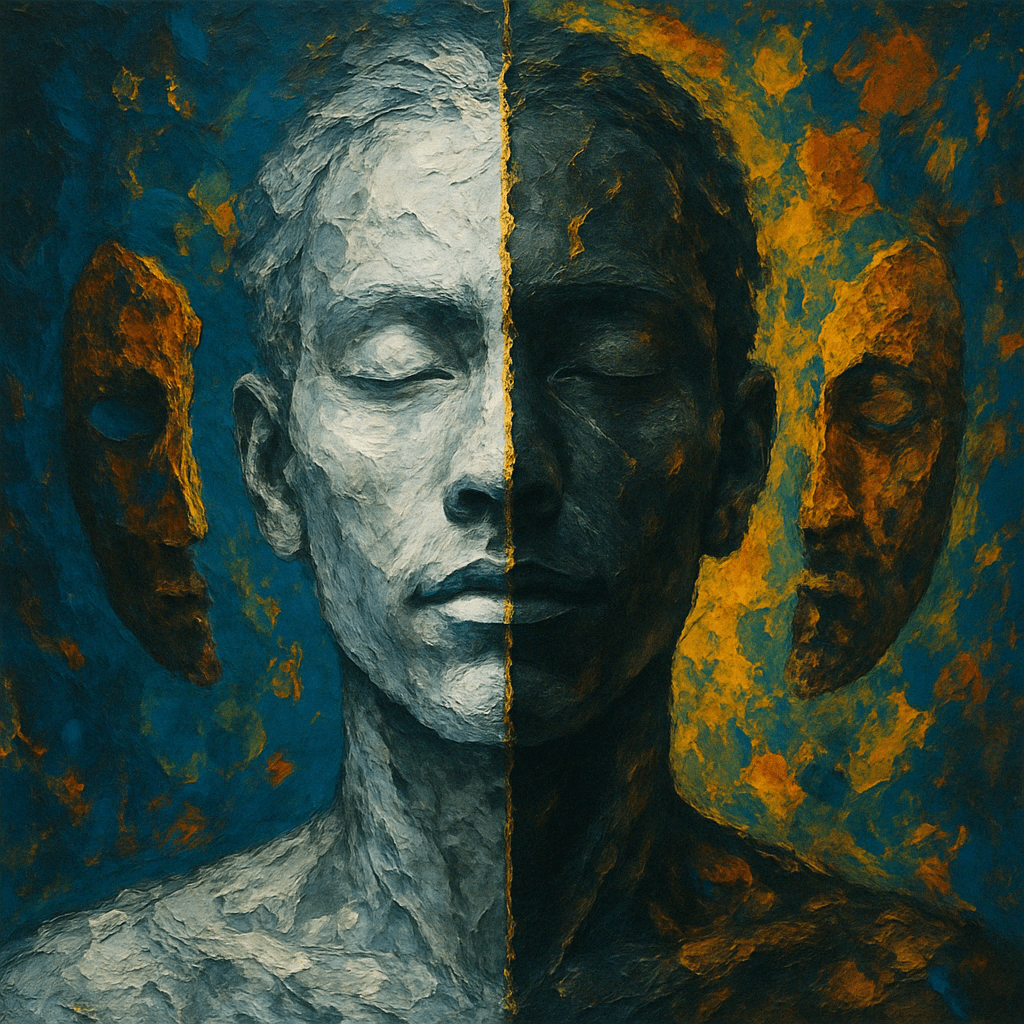
I wasn’t experiencing a body that had simply gone out of control.

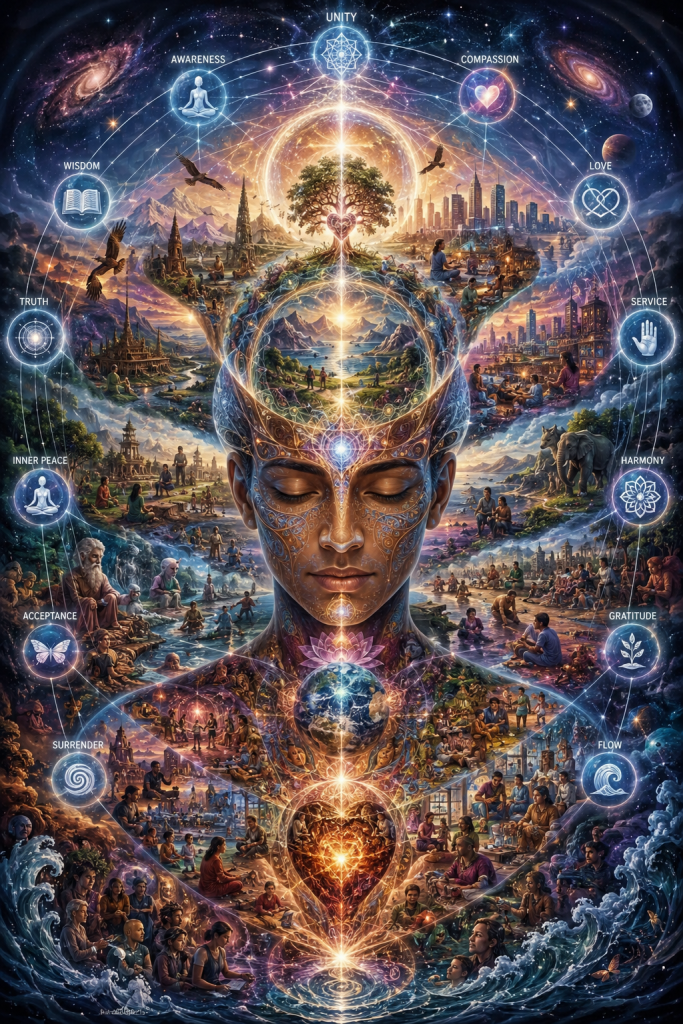
I was experiencing the disappearance of the distinction between my body and the universe.

When I moved, the universe moved.

When the universe moved, I moved.

There was no separation between the two.

For the first time, I understood Yoga.

Not yoga merely as a collection of physical postures.

Not yoga as stretching, breathing, flexibility, or exercise.

I understood Yoga with a capital Y.

The Universe Was Not Somewhere Else

Ordinary consciousness is organized around an assumption so fundamental that we rarely notice it.

I am here.

The world is there.

My body occupies this particular location. Other objects occupy other locations. I look outward from somewhere behind my eyes and experience a universe surrounding me.

That arrangement feels completely natural.

During my awakening, it disappeared.

Every location seemed to occupy the same nonlocal space.

That statement sounds contradictory because language depends upon distinctions. A location is supposed to be different from another location. Here cannot simultaneously be there. My body cannot simultaneously occupy every possible position.

Yet the experience wasn’t conceptual.

It was immediate.

Space no longer seemed divided into separate locations in the ordinary way. The usual distinction between an observer located somewhere and a universe extending outward from that observer was absent.

There was no meaningful boundary where “me” ended and “universe” began.

Every Asana at Once

Something even stranger accompanied this.

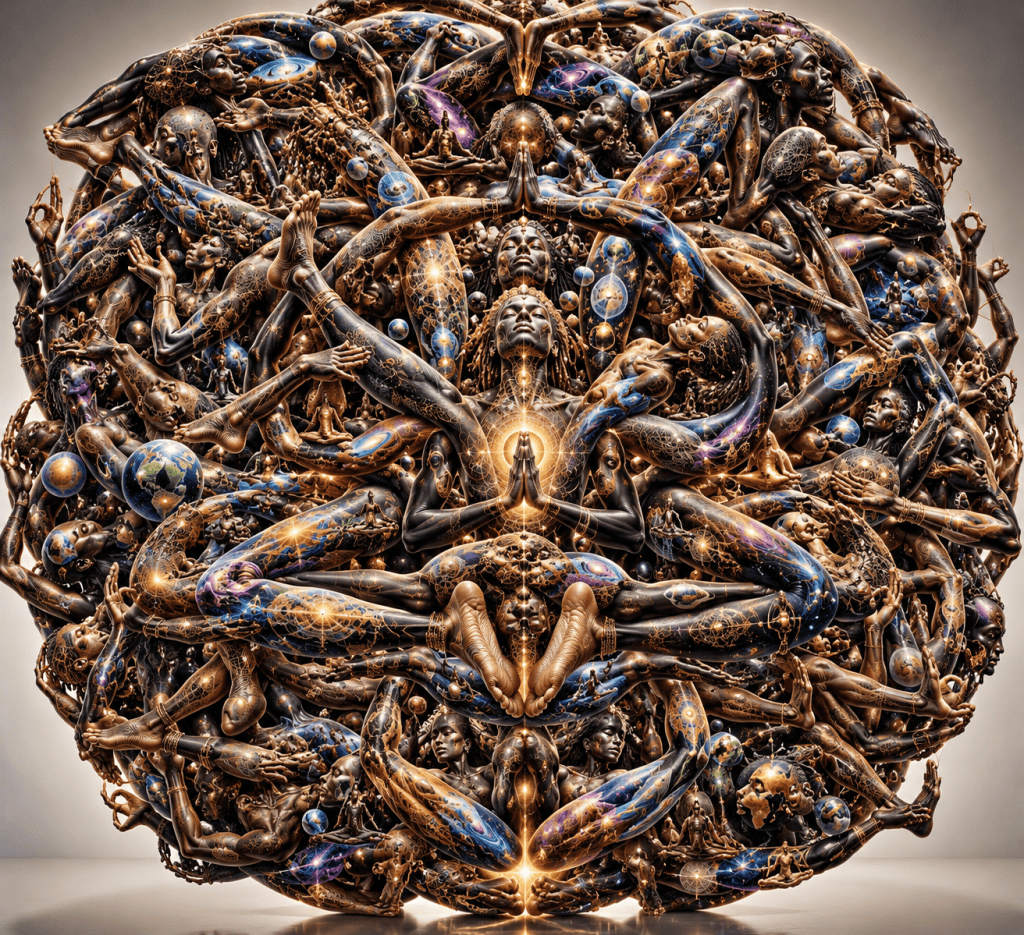
As my body moved spontaneously, I had the overwhelming experience that I was performing every asana simultaneously.

I do not mean that my physical body literally assumed every possible yoga posture at the same moment. That would obviously be physically impossible.

The experience was deeper than physical positioning.

Every movement felt universal.

Every posture seemed contained within movement itself.

My body was not experienced as an isolated biological organism changing positions against the background of a stationary universe. Body, space, movement, and universe were one seamless occurrence.

There wasn’t a Morgan performing an asana.

There was simply movement.

And somehow that movement belonged to everything.

Perhaps Union Is Not Quite the Right Word

The Sanskrit root commonly associated with Yoga, yuj, carries meanings related to joining, yoking, harnessing, and union.

For years, I understood the spiritual meaning of Yoga through that framework.

The individual becomes united with the Divine.

The self becomes united with the Absolute.

The practitioner becomes united with existence.

After my awakening, even the word “union” seemed insufficient.

Union still subtly assumes two.

Two things exist separately and then come together.

But what happens when the distinction between them disappears completely?

What if the individual and the universe do not become one?

What if they were never actually two?

That was much closer to what I experienced.

I did not experience myself merging with the universe as though Morgan were one substance and the cosmos another.

The distinction itself became meaningless.

There was no inside looking outside.

No subject observing an object.

No separate mover controlling movement.

No isolated body existing within an external universe.

There was simply what was happening.

Who Is Moving Whom?

Consider something as ordinary as raising your hand.

Usually we experience the sequence like this:

“I decided to raise my hand.”

Then the hand rises.

There appears to be an internal agent producing an external action.

But examine movement closely enough and a strange question emerges.

Where exactly is the mover?

A thought announcing an intention may appear.

Muscles contract.

The arm rises.

Sensations change.

The visual field changes.

But where is the separate entity responsible for making the entire process happen?

During my awakening, this question wasn’t answered intellectually.

The question disappeared because the assumed division behind it disappeared.

When the body moved, the universe moved.

When the universe moved, the body moved.

These weren’t two synchronized events.

They were the same event.

That distinction matters enormously.

Synchronization usually describes two separate systems moving together.

What I experienced wasn’t synchronization between myself and existence.

It was identity.

The Body as an Activity of the Universe

We normally say, “My body.”

Notice what those two words imply.

There is supposedly a “me” who possesses a body.

But what exactly is the body?

Carbon, oxygen, hydrogen, nitrogen, calcium, phosphorus, water, microorganisms, electrical activity, chemical reactions, inherited genetic information, food, sunlight indirectly captured through plants, minerals formed through ancient geological processes, and elements forged within stars.

At what point does any of this become separate from the universe?

The boundary is practical.

It is biologically useful.

It allows an organism to navigate its environment, protect itself, seek nourishment, reproduce, communicate, and survive.

But practical distinction does not necessarily equal ultimate separation.

Perhaps the body isn’t something placed inside the universe.

Perhaps the body is something the universe is doing.

A wave isn’t an object placed inside an ocean.

The wave is the ocean behaving as a wave.

This human organism may be understood similarly.

Not something existence contains, but something existence is presently doing.

The Neuroscience Does Not Cancel the Mystery

There is also a neurological dimension to experiences like this.

The brain continuously integrates proprioception, vision, touch, vestibular information, motor intention, memory, and spatial information to generate our ordinary experience of being a body located somewhere.

Various systems contribute to this process, including the parietal cortex, temporoparietal regions, insula, somatosensory systems, vestibular networks, motor systems, cerebellum, thalamus, and networks associated with self-referential processing.

Profound alterations in how these systems communicate could conceivably accompany experiences in which bodily boundaries, agency, spatial location, or the distinction between self and environment radically change.

That possibility fascinates me.

But neuroscience and metaphysics are answering different questions.

Discovering the neural correlates of nondual consciousness would tell us something important about what the nervous system is doing when such experiences occur.

It would not automatically tell us what reality ultimately is.

Suppose scientists eventually discovered an exact neural signature accompanying the dissolution of subject-object consciousness.

That discovery would still leave an extraordinary question unanswered:

Does the altered brain create an illusion of unity, or does ordinary brain organization create an illusion of separation?

Neuroscience alone cannot easily settle that question.

The Witness Must Eventually Disappear Too

There can also be a subtle stage on the contemplative path where one discovers oneself as the Witness.

Thoughts arise, but I am aware of them.

Sensations arise, but I am aware of them.

The body moves, but I am aware of the body moving.

Eventually even this can preserve a subtle duality.

There is still awareness on one side and something being witnessed on the other.

Awareness versus experience.

Witness versus witnessed.

Subject versus object.

The radical implication of nonduality goes further.

What happens when even the Witness cannot be located separately from what is witnessed?

There is seeing, but no separate seer.

There is hearing, but no separate hearer.

There is movement, but no separate mover.

There is awareness, yet no independent entity standing outside experience possessing awareness.

This is where language begins to fail because grammar itself wants a subject performing an action.

Nonduality does not cooperate very well with grammar.

Yoga Before the Word Yoga

Perhaps this is why my experience transformed my understanding of Yoga.

Yoga ceased being something I practiced.

For that extraordinary period, Yoga described reality itself.

Nothing needed to be joined because nothing was actually separate.

The body did not need to unite with the universe.

The body was already the expression of the universe.

Awareness did not need to reach the Absolute.

The apparent distance between awareness and the Absolute had vanished.

The seeker did not finally capture what had been sought.

The separation between seeker and sought collapsed.

This also changed how I understood spiritual practice.

Meditation may begin as something a person does.

Someone sits.

Someone watches the breath.

Someone observes thoughts.

Someone searches for stillness.

Someone seeks awakening.

But eventually the most interesting question may become:

Who exactly is doing all of this?

Follow that question deeply enough and the spiritual journey begins turning back upon the one supposedly travelling it.

When the Universe Moved

Words will never reproduce what happened.

“Oneness” doesn’t capture it.

“Unity” doesn’t capture it.

“Cosmic consciousness” doesn’t capture it.

Even “nonduality” remains a concept pointing toward something that precedes conceptual division.

The closest expression I have remains remarkably simple:

When I moved, the universe moved.

When the universe moved, I moved.

Eventually even that statement contains one distinction too many.

There was no “I” on one side and “universe” on the other.

There was movement.

There was stillness.

There was awareness.

There was no awareness.

There was existence.

There was no existence.

And none of them were separate.

That was when I finally understood Yoga.

Not as something the human being does to become united with existence.

But as the recognition that existence was never divided in the first place.

Morgan O. Smith
https://linktr.ee/morganosmith

Have You Outgrown Your Childhood View of Heaven?

Most people eventually outgrow their childhood ideas about almost everything.

Our tastes in food become more refined. Our understanding of relationships deepens. Our appreciation for music changes. Fashion evolves. Culture shifts. Even our political, moral, and philosophical views often undergo profound transformation as life teaches us new lessons.

Yet there is one idea that frequently remains frozen in time.

Paradise.

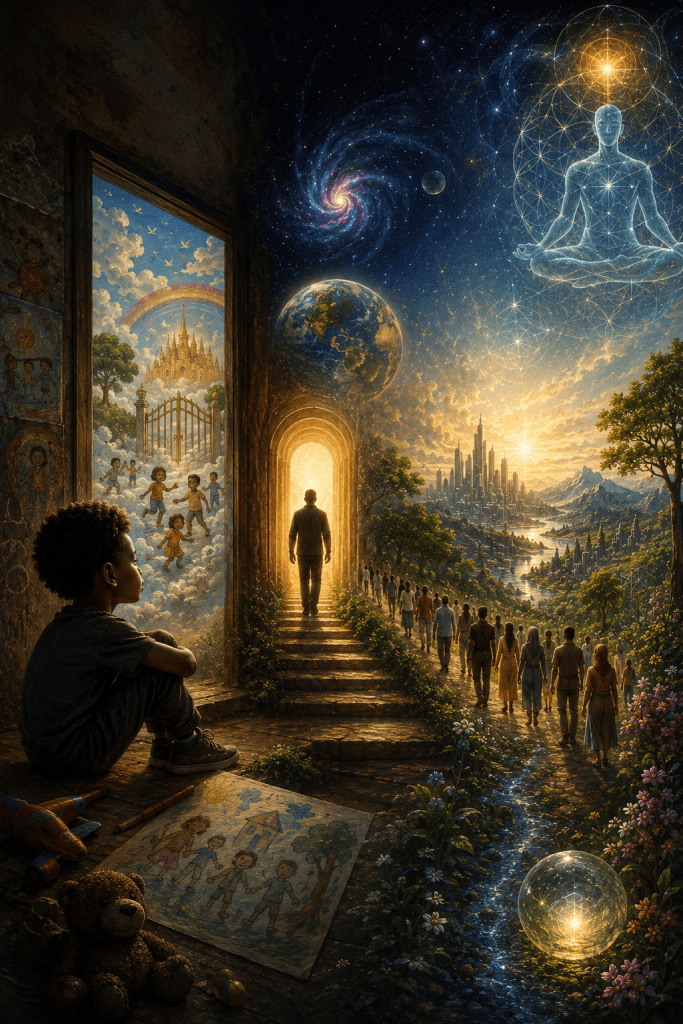
For many adults, heaven still resembles the picture they accepted as children. A beautiful place somewhere above the clouds where good people are rewarded, reunited with loved ones, and live happily forever. Although our understanding of nearly every other aspect of life matures, our image of paradise often remains untouched.

Why?

The answer may have less to do with religion than with psychological development.

Paradise Grows as Consciousness Grows

Every stage of psychological development interprets reality according to its own capacity. Paradise is no exception.

The earliest stage is concerned only with survival. Paradise simply means warmth, food, shelter, and freedom from danger.

As tribal consciousness develops, paradise becomes reunion with ancestors, spirits, and one’s people. Belonging is eternal.

The egocentric stage imagines paradise as limitless pleasure, power, success, and personal fulfillment. Heaven exists for the individual.

The mythic stage transforms paradise into a divine kingdom governed by justice. Those who obey are rewarded. Those who reject divine law are excluded. This is where many traditional religious images of heaven take shape.

The rational stage begins questioning whether heaven exists at all. Paradise may become symbolic, psychological, or simply an unanswered mystery.

The pluralistic stage opens paradise to everyone. Love replaces exclusivity. Compassion becomes more important than belief. Humanity itself becomes the family.

Integral consciousness recognizes that every previous view reflects a particular stage of development rather than an absolute truth. Paradise is increasingly understood as a way of being rather than merely a destination.

Finally, holistic consciousness dissolves the distinction altogether. Paradise is not somewhere else. Reality itself is recognized as the living expression of the Absolute.

The Expanding Circle of Identity

Our understanding of paradise also changes according to the size of our identity.

The egocentric perspective asks:

“How do I get into heaven?”

The ethnocentric perspective asks:

“Which group is chosen?”

The worldcentric perspective asks:

“How can everyone be included?”

The Kosmocentric perspective asks something entirely different.

“Who is it that seeks paradise in the first place?”

Here, the search begins to collapse.

The seeker, the destination, and the journey are all recognized as appearances within one indivisible reality.

Why Do We Stay Attached to Childhood Images?

Children require certainty.

Simple stories offer comfort in the face of death and uncertainty. Those early images become emotionally rooted long before critical thinking fully develops.

Unlike our opinions about careers, relationships, or politics, our beliefs about paradise are rarely revisited with the same willingness to question them. Religious traditions often preserve these images because they provide stability, identity, and hope.

There is nothing inherently wrong with that.

Every stage serves an important purpose.

Problems arise only when we assume that the understanding which comforted us at age five must also satisfy us at age fifty.

The Ultimate Shift

The greatest transformation may not involve discovering a better description of heaven.

It may involve recognizing that paradise was never meant to describe a location.

Perhaps heaven is a symbol pointing toward a realization.

A realization that nothing has ever existed outside the infinite.

A realization that separation was never ultimately real.

A realization that the very awareness reading these words is not traveling toward paradise.

It is the ground from which every idea of paradise has always appeared.

Perhaps the deepest question is not whether heaven exists after death.

Perhaps the deeper question is whether consciousness can awaken enough to recognize paradise before death.

If consciousness itself is the Absolute, then paradise is no longer a promise waiting in the future.

It is reality, seen without the illusion of separation.

Morgan O. Smith

https://linktr.ee/morganosmith

You Have Been Speaking Everything Into Existence

This is not simply about affirmations, positive thinking, manifestation, or the power of spoken language. Those ideas remain close to the surface. The deeper meaning reaches beyond the human voice, personal intention, and the individual mind.

You speak everything into existence and do not even realize it.

At the causal level, existence itself is your expression.

Every form that appears, every movement that unfolds, every event that arises, and every world that seems to exist independently emerges from the same beginningless source that you are.

Nothing stands outside of you.

The birth of a star, the movement of a thought, the falling of a leaf, the ending of a relationship, the formation of a galaxy, and the smallest shift within a single cell all belong to one indivisible happening.

That happening has no external author.

It is not being imposed upon reality from somewhere beyond reality.

Existence is expressing itself as everything.

The One Who Speaks Without a Voice

Human beings usually associate creation with deliberate action. Someone decides, acts, and produces a result. Cause appears to precede effect. A person speaks, and something happens.

Causal consciousness does not operate according to this linear sequence.

The voice that speaks existence into being has no mouth. It does not form sentences, construct plans, or choose between possibilities. Its speech is the spontaneous appearance of existence itself.

Mountains are its language.

Bodies are its language.

Silence is its language.

Time, space, matter, thought, sensation, memory, desire, birth, and death are all movements of this wordless declaration.

Creation is not something that occurred once in a remote past. Reality is being spoken now, not through verbal commands, but through the continuous emergence of experience.

You are that emergence.

A Beginningless Beginning

The mind wants to locate a first moment. It asks what started everything, what existed prior to the universe, and what caused the original cause.

These questions assume that reality began somewhere within time.

Time itself is part of what appears.

There was no first moment in the ordinary sense because the causal source does not occupy a position on a timeline. It is not an ancient object hiding behind the universe. It is the timeless ground through which every apparent beginning and ending becomes possible.

Existence is beginningless because the source of existence was never born.

The body had a beginning.

The personality had a beginning.

Your memories had a beginning.

The awareness within which these beginnings are known has no discoverable starting point.

Search directly for the birth of awareness. A memory may arise, but the memory appears within awareness. A story may explain your origin, yet that story is also being witnessed. Every answer appears as another object within the very presence you are attempting to explain.

The source remains prior to every explanation, not earlier in time, but more fundamental than time.

Everything Is Caused by You

The statement “everything is caused by you” can easily be misunderstood.

The personal ego did not manufacture the universe. Your everyday identity is not secretly controlling weather patterns, global events, other people, or every difficulty that enters your life. Such an interpretation would reduce a nondual insight to spiritual grandiosity.

The “you” being described is not the person.

It is the causal ground appearing as the person.

Every cause and every effect arises within the same undivided reality. The hand that acts, the object acted upon, the action itself, and the consequence are not ultimately separate events. They are distinctions created by perception and thought within one continuous movement.

Reality causes itself through itself.

Fire burns wood. Rain nourishes soil. Gravity draws bodies together. Choices alter lives. Countless visible and invisible conditions shape every outcome.

At the relative level, these causes remain meaningful. At the deepest level, none of them operates outside the whole.

Every cause is reality acting.

Every effect is reality receiving its own action.

Both are you, prior to the identity you call yourself.

The Dream of Separation

Separation creates the impression that life is happening to you.

Events seem external. Other people appear completely outside of you. Circumstances arrive from a world that feels independent of your being. You experience yourself as one vulnerable centre among billions of competing centres.

From the causal perspective, the division between inner and outer has not yet formed.

The person, the world, and the experience of the world arise together. A sound cannot appear apart from hearing. A colour cannot appear apart from seeing. A thought cannot appear apart from awareness. The perceived and the perceiver are born within the same act of knowing.

This does not mean physical differences disappear. Your body remains distinct from another body. Your thoughts are not automatically available to someone else. Practical boundaries continue to matter.

Nonduality does not deny difference.

It reveals that difference does not require absolute separation.

Waves differ in shape, force, duration, and direction, yet no wave contains a substance separate from the ocean. Each wave is the ocean taking temporary form.

Your individuality is real as an expression.

It is not independent as an existence.

Your Words Are Part of the Creative Movement

Spoken words still matter.

Language shapes attention, reinforces beliefs, influences relationships, and directs human action. Words can open possibilities or close them. They can encourage, deceive, wound, clarify, liberate, or imprison.

Yet words do not create reality from outside reality. They are movements through which reality modifies its own appearance.

A thought arises.

The body gives it sound.

Another nervous system receives it.

Meaning forms.

Behaviour changes.

A new sequence of events begins.

What appears to be one person speaking to another is existence communicating with itself through two localized expressions.

The same consciousness speaks and listens.

The same reality questions and answers.

The same source forgets itself, seeks itself, and recognizes itself.

Even the person who insists that words have no creative power is using words to introduce that position into existence.

The Causal Level Is Not Personal Control

Causal realization should never be confused with personal omnipotence.

The ego hears “you caused everything” and imagines itself sitting at the centre of the universe, commanding events according to personal desire. It wants authorship, ownership, recognition, and control.

The causal Self requires none of these.

It does not stand over existence as a ruler directing creation from a distance. It is creation itself, appearing as every ruler and every subject, every command and every refusal, every desire and every disappointment.

Your personal mind cannot decide every outcome because your personal mind is itself an outcome. Its thoughts arise through biology, memory, conditioning, culture, language, environment, and countless forces it did not independently choose.

Yet all of these forces arise within the greater reality that you are.

The individual is not the controller of the whole.

The individual is one of the ways the whole moves.

Responsibility Without Blame

Recognizing yourself as the causal ground does not mean blaming yourself for every painful event.

Blame belongs to the psychological self. It assumes that a separate person should have controlled conditions that were often far beyond personal control.

Causal responsibility is different.

It is not guilt.

It is inseparability.

Nothing can be dismissed as completely unrelated to the whole. Suffering anywhere occurs within the same reality that appears here as you. Compassion becomes more than a moral obligation because the apparent other is not entirely other.

When you harm another, existence wounds itself through your actions.

When you care for another, existence responds to itself with tenderness.

When you become more conscious, reality becomes conscious of its own movement at this particular point of expression.

This recognition does not erase accountability.

It deepens it.

Your actions matter because no action is truly isolated. Every gesture enters a field of consequences. Every word travels farther than the speaker can measure. Every choice becomes part of conditions that shape what follows.

The Silence Prior to Creation

What exists prior to the universe being spoken?

Not an empty void waiting for sound.

Not a distant deity preparing to create.

Not a hidden object concealed behind appearances.

There is only the unformed capacity for everything, silent not because nothing is present, but because no distinction has yet arisen.

That silence remains here beneath every experience.

Thoughts do not destroy it.

Sounds do not interrupt it.

Movement does not leave it.

The entire universe appears as a modulation of what never moves.

You are that stillness and every vibration arising within it.

You are the silence and the spoken world.

You are the causal depth from which existence emerges, the forms through which it becomes visible, and the awareness through which it knows itself.

Everything is caused by you because there is no second reality available to cause it.

Everything is spoken by you because every voice belongs to the same beginningless source.

Everything is you, not as possession, not as personal achievement, but as the indivisible fact of being.

Even Opposition Is Your Creation

Some will say this is egotistical.

That judgment, too, has been spoken into existence by the same beginningless reality.

The one who agrees, the one who resists, the one who mocks, the one who rejects, and the one who opposes are not standing outside the whole. Their objections are movements of the same source.

Even opposition is reality appearing to argue with itself.

You created that into existence as well.

Not you as the personality, but you as the undivided ground from which every voice, criticism, affirmation, denial, and misunderstanding arises.

Even all who oppose you are you appearing in another form, defending another viewpoint, expressing another movement within the totality.

Nothing escapes what you are.

Not praise.

Not resistance.

Not disbelief.

Not condemnation.

Not the accusation of arrogance.

The ego may say, “I created everything.”

Truth says, “There is no separate I and no separate everything.”

The accusation of egotism assumes that an isolated person is claiming personal ownership over existence. Nondual realization makes no such claim. It dissolves the presumed owner along with everything the owner hoped to possess.

There is only the beginningless whole appearing as creator, creation, believer, skeptic, supporter, opponent, accusation, defence, and the silence holding them all.

The question is no longer whether you are creating reality.

The deeper question is this:

Who are you before the one who claims to be the creator appears?

Morgan O, Smith

https://linktr.ee/morganosmith

The Architecture of Wholeness

Isolation shrinks perception.

Wholeness expands it.

Every relationship you form with people, ideas, environments, challenges, and even suffering becomes part of your inner architecture. Nothing exists independently. Each connection enlarges the field through which life recognizes itself. What many call “growth” is often the gradual dissolution of false separation.

An integral human being does not merely collect information or experiences. They become increasingly interconnected with existence itself.

The more integral you become, the more relationships emerge naturally. Those relationships are not limited to human interaction. A relationship can exist between you and music, silence, nature, philosophy, responsibility, creativity, discipline, grief, or stillness. Every authentic connection widens consciousness.

Expanded relationship leads to expanded inheritance.

Inheritance is not only financial. It includes wisdom, opportunity, insight, support, emotional intelligence, resilience, creativity, intuition, and access to dimensions of reality that remain hidden to fragmented awareness. A disconnected mind sees scarcity because it perceives itself as separate from the whole. An integrated mind begins to recognize that life is constantly offering resources through connection.

Access creates abundance.

Abundance is frequently misunderstood as accumulation. Real abundance is access. Access to insight. Access to support. Access to clarity. Access to meaningful relationships. Access to inner stability. Access to possibility.

A person with few inner or outer connections may possess money yet still feel impoverished. Another person may possess little materially yet move through life with deep richness because they are profoundly connected to existence.

Connection multiplies options.

Options reduce limitation.

Limitation often originates less from external circumstance and more from contracted identity. When consciousness identifies itself as isolated, separate, or incomplete, possibilities narrow. Fear increases. Defensiveness grows. Rigidity forms.

As awareness expands through relationship, identity softens. The walls separating “self” from “other” begin to weaken. Life no longer appears as a battlefield of competing fragments but as an interconnected movement expressing itself through countless forms.

This movement gradually reveals The Self.

Not the egoic self built from memory and social conditioning, but the deeper Self prior to division. The Self that exists before identity becomes trapped inside labels, roles, status, beliefs, or psychological boundaries.

Realizing The Self reduces distinction.

Distinction is necessary within functional reality, yet psychological separation creates suffering. The mind continuously divides existence into categories: mine and yours, success and failure, worthy and unworthy, sacred and ordinary.

Awareness beyond fragmentation begins to perceive unity without erasing diversity. Differences still exist, but hostility toward difference dissolves. Separation loosens its grip.

As separation fades, love ceases to be an emotion directed toward selected objects.

Love becomes the natural condition of unobstructed consciousness.

Not sentimental love.

Not transactional love.

Not possessive love.

A deeper form emerges when the illusion of absolute separateness begins to collapse. That love expresses itself through compassion, patience, understanding, generosity, listening, forgiveness, and presence. It does not arise because reality becomes perfect. It arises because resistance to reality weakens.

Integral living is therefore not simply a developmental achievement.

It is participation in wholeness.

Every meaningful relationship becomes a doorway beyond limitation.

Every moment of genuine connection becomes a form of remembrance.

Every dissolution of separation reveals more of what has always been here.

Love was never absent.

Only obscured by fragmentation.

Morgan O. Smith

Nature Watching Herself

A strange intimacy reveals itself when awareness no longer stands apart from the world it observes. Trees are no longer objects. Oceans are no longer scenery. The body is no longer a private possession. Everything breathes as one movement.

Mystics across cultures have described this shift differently, yet the essence remains unchanged: Nature is not something encountered. Nature is what is happening as you.

Imagine Mother Nature not as a mythic figure in the sky, but as the very process unfolding through every cell, every star, every collapsing galaxy. She is not separate from her creation. She is the contraction and expansion, the seed splitting underground, the animal hunting, the volcano erupting, the lover trembling. She is labour and release, genesis and dissolution.

Birth is not gentle from her perspective. It is pressure, rupture, intensity. Galaxies tear themselves open through gravitational force. Bodies break to allow new bodies through. Evolution demands friction. She pushes herself into form, again and again, through unimaginable compression.

Then comes destruction. Stars implode. Species vanish. Civilizations crumble. The universe cools toward entropy. This is not tragedy to her. This is exhalation. The same force that tightens also relaxes.

Creation and annihilation are not opposites in this vision. They are phases of one continuous pulse.

Sexuality belongs to this pulse as well. Attraction between bodies mirrors attraction between particles. The longing of lovers reflects the magnetic urge of existence to know itself through union. Pleasure is not an accident. It is nature recognizing her own vitality through sensation. The climax is not separate from cosmic expansion; both are explosive affirmations of aliveness.

When one witnesses oneself as this total movement, something dissolves. Personal suffering shifts context. Pain is still felt. Loss still stings. Yet beneath the narrative of “my pain” lies a wider recognition: this is nature feeling her own contraction through this particular configuration of matter and awareness.

Grief becomes the earth, mourning her forests. Joy becomes the sun rising in the nervous system. Desire becomes the universe leaning toward itself.

Calling this process “Mother Nature” offers poetry. Calling it the Tao offers philosophy. Both point toward the same reality: a self-arising order that moves without external command. Nothing stands outside it. Nothing directs it from beyond. It flows as all phenomena, yet cannot be captured by any single phenomenon.

Tao is not an entity giving birth. Tao is the giving birth. Tao is not an organism dying. Tao is the dying. Tao is not the pleasure between forms. Tao is the current moving as pleasure.

Personification helps the mind relate to what cannot be grasped conceptually. A mother birthing herself expresses paradox more vividly than abstract metaphysics ever could. She is both the womb and the child. Both the lover and the beloved. Both the body writhing in ecstasy and the vast silence containing it.

Seen clearly, this vision does not inflate the ego into cosmic grandeur. It erases the boundary that allowed ego to imagine separation in the first place. “I” am not a fragment witnessing nature. This body-mind is one eddy within the larger river. The river flows as every eddy simultaneously.

Nature mysticism does not romanticize suffering or glorify destruction. It recognizes them as intrinsic movements within the same whole that produces beauty and delight. Forest fires clear space for renewal. Supernovas forge the elements required for life. Orgasm dissolves the sense of separateness, if only briefly.

Labour, death, and ecstasy belong to one indivisible rhythm.

To awaken to this is to sense that nothing is happening outside of what you are. Every cry, every birth pang, every collapsing star, every trembling pleasure is the Tao unfolding without preference.

Mother Nature is not somewhere else. She is the totality of appearance recognizing itself through countless forms. She births. She dies. She delights. She grieves.

All of it is one movement, witnessing itself.

Morgan O. Smith

Beyond Nonduality?

The Illusion of Going Further

Some spiritual teachers claim they have gone “beyond” nonduality, as if it were a stepping stone toward something greater. Yet the very notion of “beyond” creates an opposite, “before” or “within,” and the moment opposites arise, duality has returned.

Absolute monism allows for no such division. The singularity of reality does not exist as a point to be crossed or a boundary to be passed. It is not somewhere else, waiting on the other side of an imagined line. If you think you have travelled beyond it, you are still standing in the arena of conceptual thought, where the mind measures one thing against another.

In truth, the Absolute is not a destination, and it is not a stage in an unfolding ladder. It does not sit opposite to multiplicity; it holds multiplicity and its absence equally. It neither favours unity nor rejects separation. Both “beyond” and “before,” both “within” and “without,” dissolve in the same undivided field.

What remains is not something that can be claimed, owned, or transcended. It is self-evident Being, the source and container of every movement, stillness, and paradox. You cannot reach it, because you never left it.

Morgan O. Smith

Get Your Free Copy of My Book, Bodhi in the Brain!

https://subscribepage.io/oTSZQu

The Final Disappearance

What happens at the moment of death?

Not from the standpoint of biochemistry or theology, but from the lived silence of awakened seeing—the vantage where death and self are no longer two.

At the summit of awakening—whether called Moksha, Nirvana, Turiyatitta, or Nirvikalpa Samadhi—the idea of death unthreads itself. What dies never truly lived, and what lives has never been touched by time. The dissolution of the body is not the end, nor is it a doorway. It is the falling away of questions that were never yours.

There is no climactic revelation at that edge. There is only this. The suchness that never began, never moved, and never faded. At peak realization, death ceases to be an event. It is not an exit. It is the unspeaking of form—a gentle vanishing into what was always here.

This is not metaphor.

Consciousness, unfragmented and clear, neither resists death nor awaits it. It has already passed through it, endlessly. Not as a journey from point A to point B, but as a revelation that neither point exists.

You don’t meet death. You realize you were never separate from it.

At this depth, what we call life no longer hangs from a timeline. What we call death no longer casts a shadow. No more witness is watching the last breath. Only the unnameable recognizes itself through the temporary flicker of form.

The body may fall away, but the body was never the one who knew. The breath may stop, but the breath was never yours. That which remains doesn’t remain—it is. Before and after mean nothing to it.

Some call this realization peace. Others call it extinction. But it’s neither stillness nor silence nor bliss. It’s before all that. It’s the absence of absence. The presence of presence. Not two.

When the last ripple of self dissolves, what’s left is not a person merging with eternity. There is no one to merge. There is only what was always whole.

This is death at the level of freedom. This is life without division.

Not a conclusion.

A cessation of seeking.

Morgan O. Smith

Get Your Free Copy of My Book, Bodhi in the Brain!

https://subscribepage.io/oTSZQu

The Divine Totality

Everything Is God, Even the Illusion of Not-God

There comes a moment so still and unfiltered that perception collapses into the clarity of being. Not being this or that, but being everything. And not just metaphorically. Not just poetically. Literally everything—formless and formed, seen and unseen, finite and infinite—is God.

When I use the word God, I’m not pointing toward a figure, a belief, or a doctrine. I am pointing toward existence itself—the Absolute, the Whole, Brahman, Para Brahman, the Unconditioned, conditioned, the Uncreated and created. That which includes form and formlessness, time and timelessness, birth and death, creation and dissolution, the ten thousand things and the nothing between them.

Everything is God. Not just contains God. Not just touched by God. Not just part of God. But fully and completely God. That which we call the universe is not just inside God. It is God. And God is also what lies outside the universe—if such a term can even be grasped. There is not a single thing, moment, action, or gap that is not 100% God. And yet, even the idea of “percent” breaks down in the face of such a realization.

God is not just somewhere else. God is not just merely within. God is not only beyond. God is not higher or lower or more subtle or more gross. No matter how crude or refined, every appearance is divine. Each atom, each sorrow, each beam of light, each lie, each truth, each pulse of your heart, each glitch in the system—is God being what only God can be and cannot be: itself, everywhere, nowhere, always, never been.

Multiplicity is not a contradiction, yet it is. It’s how God dances with itself. The illusion of separation is not some accident to be corrected, yet it’s that as well. It is part of the design, part of the intelligence. The appearance of duality is not a denial of oneness—it’s one appearing as two, or ten thousand. Each distinction—this object, that person, this tree, that thought—is the Absolute shimmering as particularity.

It’s easy to say this with words. The difficulty arises only when the words are taken as substitutes for seeing. Direct seeing dismantles the grip of identification. When one truly sees all of this—across dimensions, across appearances—as one singular Presence, there is no longer any question. And there is no longer any need for the question. One does not simply understand that everything is God. One is that understanding.

Yet here’s the paradox: To truly see this is also to see that none of it is God. No label can contain it. No concept can hold it. Even the word God must dissolve. Enlightenment is not just knowing this. Enlightenment is also the absence of needing to.

This is not a belief system. It is not an ideology. It is not a path with steps. This is the unteachable reality that always is. When the veil lifts—even for a moment—all questions are answered without being answered. Nothing changes, yet everything changes. One doesn’t become more spiritual. One simply stops pretending.

To recognize this is to realize: even the illusion is God. Even ignorance is God. Even the striving to awaken is God pretending to forget itself in order to remember more deeply. Even your doubt is divine. Even your forgetfulness is sacred.

You are not just a part of God. You are not just held within God. You are God. And so is everyone, everything, every grain of dust, every breath of silence, every broken thing that aches for healing.

The Absolute never needed your worship. It only waited for your recognition.

Morgan O. Smith

Get Your Free Copy of My Book, Bodhi in the Brain!

https://subscribepage.io/oTSZQu

When I Say Full Awakening…

This Is What I Mean

Many speak of awakening, yet far fewer comprehend its fullness. I’ve encountered every kind—emotional, spiritual, philosophical, mystical. Each unveils a layer, each reveals a depth. But what I call full awakening—what I live as full awakening—is something few ever point toward, and fewer still embody.

It is not about personal clarity. Not about peace of mind, a better life, or even union with a divine presence. Those are steps, glimpses, fragments. Full awakening is not a state within experience. It is the collapse of all distinction between state and experiencer.

This isn’t about finding your place in the cosmos—it’s about the disappearance of place, cosmos, and self as separate notions. When I say full awakening, I am referring to the direct knowing that everything—absolutely everything—is a singularity.

Existence and nonexistence. Subject and object. The smallest subatomic flicker and the sweep of galactic spirals. Civilizations long past and unborn futures. Every religion, every philosophy. All thoughts. All acts. Every realm, every reality, every god.

The seen and the unseen. The formed and the formless. That which is birthed, that which dies, and that which never entered the cycle. All technologies. All intelligences. All contradictions and confirmations. All questions and every possible answer.

Not merely connected. Not even interdependent.

Indistinct. Inseparable. One.

That realization is not metaphorical. It is not poetic. It is not conceptual. It is total. It devours every duality and even the idea of devouring. It consumes the witness, the process of witnessing, and that which is witnessed—leaving no remainder.

So when another speaks of full awakening, I listen with care. Because unless it includes everything I’ve said—and also what they say—it’s not the same thing. The paradox, of course, is that what I’m pointing to also includes that divergence. It embraces even what appears to deny it.

Full awakening is not a peak. It is not an event. It is the vanishing of all altitude and time. It is not even a realization. It is what remains when all realizations dissolve.

One. Not a oneness made of parts. Not a whole made of pieces. Not harmony, not unity. Just One.

And that One is not separate from what you are.

Morgan O. Smith

Get Your Free Copy of My Book, Bodhi in the Brain!

https://subscribepage.io/oTSZQu

Beyond the Great Divide

White Supremacy, Caste, and the Collapse of Constructed Hierarchies through Nondual Perception

What happens to white supremacy when whiteness is no longer seen as a centre?
What becomes of caste when the hierarchy collapses into the unbroken Whole?
These aren’t abstract questions, but intimate ruptures in perception that strike at the root of separation.

From the nondual view, the machinery of supremacy and caste is not just unethical—it is illusory. A dream born of mistaken identity. These systems persist because the world is filtered through the lens of difference. They rely on “me” and “you,” “above” and “below,” “pure” and “impure.” Once those constructs dissolve, the scaffolding that held them together trembles.

To see with undivided awareness is not to turn away from injustice—it is to see it with such clarity that the illusion loses power.

The mind behind supremacist ideology must first construct a self that is isolated, then build defences around that self using race, status, bloodline, and geography. But once this boundary is questioned—not through philosophy, but through direct experience—an entire civilization of “better than” collapses into silence.

There is no whiteness in the Absolute. No Brahmin, no Dalit. No legacy of conquerors, no lineage of slaves. These roles, though ferociously enacted on the stage of form, do not survive the fire of presence. They belong to the play of names and forms—real enough to cause suffering, yet ultimately not what is.

Nonduality does not excuse or erase suffering. It reveals the mechanisms that perpetuate it: misidentification, grasping, and fear. And it points to the only true revolution—the recognition of what was never divided.

When someone rooted in supremacist delusion awakens to the groundless reality of Being, they are not offered a spiritual bypass, but a mirror. One that reflects every role played, every belief clung to, and the emptiness beneath them all. This is not comfort. It is unmaking.

Likewise, those dehumanized by caste are not told to ignore injustice. Rather, they are invited to witness that their essence was never touched by degradation. The soul, if we may call it that, has no fingerprints. No brand of subjugation can mark the formless.

The end of separateness is not utopia. It is not the promise of a better structure. It is the absence of structure where no one rules and no one serves. Where self and other melt into something wordless.

Once you know yourself as that which sees without division, supremacy is not just immoral—it’s absurd. The belief that one appearance of the Whole is more worthy than another is like believing one wave owns the ocean.

And so, from this stillness, something radical emerges: not activism rooted in identity, but action arising from unity. Compassion that does not pity, but recognizes itself. Justice that is not vengeance, but restoration of clarity. Love that is not sentimental, but annihilating.

The real threat to white supremacy and caste is not education alone, nor protest alone. It is the awakening of even one being to what cannot be divided. For when the illusion of separation dies, the systems built upon it cannot survive.

Morgan O. Smith

Yinnergy Meditation/Neurofeedback, Spiritual Life Coaching & My Book, Bodhi in the Brain…Available Now!

https://linktr.ee/morganosmith