Author, Philosopher, Spiritual Teacher, A Lead Facilitator at Sacred Media's Integral Mastery Academy, Founder of Yinnergy Meditation/Neurofeedback, Bodhi Mental Care & Wellness, Co-founder of KeMor Centre for Innovative Development
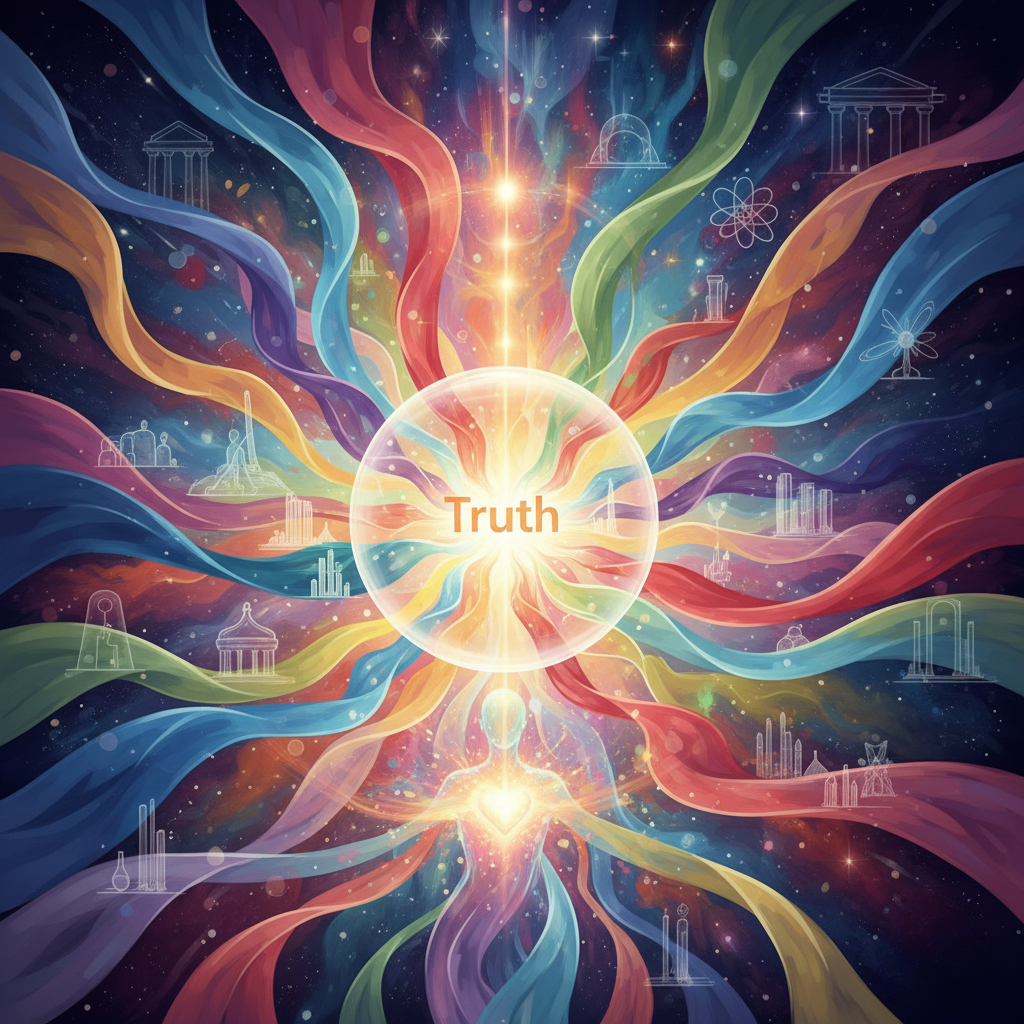
At the super-integral level, perception no longer filters reality through allegiance. Vision widens beyond affiliation, beyond the need to defend a worldview or elevate one tradition over another. What becomes visible is not a synthesis manufactured by intellect, but a recognition born of depth: each religion, philosophy, system, culture, and tradition is responding to the same mystery from a different angle of approach.
Truth does not belong to any single framework. Frameworks belong to truth.
Each system carries a partial articulation shaped by time, language, geography, psychology, and collective need. When approached from within their own context, these systems often appear contradictory. When seen from depth, they are complementary gestures pointing toward what cannot be fully captured. Disagreement dissolves not because differences disappear, but because the compulsion to absolutize any one perspective falls away.
Super-integral awareness does not flatten distinctions. It clarifies them. Christianity speaks the language of incarnation and surrender. Buddhism articulates emptiness and liberation from grasping. Advaita reveals the non-separation of Self and reality. Indigenous traditions speak through land, ancestry, and cyclical intelligence. Science maps measurable patterns of the cosmos. Psychology explores the architecture of the inner world. Each is precise within its domain. None is sufficient alone.
At this level, conflict between systems is understood as a category error. Arguments arise when symbols are mistaken for the reality they reference. Beliefs are defended as ends rather than as lenses. Super-integral seeing restores humility to knowing. It recognizes that every map is provisional and every language incomplete.
What shifts most profoundly is identity. No longer rooted in belief structures, identity relaxes into presence itself. From there, one can enter any tradition without needing to convert, reject, or appropriate. A Christian prayer, a Sufi poem, a Zen koan, a Vedantic inquiry, or a scientific equation can all be met directly, without friction. Meaning reveals itself through resonance rather than comparison.
This level of seeing does not erase devotion. It deepens it. Devotion moves from loyalty to a form toward reverence for the source animating all forms. Practice becomes fluid, responsive, and contextual. Wisdom expresses itself through discernment rather than doctrine.
Super-integral awareness is not an achievement of accumulation. It arises through subtraction, through the gradual release of identification with position, certainty, and hierarchy. What remains is a capacity to listen deeply, to recognize truth wherever it appears, and to allow contradiction to coexist without collapse.
Here, unity is not an idea. It is a lived recognition that difference is how the infinite explores itself.
Morgan O. Smith
Get Your Free Copy of My Book, Bodhi in the Brain!
How much weight does a point of view actually hold?
None. And yet, it seems to shape entire lives, govern nations, define relationships, and breed conflict. But the more one deepens into the ungraspable expanse of reality, the more all perspectives—including one’s own—become like shadows cast by a flame none can touch.
I do not feel resistance toward those who oppose my view. I feel space—vast, immeasurable space. Not tolerance, not passive indifference, but a kind of cosmic shrug. This universe is too immense, too precise, too paradoxical for me to waste even a flicker of energy defending a perspective I know was born out of a temporary configuration of memory, biology, and environment.
What I see, I see through a filter: race, culture, conditioning, gender, language, trauma, karma, personality, neurochemistry, and a moment’s breath. Someone else sees through a completely different lens. To argue over the differences is like two waves debating who touches the shore more truthfully.
Each wave is made of the same water.
Ultimate Reality does not conform to opinions. It cannot be contained by agreement or disagreement. It isn’t found in right or wrong, winning or losing. It is not trying to prove itself. It simply is, and isness doesn’t care how it’s described.
This is not nihilism. It’s reverence. Reverence for the mystery so wide, so total, that every perspective is valid precisely because none of them are.
The deeper the realization, the more perspectives one can hold. Not juggle, not compare, not rank—but hold. To see from the eyes of the enemy and the beloved, the oppressor and the oppressed, the doubter and the devotee. To feel into each vantage point, not to believe it, but to understand it from within.
Eventually, you don’t just hold perspectives. You become the capacity for perspective itself. You become the silence before thought, the awareness behind all positions.
From there, disagreement becomes theatre.
Opposition becomes dance.
And the only thing that matters is the stillness that allows it all to appear.
Morgan O. Smith
Get Your Free Copy of My Book, Bodhi in the Brain!
In the dance of the cosmos, the Absolute is often perceived through the lens of our individual experiences and understandings. Just as 100 pennies, 20 nickels, 10 dimes, and 4 quarters each represent the same dollar, our paths to understanding the Absolute are varied but ultimately converge upon the same truth. This analogy illuminates the inherent unity within diversity, revealing how different perspectives can harmoniously merge into a singular reality.
We often encounter myriad teachings, practices, and philosophies when we embark on our spiritual journeys. Each one offers a unique perspective on the nature of existence, the self, and the divine. Some may resonate more profoundly with a particular path of devotion, while others might find solace in meditative introspection or the study of ancient texts. Despite these differences, the essence remains unchanged: all paths lead us back to the Absolute.
This concept is beautifully reflected in the Hindu notion of ‘Ekam Sat, Vipra Bahudha Vadanti’—Truth is one; the wise speak of it in many ways. In our quest for spiritual awakening, we may find ourselves drawn to various expressions of this singular truth. Whether through the loving devotion of Bhakti Yoga, the disciplined inquiry of Jnana Yoga, or the selfless service of Karma Yoga, each approach offers a distinct yet complementary understanding of the Absolute.
In nondual philosophy, this unity is further exemplified by the idea that all distinctions are ultimately illusory. The dichotomies we perceive—self and other, subject and object, time and eternity—are merely constructs of the mind. At the deepest level of awareness, these distinctions dissolve, revealing the oneness that underlies all existence. This profound realization transcends the limitations of language and thought, offering a direct experience of the Absolute.
Reflecting on the analogy of different coins making up a dollar, we can see how each perspective, practice, or tradition contributes to a holistic understanding of the Absolute. This understanding invites us to appreciate the diversity of spiritual expressions without diminishing their underlying unity. It encourages us to approach our spiritual paths with openness, recognizing that every sincere effort to understand the divine is a step toward the same ultimate truth.
In embracing this diversity, we cultivate a sense of humility and respect for the myriad ways in which the Absolute can be experienced and understood. We acknowledge that our journeys are but threads in the vast expanse of existence, each contributing to the intricate and beautiful pattern of the whole. This perspective not only enriches our spiritual journeys but also fosters a deeper sense of connection and unity with all beings.
Ultimately, the realization that 100 pennies, 20 nickels, 10 dimes, and 4 quarters all amount to a dollar serves as a powerful metaphor for the unity within diversity that characterizes the Absolute. By recognizing and honouring the varied paths that lead to this ultimate reality, we move closer to experiencing the profound interconnectedness of all existence. This understanding not only deepens our spiritual practice but also inspires us to live with greater compassion, wisdom, and love.
Morgan O. Smith
Yinnergy Meditation, Spiritual Life Coaching & My Book, Bodhi in the Brain…Available Now!
In the realm of spiritual exploration, the concept of misinterpretation often carries a negative connotation, seen as a divergence from the true essence of divine wisdom. However, if we delve deeper, we might discover that these so-called misinterpretations are not merely deviations but integral elements of the divine expression itself.
Consider the myriad paths that lead seekers toward enlightenment. Each path, with its unique interpretations and understandings, contributes to the vast mosaic of spiritual experience. The divine, in its infinite wisdom, does not confine itself to a singular, unchangeable form. Instead, it reveals itself in countless manifestations, each coloured by the cultural, historical, and personal contexts of the seeker. This plurality of expressions is not a flaw but a testament to the boundless nature of the divine.
In Eastern philosophy, particularly in the realm of nonduality, there is an acknowledgment of the inherent unity of all existence. This perspective allows us to view misinterpretations not as barriers to spiritual truth but as windows into a more profound understanding. Each interpretation, no matter how seemingly erroneous, contains a fragment of truth, a glimpse into the unfathomable depths of the divine.
This approach encourages us to embrace diversity in spiritual thought. Instead of seeking to correct or align these varied interpretations, we might do well to listen, understand, and appreciate the unique insights they offer. In doing so, we acknowledge that our journey toward enlightenment is not a linear path but a rich, multi-dimensional exploration.
By accepting and even welcoming misinterpretations, we open ourselves to a broader, more inclusive understanding of spirituality. This perspective nurtures a sense of humility and wonder, as we recognize that our grasp of the divine is ever-evolving, always expanding. It is in this space of openness and curiosity that true spiritual growth occurs.
In conclusion, the misinterpretations of the divine, rather than being mere errors to be corrected, are vital expressions of the divine itself. They invite us to explore beyond the surface, to question, and to seek a deeper connection with the ultimate reality. This journey is not about finding the one right path but about embracing the richness of all paths that lead us to a greater understanding of the divine.
Morgan O. Smith
Yinnergy Meditation, Spiritual Life Coaching & My Book, Bodhi in the Brain…Available Now!
The Dance of Oneness **Introduction:** The 99 beautiful names (Asma’ul Husna) of God, as described in Islamic tradition, have long been celebrated as diverse facets of the Divine. From an Absolute Monism or non-dualistic perspective, these names are not mere titles or attributes but profound expressions of one unbroken Reality. Let’s embark on an exploration of how nondualism weaves these names into a tapestry of Oneness.
**The Unity Behind Diversity:** While the 99 names may initially appear as separate attributes or facets, they can be seen from a non-dualistic viewpoint as interwoven threads of a single Reality. Each name is but a drop in the ocean of Divine essence, which itself is nondual.
**Beyond Dualities:** Names such as Al-Mu’min (The Giver of Peace) and Al-Mumit (The Bringer of Death) may seem contradictory, but in nondualism, these apparent opposites reconcile. They represent the play and dance of the universe, where creation and dissolution are two sides of the same coin.
**The Singular Source:** Names like Ar-Rahman (The Beneficent) and Ar-Rahim (The Merciful) are emanations from a singular source. They underscore that all acts of love, mercy, and compassion in the world reflect the undivided nature of the Divine.
**The Ever-Present Witness:** Names such as As-Sami (The All-Hearing) and Al-Baseer (The All-Seeing) emphasize an ever-present witness. From a nondual perspective, this points to pure awareness, an omnipresent consciousness that perceives without being tainted by dualities.
**The Dance of Manifestation:** Names like Al-Khaliq (The Creator) and Al-Bari (The Evolver) highlight the dynamic play of manifestation. In nondualism, this is the spontaneous unfolding of the universe from the singularity of Absolute Reality. **Towards Absolute Oneness:** Al-Ahad (The One) and As-Samad (The Absolute) direct us towards the purest essence of nondualism. They indicate the unbroken, undivided reality that underlies all existence.
**Conclusion:** The 99 beautiful names of God, when viewed from a nondualistic lens, invite us to see beyond distinctions and to recognize the underlying unity in diversity. They beckon us to explore a deeper, holistic understanding of the Divine – not as a sum of attributes, but as the singular essence that manifests in myriad forms.
Morgan O. Smith
Yinnergy Meditation & My Book, Bodhi in the Brain…Available Now!
The world we inhabit is a rich tapestry of unique elements, woven together by a common thread that binds us all. From individuals to societies, from practices to systems, each entity carries its unique vibrancy and yet somehow, they all harmonize in the melody of existence. This melange of uniqueness and commonality may seem paradoxical at first, but as we evolve through our psychological stages of development, we begin to perceive a fascinating interplay of difference and similarity that makes us more whole, more integral.
The Paradox of Uniqueness and Commonality
Every person, every culture, every practice holds a distinct character, setting it apart from others. Just as no two snowflakes are the same, no two humans, cultures, or systems are exactly alike. This diversity is the engine of evolution, driving creativity, innovation, and growth. It sparks curiosity, challenges norms, and pushes us to explore beyond the boundaries of the known.
On the flip side, an equally profound truth is our commonality. We all share the same elemental building blocks of existence and thrive under the same sun. All humans experience joy, pain, hope, and fear. All cultures treasure family, community, and tradition. All systems – biological, social, or technological – operate under universal laws of cause and effect. These shared elements are the glue that holds our diverse universe together.
As we grow and evolve, our understanding of the world shifts from a narrow perspective of isolation to a more inclusive and interconnected view. This is where the psychological stages of development play a pivotal role.
The Psychological Stages of Development
Our perception of the world matures as we advance through various stages of psychological development. Each stage represents a unique worldview and corresponds to different ways of thinking, feeling, and interacting with the world.
In the initial stages, our understanding of similarities and differences is basic. We perceive ourselves as separate entities and categorize others based on superficial characteristics. As we progress, we start to understand that while there are differences, there are also common threads binding us. Our worldview expands, and we appreciate diversity while acknowledging shared experiences and universal truths.
This evolution culminates in the integral stage of development, where we see the world not as fragmented pieces but as an interconnected web of existence. Here, we appreciate both the unique individuality of each element and the underlying unity that connects everything.
The Integral Perspective: Embracing Wholeness
At the integral stage, we become conscious of the intricate dance of difference and similarity. We realize that our world is a beautiful paradox, where every unique expression contributes to a shared, collective experience. We understand that diversity is not a source of division, but a rich resource that enhances our shared human experience.
When we perceive differences, we do so with a sense of respect and curiosity, eager to learn and grow. When we spot commonalities, we do so with a sense of shared destiny and collective responsibility. We value each person’s unique contribution while realizing that we are all part of something bigger.
In this stage, we become more whole, as we internalize the complexity and interconnectedness of our world. We appreciate the dance of the unique and the common, the separate and the connected, the diverse and the shared. We become more integral, realizing that every part of our world has a unique role in shaping the grand tapestry of existence.
Conclusion: Growing Into an Integral Worldview
Cultivating an integral perspective is a lifelong journey. It requires patience, openness, and a willingness to embrace the complexity of our world. It involves acknowledging and appreciating differences, recognizing and celebrating commonalities, and integrating these insights to develop a more nuanced understanding of our world.
In a world that seems increasingly divided, adopting an integral perspective is not only enlightening but also crucial. This perspective allows us to appreciate the nuances of our environment, acknowledging that differences are essential for innovation and evolution, while similarities foster empathy and unity. By straddling the paradox of difference and commonality, we foster a world where diversity is celebrated, commonality is revered, and the entire spectrum of existence is seen as a beautiful, interwoven mosaic.
As we continue to evolve through the stages of psychological development, we realize that it’s not about choosing between the differences or the commonalities. Instead, it’s about seeing them in tandem, understanding that they co-exist, intertwine, and interplay in ways that create the fabric of life itself.
By doing so, we become more aware, more present, and more engaged with the world around us. We start to perceive patterns that were previously invisible, recognize connections that were earlier overlooked, and appreciate the underlying unity that threads through all existence.
The power of this perspective lies in its ability to reconcile opposites, bringing together the many and the one, the diverse and the common, the individual and the collective, into a harmonious whole. It’s about finding unity in diversity and diversity in unity, transcending the binary thinking of either/or to embrace the integrative mindset of both/and.
This is not just about intellectual understanding; it’s about embodying this wisdom in our everyday lives. It’s about interacting with others with respect and curiosity, fostering mutual learning and growth. It’s about contributing to our communities with an understanding of our interconnectedness. It’s about embracing the diversity of the world while recognizing the common threads that bind us.
As we step into this integral way of being, we become more open, more compassionate, and more harmonious. We evolve into more complete beings, capable of navigating the complexity of our world with grace and wisdom. And in doing so, we make our world a little more whole, a little more integrated, a little more beautiful.
Embrace the dance of commonality and difference. Grow through the stages of development. Evolve into the integral being you are meant to be. It’s a journey of a lifetime, a journey toward wholeness and completion. It’s the journey of becoming more and more integral, and it’s a journey that’s well worth embarking upon.
Morgan O. Smith
Yinnergy Meditation & My Book, Bodhi in the Brain, Available Now!




 Morgan O. Smith