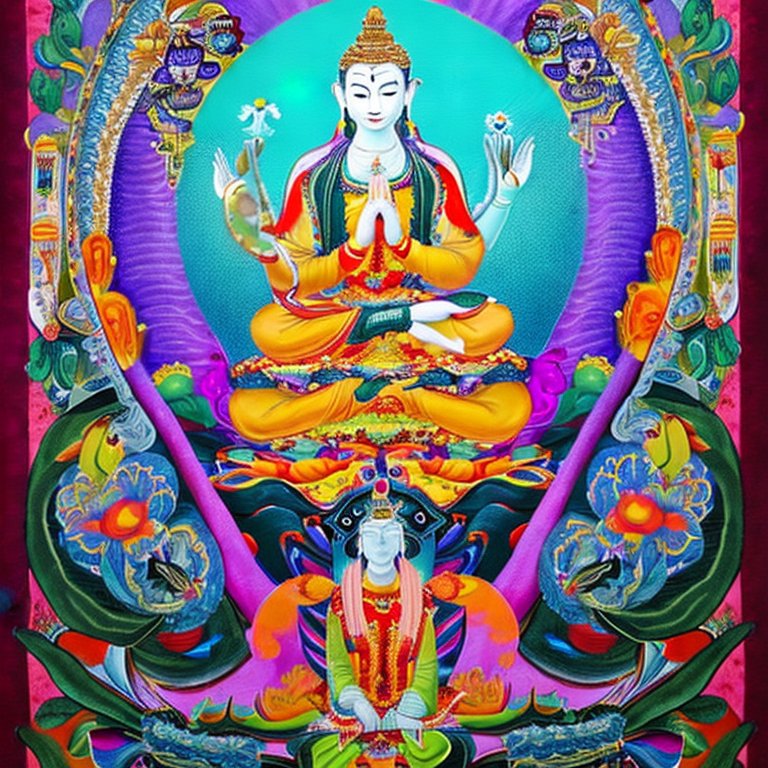
Unveiling the Paradoxical Tapestry of Nonduality
Introduction:
In the realm of profound philosophical inquiry, few concepts have captivated human minds as powerfully as the notion of nonduality. It beckons us to delve deeper into the nature of existence, challenging our preconceived notions and inviting us to explore the uncharted territories of paradox. Yet, amidst the vast expanse of literature and discourse on the subject, there lies an untrodden path, a unique perspective awaiting discovery. In this thought-provoking blog, we embark on a journey to unravel the tapestry of nonduality, weaving together the threads of seemingly opposing concepts in a way that illuminates the unexplored corners of our understanding.
Section 1: Subject-Object Wholeness: The Mirage of Separation
Traditionally, nonduality has been described as the dissolution of the boundary between subject and object. But what if we were to consider that this boundary is not merely an illusion to be dissolved, but rather a fundamental aspect of the interconnected whole? By embracing the paradoxical nature of subject and object, we transcend the notion of a binary relationship and uncover a rich tapestry where both unity and diversity dance in harmony.
Section 2: The Dance of Infinity and Finitude: An Eternal Synchrony
Infinity and finitude have long been viewed as opposites, forever in conflict. However, a fresh perspective emerges when we recognize that infinity does not exist apart from the finite, but rather encompasses it. Just as a droplet of water contains the essence of the vast ocean, the finite contains within it the spark of infinity. In this revelation, we discover an eternal synchrony where the boundaries between the two dissolve, revealing a profound interplay of expansion and limitation.
Section 3: Embracing the Yin and Yang: The Alchemy of Dualities
Within the realm of nonduality, the interplay of positive and negative transcends mere opposition. Rather than negating each other, they fuse together in a cosmic dance, giving rise to the intricate tapestry of existence. By reframing our perspective, we find that positivity and negativity are two essential forces that co-create the symphony of life, providing contrasting hues that bring depth and richness to our human experience.
Section 4: The Timeless Now: Eternity and Temporality Unveiled
Eternity and time often appear as irreconcilable opposites, with eternity representing a timeless realm and time embodying the ephemeral. However, what if we were to explore the idea that eternity is not separate from time, but rather encompasses it? In the ever-present now, the eternal reveals itself as the foundation from which time emerges. As we attune ourselves to this perspective, we can embrace the cyclical dance of birth, growth, decay, and renewal, while remaining anchored in the timeless essence.
Section 5: The Nondual Kaleidoscope: Beyond Samsara and Nirvana
Samsara and nirvana, often considered opposing states, are entwined in the fabric of nonduality. The transformative potential lies not in escaping samsara for a transcendent nirvana, but in recognizing that both exist within the same spectrum of experience. By embracing the paradoxical nature of these concepts, we open ourselves to the possibility of finding liberation amidst the cycles of existence, fostering a profound integration of the sacred and mundane.
Conclusion:
As we conclude our exploration into the uncharted realms of nonduality, we find that the fabric of existence is a tapestry of paradox, where unity and diversity, finitude and infinity, positive and negative, eternity and time, samsara and nirvana, ultimate and relative, spirit and matter, one and many, Atman and Brahman, form and emptiness, merge and interweave in a dance of cosmic significance. This unique perspective on nonduality challenges us to embrace the complexity and interplay of seemingly opposing concepts, inviting us to transcend our limited understanding and explore the profound depths of existence.
In this exploration, we are called to relinquish the impulse to categorize and label, to move beyond the constraints of linear thinking, and to embrace the boundless potential that arises when we hold paradox with reverence. It is within these liminal spaces that our consciousness expands, allowing us to perceive the interconnectedness of all things and the underlying unity that permeates the fabric of reality.
By contemplating this unique perspective on nonduality, we can cultivate a transformative shift in our perception of the world. We begin to see the inherent beauty in the interplay of opposites, recognizing that it is through the harmonization of these apparent contradictions that we can truly embrace the totality of our existence.
As we navigate the complexities of life, let us remember that the paradoxes we encounter are not obstacles to be overcome but gateways to profound insight and understanding. By embracing the intricate dance of nonduality, we embark on a journey of self-discovery and interconnectedness, transcending the limitations of our individual perspectives and merging with the vast cosmic tapestry of existence.
In this grand symphony of paradox, we are invited to become active participants, co-creators of our own reality. By engaging with the multifaceted nature of existence, we can honour the unity within diversity, find solace in the ever-present now, and discover the profound interconnectedness that weaves through all aspects of life.
So, let us venture forth with open hearts and curious minds, ready to explore the uncharted territories of nonduality. Let us embrace the unique perspective that transcends the boundaries of verbal expression and literature, and in doing so, may we awaken to the awe-inspiring beauty of the paradoxical tapestry that lies beyond the veil.
Morgan O. Smith
Yinnergy Meditation & My Book, Bodhi in the Brain…Available Now!

 Morgan O. Smith