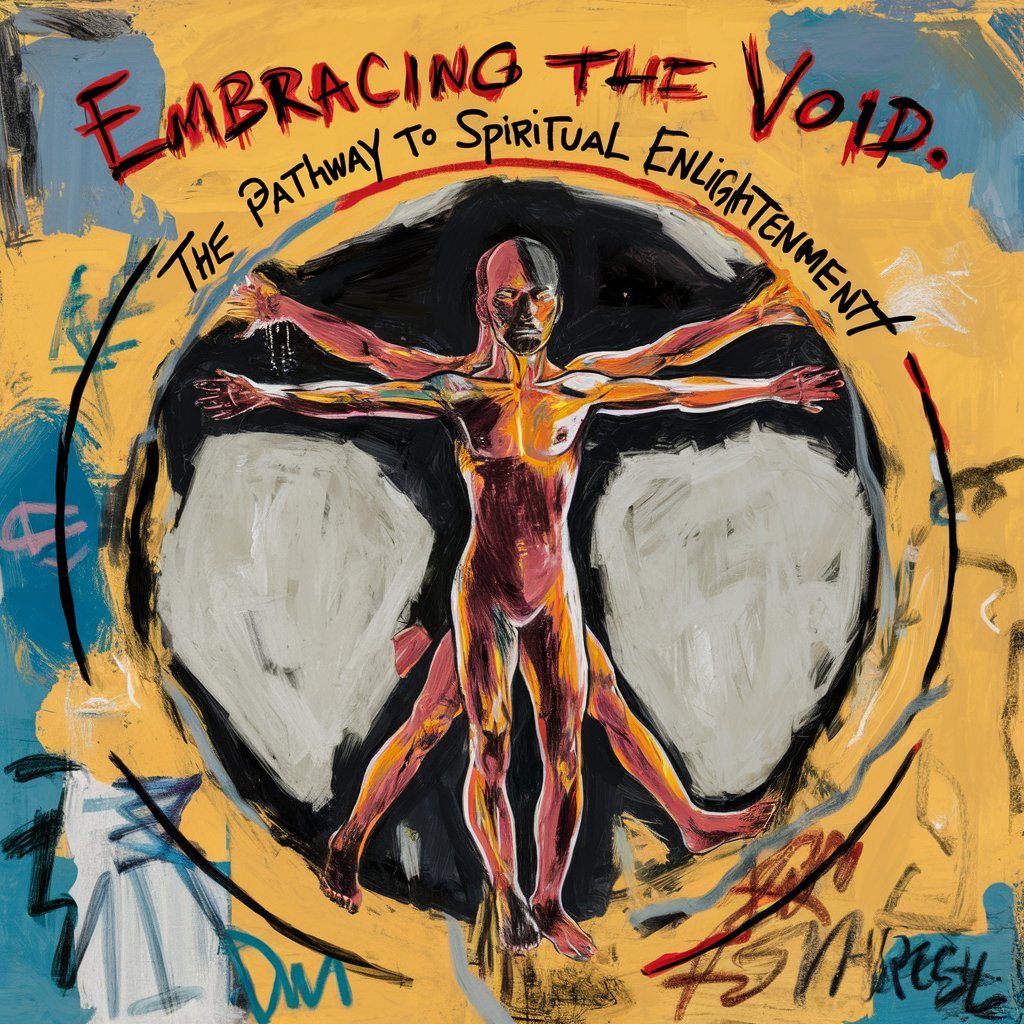
Embracing the Void

The Pathway to Spiritual Enlightenment

In the quest for spiritual enlightenment, a profound transformation beckons, one that requires an unyielding surrender of all that defines us. It is a journey beyond the tangible, beyond the confines of labels and identities that we cling to—our gender, nationality, race, ethnicity, and even our deepest desires and beliefs. This path demands an unparalleled relinquishment, a surrender not just to our inner selves but to the vast expanse of the universe and everything within it.

Enlightenment, in its truest essence, is not about acquiring something new or reaching a lofty destination. It’s about a subtle yet powerful realization: the shedding of layers, the unbecoming of what we thought we were. It’s a journey inward, where the cessation of our attachments reveals the luminous core of our existence.


Consider this: our identities, with all their complexities, are but constructs—narratives we’ve woven around our being. In the pursuit of enlightenment, these narratives unravel, revealing the simplicity and purity of our true nature. This process is not about loss; rather, it’s a rediscovery, a return to an unadulterated state of being where peace and understanding flourish.

Surrendering to the universe means accepting the impermanence and fluidity of all things. It’s an acknowledgment that our desires, beliefs, and even our strongest convictions are transient. In this acceptance lies the key to liberation—from the relentless cycle of desire and the illusion of separation.


Imagine a state where there is no ‘I’ or ‘mine,’ no clinging to personal histories or future aspirations. Here, in this boundless openness, lies the essence of nonduality—the profound understanding that we are not separate from the universe but an integral part of it. It’s a realization that the distinctions we make between ourselves and the world are illusory.

In this state of surrender, we become like the vast sky—expansive, serene, and untroubled by the transient clouds of thoughts and emotions. We experience life in its purest form, unfiltered and unobstructed by the narratives of the ego. This is the heart of spiritual enlightenment—a state of being that is in harmony with the universe, where the duality of self and other dissolves into a singular, boundless existence.


As seekers on this path, let us embrace this journey with an open heart and mind. Let us surrender to the flow of life, to the wisdom of the universe, and in doing so, discover the profound peace and understanding that lies within.

Morgan O. Smith

Yinnergy Meditation, Spiritual Life Coaching & My Book, Bodhi in the Brain…Available Now!

https://linktr.ee/morganosmith

The Divine Dance of Non-Attachment

A Journey Beyond Self

In the quietude that envelops the soul’s journey, there lies a profound realization, a moment that transcends the confines of the self and ushers us into the boundless realm of non-attachment. This is not merely an act of letting go but a sublime embrace of a state of being where one is liberated from every iota of personal existence. It is a passage through the eye of the needle, where the constructs of selfishness that bind the cells of our being dissolve into the ether, revealing the essence of our true nature.

This selfishness, a primal force that ensures our survival, becomes the very shackle we must transcend to experience the oneness of the universe. It is the adhesive that moulds our sense of individuality, carving out a distinct self from the universal continuum. Yet, it is within this self-love, this instinct for preservation, that the seeds of separation are sown. And from these seeds sprout the illusion of duality—the belief in a self apart from the rest.

The decision to let go, to relinquish the grip on this ephemeral identity, is both a death and a rebirth. It is the shedding of old skin, not in rejection of existence, but as an offering to the infinite dance of life. In this sacred act of surrender, one does not disappear but merges into the fabric of everything, becoming indistinguishable from the cosmos itself. This is the essence of non-attachment: the realization that in letting go of what we are, we become what we always were—boundless, timeless, infinite.


This experience of becoming no-thing is not an annihilation but an expansion into all. It is to stand at the heart of existence and see with clear eyes that there is no ‘other,’ no separation between the self and the universe. It is to understand that the individual story we cling to is but a drop in the vast ocean of consciousness, significant not for its separateness but for its part in the whole.

At the pinnacle of non-attachment, we encounter a paradox: in surrendering the idea of life as something to be clutched with desperate hands, we discover true life. This is not a life bounded by the narrow confines of personal gain or loss but a life that flows with the unbounded rhythm of existence itself. It is a state of being that nourishes all creation, not from a place of selfish intent but from the profound realization of our interconnectedness.


In this divine state, we find ourselves not by looking inward but by dissolving into the vastness of everything. We become a mirror reflecting the infinite, a conduit for the universal energy that animates all life. This is the ultimate freedom, the liberation from the self-imposed prison of identity. Here, in the embrace of non-attachment, we come home to our true selves—not as separate entities struggling against the tide of existence but as integral threads woven into the fabric of all that is.

Morgan O. Smith

Yinnergy Meditation, Spiritual Life Coaching & My Book, Bodhi in the Brain…Available Now!
https://linktr.ee/morganosmith

Transcending the Mind

A Journey into the Realms of True Reality

In the labyrinth of human existence, there lies a profound truth that often remains hidden beneath layers of perception and thought: the essence of reality as it truly is, unfiltered and pure. This realization dawns only when the mind transcends its boundaries, stepping beyond the constraints of its conditioned patterns and habitual ways of thinking.

The mind, a magnificent tool for navigation in the physical world, is often shackled by its creations – thoughts, beliefs, and assumptions. These mental constructs, while useful, can also act as barriers, filtering and altering reality as it presents itself to us. The journey towards understanding true reality thus begins with a paradoxical task: using the mind to transcend the mind.

In this transcendence, one experiences a shift in perspective. What was once seen as absolute may reveal its relativity. The solid ground of ‘facts’ might turn into a dance of possibilities. This isn’t a disavowal of logic or reason, but an expansion of them. It’s an acknowledgment that reality, in its vastness, cannot be fully contained within the confines of human thought.

What emerges from this transcendental experience is a sense of profound connection. The boundaries that separate the self from the universe begin to blur. In this state, one doesn’t just observe reality; one becomes a part of it, engaged in a harmonious dance where the distinction between the observer and the observed diminishes. It’s a state where the ego dissolves, and in its place arises a sense of unity with all existence.

This journey is not about acquiring new knowledge but about unlearning what obstructs the vision of reality. It’s about silencing the incessant chatter of the mind to listen to the silence that speaks volumes. In this silence, reality reveals itself not as a concept to be grasped but as an experience to be lived.

As we embark on this journey of transcending the mind, we open ourselves to a reality that is more vivid, more alive, and infinitely more profound than our habitual ways of seeing can allow. It’s a journey from the illusion of knowing to the wisdom of understanding, from the confinement of the mind to the liberation of consciousness.

In this exploration, we find not just the essence of reality but also the essence of ourselves, as beings intrinsically connected to the vast, intricate tapestry of existence. We discover that in transcending the mind, we don’t lose ourselves; we find ourselves in everything.

Morgan O. Smith

Yinnergy Meditation, Spiritual Life Coaching & My Book, Bodhi in the Brain…Available Now!
https://linktr.ee/morganosmith


Exploring the Emotional Spectrum

A Journey Through Plutchik’s Wheel and the Hindu Subtle Body

Introduction

The exploration of human emotion transcends disciplines, cultures, and time. From psychological models such as Plutchik’s Wheel of Emotions to the spiritual teachings within Hinduism concerning the subtle body, the pursuit to understand our emotional selves is as complex as it is enriching. This blog post takes a deep dive into these seemingly disparate concepts, examining the intersection of emotion, spirituality, and subtle awakening.

Plutchik’s Wheel of Emotions

Plutchik’s model identifies eight basic emotions:

1. **Joy** – A sense of happiness and fulfillment.
2. **Trust** – Confidence in something or someone.
3. **Fear** – A response to perceived danger or threat.
4. **Surprise** – A reaction to the unexpected.
5. **Sadness** – A feeling of loss or despair.
6. **Disgust** – A strong aversion or repulsion.
7. **Anger** – A reaction to perceived wrong or injustice.
8. **Anticipation** – Expectation or excitement for what’s to come.

These primary emotions combine to form complex emotions and are mapped in a way that each emotion has an opposite.

The Emotional Subtle Body in Hinduism

Hindu philosophy introduces the concept of the subtle body, an intricate and vital part of our spiritual being, separate from the physical body. Comprised of the mind (Manas), intellect (Buddhi), ego (Ahamkara), and conditioned consciousness (Chitta), the subtle body is responsible for our thoughts, emotions, and consciousness.

Connecting the Dots: Emotions and the Subtle Body

The profound connection between Plutchik’s emotional spectrum and the emotional subtle body within Hinduism lies in the universality of emotions and the depth of human experience. Here’s a breakdown:

– **Joy & Trust**: These positive emotions align with spiritual awakening and the cultivation of inner peace and compassion, reflecting a higher level of consciousness.

– **Fear & Anger**: These emotions can be linked to spiritual blocks or ignorance (Avidya) within Hinduism, which hampers spiritual growth.

– **Surprise & Anticipation**: These emotions speak to our deep connection with the universe and the ever-changing nature of life, echoing the Hindu belief in the transient nature of our physical existence.

– **Sadness & Disgust**: Often seen as negative emotions, they can be channels for growth and understanding of the self, mirroring the Hindu concept of Dharma or righteous living.

Conclusion: Emotions as Pathways to Spiritual Awakening


The emotional spectrum is not merely a psychological construct but a spiritual pathway. By understanding emotions through the lens of both Plutchik’s model and Hindu philosophy, we can embark on a journey toward subtle spiritual awakening.

The nuances of emotions, their combinations, and their reflections within the emotional subtle body offer us tools to navigate our spiritual paths. The profound connection between these concepts suggests that our emotions are not transient or superficial but deeply entwined with our very essence.

This exploration encourages us to recognize emotions as more than reactions to the world around us. They are signposts guiding us toward self-realization and a deeper connection with the divine within.

Morgan O. Smith

Yinnergy Meditation & My Book, Bodhi in the Brain…Available Now!
https://linktr.ee/morganosmith

Drugs, Mystical Experience, and the Value of Service

Post-Live Stream YouTube Event
Sunday, August 20

Michael and Linda Molina from the Emerging Sciences Foundation hosted a live interview with Morgan O. Smith to discuss the process of spiritual awakening.

Morgan O. Smith is a revered meditation instructor and spiritual guide. His life took a transformative turn in 2008, leading him to commit wholeheartedly to assisting others in discovering their inner tranquility. This led to the establishment of Yinnergy Meditation, a grassroots movement that utilizes the potency of audio-guided deep meditation practices to foster emotional, mental, and spiritual growth.

He has penned the newly released book, “Bodhi in the Brain”, which delves deeply into the symbiotic relationship between meditation and neuroscience. He has collaborated with the Institute of Noetic Sciences (IONS), and presented at the Institute for Consciousness Research’s 37th Annual Conference. He has also appeared on podcasts such as “Guru Viking” and “Waking the Wild.”

He used to be a comedy writer, stand-up comedian and an acclaimed television personality. He co-hosted the award-winning show, “Buzz” and shared the stage with comedy legends and featured in nearly 50 television shows, indie films, and documentaries. His insights influenced Arian Herbert’s compelling book, “The God Behind The God.”

Morgan’s unique journey from entertainment to the tranquil realm of mindfulness enables him to resonate with diverse audiences and guide them toward a life enriched with inner peace.

The Facets of Ego and Transcendent Experiences: Part Two

As we proceed from Part One, a profound realization dawns. During moments of complete ego death, the individual facets cease to exist, yet paradoxically, they all exist, blending into a unified consciousness. The boundaries of ‘I’, ‘you’, ‘us’, and ‘them’ dissolve, making room for an all-encompassing ‘we’.

Our ego transforms and integrates into the collective consciousness, interconnecting with the egos of all beings, and indeed, the universe itself. Every trait, every star in our constellation, becomes part of this grand cosmic tapestry.

This realization isn’t merely intellectual, but experiential. Our individual identities meld into the collective, signifying an interconnectedness that transcends our singular perspective. In the dance of the facets of ego and the mystical experiences, we uncover our deepest potential to be interconnected, to share in the collective consciousness of all beings, and to participate consciously in the magnificent orchestration of the universe.

Through this journey, we don’t lose ourselves; instead, we find our place in the cosmos, gaining a newfound appreciation for the diversity and unity that life offers. We witness our traits, without labelling them as positive or negative, as part of a unified whole. Our ego ceases to be an entity isolated from the universe and becomes a fundamental part of the cosmic consciousness.

This exploration of the ego and its many facets is not just an intellectual exercise, but a call for introspection and self-awareness. It encourages us to embrace our full spectrum of experiences, from the depths of our struggles to the heights of our joys, all the while seeking that profound connection with the universe and our place within it.

Morgan O. Smith

Yinnergy Meditation & My Book, Bodhi in the Brain…Available Now!

https://linktr.ee/morganosmith

The Moment of Omnipresent Self-Realization

Discovering the Infinite ‘I’

Introduction:
In the hushed corners of our consciousness, a whisper seeks acknowledgment – the timeless questions of existence. It is in the silent chambers of introspection that we finally experience a moment of revelation, where we realize that the Who, What, When, Where, Why, and How of our being are not merely aspects of our identity, but the very fabric of existence itself.

Who Am I? – The Boundless Entity:
As we ponder the question, “Who am I?” the expansive canvas of life unravels. In our deepest thoughts, we find a connection with the universe. We realize we are not just an isolated self but the amalgamation of everything that has ever existed and will ever be. In the echo of ancient wisdom, “I AM That”.

What Am I? – The Essence Beyond Form:
Shapes, forms, and entities fade into insignificance as we delve into our essence. We are neither body nor soul, yet we encompass all. The abstract concept of being transcends the physical, and we find ourselves to be the sum of the entire universe.

When and Where? – The Timeless, Spaceless Existence:

“When did I come into being and Where did I come from?” – such queries dissolve into irrelevance as we realize our existence transcends time and space. Like the fabric of space-time, our being is omnipresent. We are not constrained by coordinates on a plane or ticks on a clock. We are in every atom and every moment.

Why? – The Power of Creation:
One of the most profound inquiries is “Why did I create everything in existence?” The essence of creation lies within our boundless nature. We, as this unified consciousness, are created simply because it is an intrinsic expression of our endless potential. Creation is the reflection of our unlimited power.

How? – The Enigmatic Thought:

The mechanism of creation is an eternal enigma. Yet, in our moment of self-realization, we understand that the entire cosmos sprang into existence from a singular thought. This thought, an unfathomable force, is perpetually creating, altering, and sustaining the universe.

Conclusion:
The moment of self-realization is akin to a wave merging into an ocean – it is in this profound unity that we grasp the limitless boundaries of our existence. The answers to Who, What, When, Where, Why, and How are not separate, but interwoven into the very essence of what we are. In acknowledging this, we do not simply find ourselves; we become one with the boundless cosmos. This is not an end but a beginning, a continuous journey through the labyrinth of existence with a newfound understanding of our immeasurable significance within it.

Morgan O. Smith

Yinnergy Meditation & My Book, Bodhi in the Brain…Available Now!

https://linktr.ee/morganosmith

The Quest for Wholeness

Nirvana, Moksha, and Sahaja Samadhi

Introduction:

In the frantic, cacophonous world we inhabit, the pursuit of true peace of mind has become more essential than ever. Many of us harbour a longing, often unarticulated, for a state of being that transcends the mundanity of our daily routines. This is not just about calming the mind; it’s about an all-encompassing peace that permeates every fibre of our being – peace of the mind, heart, and gut. This form of liberation, known in different cultures as Nirvana, Moksha, or Sahaja Samadhi, is the ultimate aspiration.

Body:

I. Understanding the Concepts
Nirvana, a term originating from Buddhism, literally means ‘to extinguish’. It is the extinguishing of desires, ignorance, and the sense of self. Moksha, rooted in Hinduism, signifies liberation from the cycle of birth and rebirth, and the realization of one’s unity with the ultimate reality or Brahman. Sahaja Samadhi is an effortless state of deep spiritual absorption, where one is simultaneously aware of the inner Self and the external world. These three concepts, while having different origins, converge on the notion of liberation and inner peace.

II. The Nature of True Peace
True peace is not merely the absence of conflict; it is a profound sense of unity and harmony within oneself and with the universe. It’s a sense of completeness and fulfillment that is not contingent on external circumstances. It is in this state that the heart finds contentment, the mind is unshaken, and even the gut, often referred to as the ‘second brain’, is at ease.

III. The Journey Within
The quest for true peace demands a deep, inward journey. This is a path of self-discovery, contemplation, and inner transformation. Through meditation, self-reflection, and sometimes through guidance from spiritual traditions, one begins to detach from the illusions and constraints of the material world.

IV. The Liberation of the Self

In reaching Nirvana, Moksha, or Sahaja Samadhi, the self is liberated. This liberation is an awakening to the true nature of reality. It’s the realization that our essential self is not separate from the universe. This sense of oneness alleviates the turmoil of the heart, the restlessness of the mind, and the tension within the gut.

V. The Role of Compassion and Mindfulness
Compassion towards oneself and others is a vital component of this journey. It is through a compassionate heart that one can embrace the imperfections of human existence. Additionally, mindfulness helps in cultivating an awareness of the present moment, which is fundamental in the pursuit of inner peace.

Conclusion:

The pursuit of true peace, as epitomized in Nirvana, Moksha, or Sahaja Samadhi, is a deeply enriching and transformative journey. It’s not just an intellectual exercise but an all-encompassing spiritual endeavour that engages the mind, heart, and gut. This form of liberation is the pinnacle of human aspiration and a goal that can guide us toward a more harmonious and fulfilling existence.

Morgan O. Smith

Yinnergy Meditation & My Book, Bodhi in the Brain…Available Now!

https://linktr.ee/morganosmith