The Silent Witness of Truth

Two voices rise in heated exchange—one anchored in faith, the other in skepticism. They stand opposed, each convinced of their certainty, each attempting to dismantle the other’s foundation. Their words carry weight, their arguments sharpened by conviction, yet beneath the clashing ideologies, an unseen presence listens, unmoved.

Observing this, a realization dawns. Neither combatant holds the full measure of truth, yet together they sustain a delicate balance—two halves of an equation that unknowingly uphold the whole. One defends belief, the other champions reason, yet both are bound to the same unseen essence that animates their very thoughts. The paradox they refuse to entertain is the paradox they embody: truth exists beyond assertion, beyond belief and disbelief alike.

What remains when both voices fall silent? What exists beneath every question, beyond every answer? A presence, neither confined by doctrine nor diminished by doubt. It is not a belief to defend nor a theory to deconstruct. It is the stillness that remains when all concepts dissolve, the background against which all ideas emerge and fade.

This presence requires no validation, no allegiance, no name. It neither arises nor perishes, for it is not bound by time. It is the ever-present foundation upon which all things rest—the unseen essence that gives rise to both theist and the atheist, both the question and the answer.

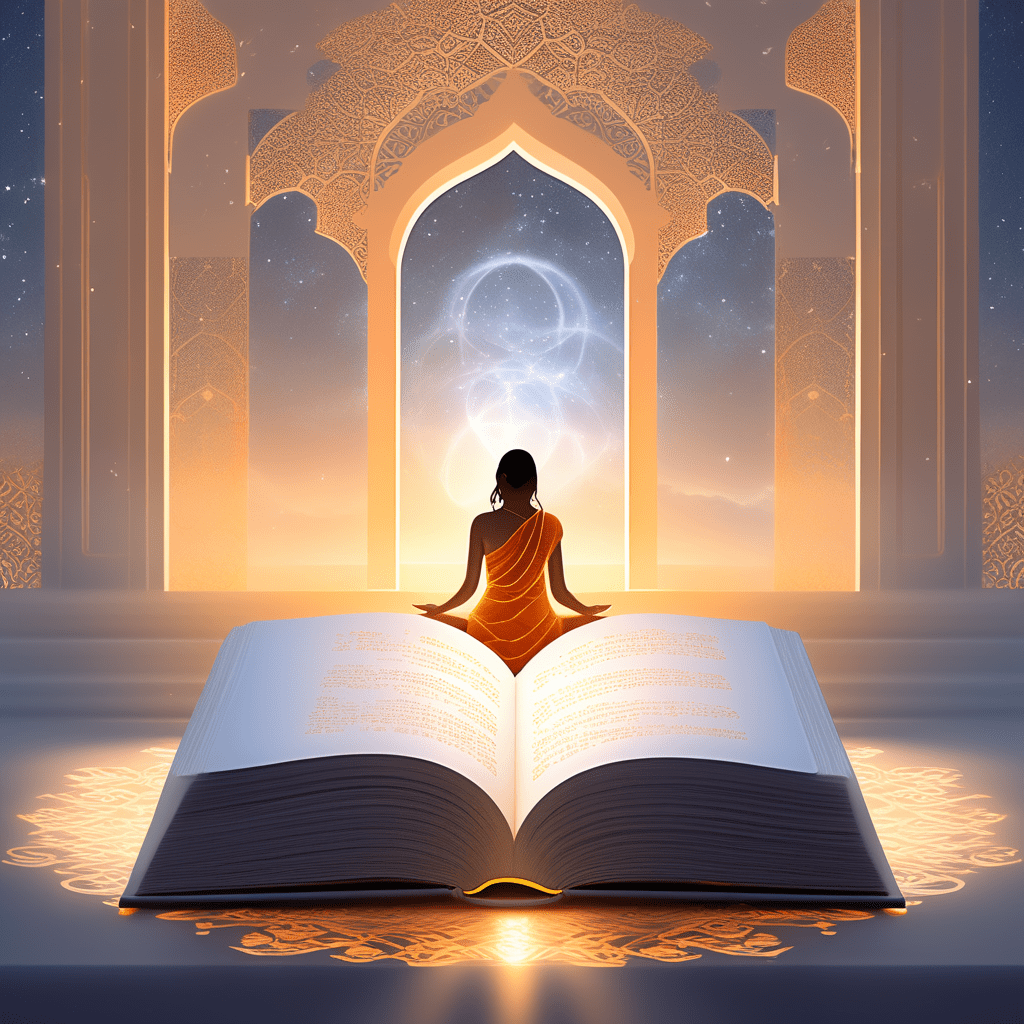
And yet, words will always fall short. Language can point, but it cannot contain. Thought can probe, but it cannot grasp. Those who have peered into the mystery have only ever gestured toward it—whether in sacred texts or silent awe. To recognize it is not to name it, but to surrender the need for certainty.

Look around. Not with the eyes of belief or disbelief, but with the eyes that see before thought intrudes. Feel its presence—not as an idea, but as the undeniable is-ness of this moment. And when you do, offer it a quiet smile. It has always been smiling back.

Morgan O. Smith

Yinnergy Meditation/Neurofeedback, Spiritual Life Coaching & My Book, Bodhi in the Brain…Available Now!

https://linktr.ee/morganosmith

The Upanishads

Beyond Textual Study to Experiential Wisdom

The Upanishads, ancient Indian texts forming the philosophical core of Hinduism, present a profound, spiritual journey. However, a critical aspect often overlooked is the distinction between mere scholarly study and experiential understanding. When one engages with the Upanishads purely from an academic perspective, without delving into the experiential practices that inspired these free thinkers, a significant essence is missed.

The free thinkers who composed the Upanishads didn’t just pen philosophical ideas; they recorded their direct experiences and spiritual revelations. These texts are not just to be read and analyzed but to be lived and experienced. When the Upanishads become a subject of mere intellectual study, they risk being reduced to just another ‘religion’ or belief system, potentially limiting the profound, universal wisdom they hold.

This is not to undermine the importance of scholarly study. It certainly lays the groundwork for understanding. However, it’s crucial to recognize that intellectual comprehension alone doesn’t lead to the transformative realization the Upanishads speak of. They call for a journey inward, an exploration of consciousness, which transcends intellectual grasp.

By treating the Upanishads as a religion, one confines them within the boundaries of dogma and doctrine. This contradicts their very essence, which is about liberation from all forms of limitation, including the confines of organized religion. The Upanishads encourage a journey beyond the mind, a leap into direct experience and realization.


In conclusion, while the study of the Upanishads is valuable, it should be a gateway to deeper, experiential understanding. This journey from intellectual comprehension to experiential wisdom is what truly unlocks the treasures of these ancient texts. To fully grasp the essence of the Upanishads, one must move beyond the confines of intellectual study and step into the realm of direct, personal experience.

Morgan O. Smith

Yinnergy Meditation, Spiritual Life Coaching & My Book, Bodhi in the Brain…Available Now!
https://linktr.ee/morganosmith

Beyond the Infinite

Contemplating the Vastness Beyond Para-Brahman

In the profound depths of Hindu philosophy, the concept of Para-Brahman represents the ultimate, unchanging reality, the absolute existence that transcends all forms and phenomena. It is an entity beyond human perception, beyond all attributes, the substratum of both the manifest and the unmanifest. But the human mind, insatiably curious and inherently uncontent with limits, dares to ponder—what, if anything, lies beyond Para-Brahman?

To consider what is beyond Para-Brahman is to engage in a philosophical exercise that stretches the boundaries of thought and existence. It is like trying to illuminate the space beyond the edge of the universe’s observable horizon. Para-Brahman itself is defined as the highest Brahman, beyond which nothing further can be conceptualized within the traditional frameworks of Hindu philosophy. However, this does not deter the most adventurous minds from speculating on the nature of the absolute’s transcendence.

In attempting to name that which is beyond the ultimate, we delve into a realm of thought that precedes language and form. Such a pursuit may lead us to the Sanskrit term “Anirvachaniya,” meaning that which cannot be expressed or described. In this context, the term acknowledges the limitations of human language and understanding when faced with the immensity of the infinite.

Yet, it is in the silence of meditation and the stillness of contemplation that Hindu tradition often finds its deepest insights. Here, the individual soul (Atman) comes into direct experience with Brahman, and it is perhaps in the dissolution of the self where one might fleetingly encounter the hint of something even more profound than Para-Brahman—something that, by its very nature, cannot be encapsulated by any concept or word.

We might then call this speculative beyond “Ananta,” the infinite, a term that suggests an endlessness that extends even beyond the ultimate expanse of Para-Brahman. It is not a place, entity, or state that can be reached or understood; it is the possibility of infinity within infinity, the essence of boundlessness that permeates every aspect of the cosmos and yet is apart from it, untouched and untouchable.

To ponder what lies beyond Para-Brahman is to embrace the essence of the Upanishadic inquiry, “Neti, neti,” not this, not this. By negating all that can be known, we are left with silent wonder, an acknowledgment that the truth is ever beyond the grasp of our finest conceptions. It is a journey not toward another concept, but towards an ever-deepening mystery that invites us to find peace in the acceptance of the unknown.

The spiritual endeavour to reach beyond even the concept of Para-Brahman invites us to a profound humility, an understanding that what we know and experience is only a fragment of the vastness of reality. It is a cosmic reminder that the journey is not just about seeking answers, but also about appreciating the beauty of the questions themselves.

In this exploration, we are not just students of Hindu philosophy but of the universe itself, engaged in a ceaseless dialogue with the essence of existence. And perhaps, in that very dialogue, we come to realize that the ultimate truth is not a distant reality to be pursued but an ever-present mystery to be lived.

Morgan O.  Smith

Yinnergy Meditation & My Book, Bodhi in the Brain…Available Now!
https://linktr.ee/morganosmith


Aham Brahmasmi

The One Identity That Transcends All

In the labyrinth of identity, where the self is often lost amidst the numerous labels and societal constructs, “Aham Brahmasmi” emerges as a beacon of profound insight. Translated as “I am Brahman”, it’s a phrase from the Upanishads, the ancient philosophical texts of India, that redefines the very essence of selfhood. A bold assertion of unity with the Absolute, it declares the individual self as non-different from the ultimate reality or cosmic principle, Brahman.

The phrase posits a paradox: it is both a declaration of identity and a negation of it. While it identifies the self with Brahman, it simultaneously obliterates all other identities that are predicated on the dualistic perception of reality. It deciphers the enigma of existence by presenting a radical understanding of the self that transcends all conventional forms of identity-based on religion, ethnicity, gender, or nationality.

In the assertion of “Aham Brahmasmi”, the identity becomes the Universe itself, simultaneously making it ‘The One Identity’. Yet, by embracing the entirety of the cosmos, it becomes ‘No Identity’ – for it is no longer confined by the limitations of individuality. It surpasses the perceived boundaries of the self and ventures into the realm of absolute oneness, a non-dual reality beyond all bifurcations.

This concept embodies the pinnacle of self-realization, where the ego-self is annihilated and one awakens to the inherent divinity within. It’s a state where there is no ‘other’. The knower, the known, and the process of knowing merge into one seamless entity, eliminating the subject-object dichotomy. It is a proclamation of the undifferentiated consciousness that pervades all existence.

Understanding “Aham Brahmasmi” prompts us to question the notion of ‘identity’ as we ordinarily understand it. It urges us to look beyond the surface, to delve deep into the essence of who we truly are. It seeks to elevate our consciousness from the transitory, ephemeral identities towards the eternal, changeless Self. It encourages the shift from multiplicity to unity, from diversity to oneness, from illusion to reality.

To comprehend and embrace “Aham Brahmasmi” is to transcend the shackles of perceived identity. It is to immerse oneself into the boundless ocean of consciousness, realizing that the waves of individuality are but manifestations of the same, unified reality. It is to witness the grand cosmic dance of existence and to understand that we are not mere spectators, but the dance itself.

This timeless wisdom reminds us of our inherent potential to realize the ultimate truth. It is an invitation to journey inwards, into the core of our being, to discover our true nature. It is to affirm that we are more than our physical bodies, more than our thoughts, emotions, and experiences. “Aham Brahmasmi” is the realization that we are that – the boundless, the infinite, the eternal. It is the unlearning of all we thought we were, to understand who we truly are.

Morgan O. Smith

Yinnergy Meditation/Bodhi in the Brain, Available Now!

https://linktr.ee/morganosmith