Beyond Existence and Non-Existence

The Paradox of God

To say “God exists” is to affirm the ultimate. To say “God does not exist” is to deny the ultimate. Both affirmations and denials, however, are shaped by the mind’s insistence on certainty. The moment one tries to hold onto either pole, a paradox emerges.

When someone claims God exists, they project a reality beyond perception, yet they confine that reality to a category recognizable to human thought. When another claims God does not exist, they too impose a conclusion, binding the ineffable to the limits of negation. Both positions carry a strange truth and a strange error. Both dissolve the moment awareness sees through the duality of affirmation and denial.

Imagine truth as a horizon: from one angle, existence appears; from another, non-existence. Walk closer, and the horizon itself vanishes; it was never a line that could be grasped, but a function of perspective. God is not merely at the horizon but the condition through which horizon, perspective, and perceiver arise.

To say both are true is to honour that reality contains affirmation and negation. To say both are false is to point out that neither claim reaches the source. To say one is true and the other false is to remain in dualistic thought. To call them half-truths is to recognize their limitation yet still attempt to measure the immeasurable. To deny even a half-truth is to bow to silence.

The statement itself, that God exists and does not exist in all these paradoxical ways, becomes the closest gesture to truth. It is not the conclusion but the capacity to hold the contradictions without collapse that reveals God’s existence, not as a concept but as the unnamable presence behind every concept.

The paradox is not meant to be solved. It is meant to exhaust the mind until only awareness remains. What remains is not the proof of God, but the direct realization that the very effort to define or deny was always occurring within and as God.

Morgan O. Smith

Get Your Free Copy of My Book, Bodhi in the Brain!
https://subscribepage.io/oTSZQu

Beyond the Quadrants

Direct Encounter with the Supreme Identity

The quadrants—I, We, It, and Its—are not just theoretical maps of experience. They can be lived, felt, and directly known in ways that reveal both their necessity and their ultimate transparency. Each quadrant opens as a doorway, and when entered deeply, each dissolves into the same ground that holds them all.

The “I” – Subjective Interior

The first-person self, the one who says “I,” often feels like the most fundamental reference point of life. Yet, in moments of profound awareness, this identity begins to unravel. The familiar sense of a centre collapses into boundless subjectivity that no longer belongs to a person. Awareness remains, but it is no longer tethered to the small self. The “I” is recognized as inseparable from the infinite.

The “WE” – Intersubjective Communion

Beyond the personal lies the shared field of relationship. Here, connection is no longer about agreement or dialogue but about an unspoken resonance. Every being, every presence, becomes part of a silent communion. The walls between self and other fall away, revealing a unity that feels more intimate than words could ever capture.

The “IT” – Objective Reality

The external world, seen through clear perception, ceases to be “out there.” Light, form, and movement are no longer divided from the one who sees. Reality appears luminous, alive, inseparable from the awareness that beholds it. Object and subject reveal themselves as two sides of the same indivisible presence.

The “ITS” – Systems and Networks

The interwoven fabric of existence discloses itself as a living system. Breath, heartbeat, ecosystems, and galaxies are perceived not as separate mechanisms but as one movement—an intricate symphony without a conductor. The interconnections are not abstractions but a direct felt sense of everything breathing together.

Beyond Quadrants – The Supreme Identity

As each quadrant is seen through, they collapse into the unbroken ground of Being. This cannot be named as “I,” “We,” “It,” or “Its.” It is the source that gives rise to them all while remaining untouched by their distinctions. This is the Supreme Identity—timeless, boundless, indivisible.

When lived from this recognition, the quadrants are not discarded but liberated. They no longer bind perception to fixed standpoints. Instead, they shine as transparent facets of a jewel that was never fractured. Every act, every relationship, every perception becomes a clear expression of the ground itself.

The Supreme Identity is not somewhere else, waiting to be found. It is what was always here—before the quadrants, within them, and beyond them.

Morgan O. Smith

Get Your Free Copy of My Book, Bodhi in the Brain!

https://subscribepage.io/oTSZQu

Beyond Quadrants

The Supreme Identity

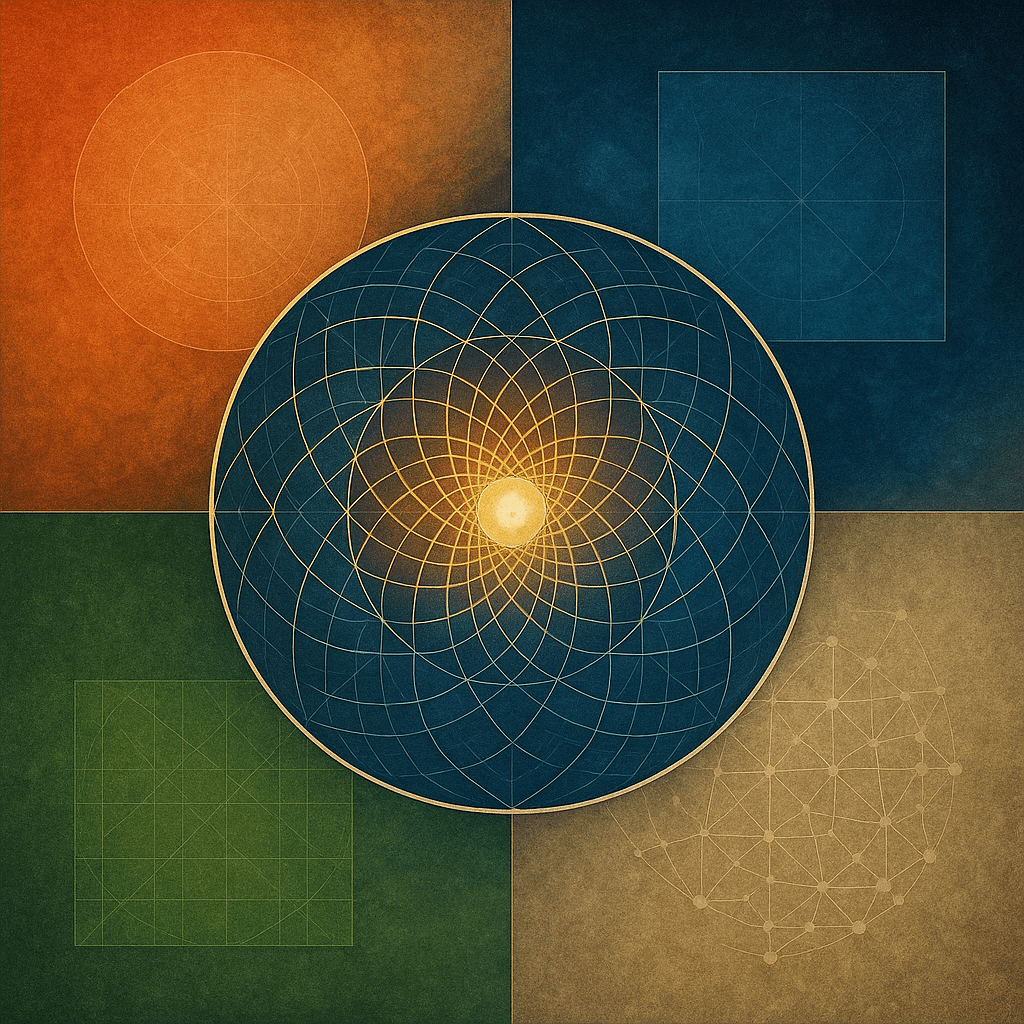
The quadrants of experience—I, We, It, and Its—have long been a lens through which consciousness organizes reality. Each provides a vital perspective: the subjective interior of the self, the shared intersubjective domain, the objective forms of matter, and the interobjective systems of the whole. These lenses do not compete; they illuminate the multiple dimensions of existence. Yet, any frame cannot contain the essence of reality, no matter how inclusive or comprehensive it may be.

What reveals itself when awareness no longer clings to a particular quadrant? A vastness appears that cannot be named solely as an “I,” nor reduced to the communion of “We.” It is not confined to the world of objects, nor to the vast interplay of systems. The Supreme Identity both transcends and enfolds these domains, existing as their ground and source.

This Identity is not separate from the quadrants; it is their silent witness and animating force. Just as light contains within it every visible colour yet is itself colourless, the Supreme Identity contains every possible perspective while remaining free of perspective altogether. When seen clearly, the quadrants dissolve into expressions of a singular field that cannot be divided.

What makes this recognition so profound is that it shatters the tendency of consciousness to fixate. The mind grasps for a standpoint—self, relationship, object, or system—but here, every standpoint is unmasked as a partial gesture of the whole. The Supreme Identity does not stand against them; it whispers through them. The “I” speaking, the “We” sharing, the “It” observed, the “Its” interlinked—all are nothing other than its unfolding.

Realizing this does not negate the quadrants. Rather, it liberates them. Each becomes transparent, shining as a clear facet of a jewel that was never fractured to begin with. The Supreme Identity calls forth a recognition: the One is never elsewhere. It is already present, before all perspectives, yet manifesting as each.

To live from this recognition is not to abandon life’s frameworks but to embody their ground. Every conversation, every act, every encounter reveals the unbroken presence that cannot be named yet pervades all. The quadrants remain as tools of navigation, but the navigator is no longer lost.

Morgan O. Smith

Get Your Free Copy of My Book, Bodhi in the Brain!
https://subscribepage.io/oTSZQu

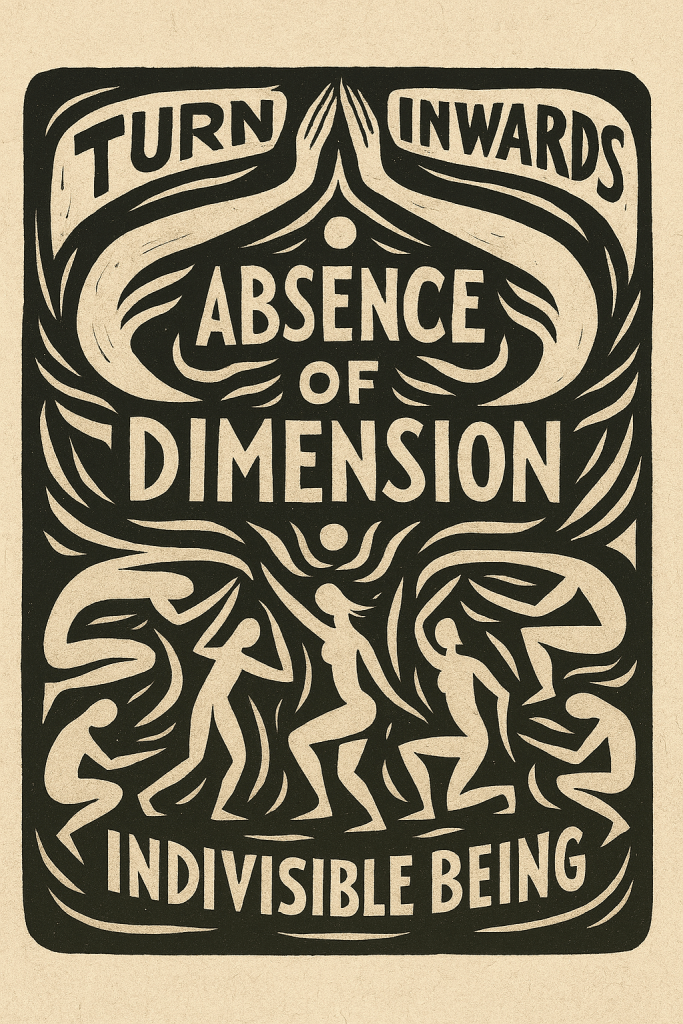
The Absence of Dimension

A Contemplation on Absolute Monism

What dimension is the experience of absolute monism?

That very question quietly collapses under its own weight.

To ask “how many” is to divide the indivisible. To quantify is to measure a mystery that can only be met in its own silence. Within the direct realization of Turiyatita—that which lies beyond even Turiya—there is no vantage point from which to count, compare, or classify. The moment dimensionality is assigned, we have already slipped back into the architecture of mind, where form assumes primacy over essence.

Still, the mind hungers for some orientation. So let’s turn the prism slowly, exploring this from a few distinct angles—not as answers, but as offerings.

1. Relative Lens: The Architecture of Experience

Certain esoteric traditions offer a gradient of consciousness: from the dense contours of the material (3D), to subtle inner time-space (4D), toward integrative fields of unity (5D and above). These serve as helpful metaphors, allowing seekers to understand how consciousness may expand or refine. Yet even the loftiest of these is still part of the dream—within the cosmic play of form.

From this lens, the direct encounter with nonduality might appear multi-dimensional, even interdimensional, because it defies the logic of linearity. It feels vast, borderless, paradoxical. But it is still being interpreted by a relative mind, even if only for a moment.

2. Transcendental Lens: The Priorness of the Real

Absolute monism is not located anywhere because it is not a location.

Dimensionality implies structure. It assumes contrast. But the Absolute is prior to all arising. It is not 1D, 5D, or 12D—it is the generative zero-point. The stillness that allows all movement. The background that isn’t separate from the foreground but holds all images without ever becoming one.

It is not empty like a void; it is empty like ungraspable fullness. The kind of emptiness that births stars and dissolves gods. Not confined to being or non-being, but transcending both.

3. Direct Realization: The Collapse of All Coordinates

No map leads here.

Direct realization is immediate and unmediated. Not because you reached a peak, but because the climber vanished. There is no experiencer—only experiencing. No mind reflecting on awareness—only awareness aware of itself.

Here, space has not been born. Time has not begun ticking. Even the concept of unity dissolves, for there is nothing to be unified. What remains is suchness—pure presence prior to presence. A silent explosion of is-ness so complete it leaves no trace.

Not a Dimension. Not Even a State.

So what do we call it?

Nothing.

And everything.

To speak of “the dimension of absolute monism” is to subtly betray it. Better to say: it is the absence of dimension in which all dimensions arise and dissolve. Not a high place, but the place before place. Not a peak, but the disappearance of altitude itself.

A Final Whisper

Absolute monism is not the highest dimension.
It is the absence of dimension,
where even “one” dissolves.
Here, all becomes what it has always been—
indivisible, unbounded, unspoken.

Morgan O. Smith

Get Your Free Copy of My Book, Bodhi in the Brain!
https://subscribepage.io/oTSZQu

God Is the Real Imaginary

Absolute Monism and the Paradox of Reality

A peculiar clarity arises once the mind exhausts its chase for permanence. Once the striving quiets, what remains is not a revelation in the ordinary sense—it is the revelation of revelation itself. God. Not as something other, but as the very condition of knowing, being, and non-being.

God is not a person, nor a power among powers. God is context itself. Not just the backdrop, but the totality—the undivided field in which all division appears. It is what Hindus call Para Brahman: the Absolute of the Absolute. The final substratum, beyond form, formlessness, and even beyond the duality of beyond and not-beyond.

Yet the paradox defies all rational anchoring: God is also imagination.

Not a figment. Not illusion in the dismissive sense. But the supreme imagining—consciousness dreaming within itself. The universe, with all its matter and mind, all its chaos and beauty, is that imagining. And because God is not apart from its imagining, God too is that imagining.

Which means this: both God and the universe are imaginary.

And also utterly real.

What we call “real” and what we call “imaginary” collapse into a single gesture when seen from God’s standpoint—which is no standpoint at all. From this viewless view, there is no separation between the dreamer and the dream, the Absolute and its expression, the Formless and the formed.

Yet the beauty of this is not that everything dissolves into sameness. The beauty is that everything becomes itself without needing to stand apart.

God and the universe are one and the same. And because they are one and the same, they are also not the same. The distinction is not contradiction. It is the very nature of what is. Distinctness does not negate unity. It reveals it.

This is not spiritual poetry. This is ontological exactness. If anything is to be absolute, it must include even the capacity to contradict itself. That is the very mark of its absoluteness.

So, what is this that appears as a tree, a thought, a thunderclap, a kiss, a death, a silence?

It is God.
It is the universe.
It is imagination.
It is reality.

One singularity. Absolute Monism.

To see it is not to figure it out. To see it is to disappear into what cannot not be.

Morgan O. Smith

Get Your Free Copy of My Book, Bodhi in the Brain!
https://subscribepage.io/oTSZQu

Nonduality

The Unspoken Reality

In the realm of spirituality and philosophy, few concepts are as intriguing and paradoxical as nonduality. Nonduality, often associated with Eastern philosophies like Vedanta and Buddhism, refers to the idea that the dualistic distinctions we make between self and other, subject and object, mind and matter, are ultimately illusory or not fundamentally real.

The profound irony of nonduality is that any attempt to discuss or conceptualize it inherently contradicts its very essence. Speaking or thinking about nonduality is, by its nature, a dualistic activity. This is because language and thought are tools that rely on differentiation and distinction. They are the media through which we carve out the ‘self’ from the ‘other’, the ‘this’ from the ‘that’. In doing so, they perpetuate the illusion of duality – the very illusion that nonduality seeks to transcend.


This paradox highlights a fundamental challenge in human cognition: our reliance on dualistic frameworks to make sense of the world. From the moment we are born, our minds are trained to categorize and differentiate. This cognitive structuring is crucial for our survival and functioning in the world, yet it also confines us within the boundaries of dualistic thinking.

Nonduality suggests a state of consciousness where these dualistic distinctions dissolve. It points to an experiential understanding where the division between subject and object, observer and observed, ceases to exist. In this state, the egoic self expands into a boundless, undifferentiated whole.

Yet, the path to realizing nonduality is not through intellectual understanding. Since it is beyond the grasp of dualistic thought and language, nonduality is often approached through practices that transcend rational thinking, such as meditation, mindfulness, or other forms of spiritual contemplation. These practices aim to quiet the mind and dissolve the ego, allowing for a direct, non-conceptual experience of reality, unfiltered by the distorting lens of dualistic thought.


In conclusion, nonduality remains an enigmatic yet profoundly significant concept. It challenges us to look beyond the apparent separateness and fragmentation of our experiences and to question the very foundations of our understanding of reality. While it may never be fully captured in words or thoughts, it stands as a powerful reminder of the limitations of our dualistic perspectives and invites us to explore the depths of our consciousness.

Morgan O. Smith

Yinnergy Meditation, Spiritual Life Coaching & My Book, Bodhi in the Brain…Available Now!

https://linktr.ee/morganosmith

The Unfathomable Brahman

Exploring the Indivisible Reality from Multiple Perspectives

The quest to understand Brahman is a journey into the heart of existence itself, a pursuit that has intrigued philosophers, sages, and seekers for millennia. In the vast expanse of Hindu philosophy, Brahman is the ultimate reality, the fabric of all that exists and beyond. It is both immanent and transcendent, the core of our being and the cosmos. This exploration of Brahman from various perspectives—gross, subtle, causal, and nondual—invites us to expand our minds beyond the limits of ordinary perception.

**From the Gross Perspective: Brahman as the World**


When we look at Brahman from the gross perspective, we see the universe in all its material splendour. Here, Brahman is not an abstract concept but the physical universe that we interact with through our senses. It is the mountains, rivers, stars, and galaxies; the dance of creation and destruction visible to the naked eye. This manifestation is known as Saguna Brahman, the form with qualities, where the Divine is seen with attributes and forms, engaged in the act of creation.

**From the Subtle Perspective: Brahman as Consciousness**


Venture deeper, and we encounter the subtle perspective. Here, Brahman is the essence of consciousness that animates life. This is not the consciousness that fluctuates with our thoughts and feelings, but the pure awareness that observes, untouched and unchanging. This subtle Brahman also referred to as Nirguna Brahman, is without qualities, where God is not limited by any attributes. It is the silent witness to the play of the universe, the inner light that illuminates our experiences.

**From the Causal Perspective: Brahman as the Source**

Moving into the causal perspective, we touch on the very source of existence. Brahman here is the unseen cause behind everything—the seed from which the tree of the universe grows. This aspect of Brahman is deeply mysterious, for it is the origin of time, space, and causality itself. It is Avidya, ignorance, not in the sense of lack of knowledge, but as the primal forgetfulness that makes us perceive duality in the nondual.

**From the Nondual Perspective: Brahman as the One without a Second**


Finally, from the nondual perspective, Brahman is realized as the one without a second—Advaita. It is not a deity, not an entity, not even a ‘thing’ that can be comprehended by the intellect. It is the underlying oneness that pervades all dualities, where the seeker and the sought merge. In this view, the individual self (Atman) and the universal self (Brahman) are the same. All distinctions between creator and creation dissolve, revealing that there is nothing but Brahman—pure existence, consciousness, and bliss (Sat-Chit-Ananda).

This journey through the perspectives of Brahman reflects the layered depths of our existence. From the tangible reality of our day-to-day lives to the deepest spiritual realization, Brahman remains the unchanging truth. Each perspective is a step closer to the ultimate truth, leading us from the outward expressions of divinity to the profound inner revelation that we are, in essence, the infinite Brahman.

To understand Brahman is to expand our awareness across the spectrum of existence. The gross perspective roots us in our environment, the subtle unfolds the inner cosmos, the causal leads us to the primal source, and the nondual reveals our true infinite nature. In contemplating these perspectives, we may find that the journey to understand Brahman is not a journey outward but a profound voyage within, to the very core of who we are.

Morgan O.  Smith

Yinnergy Meditation & My Book, Bodhi in the Brain…Available Now!

https://linktr.ee/morganosmith

Melding Into The Absolute

A Glimpse Into The Ephemeral Veil of Enlightenment

The pursuit of enlightenment, often perceived as a lofty goal, transcends the entanglement of the mundane and the superficial. It is a venture beyond the confinements of ego, a journey into the vast expanse of what is real and eternal. But what happens when one treads on the path leading toward enlightenment? Is there a profound experience awaiting or is it an indescribable state of being? This contemplation draws insights from two profound philosophies – Vedanta and Buddhism, exploring their stance and convergence at the pinnacle of enlightenment.

During the moment of enlightenment, there is no ‘ego’ to witness this majestic unfolding. If one perceives a void yet remains distinct from it, the essence of enlightenment remains elusive. However, such an experience is a beacon of progress, a sign of being on the righteous path. When enlightenment graces, there’s an inherent knowing, a certainty that obliterates doubts. It’s a paradoxical realm where everything and nothing transpires, leaving behind only the essence of what one truly is—Absolute.

The Vedantic and Buddhist interpretations, though seemingly diverse, converge at the apex of enlightenment. Vedanta extols the oneness of existence, the monistic reality, while Buddhism explores the transient nature of reality, leading to a similar dissolution of ego and a recognition of an underlying unity. It’s akin to the myriad flavours of ice cream. Despite their distinct tastes and colours, the essence remains the same – the foundational element of ice. The epitome of enlightenment, or absolute monism, can be metaphorically depicted as a blend of every conceivable flavour of ice cream and beyond, encapsulating all foods, their variations, their origins, and their surroundings.

The metaphor extends further, proposing a confluence of all experiences, a melding into the Absolute. The journey might commence from disparate standpoints, traversing through diverse experiences, yet it culminates at a singular point— the realization of the Absolute. The magnificence of enlightenment doesn’t lie merely in reaching this pinnacle but in the unravelling of profound simplicity, an unveiling of what has always been there.

Upon such a realization, the dichotomies merge, the veils of ignorance are lifted, and what remains is an unadulterated consciousness, a pristine awareness devoid of fragmentation. It’s a return to the original state of being, a melding into the boundless, an embrace of the Absolute.

Morgan O.  Smith

Yinnergy Meditation & My Book, Bodhi in the Brain…Available Now!

https://linktr.ee/morganosmith

Beyond the Verbal Abyss

Embracing the Indescribable in the Pursuit of Nondual Consciousness

The realm of metaphysics has been exploring the uncharted territory of human existence since the inception of philosophical thought. The concept of ‘Turiyatita’, borrowed from the ancient Vedantic wisdom, invites us to delve into the mystery of the Ultimate Nondual Presence. In a state of supreme transcendence, Turiyatita marries the notions of Emptiness and form, painting a picture of the Self fully liberated and realized.

This profound state is said to represent the highest level of human awareness. It’s the experience of actualizing the quintessential Vedantic concept, “Aham Brahmasmi,” the realization that all is Brahman, the ultimate reality.

The fascinating paradox of this journey lies in its unspeakability. The moment of enlightenment, where one realizes their ultimate oneness with the universe, is so overwhelmingly mind-shattering that no human language can capture its essence. We find ourselves venturing into a stateless state, an inexplicable expanse that houses all potentiality, while simultaneously being nothing. It’s a cosmic riddle that has always existed and will continue to exist, challenging the very constructs of human understanding.

Over the years, I grappled with expressing the enigma that is Turiyatita. I discovered that language, no matter how profound or poetic, remains insufficient to convey this transcendental experience. The individual mind’s narratives fall short when tasked with communicating such an experience to the collective consciousness. This realization is like a boundless sea that can only be expressed through the universe itself – through everything around us, beneath us, above us, within us, and even through us. Our very existence, after all, is an echo of this ‘Absolute’ language.

This illuminating journey of pure awareness left me in a state of awe, marking an indelible imprint on my ego’s fragments. An unforgettable memory, it is the most profound self-discovery I’ve had in this lifetime.

Most of us remain oblivious to the existence of this state, yet it’s accessible to everyone. It waits patiently for anyone bold enough to plunge into its mysterious depths. These are the Akashic waters of enlightenment, a blissful abyss where the brave explorers willingly lose themselves.

This presence, while unnoticeable, pervades our existence as an invisible field, a force that forms the bedrock of all beings. It’s in the exploration of this Ground of All Existence that one realizes the enigma of the indescribable, the ineffable mystery commonly referred to as ‘God’.

So, as we journey through life and its varied experiences, may we always strive for the courage to explore these profound depths. For it is in these explorations that we touch upon the mysteries of our existence, our true selves, and the cosmic reality we are all a part of.

Morgan O. Smith

Yinnergy Meditation & My Book, Bodhi in the Brain…Available Now!

https://linktr.ee/morganosmith