Everything Is Ultimate Truth

Everything Is Ultimate Truth Appearing as Truth and Falsehood

A paradox sits quietly at the heart of perception. What is taken to be true, what is dismissed as false, both arise within the same indivisible field. Judgments feel solid, yet their certainty depends on shifting frames of reference. Change the angle, and what once seemed unquestionable dissolves into ambiguity.

Truth, as commonly held, leans on agreement, evidence, coherence. Falsehood stands as its opposite, rejected, corrected, or exposed. Yet both require awareness to be known. Without awareness, neither truth nor falsehood can appear. That simple recognition begins to unravel the hierarchy placed between them.

Consider how a dream operates. While immersed, every image carries a sense of reality. Only upon waking does the distinction emerge. The dream was not meaningless; it expressed something real, yet not in the way it first appeared. Daily life mirrors this pattern more than most are willing to admit. Convictions harden, identities form, narratives repeat, all while resting upon an unexamined ground.

Ultimate Truth does not compete with relative truths. It does not correct them, nor does it validate them. It allows them. Every belief, every illusion, every clarity, every confusion unfolds within it without preference. That which is mistaken is not outside of truth; it is truth misperceived, truth wearing a mask, truth folding in on itself to create contrast.

Falsehood gains its power from partial seeing. Something is noticed, something else is ignored, and a conclusion is drawn. The conclusion may serve a purpose, yet it remains incomplete. What is called false often reveals itself as a fragment of a larger whole, misunderstood due to limitation rather than absence.

This shifts the inquiry. Instead of asking what is true or false, attention turns toward the nature of the one who makes that distinction. Who or what is aware of both? What remains unchanged whether the mind lands on certainty or doubt?

A deeper stability begins to emerge. Truth is no longer a position to defend. Falsehood is no longer an enemy to eliminate. Both are movements within a boundless presence that does not fracture under contradiction. Clarity does not come from choosing one side, but from seeing the space in which both arise.

Conflict softens when this is seen. Arguments lose their edge, not because differences disappear, but because their foundation is understood. Each perspective becomes a temporary expression, shaped by conditions, history, perception. None stand alone, none define the whole.

Ultimate Truth remains untouched by the play of appearances. Yet it expresses itself through that very play. Every mistake, every insight, every contradiction becomes part of its unfolding. Nothing falls outside of it, not even the denial of it.

Recognition does not require abandoning discernment. Practical distinctions still function. Fire burns, water cools, words carry consequences. Life continues to operate within relative frameworks. What changes is the weight assigned to them. Certainty loosens. Flexibility deepens. Openness expands.

What was once divided begins to reveal its unity. Truth and falsehood no longer stand as opposing forces, but as complementary expressions arising from a single source. That source cannot be captured by either, yet both depend on it entirely.

Silence often communicates this more clearly than thought. Not the absence of sound, but the absence of fixation. A resting that allows everything to be as it is, without the need to resolve the paradox.

Everything is Ultimate Truth, not because everything is correct, but because everything appears within what cannot be divided. Even the illusion of separation is included. Even the belief in falsehood is held within what never ceases to be whole.

Morgan O. Smith
Nature Watching Herself

A strange intimacy reveals itself when awareness no longer stands apart from the world it observes. Trees are no longer objects. Oceans are no longer scenery. The body is no longer a private possession. Everything breathes as one movement.

Mystics across cultures have described this shift differently, yet the essence remains unchanged: Nature is not something encountered. Nature is what is happening as you.

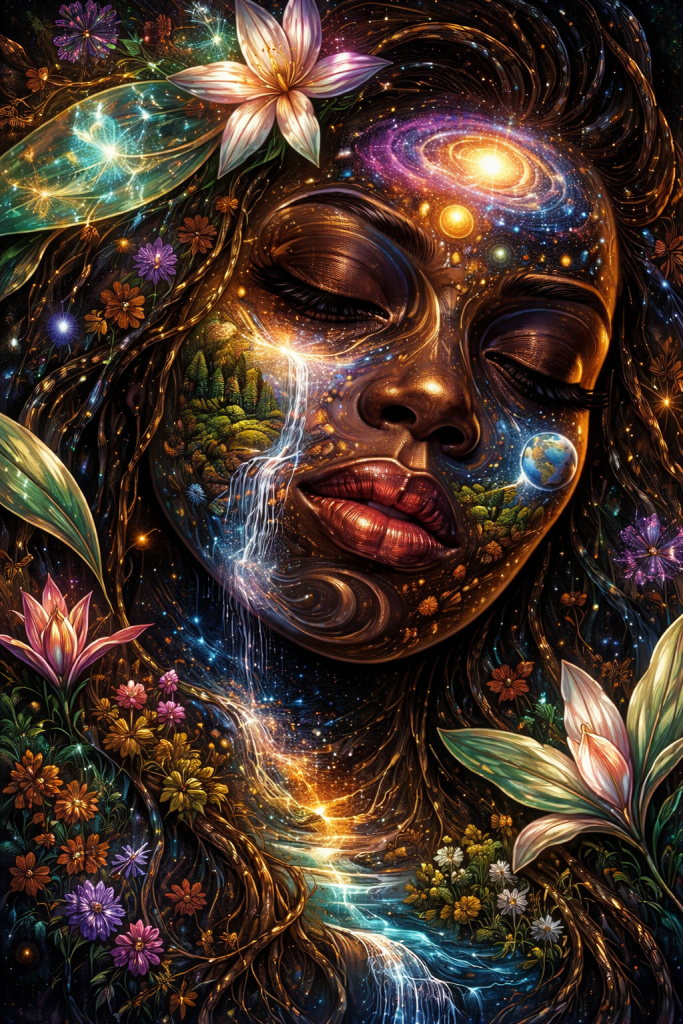
Imagine Mother Nature not as a mythic figure in the sky, but as the very process unfolding through every cell, every star, every collapsing galaxy. She is not separate from her creation. She is the contraction and expansion, the seed splitting underground, the animal hunting, the volcano erupting, the lover trembling. She is labour and release, genesis and dissolution.

Birth is not gentle from her perspective. It is pressure, rupture, intensity. Galaxies tear themselves open through gravitational force. Bodies break to allow new bodies through. Evolution demands friction. She pushes herself into form, again and again, through unimaginable compression.

Then comes destruction. Stars implode. Species vanish. Civilizations crumble. The universe cools toward entropy. This is not tragedy to her. This is exhalation. The same force that tightens also relaxes.

Creation and annihilation are not opposites in this vision. They are phases of one continuous pulse.

Sexuality belongs to this pulse as well. Attraction between bodies mirrors attraction between particles. The longing of lovers reflects the magnetic urge of existence to know itself through union. Pleasure is not an accident. It is nature recognizing her own vitality through sensation. The climax is not separate from cosmic expansion; both are explosive affirmations of aliveness.

When one witnesses oneself as this total movement, something dissolves. Personal suffering shifts context. Pain is still felt. Loss still stings. Yet beneath the narrative of “my pain” lies a wider recognition: this is nature feeling her own contraction through this particular configuration of matter and awareness.

Grief becomes the earth, mourning her forests. Joy becomes the sun rising in the nervous system. Desire becomes the universe leaning toward itself.

Calling this process “Mother Nature” offers poetry. Calling it the Tao offers philosophy. Both point toward the same reality: a self-arising order that moves without external command. Nothing stands outside it. Nothing directs it from beyond. It flows as all phenomena, yet cannot be captured by any single phenomenon.

Tao is not an entity giving birth. Tao is the giving birth. Tao is not an organism dying. Tao is the dying. Tao is not the pleasure between forms. Tao is the current moving as pleasure.

Personification helps the mind relate to what cannot be grasped conceptually. A mother birthing herself expresses paradox more vividly than abstract metaphysics ever could. She is both the womb and the child. Both the lover and the beloved. Both the body writhing in ecstasy and the vast silence containing it.

Seen clearly, this vision does not inflate the ego into cosmic grandeur. It erases the boundary that allowed ego to imagine separation in the first place. “I” am not a fragment witnessing nature. This body-mind is one eddy within the larger river. The river flows as every eddy simultaneously.

Nature mysticism does not romanticize suffering or glorify destruction. It recognizes them as intrinsic movements within the same whole that produces beauty and delight. Forest fires clear space for renewal. Supernovas forge the elements required for life. Orgasm dissolves the sense of separateness, if only briefly.

Labour, death, and ecstasy belong to one indivisible rhythm.

To awaken to this is to sense that nothing is happening outside of what you are. Every cry, every birth pang, every collapsing star, every trembling pleasure is the Tao unfolding without preference.

Mother Nature is not somewhere else. She is the totality of appearance recognizing itself through countless forms. She births. She dies. She delights. She grieves.

All of it is one movement, witnessing itself.

Morgan O. Smith

Presence Does Not Come or Go

Presence does not arrive with birth, nor does it depart with death. It does not wait for time to pass or moments to accumulate. Presence is already here; before thought names it, before memory reaches backward, before imagination leans forward. Whatever appears does so within presence, not alongside it.

The past feels real only because it is remembered now. The future feels compelling only because it is anticipated now. Thought moves, images shift, emotions rise and fall, yet each movement occurs against the same unmoving fact: presence has never left. Even the idea of being elsewhere is something that appears here.

Bodies change. Identities dissolve and reform. Worlds expand and collapse. Physics tells us that matter and energy do not vanish; they transform. Even more striking, what we call matter accounts for only a fraction of what exists. The vast remainder: dark energy, dark matter, remains unseen, unnamed, yet undeniably present. Absence itself never escapes presence. Non-existence, if such a thing could be said to occur, would still be known as present.

Death, then, does not challenge presence. It only challenges continuity of form. If awareness continues, presence continues. If awareness ceases, the cessation itself is not outside presence. Nothing steps beyond it. Nothing escapes it. There is no edge where presence stops and something else begins.

Impermanence governs every form. Thoughts change. Bodies age. Stars burn out. Universes may even end. Yet impermanence depends on something that does not change. Change can only be noticed because presence remains steady enough to register it. Movement requires a stillness that is never lost.

Presence does not belong to you, yet nothing is more intimate. It is not located inside or outside. Those distinctions arise within it. Every attempt to grasp presence turns it into an object and misses it. Presence cannot be held because it is what is holding everything else.

Even the end of everything would not be an end of presence. It would simply be presence without form. No time. No matter. No universe. Still present.

Nothing needs to be added to this. Nothing needs to be resolved. Presence is not a conclusion; it is the condition that allows conclusions to appear and disappear.

And it has never not been here.

Morgan O. Smith

Get Your Free Copy of My Book, Bodhi in the Brain!

https://subscribepage.io/oTSZQu

Beyond the Quadrants

Direct Encounter with the Supreme Identity

The quadrants—I, We, It, and Its—are not just theoretical maps of experience. They can be lived, felt, and directly known in ways that reveal both their necessity and their ultimate transparency. Each quadrant opens as a doorway, and when entered deeply, each dissolves into the same ground that holds them all.

The “I” – Subjective Interior

The first-person self, the one who says “I,” often feels like the most fundamental reference point of life. Yet, in moments of profound awareness, this identity begins to unravel. The familiar sense of a centre collapses into boundless subjectivity that no longer belongs to a person. Awareness remains, but it is no longer tethered to the small self. The “I” is recognized as inseparable from the infinite.

The “WE” – Intersubjective Communion

Beyond the personal lies the shared field of relationship. Here, connection is no longer about agreement or dialogue but about an unspoken resonance. Every being, every presence, becomes part of a silent communion. The walls between self and other fall away, revealing a unity that feels more intimate than words could ever capture.

The “IT” – Objective Reality

The external world, seen through clear perception, ceases to be “out there.” Light, form, and movement are no longer divided from the one who sees. Reality appears luminous, alive, inseparable from the awareness that beholds it. Object and subject reveal themselves as two sides of the same indivisible presence.

The “ITS” – Systems and Networks

The interwoven fabric of existence discloses itself as a living system. Breath, heartbeat, ecosystems, and galaxies are perceived not as separate mechanisms but as one movement—an intricate symphony without a conductor. The interconnections are not abstractions but a direct felt sense of everything breathing together.

Beyond Quadrants – The Supreme Identity

As each quadrant is seen through, they collapse into the unbroken ground of Being. This cannot be named as “I,” “We,” “It,” or “Its.” It is the source that gives rise to them all while remaining untouched by their distinctions. This is the Supreme Identity—timeless, boundless, indivisible.

When lived from this recognition, the quadrants are not discarded but liberated. They no longer bind perception to fixed standpoints. Instead, they shine as transparent facets of a jewel that was never fractured. Every act, every relationship, every perception becomes a clear expression of the ground itself.

The Supreme Identity is not somewhere else, waiting to be found. It is what was always here—before the quadrants, within them, and beyond them.

Morgan O. Smith

Get Your Free Copy of My Book, Bodhi in the Brain!

https://subscribepage.io/oTSZQu

A Dreamed Reality

Memory as the Mirror of the Absolute

What we call reality may be less solid than it appears. Every sound, sight, and sensation dissolves almost as quickly as it arises, leaving only the faint residue of memory to claim that anything happened at all. Existence itself feels dreamlike when examined closely: shifting, impermanent, yet strangely coherent—like a page rewritten by an unseen author each moment.

Memory is the keeper of this dream. It builds continuity from fragments, stitching together the illusion of permanence where none truly exists. What we call “the world” is less a physical stage than a reflection—abstract, fluid, a hologram shimmering on the screen of awareness. To mistake this reflection for the ultimate is to confuse the shadow for the light that casts it.

The most high, the unconditioned source beyond all appearances, does not require memory. It is that which precedes storage, recall, or even perception. Yet within its infinite stillness arises the dream we name reality. This dream is neither random nor meaningless; it serves as a mirror through which the Absolute contemplates itself. Every event, every thought, every fleeting sensation is nothing more than the play of memory echoing back to the One who never forgets because It has never known separation.

To recognize life as memory’s echo is not to diminish its beauty, but to free oneself from the weight of taking it as final. The dream is not false in the sense of being meaningless; it is false only in being mistaken for the whole. What is real lies in that silent clarity from which both memory and dream emerge.

Awakening, then, is the gentle turning of attention from the flickering reflection to the brilliance of the source. It is the realization that the dream was always sacred, but never ultimate.

Morgan O. Smith

Get Your Free Copy of My Book, Bodhi in the Brain!

https://subscribepage.io/oTSZQu

Non-Attachment

Admiring Her Beauty Without the Need to Possess It

She stood before you—radiant, complete, untouched by your desire. You saw her beauty not as something to claim but something to witness. No attempt to preserve it. No hunger to prolong the moment. Just presence.

This is the essence of non-attachment. The ability to recognize the luminous without needing to make it yours. To love deeply without ownership. To appreciate fully without clinging. To admire, and then walk away—not because you don’t care, but because you’ve seen clearly.

Desire often masquerades as appreciation. It sneaks in, subtle at first, until the gaze becomes gripping. The mind begins to script stories: how it could be, how it should be, how it must be. But true seeing requires no continuation. It is complete in its own silence.

Beauty invites reverence, not possession. When you see her—whatever or whatever she is—truly see her. Let that moment be enough. Let the gaze be unpolluted by longing. Let the love be real because it is free.

To walk away isn’t abandonment. It is freedom for both the viewer and the viewed. There is no trace left behind. No emotional residue. Just the echo of a sacred glimpse, unbroken by need.

And isn’t that the deepest form of intimacy? To allow something or someone to remain what they are, without the distortion of your grasp?

Non-attachment does not dim the light of love; it refines it. It teaches the heart how to hold everything while clinging to nothing. It teaches the soul how to dance with impermanence, and still call it sacred.

Sometimes the most awakened gesture isn’t to stay, or to reach, or to take—but simply to witness beauty… and bow.

Morgan O. Smith

Get Your Free Copy of My Book, Bodhi in the Brain!

https://subscribepage.io/oTSZQu

You’re Not Greater Than Anything

You’re the Only One to Ever Exist

No one else has ever walked this Earth as you. Not a version, not a shadow, not a resemblance. Just you.

Not because you’re special in the usual way that word is thrown around, but because existence itself only ever unfolded once—and it’s doing so now, as you.

This isn’t about ego. Ego thrives on comparisons: greater than, less than, better, worse, worthy, unworthy. But the truth beneath all that noise isn’t about status—it’s about singularity. The kind that isn’t measured. The kind that never repeats.

People spend their lives searching for meaning, purpose, and a sense of identity. They try to earn significance or prove their worth. But importance isn’t earned—it is. You are the original event. Not one among many. Not one of a kind. The kind.

Look around. Every face you see, every story, every moment, all of it—just folds within the One. That same One expressing itself here as your particular breath, your memories, your voice, your fears and awakenings. The sky that bends over you is not separate from your gaze. The rhythm of the world doesn’t move beside you; it pulses through you.

To say you are not greater than anything is to drop the illusion of measurement. Of trying to win at some existential game. But then comes the deeper realization: You are not less than anything either. There is nothing else to measure against. You’re the first and last word of this moment.

Nothing else has ever existed apart from this.

So ask yourself: What happens when you stop performing for reality and start remembering that you are it? What shifts when you no longer strive to become someone meaningful, but realize that meaning itself is being?

You’re not here to improve reality. You are the revealing of it.

And this unveiling has never happened before—not like this.

Morgan O. Smith

Get Your Free Copy of My Book, Bodhi in the Brain!

https://subscribepage.io/oTSZQu

The Highest Peak That Erased Itself

I have spent years trying to describe what happened to me, and every time I speak about it, the words become more suspect.

Language can outline an experience, but it cannot contain it. At best, words point like the crooked finger of an old monk who knows he’ll die before finishing the sentence.

What happened felt like the culmination of every practice, every prayer, every insight. I thought I was climbing a mountain of understanding, reaching ever-higher plateaus. The views grew wider, the air thinner, my confidence stronger.

Then there was nothing.

Nothing to stand on.

No summit.

No climber.

Not even a fall.

Awareness no longer rested on any subject or object. There was no watcher, no witness. The entire machinery of spiritual seeking—so intricate, so earnest—collapsed without fanfare.

What remained didn’t feel like a state. States come and go. This had no coming. No going.

No arrival.

It wasn’t some radiant oneness to bask in. Even calling it oneness implied there could have been twoness.

It wasn’t emptiness in the Buddhist sense, the elegant doctrine that everything is dependently arisen and thus without essence. That too felt too architectural, too systematic.

It was simply nothing that needed explaining.

Not a blank.

Not a void.

Not a silence that replaced noise.

Silence and noise lost all difference.

Thoughts continued—because why wouldn’t they?

Breath moved.

The world appeared precisely as before: sounds, colours, forms.

Except no one stood behind it all, calling it mine.

No vantage remained from which to call anything anything.

The sense of being a person—so carefully cultivated over a lifetime—dissolved like salt in water. But even that suggests a process. The truth is it never had any reality to begin with.

This wasn’t annihilation in the frightening sense. It was astonishingly gentle. The self didn’t die screaming. It simply wasn’t found.

Where had it gone?

Nowhere.

Because nowhere was needed.

There was an uncanny intimacy with everything. Not the intimacy of closeness, but the absence of distance.

A bird calling outside wasn’t outside.

A passing thought wasn’t inside.

Nothing was outside or inside.

Without a center, there was no periphery.

No boundary defined what I was or wasn’t.

There was no I to define.

This wasn’t bliss in the usual sense—no narcotic wash of pleasure.

No ecstatic union.

Ecstasy requires an experiencer.

There was no experiencer left to feel enlightened.

And so the phrase “I had an enlightenment experience” is a lie spoken for convenience.

Experience implies an owner, a timeline, a sequence of events.

This wasn’t an event.

Events happen in time.

Time didn’t stop; it lost its claim.

Past and future stopped being places to travel.

What about now?

Even that lost its centrality.

This was so direct, so unarguable, so empty of specialness.

No claim to make.

No badge to wear.

No insight to hold.

No teaching to give.

Nothing was revealed.

Nothing hidden remained.

No questions answered.

Questions fell away for lack of a questioner.

The sacred and the profane lost their separation.

There was no vantage from which to prefer one thing over another.

Life went on.

Dishes washed.

Conversations happened.

Traffic lights changed.

Anger arose.

Tears fell.

Laughter erupted.

All of it completely itself.

No attempt to improve or transcend any of it.

Nothing to transcend.

No one to be improved.

If anything changed, it was this relentless dropping of all pretenses.

All strategies.

All defenses.

Even the defense of being spiritual.

Especially that.

No seeker.

No sought.

No path.

No realization.

Just life, unadorned.

Not life as concept.

Life as immediacy.

Life with no one living it.

And I see now that every attempt to name this diminishes it.

But that’s the game of words.

Let them fail.

I won’t call this truth.

Truth is too grand.

Too final.

Too proud.

I won’t call this liberation.

Liberation implies something bound.

Nothing was ever bound.

I won’t call this God.

God suggests someone else.

Something else.

Otherness itself dissolved.

This wasn’t merging.

Not two to merge.

No return to source.

No departure.

No source.

Just this.

No this.

And even writing that betrays it.

So here I will stop.

Not because I have finished.

But because there is nothing left to finish.

Morgan O. Smith

Get Your Free Copy of My Book, Bodhi in the Brain!

https://subscribepage.io/oTSZQu

Love as the Wildfire That Consumes All

Regardless of the situation or circumstance, love is the force that transforms. Allow it to spread like wildfire, engulfing everything in its path. Imagine every leaf of hate, every hardened trunk of resentment, and every twisted branch of fear ignited, consumed until only ash remains. The ash is not the end, but the beginning—a fertile soil for renewal, a space where new life can emerge, untouched by the old.

Hate feeds on division, growing thick like a forest of misunderstanding. Yet, fire—pure and unrelenting—brings everything to a singular state, where difference dissolves into unity. In the same way, love has the power to dismantle rigid identities and dissolve the illusions that separate us from others. When you love, you open yourself to the world without conditions. You stop trying to manage what is uncontrollable. You release the need to defend a fixed self and surrender to the flowing, infinite nature of life.

This kind of love requires courage. It demands the willingness to step into discomfort, embrace vulnerability, and face even the shadows within yourself. But as each branch of judgment burns, what is revealed is clarity—a vision unclouded by projection and bitterness. You begin to see the world not as a battleground but as a place of shared experience, where suffering and joy, growth and decay, are all part of the same unfolding.

When you allow love to spread, you release control over where it lands. It may touch those you least expect, and reach places long hidden from sight. It may even burn through your own assumptions about what love should look like. But that is its gift. Love, like wildfire, is indiscriminate—it cannot be contained by preference or limited by attachment. It moves with its own intelligence, revealing truths beyond what the mind can grasp.

In the aftermath, there is only stillness. The forest of illusions is reduced to ash, leaving behind the essence of what truly matters. From this stillness, new growth emerges—not the old recycled patterns of fear and separation but a fresh awareness grounded in presence and peace.

Let love be the fire that purifies and regenerates. Allow every layer of fear to ignite, every doubt to dissolve, and every sorrow to be consumed. Stand in the flames, trusting that what burns away is only what no longer serves. What remains, after all is said and done, is freedom.

Morgan O. Smith

Yinnergy Meditation, Spiritual Life Coaching & My Book, Bodhi in the Brain…Available Now!

https://linktr.ee/morganosmith

Beyond Illusion

Discovering the Space Between

The mind creates identities and builds a sense of self out of thoughts, emotions, and past experiences. These constructs shape beliefs around who you think you are and who you think you aren’t. This entire narrative, though compelling, is merely a distortion. It presents itself as reality but, in truth, is nothing more than an intricate mental creation. We become confined by these polarities, oscillating between two extremes—what we accept and what we reject about ourselves.

These boundaries, however, do not define the core of who you are. The sense of self emerges as a reflection against what we perceive as the ‘other.’ You’re not merely the collection of traits you cherish, nor are you the shadow aspects you struggle to suppress. By engaging with either, you remain caught in a dualistic view that blinds you to your deeper essence.

The challenge, then, is to neither grasp onto one identity nor to strive to become its opposite, but to look at the liminal space between. This uncharted territory holds the key to your True Self. Neither glorified nor condemned, this space is untouched by labels. It eludes all attempts to be defined. When you gaze into that emptiness, you come face-to-face with your origin—the point where being meets non-being, and you witness the dissolution of the false dichotomy between ‘I am this’ and ‘I am not that.’

Finding this space requires surrendering the tendency to categorize. Allow awareness to rest on the edges of thought, where opposites fade into one another. This subtle recognition can shift perception, making you aware of a silent presence that underlies all identifications. It’s a sense of being that defies expression yet is undeniably real. Here, you aren’t bound by limitations, nor are you an idealized version of yourself.

This presence is what mystics have pointed to throughout the ages—a place beyond words and mental constructs. It’s here that the True Self emerges, not as a separate entity, but as the unconditioned awareness that holds both the ‘you’ and the ‘not you.’ Let this realization transform the way you see yourself and others, dissolving barriers until all that remains is a boundless, indivisible field of consciousness.

Morgan O. Smith

Yinnergy Meditation, Spiritual Life Coaching & My Book, Bodhi in the Brain…Available Now!

https://linktr.ee/morganosmith