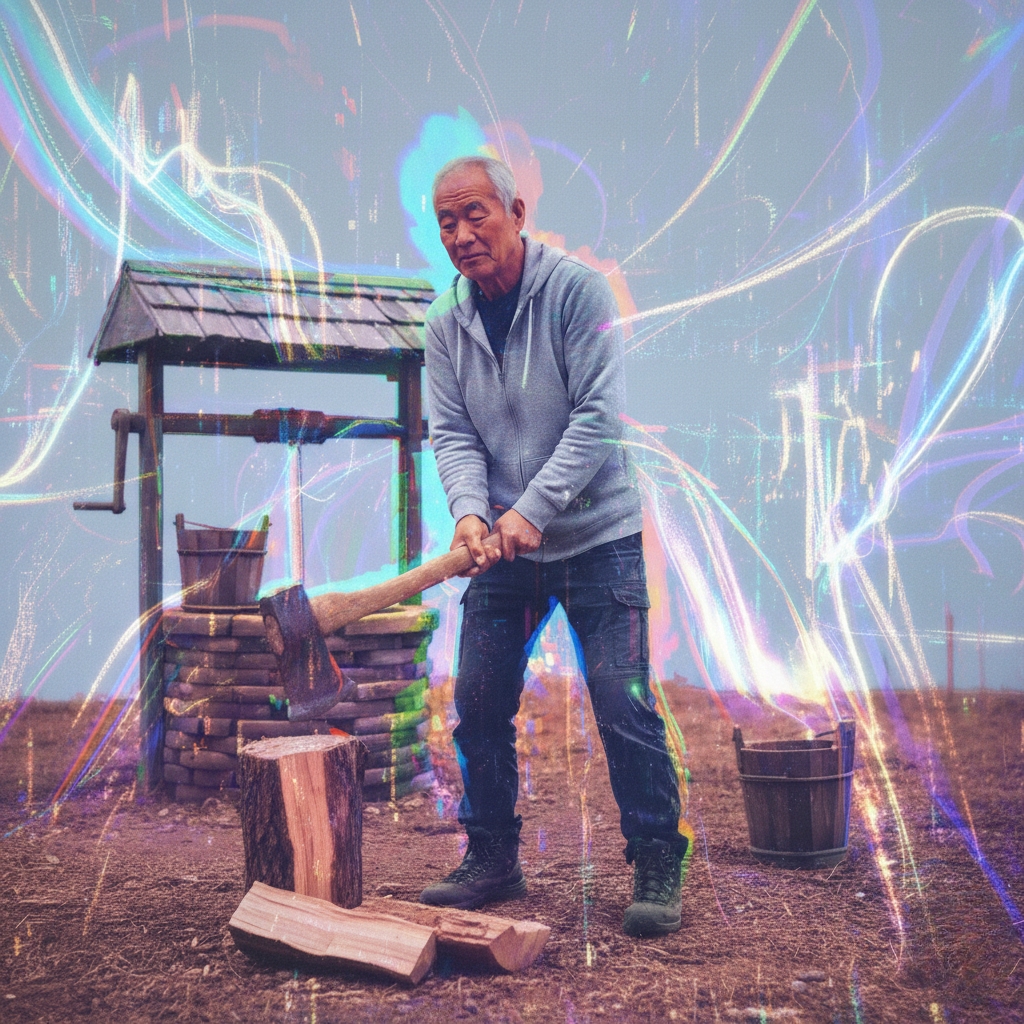
“As they say, before enlightenment, chop wood carry water; after enlightenment, chop wood carry water.”
This phrase is often repeated as reassurance that awakening does not remove one from ordinary life. Yet when examined carefully, it exposes a deeper paradox that cannot be resolved by sentiment alone.
Wood is Maya.
Water is Maya.
The body that lifts the axe is Maya.
The action of chopping is Maya.
The sense of a doer performing the act is Maya.
Nothing in the scene escapes appearance.
If awakening reveals that all phenomena are expressions of Maya, then what is being chopped? What is being carried? One cannot act upon illusion from outside illusion. Maya does not stand opposed to some other realm where truth resides. There is no second substance available to intervene.
This is where the saying begins to point beyond itself.
Before awakening, chopping wood feels purposeful. A future outcome motivates the action. Hunger will arise later. Cold must be prevented. Life appears as a sequence of needs demanding management. The world seems solid, personal, and unfinished. Actions feel necessary because something is believed to be lacking.
After awakening, the appearance of chopping may continue, but necessity dissolves. Nothing is required for completeness. No future state needs securing. The movement of the body happens without reference to deficiency or gain. Action no longer attempts to fix reality.
Wood is chopped, not because it must be, but because chopping happens.
This distinction is subtle and easily missed. Enlightenment does not negate Maya. It reveals its status. Appearance continues without being mistaken for truth. Function remains without belief in ultimate significance. Life moves, but no longer claims ownership of movement.
Chopping and carrying are no longer means to an end. They are expressions without agenda.
The phrase does not suggest sameness of experience across awakening. It points to sameness of appearance with a radically different orientation. The world looks the same, yet its weight has vanished. Consequence still operates, but urgency evaporates. Responsibility remains, but without the burden of identity.
Nothing is being done for reality after awakening.
Reality is not managed, improved, or corrected.
Action occurs because appearance unfolds.
Movement moves because movement is present.
Maya dances without needing justification.
After enlightenment, chopping wood carries no metaphysical significance. Carrying water does not symbolize humility or virtue. These interpretations belong to the mind seeking meaning where none is required.
What remains is effortless participation without belief in a participant.
No one chops Maya.
No one carries Maya.
Maya appears as chopping and carrying, empty of centre, complete as it is.
That is what the saying gestures toward when read beyond comfort.
Nothing special happens after enlightenment—except that nothing is believed to be happening to someone anymore.
Morgan O. Smith
AI for Wellness and Spirituality Summit
February 9 & 10, 2026
 Morgan O. Smith