Beyond Distinctions

Exploring Turiyatita and Absolute Monism in Advaita Vedanta

In the spiritual landscape of Advaita Vedanta, the concept of nonduality transcends the mere absence of distinctions—it ushers us into the realm of Absolute Monism, or Turiyatita—the state of “the one without a second.” This profound philosophical framework challenges our everyday perceptions, urging us to look beyond the apparent separateness of the world.

Nonduality in this context does not imply a simplistic erasure of distinctions, but a deeper recognition that all forms and phenomena arise from the same underlying reality. This reality is not one of many, but a singular existence that pervades all, without an other or a second to stand beside it.

The journey to understanding Turiyatita involves peeling back the layers of illusion that fabricate duality within our experiences. Common perceptions of separation between self and other, observer and observed, are seen as just that—perceptions. These are not absolute truths but conditioned responses to the world. The realization of Turiyatita invites a shift from these conditioned views towards a holistic awareness, where dualities merge into a singular, expansive consciousness.

This path to enlightenment challenges the seeker to transcend the intellectual and embrace a lived experience of oneness. It is not about negating diversity but understanding the underlying unity that makes diversity possible. By recognizing the unity underlying all diversity, one does not lose the uniqueness of individual expressions; rather, one gains an appreciation of how these expressions emerge from the same source.


The implications of this understanding are vast and transformative. Embracing Turiyatita can lead to profound peace, as conflicts often stem from perceptions of separation. When one sees all beings and things as extensions of the same infinite reality, compassion and empathy flow naturally.

Advaita Vedanta’s discourse on nonduality and Turiyatita thus offers not just a philosophical stance, but a practical guide to living more harmoniously within the apparent complexities of the world. It beckons us to experience life from a place where the oneness of existence becomes not only a concept but a living reality.

Morgan O. Smith

Yinnergy Meditation, Spiritual Life Coaching & My Book, Bodhi in the Brain…Available Now!

https://linktr.ee/morganosmith
The Mirage of Self

Unveiling the Illusion of Biological Existence

In the profound journey of spiritual awakening, there comes a moment of startling clarity, where the veils of illusion are lifted, and the mystical truth of our existence is unveiled. This truth, often elusive and wrapped in layers of misconception, shatters the conventional belief in our biological reality.

Imagine, for a moment, that what you perceive as your physical self is not the ultimate reality, but a mere projection, an intricate illusion. This concept, startling as it may be, invites us to delve into the depths of our consciousness and question the very foundation of our perceived existence.

The notion that we are solely biological entities is a limiting perspective, a fragment of a much grander cosmic play. In Eastern philosophy, particularly in the teachings of nonduality, there is a profound understanding that the physical form is simply a transient expression of something far more vast and immeasurable. This form, which we identify with so strongly, is in truth a temporary manifestation of the boundless, formless essence that is our true nature.


In this context, the belief in our biological reality becomes a mystically orchestrated illusion. It is a play of consciousness, a dance of the universe expressing itself in myriad forms and experiences. The realization of this truth leads to a radical shift in perception. Suddenly, the boundaries that separate ‘you’ from the ‘other’ dissolve, revealing the underlying oneness that connects all existence.

This revelation is not a denial of the physical world but rather a deeper understanding of its transient and illusory nature. It encourages us to embrace life with a renewed sense of wonder, experiencing each moment as a unique expression of the divine play, while simultaneously understanding the ephemeral nature of our physical existence.

As we embark on this journey of self-discovery, we begin to see the world through a lens of profound spiritual insight. The realization that we are not merely biological beings, but expressions of a vast, interconnected consciousness, transforms our experience of life. It invites us to live with greater mindfulness, compassion, and a deep sense of connectedness to the universe.


In conclusion, the belief in our biological reality as the sole truth is a mystical illusion, a limited understanding of our true nature. By transcending this illusion, we open ourselves to the infinite possibilities of existence, where every moment becomes an opportunity for spiritual growth and enlightenment.

Morgan O. Smith

Yinnergy Meditation, Spiritual Life Coaching & My Book, Bodhi in the Brain…Available Now!

https://linktr.ee/morganosmith

Exploring the Infinite

The Space of Pure Probability

In the vast expanse of our understanding, an enigmatic and profound concept exists the Space of Pure Probability. It is a domain where the lines between the possible and impossible blur, where probabilities and improbabilities coalesce into a singular, boundless continuum.

This concept invites us to delve into the heart of absolute monism, where the distinction between subject and object dissolves. In this space, what we perceive as reality is merely one of an infinite array of potentialities. Our existence, our universe, is but one manifestation in an endless sea of probabilities.

This notion aligns seamlessly with the principles of Eastern philosophy, where the perception of duality is seen as an illusion. In the Space of Pure Probability, this illusion is stripped away, revealing a state of pure being, unbound by the constraints of dualistic thought. Here, every event and moment is not predetermined but a spontaneous expression of the whole.


In contemplating this realm, we are encouraged to consider our own lives as a dance of possibilities. Our choices, actions, and thoughts are threads in the vast web of existence, each contributing to the unfolding of the universe. We are both the creators and the creations, the observers and the observed, participating in the grand orchestration of existence.

The Space of Pure Probability also challenges our understanding of time and causality. In this realm, time is not linear but multidimensional, where past, present, and future coexist and interweave. This perspective offers a profound insight into the nature of reality, suggesting that our linear experience of time is but a limited perception of a much more complex, interconnected reality.

As we journey through our spiritual and philosophical explorations, the concept of the Space of Pure Probability serves as a reminder of the vastness of existence and the limitless potential within each of us. It beckons us to look beyond the apparent, to question, and to open ourselves to the myriad possibilities that life offers.


In embracing this space, we embrace the infinite, stepping into a realm where all is possible, and where the journey of self-discovery and enlightenment continues to unfold in wondrous and unexpected ways.

Morgan O. Smith

Yinnergy Meditation, Spiritual Life Coaching & My Book, Bodhi in the Brain…Available Now!

https://linktr.ee/morganosmith
The Eternal Cycle

Death’s Feast and the Birth of Life

In the intricate dance of existence, death is not merely an end but a vital participant in the cycle of life. This profound interplay, often overlooked, reveals the essential truth that in the demise of one form lies the genesis of another.

Death, in its most elemental guise, dines upon the physical remains of life. Be it the flesh of creatures or the verdure of plants, death consumes without distinction. This act, often viewed with solemnity or fear, is, in fact, a transformative process. As bodies decompose and vegetation withers, they are not vanishing into oblivion. Instead, they are undergoing a metamorphosis, a sacred transition that feeds the very essence of life.

In this process, what was once living matter returns to the earth, breaking down into simpler forms. This decomposition is not merely a physical breakdown; it is a release of energy, a surrender of essence back to the source from which it came. It’s a testament to the interconnectedness of all things, where the end of one entity fuels the beginning of another.


This cycle is a reflection of the profound truth of nonduality. In the realm of absolute monism, death and life are not opposites but are inseparably intertwined, each giving meaning and substance to the other. This realization brings a deeper understanding of the nature of existence, where every ending is a new beginning, and every loss is a step towards renewal.

Thus, contemplating death’s role in the continuum of life opens a doorway to a more profound spiritual awakening. It invites us to view life and death not as a linear journey with a definitive end but as an eternal cycle of transformation and rebirth.


As we ponder this cycle, we are reminded of the impermanence of physical form and the permanence of the spiritual essence. This understanding can be a catalyst for personal growth, urging us to look beyond the transient and to connect with the eternal. It encourages us to embrace the present moment, live with mindfulness and compassion, and understand that in the grand scheme of existence, every moment is a part of this sacred cycle.

In embracing this perspective, we find peace in the knowledge that in every ending lies a new beginning, and in every death, the seeds of new life are sown.

Morgan O. Smith

Yinnergy Meditation, Spiritual Life Coaching & My Book, Bodhi in the Brain…Available Now!

https://linktr.ee/morganosmith
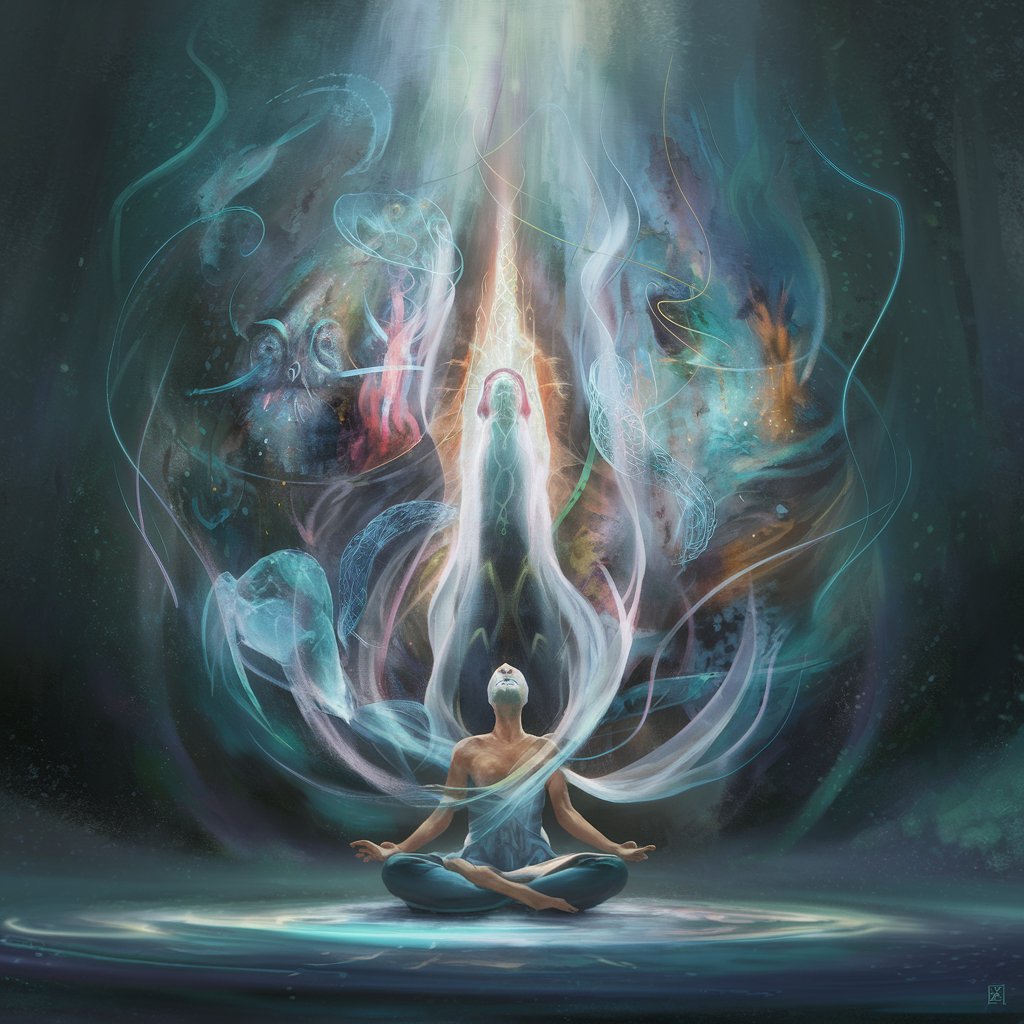
The Dawn of Inner Illumination

Embracing the Light Within

In the depths of our being, there lies a profound revelation, akin to the experience of witnessing the first rays of dawn after a long night. This awakening is not just a mere encounter with light; it is the realization that you are that very light, cradled in the embrace of darkness, which is also an integral part of your essence.

Imagine living in a realm of perpetual twilight, where the distinction between light and darkness blurs, creating a harmonious coexistence. This is the realm of our inner world, where we discover that light and darkness are not adversaries but complementary forces. In the heart of this realization, we find that our true nature transcends these dualities.

The journey towards this awakening begins with a simple, yet profound question: Who am I? This inquiry, deeply rooted in the wisdom of Eastern philosophy, is not a quest for a label or a definition. Instead, it is an exploration of the essence of being. As we delve deeper, we peel away the layers of conditioned thoughts and societal constructs, arriving at the core of our existence.


In this core, we discover that we are the silent observers, the light of consciousness, witnessing the dance of life. This light does not falter; it remains constant, illuminating our experiences, thoughts, and emotions. Yet, it is untouched by them, just as the sun is untouched by the activities it lights up.

This realization brings a profound sense of freedom. We are no longer bound by our limitations of ourselves. We are the vastness that encompasses all things, the eternal light shining in the heart of darkness. This is the essence of absolute monism – the understanding that all is one and that one is all.

But this awakening is not the end. It is the beginning of a new journey. A journey of living in the light of this truth, of embodying this understanding in every aspect of our lives. It is about finding the balance between being and becoming, between stillness and movement, and between the light and the darkness within.


As we embrace this light within, we become beacons for others on their paths. We inspire, guide, and uplift, not by words alone, but by the very essence of our being. Our lives become a testament to the truth that in the heart of darkness lies the most radiant light.

Morgan O. Smith

Yinnergy Meditation, Spiritual Life Coaching & My Book, Bodhi in the Brain…Available Now!

https://linktr.ee/morganosmith

Exploring the Concept of ‘The Absolute’

In Philosophy and Spirituality

The notion of ‘The Absolute’ is a profound and enigmatic concept that has intrigued philosophers, theologians, and spiritual seekers for centuries. At its core, The Absolute represents the ultimate reality or truth that transcends ordinary understanding. It is often described as the ever was, the ever is, and the ever shall be, encompassing the past, present, and future in a singular, unified existence.

This concept is not confined to any one religion or philosophical system. It is found in various forms across different cultures and spiritual traditions. In Hindu philosophy, it is known as Brahman, an unchanging, infinite, immanent, and transcendent reality that is the source of everything. Brahman is the ultimate cause and foundation of all existence.


In Buddhism, particularly in its Theravada tradition, the concept of Anatta or ‘non-self’ echoes a similar idea. Anatta suggests that living beings have no unchanging, permanent self, soul, or essence. It points to a kind of Absolute that is devoid of individual identity, yet underpins the nature of existence.

Similarly, in Islamic theology, Allah is the Absolute, encompassing all attributes and beyond all human understanding. Allah is the ultimate reality, creator, and sustainer of the universe, beyond all temporal and spatial limitations.


In Christian mysticism, the term ‘God’ often transcends the anthropomorphic deity figure, representing instead an Absolute that is the ground of all being. This idea is also seen in other forms of monotheism and panentheism, where God is understood as both immanent and transcendent, existing within and beyond the universe.

The concept of ‘The Absolute’ also finds a parallel in Western philosophy, particularly in the idea of Absolute Monism. This philosophy posits that there is only one underlying reality, and all diversity and plurality we observe are merely manifestations of this singular existence.


At the heart of these diverse interpretations is a common thread: The Absolute is the ultimate reality, beyond the grasp of human thought and language, transcending our limited perceptions of time and space. It is a concept that challenges us to look beyond the material and ephemeral world, urging us to ponder the mysteries of existence and the universe.

In exploring ‘The Absolute,’ we delve into the deepest questions of life and existence. It’s a journey that takes us beyond the boundaries of conventional thought, into the realms of spirituality and metaphysical contemplation.

Morgan O. Smith

Yinnergy Meditation, Spiritual Life Coaching & My Book, Bodhi in the Brain…Available Now!

https://linktr.ee/morganosmith

Absolute Causality and the Epiphany of Absolute Monism

In the profound journey of spiritual exploration, a moment stands out as particularly transformative: the moment of spiritual enlightenment. This isn’t just a fleeting insight; it’s an experiential understanding of “Absolute Monism”. This is a state where one perceives the unity and interconnectedness of all things, leading to an astonishing realization: every action, behaviour, situation, or event, regardless of its scale or significance, is intrinsically linked to the very cause of the universe’s existence – the Big Bang.

This concept, which I term “Absolute Causality”, posits that the Big Bang isn’t just a distant historical event; it’s an ongoing process that manifests in every aspect of our lives. This perspective radically alters our understanding of time, causality, and our place in the universe. We begin to see that our every action isn’t merely a drop in the ocean but is, in fact, part of the ocean itself.


Absolute Monism, in this context, becomes more than a philosophical idea; it’s a lived experience. It dissolves the illusion of separation between the self and the universe, leading to a profound sense of unity and interconnectedness with all existence. This realization fosters a deeper sense of responsibility and mindfulness in our actions, as we understand that what we do has a ripple effect throughout the fabric of the cosmos.

Furthermore, Absolute Causality redefines our understanding of time. Rather than viewing the Big Bang as a one-time event in the distant past, we perceive it as an eternal process that continuously unfolds in every moment. This view aligns with certain interpretations of quantum physics, suggesting that time is not linear but a more complex, interconnected web of events and possibilities.


In conclusion, the experience of Absolute Monism and the realization of Absolute Causality offer a transformative lens through which we can view our existence. It’s a perspective that encourages us to live more consciously, understanding that our actions are not just our own but part of a grand, cosmic dance that began with the universe itself.

 Morgan O. Smith

Yinnergy Meditation, Spiritual Life Coaching & My Book, Bodhi in the Brain…Available Now!

https://linktr.ee/morganosmith

Navigating the Depths

Nonduality vs. Absolute Monism

In the intricate tapestry of philosophical thought, two concepts often emerge as profound and perplexing: Nonduality and Absolute Monism. These philosophical gems, though seemingly similar, hold distinct perspectives on the nature of existence and the universe.

**Nonduality: The Unity of Existence**

Nonduality, a term often associated with Eastern philosophies, particularly Advaita Vedanta, posits a fundamental principle: reality is one, and the perception of duality or separation is illusory. It suggests that what we experience as separate entities – ourselves, others, and the world around us – are not distinct, but part of a unified whole. The philosophy of Nonduality encourages us to transcend this illusion, to realize that at the core of our being, we are not separate from the universe but one with it.


**Absolute Monism: The Dance of Oneness and Multiplicity**

Absolute Monism, on the other hand, takes a slightly different approach. While it agrees with the principle of oneness, it also acknowledges the existence of multiplicity. This philosophy, as I interpret it, embraces the paradoxes of existence: one and not two, two and not one, one and two, two and one, one within two, two within one, yet simultaneously neither one nor two. It reflects a deeper understanding of the cosmos as a dynamic interplay of unity and diversity, where the singular and the plural coexist in a harmonious yet complex relationship.

**The Interplay and Implications**

The discussion of Nonduality versus Absolute Monism is not just a theoretical exercise but has profound practical implications. In Nonduality, the path to enlightenment or understanding involves the realization of oneness, leading to a sense of peace and connectedness with all. In Absolute Monism, the journey is about embracing and understanding the complexity and paradox of existence, leading to a deep appreciation of life’s multifaceted nature.

Both philosophies, in their essence, guide us toward a greater understanding of our place in the universe. They invite us to look beyond the superficial and to question the very nature of reality.


**Conclusion: A Journey of Understanding**

In the end, whether one leans towards Nonduality or Absolute Monism, the journey is one of deep introspection and understanding. It’s about peeling back the layers of what we perceive and understanding the deeper truths of our existence. As we delve into these philosophies, we find not just answers, but also a greater appreciation for the questions themselves.

Morgan O. Smith

Yinnergy Meditation & My Book, Bodhi in the Brain…Available Now!

https://linktr.ee/morganosmith
Exploring the Depths of Absolute Monism

And its Relation to Nonduality

In my deep exploration of spiritual teachings, I’ve gained a profound insight into the nature of reality, particularly focusing on Absolute Monism and its relation to nonduality. I understand that Absolute Monism goes beyond nonduality (at least how it’s interpreted here in the West), offering a perspective that is both inclusive and expansive.

At the heart of nonduality is oneness – the interconnectivity of everything and the illusion of separateness. I often discuss this, saying, “There’s something between those two opposing views [of separation and non-separation] that is absolute; something that is neither true nor false…it just is.” This reveals that the truth of our existence lies beyond the dualistic ideas of separateness or oneness, in a realm where these notions are simply aspects of a greater truth.

In my exploration of Absolute Monism, I describe a state that transcends the oneness found in nondual teachings. It’s not about negating duality but about moving beyond the need to categorize existence as either one or many. I believe that the ultimate reality is beyond human comprehension, yet it’s inherently present in every aspect of existence. As I often say, “Everything that has ever happened and every future event that will happen is happening now in the present…but the actual present is only a made-up concept.” This points to a reality where time and space, past and future, existence and nonexistence, are all part of an eternal ‘now’ – a state that is ineffable and boundless.

Furthermore, I suggest that profound spiritual experiences, like the awakening of Kundalini, are manifestations of this absolute reality. I note, “Even kundalini and all its magnificence is only a made-up manifestation of who and what you truly are.” This means that while spiritual experiences can be transformative, they still exist within the manifest universe and aren’t the ultimate reality.

In summary, my teachings offer a unique perspective on Absolute Monism. This view transcends and includes the principles of nonduality, hinting at a reality beyond the dualistic constructs of human understanding. It points to an ultimate truth that encompasses all experiences and concepts, a truth that ‘just is’ – beyond definition, beyond separation, and oneness.

Morgan O. Smith

Yinnergy Meditation & My Book, Bodhi in the Brain…Available Now!

https://linktr.ee/morganosmith

Melding Into The Absolute

A Glimpse Into The Ephemeral Veil of Enlightenment

The pursuit of enlightenment, often perceived as a lofty goal, transcends the entanglement of the mundane and the superficial. It is a venture beyond the confinements of ego, a journey into the vast expanse of what is real and eternal. But what happens when one treads on the path leading toward enlightenment? Is there a profound experience awaiting or is it an indescribable state of being? This contemplation draws insights from two profound philosophies – Vedanta and Buddhism, exploring their stance and convergence at the pinnacle of enlightenment.

During the moment of enlightenment, there is no ‘ego’ to witness this majestic unfolding. If one perceives a void yet remains distinct from it, the essence of enlightenment remains elusive. However, such an experience is a beacon of progress, a sign of being on the righteous path. When enlightenment graces, there’s an inherent knowing, a certainty that obliterates doubts. It’s a paradoxical realm where everything and nothing transpires, leaving behind only the essence of what one truly is—Absolute.

The Vedantic and Buddhist interpretations, though seemingly diverse, converge at the apex of enlightenment. Vedanta extols the oneness of existence, the monistic reality, while Buddhism explores the transient nature of reality, leading to a similar dissolution of ego and a recognition of an underlying unity. It’s akin to the myriad flavours of ice cream. Despite their distinct tastes and colours, the essence remains the same – the foundational element of ice. The epitome of enlightenment, or absolute monism, can be metaphorically depicted as a blend of every conceivable flavour of ice cream and beyond, encapsulating all foods, their variations, their origins, and their surroundings.

The metaphor extends further, proposing a confluence of all experiences, a melding into the Absolute. The journey might commence from disparate standpoints, traversing through diverse experiences, yet it culminates at a singular point— the realization of the Absolute. The magnificence of enlightenment doesn’t lie merely in reaching this pinnacle but in the unravelling of profound simplicity, an unveiling of what has always been there.

Upon such a realization, the dichotomies merge, the veils of ignorance are lifted, and what remains is an unadulterated consciousness, a pristine awareness devoid of fragmentation. It’s a return to the original state of being, a melding into the boundless, an embrace of the Absolute.

Morgan O.  Smith

Yinnergy Meditation & My Book, Bodhi in the Brain…Available Now!

https://linktr.ee/morganosmith