Beyond the Verbal Abyss

Embracing the Indescribable in the Pursuit of Nondual Consciousness

The realm of metaphysics has been exploring the uncharted territory of human existence since the inception of philosophical thought. The concept of ‘Turiyatita’, borrowed from the ancient Vedantic wisdom, invites us to delve into the mystery of the Ultimate Nondual Presence. In a state of supreme transcendence, Turiyatita marries the notions of Emptiness and form, painting a picture of the Self fully liberated and realized.

This profound state is said to represent the highest level of human awareness. It’s the experience of actualizing the quintessential Vedantic concept, “Aham Brahmasmi,” the realization that all is Brahman, the ultimate reality.

The fascinating paradox of this journey lies in its unspeakability. The moment of enlightenment, where one realizes their ultimate oneness with the universe, is so overwhelmingly mind-shattering that no human language can capture its essence. We find ourselves venturing into a stateless state, an inexplicable expanse that houses all potentiality, while simultaneously being nothing. It’s a cosmic riddle that has always existed and will continue to exist, challenging the very constructs of human understanding.

Over the years, I grappled with expressing the enigma that is Turiyatita. I discovered that language, no matter how profound or poetic, remains insufficient to convey this transcendental experience. The individual mind’s narratives fall short when tasked with communicating such an experience to the collective consciousness. This realization is like a boundless sea that can only be expressed through the universe itself – through everything around us, beneath us, above us, within us, and even through us. Our very existence, after all, is an echo of this ‘Absolute’ language.

This illuminating journey of pure awareness left me in a state of awe, marking an indelible imprint on my ego’s fragments. An unforgettable memory, it is the most profound self-discovery I’ve had in this lifetime.

Most of us remain oblivious to the existence of this state, yet it’s accessible to everyone. It waits patiently for anyone bold enough to plunge into its mysterious depths. These are the Akashic waters of enlightenment, a blissful abyss where the brave explorers willingly lose themselves.

This presence, while unnoticeable, pervades our existence as an invisible field, a force that forms the bedrock of all beings. It’s in the exploration of this Ground of All Existence that one realizes the enigma of the indescribable, the ineffable mystery commonly referred to as ‘God’.

So, as we journey through life and its varied experiences, may we always strive for the courage to explore these profound depths. For it is in these explorations that we touch upon the mysteries of our existence, our true selves, and the cosmic reality we are all a part of.

Morgan O. Smith

Yinnergy Meditation & My Book, Bodhi in the Brain…Available Now!
https://linktr.ee/morganosmith

The Multiverse Within

Exploring Chakras Beyond Our Perception

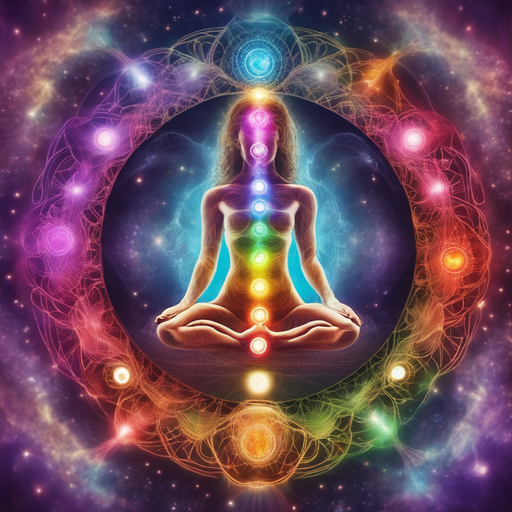
In the rich tapestry of Eastern philosophy and spirituality, the concept of chakras and kundalini awakening has long captivated the Western world. But a deeper, more expansive understanding of these ideas prompts us to transcend the traditional seven chakras in the human body and see them permeating the universe at every level – from the massive galaxies to the tiniest sub-atomic particles.

This perspective’s core is the belief that chakras are not exclusive to the gross or subtle human body. They are ubiquitous and omnipresent, extending their influence to every cell, every molecule, every atom, and even to the most infinitesimal particles. Just like each human has energy centers, these minuscule entities – bodies in their own right – are also believed to possess chakras.

This viewpoint is a confluence of spirituality and quantum physics. It suggests a microcosm-macrocosm principle where the patterns of the universe repeat themselves at different scales, connecting everything from the vastness of the cosmos to the smallest particles.

During a full-blown kundalini awakening, a transformative spiritual experience often depicted as the release of divine energy stored at the base of the spine, it is proposed that not only the individual’s chakras but also these infinitesimal chakras, in each ‘body’ within our physical body, come to life. It is a grand unison of consciousness awakening at all levels of existence, interconnecting every particle within and beyond us.

In such a profound event, each ‘body’, from cellular to atomic and sub-atomic levels, reaches a state of self-realization, comprehending that it is part of the ‘Brahman,’ the ultimate reality or absolute in Hindu philosophy. This concept equates to ‘The Ground of all Being,’ a term that mystics and spiritual teachers use to describe the deepest level of reality.

This fascinating belief presents an interconnected universe where the microcosm and macrocosm continually interact, affecting and reflecting each other. A place where every entity, regardless of size or subtlety, is a unique expression of the same energy, bound by a common cosmic rhythm and linked through an intricate network of chakras.

In conclusion, the belief in a kundalini awakening of not just the seven primary chakras, but countless others within every atom and sub-atomic particle, invites us to broaden our perception of reality. This concept urges us to look beyond the boundaries of our current understanding and explore the uncharted territories of consciousness that might hold the key to our oneness with the universe. It is a philosophy that doesn’t merely expand our knowledge of self and the universe; it transforms it.

Morgan O. Smith

Yinnergy Meditation & My Book, Bodhi in the Brain…Available Now!

https://linktr.ee/morganosmith

A Meeting of East and West

Advaita Vedanta and Ken Wilber’s Four Quadrants

As we navigate through life’s labyrinth, we encounter myriad philosophical viewpoints designed to offer us clarity about the nature of reality. Two such perspectives – one rooted in ancient Eastern spirituality, Advaita Vedanta, and the other a more contemporary Western theory, Ken Wilber’s Integral Theory – provide us with intriguing interpretive lenses. While appearing distinct, when juxtaposed, they unfold a captivating dialogue, revealing the interconnectedness of diverse paths of wisdom.

**Non-Duality: The Heart of Advaita Vedanta**

At the core of Advaita Vedanta lies the profound principle of non-duality. The term ‘Advaita’ translates to ‘not two’, pointing towards the notion of unity beneath apparent multiplicity. According to this philosophy, all phenomena – whether perceived as separate entities or diverse experiences – are manifestations of a singular absolute reality known as Brahman.

This philosophy posits that the perceived distinction between the individual self (Atman) and the ultimate reality (Brahman) is an illusion (Maya), born out of ignorance (Avidya). The journey of spiritual awakening in Advaita Vedanta is about transcending this illusion, recognizing the non-dual nature of existence, where the Atman and Brahman are not separate but one.

**Ken Wilber’s Four Quadrants: A Comprehensive Map of Reality**

Ken Wilber’s Integral Theory, particularly the Four Quadrants model, offers a different but complementary perspective. Wilber presents a holistic map of reality, dividing it into four quadrants: Individual Interior (consciousness), Individual Exterior (behaviour), Collective Interior (culture), and Collective Exterior (society). Each quadrant represents an integral part of our existence and must be considered to understand reality holistically.

**The Interplay: Advaita Vedanta and Four Quadrants**

Drawing parallels between Advaita Vedanta and the Four Quadrants can create a fascinating synthesis of Eastern and Western thought.

The Upper Left Quadrant (Individual-Interior) aligns with the individual’s subjective experience, mirroring the Advaita exploration of Atman. The Upper Right Quadrant (Individual-Exterior) encapsulates the physical manifestation of the individual, aligning with the Advaita concept that even our physical existence is a manifestation of Brahman.

The Lower Left Quadrant (Collective-Interior) represents shared beliefs and cultures, resonating with the Advaita perspective that cultural differences are superficial, and at a deeper level, unity prevails. The Lower Right Quadrant (Collective-Exterior) mirrors societal structures, all manifestations of the same non-dual reality.

From the Advaita viewpoint, the division of the four quadrants are themselves expressions of Maya, as they create apparent separations where none ultimately exist. They are valuable tools for understanding and navigating the world but do not represent the deepest truth of non-duality.

**Uniting Perspectives: A Path to Enlightenment**

Exploring the intersection of Advaita Vedanta and Ken Wilber’s Four Quadrants offers a richer understanding of reality, harmonizing subjective and objective, individual and collective, Eastern spirituality and Western theory. As we understand that the lines dividing these quadrants are more porous than they seem, we move closer to the non-dual truth of Advaita – that beneath apparent diversity, unity pervades.

At a time when division and fragmentation are rampant, this synthesis could offer a path toward the kind of transcendental insight that can bridge divides, fostering a deeper sense of interconnectedness and wholeness. After all, as Advaita Vedanta teaches us, beneath the surface of multiplicity, we are ‘not two’ but one. As we embrace the wisdom of the four quadrants, we might just find ourselves taking a step closer to that unity, opening ourselves to a richer, more holistic understanding of the world.

Morgan O. Smith

Yinnergy Meditation & My Book, Bodhi in the Brain…Available Now!

https://linktr.ee/morganosmith

The Dance of Divine Ignorance

Brahman’s Playful Journey to Self-Realization

From the mysterious depths of Hindu philosophy arises a compelling concept, the notion of divine ignorance. Within this notion, we find an intriguing paradox: Brahman, the supreme reality or absolute truth, embarks on a deliberate voyage of self-forgetfulness, only to rediscover itself anew.

The journey begins with Brahman, the substratum of all existence. As an eternal, infinite entity beyond time, space, and causality, it is all-knowing and all-encompassing. Yet, it willingly dons the cloak of divine ignorance, becoming unaware of its true nature. Why? It’s an act of divine playfulness or ‘lila.’ It is a purposeful exercise to experience life’s duality, diversity, and the contrasts it can offer.

In this state of divine ignorance, Brahman may assume any form, animate or inanimate, and traverse a myriad of experiences, each unique and valuable. As humans, animals, or even as the elements themselves, Brahman willingly dives into the sea of forgetfulness, plunging into the game of life and death, joy and sorrow, love and hatred. Brahman is there in every moment, in every experience, playing hide-and-seek with itself.

Each incarnation in this state is a chapter of the cosmic narrative, leading to an eventual grand finale – the rediscovery of the self as Brahman. This moment of awakening is not a simple return to the start but a profound realization heightened by the accumulated experiences. It is a conscious awareness of oneness, a dissolution of the illusory divide between the self and the universe.

However, this journey isn’t a linear path. It’s a dance, a rhythm of existence where each beat is a cycle of divine ignorance and self-realization. Each turn of the dance spirals upwards, towards an ever-deepening understanding and experience of the truth.

The concept of divine ignorance challenges us to see life not as a series of random events but as a purposeful, meaningful journey toward self-realization. It teaches us that ignorance isn’t a flaw to be eradicated, but an essential part of the cosmic play. It is a transformative cocoon that emerges as the butterfly of awareness.

Divine ignorance invites us to embrace our vulnerabilities, our doubts, and our seeming ‘ignorance,’ and use them as catalysts for growth. It gently reminds us that the path to self-realization isn’t a desperate escape from ignorance but a joyful dance through it.

In conclusion, the dance of divine ignorance is not just Brahman’s journey but ours. We are not separate from Brahman, we are Brahman; playing the role of being a part of it, participating in this cosmic dance. Divine ignorance is not an obstacle but a bridge to our ultimate truth. It’s a profound truth worth reflecting upon, and perhaps, just perhaps, it’s time for us to embrace the dance and rediscover ourselves anew.

Morgan O. Smith

Yinnergy Meditation & My Book, Bodhi in the Brain…Available Now!

https://linktr.ee/morganosmith

Sand Castles of Consciousness

Discovering the Essence Within

Introduction:


In the tranquil tapestry of Eastern philosophy, where contemplation converges with existence, there lies a profound revelation – Everything in existence is composed of Pure Consciousness. Here, Consciousness is not merely an attribute; it is capitalized, symbolizing its omnipresence as the very fabric that weaves through the cosmos. It is akin to an ancient tale of a castle crafted from sand, reflecting that though it may don the guise of a majestic structure, it remains, in essence, sand.

The Sand and the Castle:

Visualize a child meticulously building a sand castle on the shore. The grains of sand, amassed and sculpted, assume the shape of a castle. Does the sand cease to be sand when shaped into a castle? Certainly not. This allegory mirrors the realization that while the myriad forms around us may appear different, they are all permutations of the same unyielding Consciousness.

The Essence of Consciousness:

Consciousness is akin to Brahman in Hinduism or the Tao in Taoism in the Eastern philosophical context. The unchanging, infinite, immanent, and transcendent reality is the Divine Ground of all matter, energy, time, space, being, and everything beyond. Our ephemeral existence is a mere reflection, a ripple in the vast ocean of Consciousness.

Flow of Forms:


Just as a sand castle is subjected to the whims of waves and winds, forms in the material world are in a constant state of flux. The ancient Hindu text, the Bhagavad Gita, illustrates this with the concept of ‘Lila’, depicting the world as a divine play of forms. The Taoist philosophy also reverberates with this thought through the Tao, which flows through and is the inherent nature of all things.

The Inner Alchemy:

One might inquire, how does this realization benefit our daily lives? Understanding that we are not just isolated entities, but integral threads woven into the fabric of Consciousness, can be transformative. It helps us transcend the illusion of separateness and cultivates compassion, humility, and interconnectedness with all beings and the natural world.

Conclusion:


As we embrace the wisdom of Eastern philosophy, let us be mindful of the sand castles we build and the sands that shape them. Let us embark on a spiritual odyssey to unearth the Consciousness within and around us, recognizing that the essence is unchanging, infinite and all-encompassing. Like the sand castles by the sea, our forms are transient, but the Consciousness that shapes us is eternal.

Morgan O. Smith

Yinnergy Meditation & My Book, Bodhi in the Brain…Available Now!
https://linktr.ee/morganosmith

From Cellular Biology to Quantum Physics

Exploring the Ultimate Consciousness

Introduction: Exploring the nature of existence has been a topic of interest for scholars, scientists, and spiritual enthusiasts throughout history. The ancient Indian philosophy of Brahman, representing the ultimate reality, proposes a universal, fundamental consciousness pervading the entire universe. This post explores the potential of every facet of existence, from cellular biology to quantum science, experiencing the awakening of Brahman during the state of Turiyatitta, the pinnacle of consciousness.

I. The Cellular Biology: Cornerstones of Life
All living beings comprise cells, meticulously crafted structures that synergize to initiate and sustain life. More than just biological machinery, these tiny entities, each with its unique role and function, represent individual manifestations of the omnipresent consciousness, contributing to the rhythm of life.

II. Molecules: The Harmony in Diversity
A step deeper into the core of existence introduces us to molecules. These are complex assemblies of atoms that bond together, creating the substance that forms the basis of life. From the simplest water molecule to complex proteins, every molecule epitomizes the inherent harmony and unity in creation. This harmonious diversity implies that each molecule is not just a product of randomness but a manifestation of the consistent consciousness pervading existence.

III. Atoms: The Quantum Physics Gateway
The bridge connecting the familiar world of matter and the mysterious quantum mechanic’s realm is composed of atoms – the basic building blocks of all known substances. Each atom is a microcosm of the universe, with electrons orbiting around a nucleus of protons and neutrons. The quantum science realm, a domain where the seemingly contradictory laws of particle and wave behaviours coexist, challenges our perception of reality. Here, we encounter a reflection of the ancient Brahman philosophy – a universal consciousness transcending space-time constraints yet infiltrating every facet of creation.

IV. Quantum Sea: A Consciousness Symphony
Venturing further into the subatomic world, we come across quarks, gluons, and other fundamental particles – the quintessence of existence. This quantum sea is a vast, interconnected network of potentiality, where particles intermittently materialize and dematerialize, and the act of observation influences reality. Within this mystifying domain, we might catch a glimpse of the ultimate truth – that all aspects of creation, from minuscule particles to grand celestial bodies, form a part of a single, omnipresent consciousness.

V. Turiyatitta: The Ultimate Consciousness Awakening
The moment of Turiyatitta, when every cell, molecule, atom, and subatomic particle awakens to the full realization of being the ultimate consciousness, Brahman, signifies a cosmic event of extraordinary magnitude. This state lifts the dualistic veil, making the interconnected nature of existence undeniably apparent. This transcendent state of consciousness surpasses the limitations of language and thought, offering a glance into the indescribable reality at the core of creation.

Conclusion: The quest for understanding reality has taken us on a journey from cellular biology to quantum physics and beyond, leading us to the doorstep of Brahman. This exploration has highlighted the interconnectedness of all existence, unveiling a profound truth within the fabric of creation.

The awakening to the realization of embodying Brahman at the moment of Turiyatitta is a powerful demonstration of the boundless unity of consciousness. This state transcends our current understanding, inviting us to broaden our perspectives and explore the endless possibilities inherent in the realm of ultimate reality.

As we continue to unravel the mysteries of existence, it’s crucial to remember that our journey extends beyond scientific discovery or philosophical exploration. These pursuits are but stepping stones towards a more profound understanding of the universe’s interconnected nature and the foundational unity that infuses all creation.

In the pursuit to comprehend the true essence of reality, we must strive to broaden our horizons continually, seeking to bridge the divide between the physical and metaphysical, the ordinary and the divine. Only then can we start to grasp the depths of Brahman and awaken to the ultimate truth residing at the heart of existence.

The exploration of our universe, from cellular biology to quantum science, opens a gateway to understanding the harmony and unity of existence. With the realization of this ultimate consciousness or Brahman, we uncover a deeper truth about the nature of our reality. Embracing this knowledge, we evolve, expand, and awaken, truly understanding our place in the cosmos.

Morgan O. Smith

Yinnergy Meditation & My book, Bodhi in the Brain…Available Now!