The Paradox of Divine Knowledge

Beyond the Mind’s Perception

God knows nothing yet knows everything—a contradiction that stands as a perfect reflection of the nature of absolute reality. This enigmatic statement, like a koan, invites deeper contemplation beyond linear thinking. It points to a knowledge that defies conceptual grasp, a knowing that cannot be possessed by the mind.

To say God knows everything implies omniscience—a perfect awareness of all events, possibilities, and outcomes within the realm of manifestation. Yet, to say God knows nothing points to an awareness that transcends any form of subject-object relationship. Here, knowledge is not fragmented into parts. Rather, it exists as a pure, nondual state of being.

This paradox can only be resolved through a radical shift in perception. From the mind’s perspective, knowing implies a knower and a known—a separation that inherently breeds confusion. The clearer this division becomes, the more apparent the contradiction. But from the perspective of absolute awareness, there is no such division. Knowing and not knowing collapse into a single essence, a seamless flow where everything is already perfectly held without the need for grasping or possessing.

The confusion arises only when one attempts to use a dualistic framework to analyze a nondual reality. For those entrenched in rational thought, this statement appears illogical. Yet, the crystal clarity of this confusion emerges when seen through the lens of direct experience. God’s knowing is not intellectual; it is a luminous stillness that enfolds every possible expression of existence without ever defining itself through those expressions.

What, then, does it mean for God to “know nothing”? It signifies the emptiness of all forms, a state where no thought, label, or concept can fully capture what is. It is a knowing that is the essence of all things yet free from the content of knowing itself. There are no judgments, no biases, no preferences—just a silent, omnipresent witnessing. The awareness is so pure that it does not even recognize itself as “knowing” in the conventional sense. It is like the sky holding all clouds yet remaining untouched by their presence or absence.

This is the clarity that lies within the paradox: God knows everything because God is everything. Simultaneously, God knows nothing because God is not bound by the limitations of any particular knowledge. The confusion dissolves when we release the need to categorize and understand reality through fixed structures.

To experience this confusion as crystal clear requires embracing the humility of not knowing. When all concepts, beliefs, and labels are dropped, what remains is a pure awareness that is as empty as it is full. The mind may struggle to grasp this state, but the heart recognizes it intuitively. It is a state of grace, a luminous unknowing that is beyond the reach of both thought and language.

Paradox is not a flaw in understanding; it is the gateway to freedom. It invites one to look beyond the confines of intellect and rest in a knowing that cannot be spoken. This is the ultimate clarity: a confusion that reveals the divine nature of all that is.

Morgan O. Smith

Yinnergy Meditation, Spiritual Life Coaching & My Book, Bodhi in the Brain…Available Now!

https://linktr.ee/morganosmith

The Illusion of Maya

Seeing Beyond the Show

Everything we perceive—the people, places, and events around us—is, at its core, a show. This is not a dismissal of life’s value but an invitation to explore its deeper essence. What we call “reality” is Maya, a veil of illusion that covers the truth. Maya is the great play of forms, the endless dance of opposites, and the theatre of duality where all things appear separate.

Yet, behind the scenes of this elaborate show lies something far more profound. Maya is the stage, but consciousness is the ever-present witness. The mind, with all its perceptions, attachments, and desires, keeps us captivated by the performance. We become so engrossed in the unfolding drama of our lives that we forget we are not the characters, but the awareness watching it all unfold.

Understanding Maya isn’t about rejecting the world or treating life as insignificant. Rather, it’s about seeing through the illusion. The key is not to escape Maya but to recognize it for what it is—a fleeting projection of the eternal. Once the illusion is seen for what it truly is, everything shifts. Life no longer feels like a weight to carry or a puzzle to solve. It becomes a dance, a cosmic play where each movement, no matter how dramatic, is infused with a deeper stillness.

Consider the waves of the ocean. They rise and fall, each one unique, yet they are never separate from the ocean itself. The wave may take shape, crash, and disappear, but the ocean remains constant. So, too, with Maya—forms come and go, experiences rise and fall, but consciousness remains unchanging, ever-present, and infinite.

To see beyond the illusion of Maya is to live with a lightness of being, recognizing that while everything is part of the grand show, none of it defines the true self. The self that watches, silently aware, is the only constant. When this is realized, life becomes a paradoxical blend of deep engagement and effortless detachment. You play your role in the world, knowing full well that it is all a divine drama, yet you remain untouched by its outcomes.

Maya invites us to enjoy the show while remembering we are not bound by it. Behind every illusion lies the vastness of truth, waiting to be uncovered by the silent observer within.

Morgan O. Smith

Yinnergy Meditation, Spiritual Life Coaching & My Book, Bodhi in the Brain…Available Now!

https://linktr.ee/morganosmith

Expressions of Unity

How do we reconcile the existence of human atrocities and natural disasters within a spiritual framework that emphasizes oneness and unity? This question often challenges those who begin exploring nondual perspectives, where all phenomena, no matter how destructive or painful, are viewed as interconnected expressions of the same singular source. The nondual approach offers a radical shift in perception, one that dissolves the illusion of separation between events that we label as “good” or “bad” and invites us to see these occurrences as part of the grand play of existence.

Violent actions and harmful behaviours in the world, when viewed from a dualistic standpoint, can easily be categorized as manifestations of evil or wrongdoing. However, nonduality reveals that such acts emerge not from some inherent brokenness or malevolence, but from ignorance—a misunderstanding of our shared unity. This ignorance fosters the illusion of separateness, leading to behaviours rooted in fear, hatred, or selfishness. But when we awaken to the truth that there is no real division between self and other, the impulse to harm dissolves. The violence that once seemed so senseless is recognized as a consequence of an illusion. Healing, therefore, does not come through retribution but through awakening to the truth of our interconnectedness.

Natural disasters, often seen as chaotic or punishing forces, are similarly reframed. Rather than being viewed as random or cruel acts of nature, these events reflect the cyclical nature of the cosmos, expressions of impermanence and transformation. The suffering caused by such disasters, while profound, stems from attachment to the belief in permanence, the illusion that we can hold onto fixed forms in a world of constant flux. Through the nondual lens, even the most devastating natural occurrences are understood as part of the rhythmic dance of life, reminders of the ephemeral nature of all things.

What arises from this perspective is a deep acceptance of life’s paradoxes. The seeming contradiction of living in a world filled with both beauty and devastation, joy and suffering, dissolves when we recognize that all such experiences are expressions of a singular, undivided reality. From this space of understanding, we cultivate compassion, not through an emotional reaction to suffering, but from the profound realization that all beings and events arise from the same source. Suffering, then, becomes not an ultimate truth, but a temporary appearance within the endless ocean of consciousness.

Embracing nonduality allows us to witness both atrocities and natural disasters with equanimity, to understand them not as aberrations or misfortunes, but as fleeting expressions of a larger cosmic unfolding. This does not imply passivity or indifference. Instead, it cultivates a deeper capacity for compassionate action, arising from the knowledge that we are not separate from the suffering we seek to alleviate. In this space, we move beyond the limited notions of blame or punishment, and towards a profound embrace of the totality of existence, where all things are seen as interconnected, transient waves within the boundless ocean of being.

Morgan O. Smith

Yinnergy Meditation, Spiritual Life Coaching & My Book, Bodhi in the Brain…Available Now!

https://linktr.ee/morganosmith

Beyond the Multiverse

Exploring the Infinite Horizon of the Omniverse

When contemplating the nature of reality, it’s tempting to consider our universe as the ultimate expanse. However, the idea of an omniverse beckons us to consider a reality that transcends even the multiverse—a boundless realm where all possibilities converge, diverge, and coexist simultaneously.

The concept of an omniverse challenges the limits of our understanding. It’s not merely an endless string of universes scattered through the void but the totality of all that exists and can exist, both seen and unseen. It holds within it every possible universe, each with its distinct laws of physics, timelines, and outcomes. Yet, this is not just about space and time. It is about a profound realization that within every layer of existence lies a deeper potentiality—one that hints at the limitless creative force behind all manifestation.

Many seek to explore what lies beyond the edges of the known, hoping to unravel mysteries of parallel universes or alternate dimensions. Yet, when contemplating the omniverse, we touch on something far more profound: the convergence of all realities. Every possible configuration of existence is contained here, but what holds it all together? Consciousness. It’s consciousness that underlies every universe, dimension, and realm within the omniverse.

Imagine for a moment that every choice ever made, every potential future, every conceivable world, is occurring somewhere within this greater expanse. But who or what perceives all these realities? It is not a separate entity standing outside the omniverse, observing from a distance. The observer is woven into the fabric of all things. Consciousness, that which is aware of existence itself, is both the creator and the experiencer of the omniverse.

This realization invites us to consider the omniverse as not just an external system but as an integral part of the self. Every potentiality exists because consciousness dreams it so. You are not separate from this boundless expanse—you are one with it. Your awareness stretches far beyond the physical body, touching the very edges of this infinite creation.

What does it mean to embrace the omniverse in daily life? It means expanding beyond the limited perspective of individual identity and recognizing your role as both creator and witness. It means understanding that every experience, no matter how small, ripples through an unimaginable expanse of reality. Each moment contains the seeds of all potentiality, an invitation to awaken to your true nature.

As we stand at the edge of what we know, poised to leap into the unknown, the omniverse is a reminder that the true nature of reality cannot be confined to any one perspective. It is an open invitation to dive deeper into the infinite and discover that consciousness itself is the ultimate ground of all being.

Morgan O. Smith

Yinnergy Meditation, Spiritual Life Coaching & My Book, Bodhi in the Brain…Available Now!

https://linktr.ee/morganosmith

The Elusive Blind Spot of Enlightenment

A paradox begins to unfold from the moment consciousness takes form and you are born into this world. Enlightenment, often considered the pinnacle of spiritual realization, simultaneously becomes a blind spot. It’s not that enlightenment is absent; rather, it exists so close to you that it evades your direct perception. The act of becoming a being—separate from the whole—creates the veil obscuring what was never lost.

Most people search for this elusive state, hoping to grasp it through teachings, practices, and philosophies. Yet, the search itself can deepen the sense of separation, reinforcing the idea that enlightenment is something external to be found. But what if enlightenment was never something you needed to find? What if it was something you simply needed to stop resisting?

Human existence is an exquisite contradiction. On one hand, the moment you identify as an individual, you begin to experience duality—subject and object, self and other. On the other hand, this identification simultaneously masks the realization that you are already one with everything. Enlightenment is not an external destination; it is the underlying reality that permeates your existence.

The blind spot isn’t due to a lack of spiritual capacity or effort, but the mind’s incessant clinging to the notion of self. The moment you try to achieve enlightenment as a personal goal, it slips further away, like trying to catch a shadow. Perhaps the real journey is not about seeking, but about unlearning. The simplicity of just being, without striving, can often be the most profound realization of all.

What happens when you stop searching? What if you allow yourself to see that enlightenment is not a peak experience to attain, but the constant, ever-present background of awareness that you are, and always have been? This blind spot only remains as long as there is an effort to overcome it. Let go of that effort, and what reveals itself has been present all along—your original nature.

The key lies in the willingness to let go of the need for enlightenment, to surrender the very idea that you are separate from it. Only then does the blind spot dissolve, and the reality of your true self, free from all constructs, comes into clear view.

Morgan O. Smith

Yinnergy Meditation, Spiritual Life Coaching & My Book, Bodhi in the Brain…Available Now!

https://linktr.ee/morganosmith

The Mirror of Divinity

The Mutual Birth of Creator and Created

A profound realization dawns when one contemplates the relationship between the Creator and the created. This dance of existence, where the boundaries blur, offers a glimpse into the nature of reality itself. The moment you emerge into being, a reflection is cast—one that you recognize as God. But what is this reflection if not the birth of God within your awareness?

This notion challenges the conventional understanding of divinity. God is not a distant figure, separate and apart, but a presence that arises simultaneously with your consciousness. In the act of creation, both God and the self are born together, entwined in a relationship that defies traditional hierarchies. The creation of God is not an external event but an internal realization, a moment where you recognize the divine within and beyond.

This mutual emergence suggests a symbiotic relationship between the divine and the self. You are not a mere byproduct of divine creation; you are a co-creator in the truest sense. The divine essence within you reflects the infinite potential that exists in all things. When you awaken to this truth, the concept of God transforms from a distant, omnipotent being to an intimate, ever-present reality that is both within and beyond your grasp.

Such an understanding compels a re-examination of faith, spirituality, and existence itself. The divine is no longer an external authority but an intimate partner in the journey of life. This partnership demands a new kind of responsibility—a recognition that your thoughts, actions, and very presence shape the divine essence you perceive.

When you recognize this truth, every moment becomes a sacred act of co-creation. You are constantly shaping and being shaped by the divine, in a dance that is as eternal as it is immediate. This perspective invites a deeper connection with the world, one where every encounter, every experience, becomes a reflection of the divine interplay between creator and created.

The mutual birth of God and self invites you to explore the depths of your own divinity. It asks you to look beyond the surface of existence and recognize the profound interconnectedness that binds all things. By doing so, you step into your role as a co-creator, embracing the divine not as a distant figure, but as an ever-present reality that is born anew with every breath you take.

Morgan O. Smith

Yinnergy Meditation, Spiritual Life Coaching & My Book, Bodhi in the Brain…Available Now!
https://linktr.ee/morganosmith

The Silent Revolution

Awakening Amidst Chaos

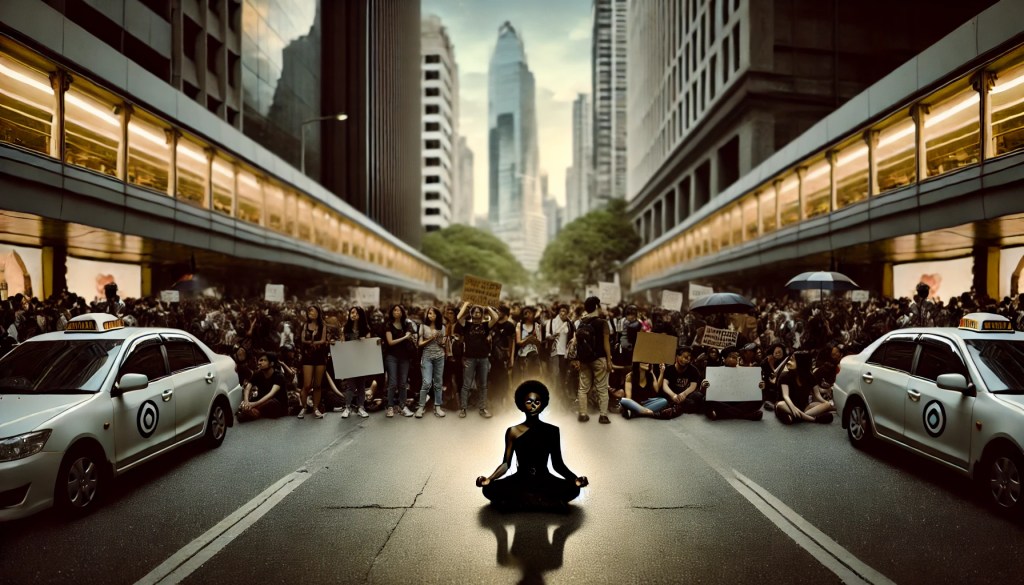
Chaos and tranquility often seem like opposites. However, they are intimately linked in the dance of life. As the world spins ever faster, with crises emerging like sudden storms on a summer day, a silent revolution is brewing beneath the surface—one that is neither loud nor confrontational but profoundly transformative.

This quiet revolution doesn’t rely on grand gestures or sweeping movements. It starts within the hearts of individuals who, despite the world’s noise, have tapped into a deeper current of awareness. These individuals aren’t driven by the need to change the world through force or ideology. Instead, they embody a shift that occurs when one aligns with the innate wisdom that lies beyond thought, beyond fear, and beyond the endless distractions that dominate modern life.

Imagine a moment where the rush of daily life pauses—not because external circumstances have shifted, but because the internal landscape has transformed. This shift is not the result of escaping the world, but of embracing it fully, with all its imperfections, recognizing that within the chaos lies the seed of order. When one looks deeply into the heart of the turmoil, an unexpected clarity can emerge, revealing the profound interconnectedness of all things.

Such moments of awakening are not reserved for the select few, nor do they require years of preparation or ascetic withdrawal from life. Often, they arrive unexpectedly, during the most mundane tasks or amid personal challenges. What matters is not the circumstances but the openness to receive what is always present: the silent awareness that underlies all experience.

This awareness doesn’t impose itself; it simply waits to be noticed. When recognized, it offers a perspective that transforms the ordinary into the extraordinary, where the boundaries between self and other dissolve, revealing a reality that is both deeply personal and universally shared.

The implications of this shift are profound. As more individuals awaken to this silent awareness, the collective consciousness begins to change. Actions rooted in fear and separation give way to those motivated by compassion and unity. Societal change, once thought to be driven by external forces, starts to emerge organically, from the inside out.

The silent revolution is not about overthrowing systems or confronting power. It is about the gradual realization that true power lies in the ability to remain anchored in awareness, no matter the external circumstances. This power is subtle, yet its impact can be far-reaching. As each person awakens, the collective vibration shifts, creating ripples that extend far beyond individual lives.

In times of chaos, this inner revolution offers a way forward—not by avoiding the challenges of the world, but by embracing them with a new understanding. It is the recognition that every moment, no matter how chaotic, holds the potential for awakening. When approached with awareness, even the most difficult experiences can become opportunities for profound growth and transformation.

This silent revolution is happening now, within the hearts of many. It doesn’t make headlines or trend on social media, but its effects are felt everywhere. The world is changing, not through external force, but through the quiet, steady awakening of consciousness.

Morgan O. Smith

Yinnergy Meditation, Spiritual Life Coaching & My Book, Bodhi in the Brain…Available Now!
https://linktr.ee/morganosmith

Turiyatitta and the One-Electron Universe

A Journey into Nondual Oneness

As proposed by physicist John Archibald Wheeler, the concept of the one-electron universe suggests that every electron in the universe might be the same particle, traversing back and forth through time. This radical idea blurs the boundaries between individuality and unity, inviting profound contemplation on the nature of existence and consciousness.

Electrons, as identical entities, lack distinguishing features beyond their position and momentum, mirroring the fundamental principle of nonduality—the essence that underlies all forms is the same. The notion of a singular electron moving through time, creating the illusion of multiplicity, parallels the experience of Turiyatitta, the state of nondual suchness where the distinctions between self and other, subject and object, dissolve into a unified whole.

Turiyatitta, the fourth state of consciousness beyond waking, dreaming, and deep sleep, represents a transcendence of dualistic perception. This state aligns with the idea of the one-electron universe, where what appears as many is, in essence, one. The perceived separation between particles, events, and experiences collapses when viewed from the standpoint of timelessness, revealing a reality where all is interconnected and indivisible.

The spiritual peak experience of nondual suchness is akin to glimpsing the one-electron universe—an awareness that what seems fragmented and diverse is a manifestation of a singular, timeless presence. This insight challenges the ordinary perception of reality, encouraging a shift from seeing the world as a collection of separate entities to recognizing the seamless flow of existence.

Contemplating the one-electron universe invites a deeper understanding of Turiyatitta. It prompts reflection on the possibility that all experiences, all states of consciousness, are expressions of a single, underlying reality. Just as the electron moves through time, creating the appearance of multiplicity, consciousness flows through the spectrum of awareness, giving rise to the illusion of duality. Yet, at the core of this illusion lies the truth of oneness—a truth that becomes evident in the state of Turiyatitta.

Exploring the one-electron universe and its connection to nondual suchness encourages a re-evaluation of the boundaries between science and spirituality. Both realms point toward a deeper understanding of reality, one that transcends the limitations of time, space, and individual identity. Through this lens, the spiritual journey toward Turiyatitta can be seen as a movement toward recognizing the singular nature of existence, where all distinctions dissolve, and only the undivided whole remains.

Morgan O. Smith

Yinnergy Meditation, Spiritual Life Coaching & My Book, Bodhi in the Brain…Available Now!
https://linktr.ee/morganosmith

The Unraveling of the Self

Emotional and Mental Breakdowns During Spiritual Awakening

Introduction

The journey toward spiritual awakening often appears, from the outside, as a serene and enlightened path. Yet, for those who walk it, the experience can be anything but peaceful. Emotional and mental breakdowns are common, and they serve a profound purpose. These breakdowns are not merely unfortunate side effects but are integral to the transformation that takes place during spiritual awakening. Understanding why and how they occur sheds light on the deeply transformative nature of this journey.

The Dissolution of the Ego

At the heart of spiritual awakening lies the dissolution of the ego, the part of us that identifies with our thoughts, emotions, and external identities. The ego forms a protective shell around our innermost being, creating a sense of separation from the world and others. As spiritual awakening progresses, this shell begins to crack and dissolve. The breakdowns that occur during this process are the ego’s desperate attempts to hold onto the illusions it has created.

Emotional turmoil arises as old wounds, suppressed fears, and unresolved traumas surface. These are not new experiences; they are fragments of our psyche that have been buried deep within. The awakening process brings them to the surface, demanding that they be acknowledged, felt, and released. This can manifest as intense sadness, anger, or anxiety, often without a clear trigger. The breakdowns are not a sign of failure but a necessary purging of what no longer serves the soul’s evolution.

Mental Deconstruction

Alongside the emotional upheaval, there is often a mental breakdown that accompanies spiritual awakening. Our minds are accustomed to operating within the framework of duality—right and wrong, good and bad, self and other. As awakening deepens, this framework begins to disintegrate, leading to confusion, disorientation, and a sense of losing touch with reality.

The mind, which has always sought control through understanding and categorizing, now faces the incomprehensible. Concepts that once provided a sense of stability and security—such as time, identity, and purpose—start to unravel. This can feel like madness, as the mind struggles to find footing in a reality that no longer adheres to the rules it once knew.

However, this mental breakdown is a gateway to a higher understanding. It forces the individual to let go of the need to intellectually grasp the vastness of existence and instead invites them to surrender to the mystery of being. What emerges from this surrender is a more expansive awareness that transcends the limitations of the thinking mind.

The Purpose Behind the Breakdown

The emotional and mental breakdowns during spiritual awakening serve a profound purpose. They are not signs of weakness or instability but are essential phases of the journey. These breakdowns break open the rigid structures of the ego and the mind, allowing the true self to emerge. The pain and confusion are catalysts for shedding the old, making way for a new way of being.

In essence, these breakdowns are acts of grace. They strip away the false layers of the self, revealing the underlying essence that is interconnected with all of existence. Through the process of breaking down, one is rebuilt on a foundation of truth, love, and unity.

Navigating the Breakdown

For those experiencing these breakdowns, it’s important to understand that they are temporary and purposeful. Practicing self-compassion and seeking support from others who understand the journey can be invaluable. Meditation, grounding practices, and connecting with nature can also help stabilize the experience. Above all, embracing the breakdown as part of the awakening process allows for a more graceful passage through these intense phases.

When to Seek Extra Support

These breakdowns are not obstacles for most individuals. But there are cases where mental illness could be a factor and needs to be identified and not mistaken for the awakening process. Extra support and seeking professional help in these cases may be needed. They should never be avoided or spiritually bypassed. In some cases, spiritual practices should be avoided altogether, especially if they exacerbate the symptoms or lead to further confusion and distress. Understanding the difference between a spiritual crisis and a mental health issue is crucial, as neglecting the latter can lead to unnecessary suffering and hinder the healing process.

Conclusion

Spiritual awakening is not a gentle process; it is a profound upheaval that shakes the very core of our being. The emotional and mental breakdowns that occur are not obstacles but necessary steps in the dissolution of the old self. By understanding and embracing these breakdowns, one can move through them with greater ease, allowing the transformation they bring to unfold fully. In the end, what emerges from the ashes of the breakdown is a self that is more authentic, whole, and deeply connected to the essence of life itself.

Morgan O. Smith

Yinnergy Meditation, Spiritual Life Coaching & My Book, Bodhi in the Brain…Available Now!

https://linktr.ee/morganosmith

From Curiosity to Self-Realization

The Path of Unveiling True Identity

Curiosity is a subtle yet potent force that nudges us toward self-discovery. It begins as an innocent desire to understand the world, to unravel the mysteries that surround us. Yet, beneath this surface, curiosity harbours a deeper, more profound impulse: the yearning to uncover the truth of our existence. This journey from mere inquisitiveness to the realization of who and what we truly are is a transformative process, one that dissolves the illusions of separation and reveals the boundless nature of consciousness.

At first, curiosity may lead us to explore the outer world and to seek knowledge in science, philosophy, and art. We investigate the principles that govern the cosmos, the nature of life, and the intricacies of the mind. Each question we ask, each answer we uncover, brings us closer to the edge of understanding. But there comes a point when the external search no longer satisfies. The answers we find, while intellectually stimulating, fail to quench the deeper thirst within us.

This is the moment when curiosity turns inward. We begin to question not just the world, but the very nature of the self. Who am I? What am I? These questions, so simple on the surface, carry within them the seeds of profound realization. As we delve into these inquiries, we start to unravel the layers of identity that we have constructed over a lifetime—roles, beliefs, memories, and emotions. We come to see that these layers while forming the fabric of our experience, do not define our true essence.

The deeper we inquire, the more we recognize the transient nature of these identities. We observe that the thoughts, emotions, and perceptions we once took as definitive of “self” are mere phenomena, arising and passing within the field of awareness. This awareness itself, however, remains unchanged, ever-present, and untouched by the fluctuations of experience. It is in this recognition that the first glimmers of self-realization emerge.

As curiosity continues to fuel our exploration, we begin to sense a shift. The realization dawns that what we are seeking is not an object or concept that can be grasped but the very subject of all experience—the pure awareness that is our true nature. This awareness is not separate from the world we once sought to understand; it is the ground of all being, the source from which all phenomena arise.

This realization is both a moment of profound insight and the beginning of a new way of being. No longer identified with the fleeting contents of experience, we come to rest in the boundless, formless presence that we truly are. This is the culmination of curiosity’s journey: the recognition that the seeker and the sought are one and the same.

In this state of realization, curiosity does not vanish. Instead, it transforms into a deep, abiding wonder at the mystery of existence itself. The world, once viewed as a collection of separate objects, is now seen as an expression of the same consciousness that we are. Every moment, every encounter becomes an opportunity to experience the infinite nature of our being. This is the ultimate gift of curiosity—the revelation of our true identity as pure awareness, beyond all concepts and distinctions.

Morgan O. Smith

Yinnergy Meditation, Spiritual Life Coaching & My Book, Bodhi in the Brain…Available Now!

https://linktr.ee/morganosmith