Exploring the Depths of Absolute Monism

And its Relation to Nonduality

In my deep exploration of spiritual teachings, I’ve gained a profound insight into the nature of reality, particularly focusing on Absolute Monism and its relation to nonduality. I understand that Absolute Monism goes beyond nonduality (at least how it’s interpreted here in the West), offering a perspective that is both inclusive and expansive.

At the heart of nonduality is oneness – the interconnectivity of everything and the illusion of separateness. I often discuss this, saying, “There’s something between those two opposing views [of separation and non-separation] that is absolute; something that is neither true nor false…it just is.” This reveals that the truth of our existence lies beyond the dualistic ideas of separateness or oneness, in a realm where these notions are simply aspects of a greater truth.

In my exploration of Absolute Monism, I describe a state that transcends the oneness found in nondual teachings. It’s not about negating duality but about moving beyond the need to categorize existence as either one or many. I believe that the ultimate reality is beyond human comprehension, yet it’s inherently present in every aspect of existence. As I often say, “Everything that has ever happened and every future event that will happen is happening now in the present…but the actual present is only a made-up concept.” This points to a reality where time and space, past and future, existence and nonexistence, are all part of an eternal ‘now’ – a state that is ineffable and boundless.

Furthermore, I suggest that profound spiritual experiences, like the awakening of Kundalini, are manifestations of this absolute reality. I note, “Even kundalini and all its magnificence is only a made-up manifestation of who and what you truly are.” This means that while spiritual experiences can be transformative, they still exist within the manifest universe and aren’t the ultimate reality.
In summary, my teachings offer a unique perspective on Absolute Monism. This view transcends and includes the principles of nonduality, hinting at a reality beyond the dualistic constructs of human understanding. It points to an ultimate truth that encompasses all experiences and concepts, a truth that ‘just is’ – beyond definition, beyond separation, and oneness.

Morgan O. Smith

Yinnergy Meditation & My Book, Bodhi in the Brain…Available Now!
https://linktr.ee/morganosmith

Embracing the Paradox of Nonduality

Beyond Cherry-Picking Reality

In pursuing spiritual understanding, the concept of nonduality presents a profound paradox. This philosophy, deeply rooted in various traditions, asserts that reality is an undivided whole, transcending the usual distinctions we make between self and other, here and there, or this and that. Nonduality suggests that these separations are illusions, conceptual divisions in the seamless fabric of existence.

However, a common pitfall in approaching nonduality is what could be termed “cherry-picking.” This is where one selectively embraces aspects of nonduality that appeal to them, while conveniently discarding others. It’s akin to admiring the beauty of a rose while ignoring its thorns. Yet, true nonduality, as a concept, includes and transcends all there is. It encompasses every aspect of existence, leaving nothing out, yet paradoxically, it also transcends everything we can conceive or perceive.


The crux of understanding nonduality lies in its experiential realization. Unlike concepts that can be learned from books or teachings, nonduality must be directly experienced to be truly known. This direct experience often defies language and intellectual comprehension. It’s a state of being where the boundaries that separate the self from the universe dissolve, revealing a fundamental unity.

This direct experience of nonduality often comes in fleeting moments of profound insight or deep meditation. In these moments, the constructs of the mind fall away, and what remains is a sense of oneness with all that is. This experience can be both exhilarating and disorienting, as it challenges the most fundamental beliefs about ourselves and the world.


The journey to nondual realization is, therefore, not about acquiring new knowledge but about unlearning – letting go of the deeply ingrained patterns of thought that keep us locked in the illusion of separateness. It’s a process of deconstruction, where one sheds layers of conditioned thinking to reveal the underlying unity of existence.

In embracing nonduality, one must be wary of the temptation to cherry-pick. The whole of existence, with its beauty and brutality, its joy and suffering, is included in the nondual understanding. Nothing is excluded, yet everything is transcended. This paradox is at the heart of nonduality – a reminder that the ultimate truth lies beyond the grasp of our usual ways of thinking and perceiving.

In conclusion, nonduality offers a radical perspective that challenges our conventional understanding of reality. It invites us to look beyond our selective perceptions and embrace the totality of existence. While its true essence can only be known through direct experience, the journey toward this realization can transform our understanding of ourselves and the world.

 Morgan O.  Smith

Yinnergy Meditation & My Book, Bodhi in the Brain…Available Now!
https://linktr.ee/morganosmith

The Paradox of Unconditional Love

From Relative to Ultimate Self

In the pursuit of understanding love, especially unconditional love, we encounter a profound dichotomy between our relative self and our ultimate self. This journey from dualistic thinking to a non-dualistic state of being offered a rich terrain for philosophical exploration.

#### Relative Self: The Duality of Love and Judgment

The relative self operates in a world of dualities. Here, we are taught to “love the sinner, hate the sin,” a phrase that encapsulates our struggle to navigate the complexities of love intertwined with judgment. This perspective, while grounded in good intentions, often leads us into a labyrinth of conditional affection, where love is metered out based on perceived right or wrong.

However, this is not the endpoint of our journey with love. As relative beings, we are called to observe our actions, thoughts, and emotions without judgment or bias. This doesn’t imply a passive existence but rather an active engagement in self-awareness. It’s about understanding our reactions and biases at every stage of our development.


#### Ultimate Self: Realizing Love as the Essence of Being

Transitioning to the concept of the ultimate self, we enter a realm where the individual self dissolves into a universal consciousness. In this state, “everything is the self, and of the self,” leading to the realization that all there is, is Love – with a capital L. This Love transcends the dualities of the relative self. It is not just an emotion or a state of being but the very essence of existence.

Unconditional love, in this ultimate sense, is not something one can force. It’s a realization that emerges as the soul matures and lets go of attachments and prejudices. It’s recognizing the self in all things and all things in the self.

#### The Path to Unconditional Love

The journey to unconditional love is neither linear nor predictable. It involves years of introspection, meditation, and conscious efforts to detach from the biases and attachments of the relative self. This path requires patience, as unconditional love doesn’t happen overnight.

In this process, action and acceptance go hand in hand. While it’s important to act and change situations for the better, it’s equally vital to accept what cannot be changed. This acceptance is a form of unconditional love, acknowledging that not everything is within our control or needs to be controlled.


#### Conclusion

Unconditional love is more than an ideal; it’s a transformative journey that bridges the gap between the relative and the ultimate self. It’s about realizing that at the core of our being, beyond the layers of judgment and bias, lies an all-encompassing love. This realization dawns not through force but through a gradual awakening of the soul, ready to embrace the self in all its forms.

 Morgan O.  Smith

Yinnergy Meditation & My Book, Bodhi in the Brain…Available Now!
https://linktr.ee/morganosmith

Inner Flame

The Dual Paths to Spiritual Enlightenment

Spiritual enlightenment is often perceived as the pinnacle of human consciousness, a state of profound insight and understanding that transcends ordinary perception. But is this enlightenment an attainment through arduous pursuit, or is it a state into which some are born?

The notion of being born spiritually enlightened is intriguing. It implies an intrinsic connection with the divine, an innate wisdom that does not require the rigours of spiritual discipline to uncover. This concept is not new; various traditions speak of souls incarnating with a certain level of spiritual awareness, suggesting that enlightenment is a continuing journey across lifetimes rather than a single life’s goal.


On the other hand, the pursuit of spiritual enlightenment is a cornerstone of many religious and philosophical systems. It is seen as a process of transformation, involving practices such as meditation, self-inquiry, and ethical living. This path suggests that enlightenment is not a starting point but a destination, reached through the cultivation of consciousness and the shedding of ignorance.

The difference between these perspectives raises profound questions. Is enlightenment a universal potential, available to all who seek it, or is it a rarefied state, the birthright of only a chosen few? The journey towards enlightenment, for many, involves peeling back the layers of personal illusion and societal conditioning to reveal a truth that is said to be ever-present, not granted or achieved but realized.


This duality of enlightenment — as both an inherent state and an achievement — reflects the complexity of the human spirit. Perhaps the truest answer lies in the synthesis of both views: that we are all born with a spark of the divine, yet it is through living, learning, and loving that we fan this spark into a flame bright enough to illuminate the depths of our being.

Morgan O.  Smith

Yinnergy Meditation & My Book, Bodhi in the Brain…Available Now!

https://linktr.ee/morganosmith

The Tapestry of Reality

Synchronicity and the Illusion of Separateness

In the dance of existence, our perceptions often lead us to believe in the solidity and separateness of things. The term “Maya,” derived from ancient philosophical traditions, refers to the illusory nature of the world. It’s a veil that covers the true essence of reality, suggesting that what we experience is not exactly what it seems.

The concept of “Atman,” on the other hand, points to a deeper truth. It is the individual soul, the pure, unchanging self within each person that is part of a universal soul, Brahman. The realization of Atman within oneself is to acknowledge that one is not just a passive observer of reality but an active creator of it. The synchronicities we encounter, those meaningful coincidences that seem to defy mere chance, are glimpses into this profound interconnectedness of all things.

Meditation serves as a pathway to peel back the layers of Maya, to expand our consciousness from the narrow confines of the ego and to experience the oneness with Brahman. Enlightenment, the pinnacle of spiritual realization, is the recognition that one is not separate from the universe but is the universe, participating in its unfolding as both creator and creation.

In this state, everything occurs simultaneously, and the distinctions between actor, action, and acted upon blur. You are the painter and the canvas, the dancer and the dance, the dreamer and the dream. Your everyday reality is a play of consciousness, a symphony where the whole orchestrates every part.

But the ego is not equipped to handle the enormity of this realization; hence, we experience reality in fragments, in synchronicities that hint at a larger, more intricate design. These moments are invitations to look deeper, to question, and to ultimately discover that you are, in essence, everything you perceive—boundless and infinite.

In the end, perhaps all of existence is an elaborate tapestry woven from the threads of nothingness, and in every stitch, there’s a story of creation and the creator, entwined in an eternal dance.

Morgan O.  Smith

Yinnergy Meditation & My Book, Bodhi in the Brain…Available Now!

https://linktr.ee/morganosmith

Understanding God

A Tapestry of Perspectives

The quest to understand and comprehend the Divine has been a central theme across all human cultures and epochs, a pursuit that intertwines with our very essence. To fathom God is to reach into the depths of our consciousness and the cosmos alike, embarking on a journey that stretches the fabric of our understanding. Every culture, every religion, and every individual offers a unique lens through which we can view the Infinite, like a multifaceted gem reflecting a spectrum of light.

From the analytical philosopher dissecting arguments for God’s existence to the mystic experiencing an ineffable union with the divine, the panorama of understanding is vast. The philosopher seeks to tame the transcendent with logic, while the mystic relinquishes the grasp of reason for the embrace of the ineffable. Both, however, are moved by a shared sense of wonder and an insatiable thirst for the ultimate truth.

The theologian pores over ancient texts, seeking to understand God through the prism of religious doctrine. At the same time, the scientist looks to the natural world for signs of intelligent design and purpose. Where the theologian finds solace in faith, the scientist finds awe in the elegance of the universe’s laws. Their paths may differ, but their horizon is the same: to make sense of the Great Mystery that envelops our existence.

In the diversity of human experience, we find a common thread: the recognition of a reality greater than ourselves that calls to us, challenging us to grow in wisdom and compassion. The devout may experience God through service and love, embodying the divine through acts of kindness and mercy. Meanwhile, the skeptic keeps the conversation alive, ensuring that our understanding remains dynamic and open to new insights.

To comprehend God from all human perspectives is to accept that our individual experiences are threads in a larger tapestry. Each thread adds colour and texture to the whole, and while no single perspective can capture the entirety of the Divine, together they create a richer, more inclusive picture.

The journey to understand God is ultimately a journey into the human heart and mind. It is a quest that calls us to transcend our limited perspectives, learn from each other, and grow beyond our imagined boundaries. In the symphony of human understanding, each voice has a part to play, and it is only through the harmony of our combined voices that we may inch closer to the divine harmony that orchestrates the universe.

Morgan O.  Smith

Yinnergy Meditation & My Book, Bodhi in the Brain…Available Now!

https://linktr.ee/morganosmith

Illumination of the Soul

Spiritual Enlightenment and Moksha

As seekers on the path of inner wisdom, we often encounter the concepts of spiritual enlightenment and moksha. Both are beacons that promise to guide us out of the darkness of ignorance, yet they are not the same.

Spiritual Enlightenment is a term that has found its roots in the West, heavily influenced by the philosophies and meditative practices of the East. It implies an awakening to a reality that transcends our ordinary experience of self and the universe. The enlightened being sees the interconnectivity of all life, perceives the illusion of the ego, and often experiences profound peace and understanding of the present moment. It’s an expansive realization of consciousness, often accompanied by a deep compassion for all beings.

Moksha, on the other hand, is a Sanskrit word that originates from ancient Indian philosophy and is integral to spiritual traditions like Hinduism, Buddhism, and Jainism. Moksha goes beyond the realization of interconnectedness; it represents the ultimate release from the cycle of birth, death, and rebirth — the wheel of samsara. It is not merely an enlightenment of the mind but a liberation of the soul from the karmic ties that bind it to the physical plane.

The distinction lies in their ultimate goals and the pathways to reach them. Spiritual enlightenment is often seen as a milestone, a significant spiritual awakening that may happen time and again, deepening one’s insight and wisdom. Moksha, however, is the final destination — a state of eternal bliss and cessation of all suffering.

To consider enlightenment and moksha is to dance with the profound mysteries of existence. Are they two different peaks or simply different paths up the same mountain? Perhaps the journey is less about the distinctions and more about the profound transformation each individual undergoes in their quest for the ultimate truth.

In our modern age, where the material often overshadows the spiritual, revisiting these ancient concepts might offer a lens to reevaluate our lives purpose. Whether we seek enlightenment or moksha, the essence of our search is a testament to the human spirit’s unyielding quest for the absolute.

And so, we continue to explore, meditate, and live virtuously, with the hope that whether through enlightenment or moksha, we may all find our way to that which we most deeply yearn for — peace, understanding, and liberation.

Morgan O.  Smith

Yinnergy Meditation & My Book, Bodhi in the Brain…Available Now!
https://linktr.ee/morganosmith

The Luminous Path

Shaktipat and Darshan in the Quest for Enlightenment

In the rich tapestry of spiritual traditions, the concepts of Shaktipat and Darshan emerge as profound mechanisms of grace, each offering a unique conduit to the divine. These terms are often encountered in the lexicon of Indian spirituality, particularly within the paths of yoga and tantra, where the pursuit of enlightenment takes a form as varied as the seekers themselves.

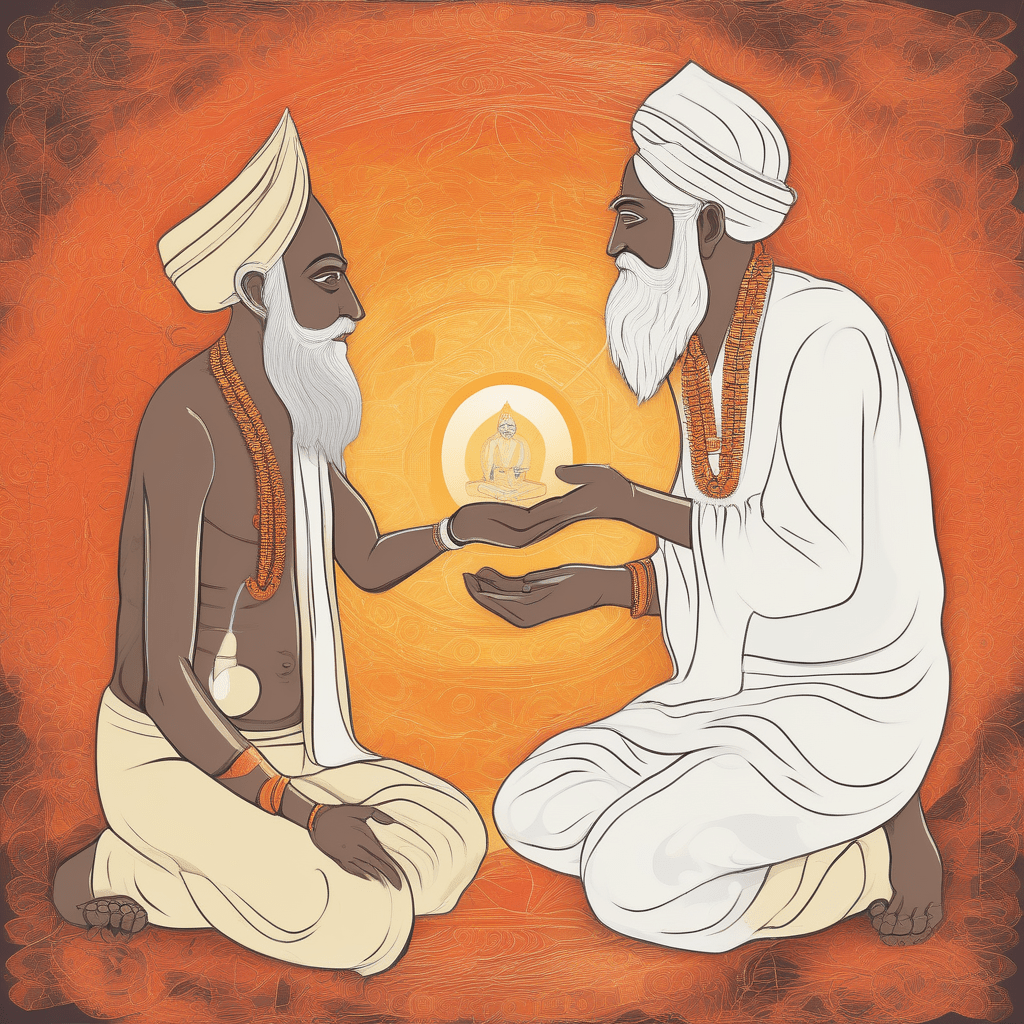
Shaktipat, often translated as the “descent of grace,” is a spiritual act where a guru or enlightened master transmits spiritual energy to a seeker. This transmission can catalyze a profound transformation, initiating or deepening the spiritual awakening process. It is an act of unlocking, a key turned in the lock of latent spiritual potential, often without the necessity of the seeker’s understanding or effort. It is said to be a direct intervention by the divine through the guru, whereby the seeker’s energy is awakened and the journey towards self-realization is accelerated.

Conversely, Darshan translates to “sight” or “a glimpse” in Sanskrit. It refers to the auspicious seeing or beholding of a holy person, deity, or sacred object. Darshan is not merely a passive observation; it is an active engagement, a reciprocal act where the seer is seen, where the act of viewing is saturated with spiritual significance. In darshan, the barriers between the divine and the devotee dissolve in the act of sacred viewing, and it is in this mutual encounter that blessings are believed to flow.

While Shaktipat can be considered an active transmission of spiritual energy, Darshan is a more passive receipt of divine presence. Yet, both hold the common thread of divine grace as central to their efficacy. They differ not in their ultimate aim—liberation and enlightenment—but in their operation. Shaktipat is akin to the wind that stirs the still waters of a lake, while Darshan is like the sun that is reflected upon it.

In contemplating Shaktipat and Darshan, one realizes that they are not mere practices but experiences that lie at the heart of the mystical relationship between the individual and the absolute. They embody the dual aspects of the spiritual journey: Shaktipat represents the inner transformation through direct intervention, and Darshan symbolizes the outer reflection of the divine in the world.

Ultimately, both Shaktipat and Darshan remind us that enlightenment is not a solitary pursuit; it involves a profound interconnectedness with the divine and the world. They encourage the seeker to remain open to the myriad ways grace manifests and recognize that each moment holds the potential for a deeper awakening.

In the spiritual odyssey, Shaktipat and Darshan are not merely destinations or methods; they are living dialogues with the divine, where each seeker is both a witness and a participant in the eternal dance of consciousness. As we embrace the mystery and beauty of these encounters, we find ourselves woven into the very fabric of spiritual unfolding, a journey that is as unique as it is universal.

Morgan O.  Smith

Yinnergy Meditation & My Book, Bodhi in the Brain…Available Now!

https://linktr.ee/morganosmith

Illuminating the Mind

The Dual Paths of Enlightenment and Spiritual Awakening

The quest for Enlightenment has been the pinnacle of human aspiration in various domains—intellectual, ethical, and spiritual. At the heart of this quest lies the promise of awakening, a transformative experience that propels an individual beyond the ordinary perception of existence. Yet, despite the shared terminology, Enlightenment and Spiritual Enlightenment diverge on fundamental grounds, embodying distinct trajectories in the pursuit of truth and self-realization.

Enlightenment, in its classic Western sense, refers to the age of reason that dawned in the 17th and 18th centuries. This period was marked by a surge in philosophical thinking, scientific discovery, and the push for political and individual freedoms. It was an era where human intellect, armed with skepticism and inquiry, sought to dispel the shadows of ignorance and dogma. The Enlightenment’s legacy is one of empowered rationality, urging humanity to harness knowledge as the light to guide society toward progress and civilization.

In contrast, Spiritual Enlightenment is an Eastern siren call that echoes through the annals of various religious and metaphysical traditions. It is not merely an expansion of knowledge but a profound transformation of consciousness. Spiritual Enlightenment implies an experiential realization of oneness with the ultimate reality. It is often depicted as the dissolution of the individual ego, a leap into the boundless ocean of divine essence, which exists beyond the material plane and the constructs of intellectual thought.

The distinction between these two is as significant as it is subtle. The Enlightenment champions the mind’s ability to question, to deduce, and to construct, seeking freedom from external tyranny. Meanwhile, Spiritual Enlightenment seeks liberation from the internal chains of desire, ego, and illusion, focusing on transcending the self rather than actualizing it.

One could argue that the paths are not mutually exclusive but are rather complementary. The enlightened mind that questions and reasons can pave the way for a deeper spiritual quest by clearing the underbrush of superstition and prejudice. Conversely, a spiritually awakened soul may view the dance of creation with a profound sense of peace and interconnectedness, bringing a compassionate perspective to the rational world.

In a broader sense, both forms of enlightenment are beacons of human aspiration. Whether it is the light of reason or the glow of spiritual wisdom, each seeks to illuminate the human experience profoundly. It is perhaps in the convergence of these paths that one may find the truest sense of enlightenment—a holistic awakening that marries the mind’s brilliance with the heart’s intuitive depths.

In conclusion, while the Enlightenment speaks to the power of human intellect and the value of empirical truth, Spiritual Enlightenment invites us to explore the mystical depths of our being and the universe. Together, they form a bidirectional odyssey of enlightenment that continues to inspire and challenge humanity to rise above its primal origins and embrace a more illuminated state of existence.

Morgan O.  Smith

Yinnergy Meditation & My Book, Bodhi in the Brain…Available Now!
https://linktr.ee/morganosmith

Satcitananda

The Voyage from Happiness to Bliss

In the pursuit of well-being, human beings have often conflated happiness with bliss, treating them as interchangeable states. However, the ancient concept of Satcitananda, a Sanskrit term embodying the essence of ultimate reality offers a profound distinction between these two.

Happiness is a fleeting emotion, a reaction to external stimuli, tethered to the temporal and the material. It is as changeable as the weather, reliant on circumstances, people, possessions, and places. Happiness is the surface-level response to life’s favourable events and acquisitions, tied to the sensory and the transient.

Bliss, or Ananda, in contrast, represents a state beyond the physical or emotional. It is not contingent on the external but is the intrinsic nature of being, untouched by the vicissitudes of life’s ever-changing landscape. Bliss is the deep, unshakable contentment that comes not from what happens to us but from what we are at our core. It is a realization of one’s true nature, a state of being where one exists in complete harmony with the universe.

Satcitananda breaks down into ‘Sat’, ‘Chit’, and ‘Ananda’. ‘Sat’ refers to truth or existence itself, ‘Chit’ to consciousness or knowledge, and ‘Ananda’ to bliss. These are not mere attributes but the very fabric of the ultimate reality, the Brahman. To realize Satcitananda is to awaken to the truth that our own deepest self is not separate from this reality.

The journey from happiness to bliss is a transformational process of expanding one’s understanding from the finite to the infinite, from a state of doing to a state of being. Where happiness might be thought of as a single note in a symphony, bliss is the symphony itself. It is the silent space between notes, as integral to the music as the sound, offering a depth that is both immanent and transcendent.

To chase happiness is to chase the shadows of what we believe we lack, while to embrace bliss is to step into the light of our divine nature, which lacks nothing. It is a shift from seeking satisfaction from the external world to discovering the inexhaustible joy within.

In Satcitananda, one finds the key to unlocking a truth that spiritual traditions have whispered for millennia: that what we seek outside has always been within. As we navigate the shifting tides of life, the realization that we are not merely chasing fleeting happiness but are embodiments of eternal bliss can transform our entire way of being.

Thus, Satcitananda is not merely a philosophical concept; it is an invitation to a way of life, a reminder that beneath the ephemeral dance of happiness and sorrow lies a profound peace and joy, waiting to be realized.

Morgan O.  Smith

Yinnergy Meditation & My Book, Bodhi in the Brain…Available Now!

https://linktr.ee/morganosmith