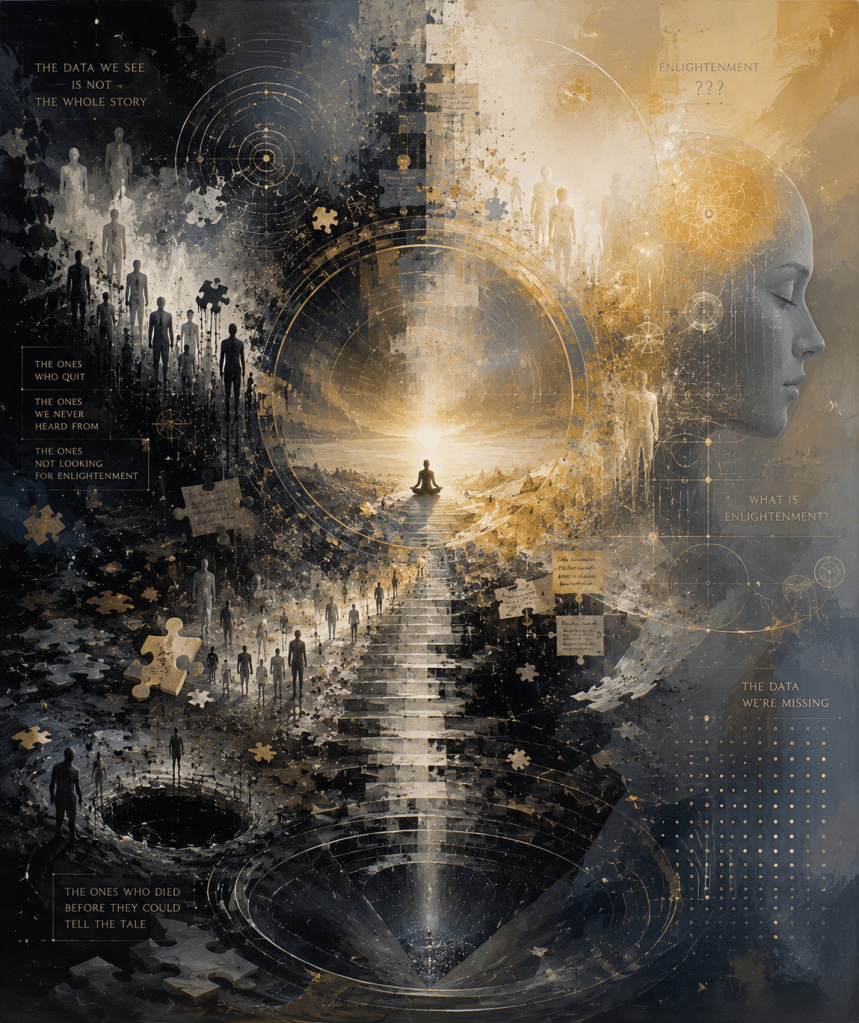
The Missing Data in the Search for Enlightenment

Looking at the issue rationally, however, reveals a far more complicated picture.

Some people making these claims are undoubtedly mistaken. Others may be describing something genuine, yet only from the perspective of a single life. Personal realization, no matter how profound, is still a sample size of one. Direct experience carries immense value, but it does not automatically reveal the complete mechanism behind the experience.

Every few years, someone claims to have uncovered the science of spiritual enlightenment. Some speak from decades of disciplined practice. Others present neuroscience, psychology, or contemplative research as evidence. I have made similar claims myself, based on my own direct experience.

Another complication lies in language. Not everyone who undergoes a profound shift calls it enlightenment. Some describe it as psychological freedom, ego dissolution, awakening, union with God, self-realization, mystical consciousness, or simply becoming fully present. Others never place a label on it at all. Entire populations may have experienced comparable transformations while using completely different conceptual frameworks.

Bias enters the conversation from every direction. Traditions often assume their own methods are uniquely effective while dismissing others. Skeptics sometimes reject extraordinary claims before examining the evidence. Devotees may accept them without sufficient scrutiny. Researchers may overlook valuable observations because they originate outside established academic institutions. Teachers may overestimate the universality of their own path because it worked for them.

Perhaps the largest blind spot receives surprisingly little attention.

Survivorship bias.

We primarily hear from those who report success.

They successfully write books. They appear on podcasts. They teach retreats, facilitate workshops, and attract students eager to follow their path. Their stories become the data set from which future seekers attempt to reverse engineer enlightenment.

Far less attention is given to everyone else.

What about those who devoted twenty years to meditation without reaching the destination they sought?

What about practitioners who quietly concluded the pursuit was not for them?

What about individuals whose lives improved significantly through practice but who never considered themselves enlightened?

What about those whose deepest realization occurred privately, with no desire to teach or publish?

What about those whose greatest insight arose during the final moments of biological life, leaving no opportunity to communicate what they discovered?

These voices rarely become part of the conversation.

Without them, our understanding may be fundamentally incomplete.

Imagine trying to understand the science of becoming an Olympic athlete by interviewing only gold medalists. Their insights would be invaluable, yet thousands of equally dedicated athletes who trained just as hard but fell short would possess information that is every bit as important. Their experiences might reveal overlooked variables, hidden obstacles, ineffective assumptions, or simply the role of chance.

The search for enlightenment may suffer from the same limitation.

If every authentic teacher described exactly how awakening unfolded, we would still be missing the experiences of everyone who practiced with equal sincerity but arrived somewhere else. That absence distorts the picture.

Adding another layer of complexity, we have yet to reach universal agreement on what enlightenment actually is. Is it permanent nondual awareness? Freedom from psychological suffering? Stable witness consciousness? Complete ego transcendence? Union with God? A measurable neurological state? Or are these different expressions of a broader phenomenon?

Without a shared definition, comparing outcomes becomes extraordinarily difficult.

Some scientists argue that the mystery has already been solved through neuroscience, predictive processing, or cognitive models of consciousness. Others remain unconvinced, pointing out that many proposed explanations have yet to withstand broad scientific scrutiny. The debate continues because the available evidence remains incomplete.

Personally, I know several people who have undergone profound spiritual awakenings. Their lives changed in unmistakable ways. Yet I know even more people who abandoned the search altogether, or whose goals were never enlightenment in the first place. Most of them will never write a memoir or appear in a documentary. Their experiences remain invisible.

Ironically, those invisible experiences may hold some of the most valuable clues.

Perhaps solving the mystery of enlightenment requires more than studying those who claim to have arrived. Perhaps it requires listening just as carefully to those who did not, those who stopped searching, those who never used spiritual language, and those whose stories were never recorded.

The greatest breakthrough may not come from discovering another enlightened teacher.

It may come from finally paying attention to everyone we forgot to ask.

Morgan O. Smith

https://linktr.ee/morganosmith

Embracing Falsehoods at the Pinnacle of Awareness

In the realm of human consciousness, there exists a fascinating paradox. At the highest level of awareness, a person can reach a state where they can believe in something, fully aware that it is not true. This peculiar aspect of human psychology offers a deep insight into the nature of belief, perception, and the human mind.

What does it mean to believe in something while knowing it isn’t true? It’s like willingly suspending disbelief while watching a movie. You enter into a contract with the fiction, fully aware that dragons don’t exist or that superheroes don’t fly, yet you allow yourself to believe in these concepts for the duration of the experience. This phenomenon isn’t just limited to entertainment but extends to the very core of our everyday lives.

Why do people engage in such seemingly contradictory behaviour? The answer lies in the complexity of the human mind and its quest for meaning and comfort. Beliefs, even those acknowledged as false, can provide a sense of comfort, belonging, or identity. They can be a source of inspiration or a means of coping with the harsh realities of life. In a world that often feels chaotic and unpredictable, these beliefs, however, detached from reality, can offer a sense of order and purpose.


This ability to believe in the unbelievable highlights the power of the human imagination and creativity. It’s a testament to our ability to envision worlds and possibilities beyond our immediate reality, a skill that has been a driving force behind art, literature, and scientific innovation. It allows us to explore ideas and scenarios that, while not real, can lead to real-world insights and advancements.

However, this power comes with a responsibility. While it can be enriching and beneficial, deliberately believing in falsehoods can also lead to dangerous delusions and collective harm if not approached with critical thinking and ethical considerations. It’s vital to find a balance, to know when to embrace these beliefs as a source of inspiration and when to acknowledge them as mere constructs of our imagination.


In conclusion, the capacity to believe in something while knowing it isn’t true is a unique aspect of human consciousness, reflecting our complex psychology. It’s a powerful tool that, when used wisely, can enrich our lives and propel us toward greater heights of imagination and understanding. However, it’s crucial to navigate this terrain with discernment and a keen sense of reality.

Morgan O. Smith

Yinnergy Meditation, Spiritual Life Coaching & My Book, Bodhi in the Brain…Available Now!

https://linktr.ee/morganosmith

Navigating the Complexities of Wisdom and Morality

In spirituality and personal development, the distinction between the message and the messenger often becomes blurred. A question that frequently arises is how to approach the teachings of spiritual leaders or gurus who are embroiled in controversies, particularly those involving moral transgressions like sexual assault. The predicament is whether their teachings, often profound and life-changing, lose their value when the teachers themselves fall from grace.

At the core of this dilemma is the age-old debate of separating the art from the artist, the wisdom from the wise. A parallel can be drawn with a simple mathematical truth: “1+1 equals 2.” This statement remains true regardless of who states it – be it a revered mathematician or someone convicted of a heinous crime. The truth, in its purest form, is untainted by the character of its proponent. In the same vein, can spiritual teachings retain their worth even if their source is flawed?

The key lies in discerning the message from the individual. Spiritual teachings, at their best, transcend the personal attributes of the one who delivers them. They tap into a universal truth that is not diminished by personal failings. However, this is not to say that the actions of the teacher are inconsequential. While the wisdom may still hold, the credibility and the moral authority of the teacher to impart these teachings come into question.

This leads to a nuanced approach. One can accept the wisdom that resonates and is beneficial while simultaneously acknowledging and condemning the wrongful actions of the teacher. It is about not idolizing the individual to the point where their failings are ignored or excused. It’s about focusing on the essence of the teachings and applying critical thinking to discern what is valuable and what aligns with one’s ethical and moral compass.

In conclusion, the journey of spiritual growth is inherently personal and complex. It involves navigating through the gray areas where wisdom can be found in imperfect vessels. The challenge is to embrace the truth in the teachings while maintaining a critical awareness of the human fallibility of the teacher. It’s about evolving our understanding of spirituality beyond the confines of idealized figures to a more grounded, discerning, and inclusive practice.

Morgan O. Smith

Yinnergy Meditation, Spiritual Life Coaching & My Book, Bodhi in the Brain…Available Now!

https://linktr.ee/morganosmith


The Constructed Sovereign Born from our Profound Void

The Illusion of Divinity and the Awakening of Inner Sovereignty

When we summon the image of an omnipotent moral authority, an unseen deity, we’re sketching a spectre birthed within the confines of our minds. This entity isn’t a divine phenomenon, but an offspring of our collective ego — an abstract amalgamation of ethics, morality, societal norms, rules, and dogmas. It thrives within the interconnected webs of our cultural and religious environment, existing as a part of us we’ve divorced from our understanding, enthroned too high in sacred spheres to accept it as our creation.

This fabricated deity stands as a sentinel, shielding us from the lure of a so-called demon, our id. This id, a tempestuous, liberated facet of our psyche, intimately bound to our physicality, represents the part we battle relentlessly. It’s in this internal war where the dream of resolution dawns, an arena where the ego and the id duel to claim dominance, awaiting a day when one will stand victorious upon the self’s throne.

We hold a solution in our grasp. Yet when enlightened souls, unhindered by societal constructs, attempt to illuminate the truth about this divine entity, we recoil. We revile them with hushed condemnations, predicting their doom by the flickering light of divine retribution. We imagine they’ll be smitten by a wrathful deity, ironic considering we believe this god granted us the right to reason critically and voice our truths.

Despite the inflexibility of our beliefs, the spectre remains. Even if we dismantle our collective ego, or raze all institutional bodies of authority and religious tenets, this deity will endure. Its eradication would unleash the collective id in a surge of high entropy chaos, shredding order, poised to reconstruct once our desires breed more disillusionment.

So, we are left under the shadow of a perceived dominator, who indeed governs as long as we believe it defends virtue. We extol this deity as the supreme entity, blind to the reality that we, the self-proclaimed limited beings, are the puppeteers. The stern god we fear is merely a man-made construct, a mythical lord over a land it doesn’t possess. We’re the true sovereigns, unknowingly directing a god on a leash, a faithful creature that bows to our every whim.

I implore you to see beyond the shimmering facade of your golden idol. The essence of the authentic divine, indivisible from us, is the omnipresent force permeating the All. To fathom the authentic divine is to realize there’s no puppet god, and in embracing this enlightenment, we shatter the chains of ignorance.

A creator does exist, but not outside of you. The world you perceive as external is an extension of your internal narrative. You are Consciousness, Spirit, Existence, and Ultimate Reality embodied, performing the roles of physical, psychological, and emotional existence. You are not merely a being, but a Presence, an omnipresent force enacting a grand cosmic play of energy, particles, atoms, cells, objects, systems, and their operational mechanics. This essence, forever within your grasp, is empowered by your belief in it, yet you offer this power to a creator birthed from you, the genuine Almighty.

Morgan O. Smith

Yinnergy Meditation & My Book, Bodhi in the Brain…Available Now!

https://linktr.ee/morganosmith