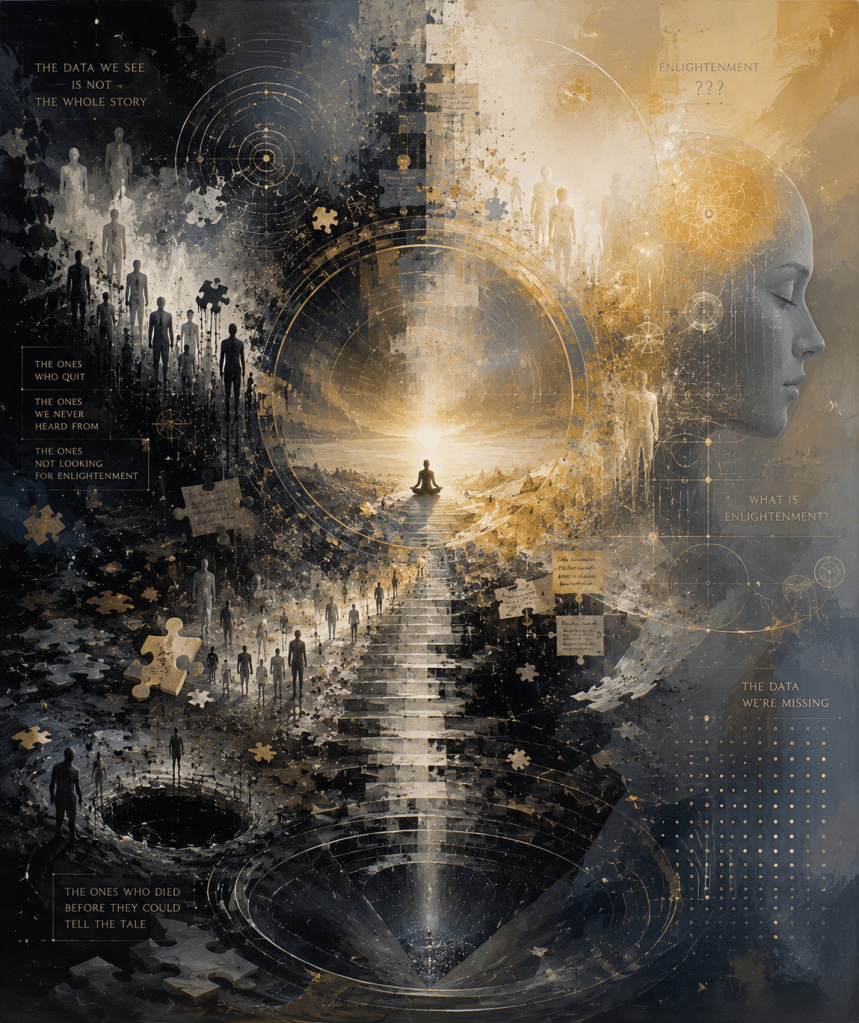
Looking at the issue rationally, however, reveals a far more complicated picture.
Some people making these claims are undoubtedly mistaken. Others may be describing something genuine, yet only from the perspective of a single life. Personal realization, no matter how profound, is still a sample size of one. Direct experience carries immense value, but it does not automatically reveal the complete mechanism behind the experience.
Every few years, someone claims to have uncovered the science of spiritual enlightenment. Some speak from decades of disciplined practice. Others present neuroscience, psychology, or contemplative research as evidence. I have made similar claims myself, based on my own direct experience.
Another complication lies in language. Not everyone who undergoes a profound shift calls it enlightenment. Some describe it as psychological freedom, ego dissolution, awakening, union with God, self-realization, mystical consciousness, or simply becoming fully present. Others never place a label on it at all. Entire populations may have experienced comparable transformations while using completely different conceptual frameworks.
Bias enters the conversation from every direction. Traditions often assume their own methods are uniquely effective while dismissing others. Skeptics sometimes reject extraordinary claims before examining the evidence. Devotees may accept them without sufficient scrutiny. Researchers may overlook valuable observations because they originate outside established academic institutions. Teachers may overestimate the universality of their own path because it worked for them.
Perhaps the largest blind spot receives surprisingly little attention.
Survivorship bias.
We primarily hear from those who report success.
They successfully write books. They appear on podcasts. They teach retreats, facilitate workshops, and attract students eager to follow their path. Their stories become the data set from which future seekers attempt to reverse engineer enlightenment.
Far less attention is given to everyone else.
What about those who devoted twenty years to meditation without reaching the destination they sought?
What about practitioners who quietly concluded the pursuit was not for them?
What about individuals whose lives improved significantly through practice but who never considered themselves enlightened?
What about those whose deepest realization occurred privately, with no desire to teach or publish?
What about those whose greatest insight arose during the final moments of biological life, leaving no opportunity to communicate what they discovered?
These voices rarely become part of the conversation.
Without them, our understanding may be fundamentally incomplete.
Imagine trying to understand the science of becoming an Olympic athlete by interviewing only gold medalists. Their insights would be invaluable, yet thousands of equally dedicated athletes who trained just as hard but fell short would possess information that is every bit as important. Their experiences might reveal overlooked variables, hidden obstacles, ineffective assumptions, or simply the role of chance.
The search for enlightenment may suffer from the same limitation.
If every authentic teacher described exactly how awakening unfolded, we would still be missing the experiences of everyone who practiced with equal sincerity but arrived somewhere else. That absence distorts the picture.
Adding another layer of complexity, we have yet to reach universal agreement on what enlightenment actually is. Is it permanent nondual awareness? Freedom from psychological suffering? Stable witness consciousness? Complete ego transcendence? Union with God? A measurable neurological state? Or are these different expressions of a broader phenomenon?
Without a shared definition, comparing outcomes becomes extraordinarily difficult.
Some scientists argue that the mystery has already been solved through neuroscience, predictive processing, or cognitive models of consciousness. Others remain unconvinced, pointing out that many proposed explanations have yet to withstand broad scientific scrutiny. The debate continues because the available evidence remains incomplete.
Personally, I know several people who have undergone profound spiritual awakenings. Their lives changed in unmistakable ways. Yet I know even more people who abandoned the search altogether, or whose goals were never enlightenment in the first place. Most of them will never write a memoir or appear in a documentary. Their experiences remain invisible.
Ironically, those invisible experiences may hold some of the most valuable clues.
Perhaps solving the mystery of enlightenment requires more than studying those who claim to have arrived. Perhaps it requires listening just as carefully to those who did not, those who stopped searching, those who never used spiritual language, and those whose stories were never recorded.
The greatest breakthrough may not come from discovering another enlightened teacher.
It may come from finally paying attention to everyone we forgot to ask.
Morgan O. Smith

