The Spectrum Theory of Spiritual Enlightenment

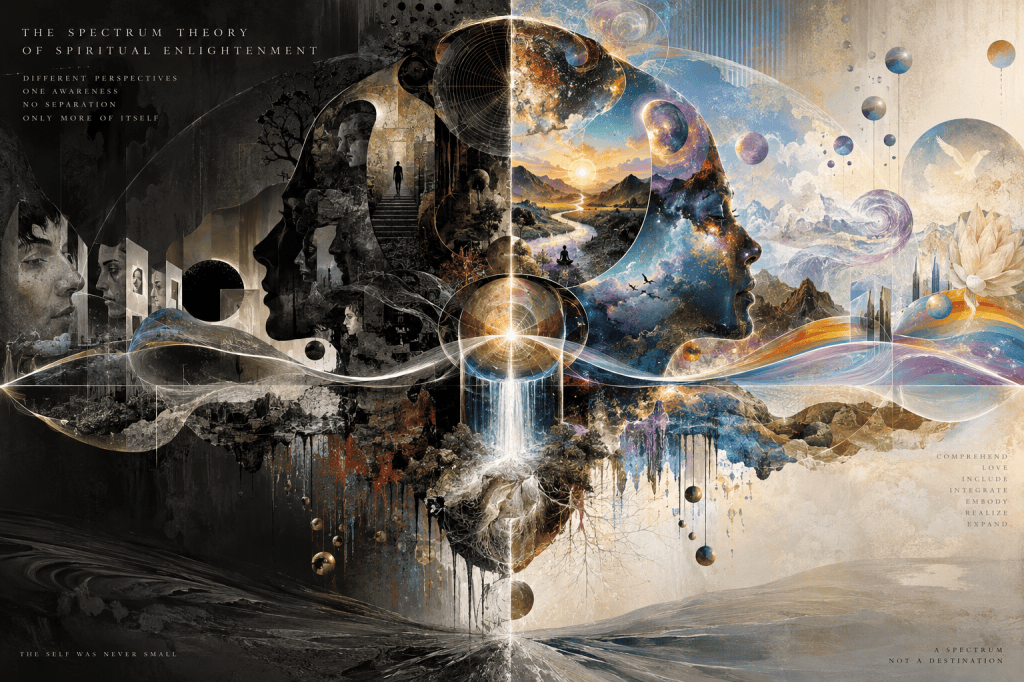
Spiritual enlightenment may be better understood as a spectrum.

This challenges one of the oldest assumptions surrounding enlightenment: that someone either has it or does not.

Enlightened. Unenlightened.

Awake. Asleep.

Self-realized. Ignorant.

Such divisions may be useful when describing a radical shift in consciousness, but they become inadequate when we begin examining the enormous differences between people who have undergone profound spiritual realization.

Two individuals may both recognize the nondual nature of reality and still differ tremendously in their capacity for love, emotional integration, intellectual complexity, perspective-taking, creativity, compassion, self-awareness and their ability to function within the complexity of human life.

This suggests something important.

Realization may happen, while enlightenment continues to unfold.

Enlightenment Is Not Simply What You Experience

Mystical experience alone cannot adequately define enlightenment.

A person may experience ego dissolution, timelessness, boundlessness, unity, emptiness or the disappearance of the subject-object boundary. These experiences can radically alter one’s understanding of reality.

Yet experience eventually encounters interpretation.

The human organism must somehow understand what occurred.

A Christian mystic may interpret unity through Christ. An Advaita practitioner may interpret it through Brahman. A Buddhist may describe emptiness. A neuroscientist may speak about changes within the brain’s construction of selfhood.

The experience may contain striking similarities while the interpretation reflects the developmental capacity of the person experiencing it.

This raises a provocative possibility:

What if enlightenment is not measured solely by how deeply you can disappear, but also by how much reality you can contain when you return?

The Capacity to Hold More

Perhaps spiritual development can partly be understood as increasing capacity.

The more you can comprehend.

The more you can love.

The more perspectives you can hold simultaneously.

The more contradiction you can tolerate without immediately forcing reality into either-or categories.

The more emotional intensity you can experience without becoming completely possessed by it.

The more uncertainty you can encounter without manufacturing certainty simply to make yourself comfortable.

The more of yourself you can observe without defending an identity.

The more of another person you can understand without requiring them to resemble you.

Something begins expanding.

Not necessarily the Self, because from the nondual perspective the Self was never small.

What expands is the human capacity to consciously express what has always been unlimited.

Depth and Breadth Are Different

Someone can go extraordinarily deep while remaining relatively narrow.

This distinction deserves attention.

A profound meditator might enter states of consciousness inaccessible to most people while still possessing rigid cultural assumptions.

A brilliant philosopher might understand dozens of perspectives intellectually while remaining emotionally defended.

A deeply compassionate person may possess extraordinary interpersonal wisdom without having experienced nondual realization.

A mystic may recognize the Absolute while still carrying unresolved psychological conditioning.

These are different dimensions of development.

Calling all of them simply “spiritual advancement” obscures what is actually happening.

A more complete model of enlightenment would therefore require several dimensions.

Depth concerns how completely consciousness penetrates the apparent separation between observer and observed.

Breadth concerns how many perspectives, systems, cultures, disciplines and modes of knowing can be included within one’s understanding.

Integration concerns how thoroughly unconscious, emotional and psychological material becomes incorporated rather than denied, projected or spiritually bypassed.

Embodiment concerns whether realization actually changes how someone lives, relates, creates, responds and participates in the world.

We could express the basic model as:

Enlightenment = Depth × Breadth × Integration × Embodiment

This is not intended as a literal mathematical equation. It is a conceptual instrument.

Its purpose is to prevent one extraordinary dimension from being mistaken for the whole.

Absolute Realization, Relative Development

Here lies an apparent paradox.

The Absolute does not develop.

If nonduality is ultimately true, then there cannot be more or less of the Absolute. There cannot be 40 percent Brahman, 72 percent emptiness or 95 percent pure awareness.

What is fundamental simply is.

Yet the organism through which realization expresses itself certainly develops.

The nervous system develops.

Language develops.

Emotional intelligence develops.

Perspective-taking develops.

Ethical sensitivity develops.

Creativity develops.

Conceptual sophistication develops.

The ability to tolerate complexity develops.

This means absolute realization and relative development should not be confused.

Someone may recognize what is timeless while still being a very particular human being shaped by history, biology, culture, trauma, education and psychological conditioning.

Enlightenment does not necessarily erase the relative human structure.

It changes the relationship to it.

The Number of Perspectives You Can Become

Perspective-taking may be one of the most overlooked dimensions of spiritual maturity.

Early consciousness tends to experience its own perspective as reality itself.

“This is what happened.”

“This is what God wants.”

“This is who I am.”

“This is who you are.”

Greater awareness begins noticing something strange.

Every perspective reveals something while simultaneously concealing something.

Move positions and reality changes.

The child sees one world.

The parent sees another.

The scientist sees another.

The artist sees another.

The mystic sees another.

The atheist sees another.

The person who hurt you sees another.

None necessarily possesses the complete picture.

Spiritual maturity may therefore involve becoming increasingly capable of moving between perspectives without being imprisoned by any of them.

Eventually something even stranger becomes apparent.

The perspectives themselves are occurring within awareness.

Then the question changes from:

Which perspective is ultimately correct?

to:

What is it that can become all of these perspectives without being limited to any of them?

That question points directly toward nonduality.

Love as Expanded Identity

Love also changes when viewed through this model.

Love is usually understood emotionally. We love certain people because they matter to us.

Nondual realization introduces another possibility.

What happens when the boundary defining “me” becomes less convincing?

Compassion may no longer arise merely because one has been instructed to care about others.

Another person’s suffering begins to matter because “other” has become philosophically and experientially unstable.

Their consciousness is no longer entirely foreign territory.

The expansion of love may therefore correspond with an expansion of identity.

First, myself.

Then my family.

My community.

My people.

Humanity.

Sentient life.

Life itself.

Existence.

Eventually the circle collapses because there is nowhere outside it.

Love becomes less about extending kindness from one separate being toward another and more about reality recognizing itself through apparent difference.

Enlightenment Does Not Make You Finished

Perhaps one of the most dangerous ideas surrounding enlightenment is the belief that awakening makes further development unnecessary.

That belief can transform realization into another identity.

“I am enlightened.”

Now the ego possesses the absence of ego.

A remarkably clever maneuver.

Genuine realization may actually make development more demanding because fewer psychological hiding places remain convincing.

There can still be conditioning to examine.

Relationships to repair.

Knowledge to acquire.

Blind spots to discover.

Emotional capacities to strengthen.

Perspectives to encounter.

Humanity to embody.

Awakening does not necessarily end development.

It may remove the central illusion around which development previously revolved.

A Spectrum Without a Final Number

The spectrum model should not become another spiritual ranking system.

Its purpose is not to assign enlightenment scores.

The moment we begin arguing that one person is “Level 8 enlightened” while another is “Level 5,” we risk rebuilding hierarchy around something that fundamentally undermines the separate self seeking status.

The spectrum is multidimensional.

Someone may possess extraordinary contemplative depth but limited psychological integration.

Another person may demonstrate remarkable compassion and embodiment while having little interest in metaphysics.

Another may possess tremendous intellectual breadth but little experiential realization.

Development can be uneven.

That unevenness is precisely why a spectrum model becomes useful.

It allows us to stop pretending that enlightenment must produce identical human beings.

The Strange Conclusion

The deepest realization may reveal that nothing needs to become enlightened.

What you fundamentally are was never trapped.

Awareness itself was never confused.

The Absolute never forgot itself.

The person was the apparent location through which forgetting and remembering occurred.

Yet something continues after that recognition.

The human expression can become wider.

More integrated.

More sensitive.

More capable of holding contradiction.

More capable of intimacy.

More capable of uncertainty.

More capable of seeing through its own assumptions.

More capable of allowing perspectives that once threatened its identity.

More capable of loving without possession.

Perhaps enlightenment contains two movements that appear contradictory only when confused with one another.

One movement reveals that there is nowhere to go.

The other reveals that development has no obvious endpoint.

The Absolute is complete.

Its expression through a human life is not.

This may be one of the great paradoxes of spiritual enlightenment:

You can realize that you are already everything while continuing to discover how much more of everything you are capable of consciously containing.

Morgan O. Smith
https://linktr.ee/morganosmith

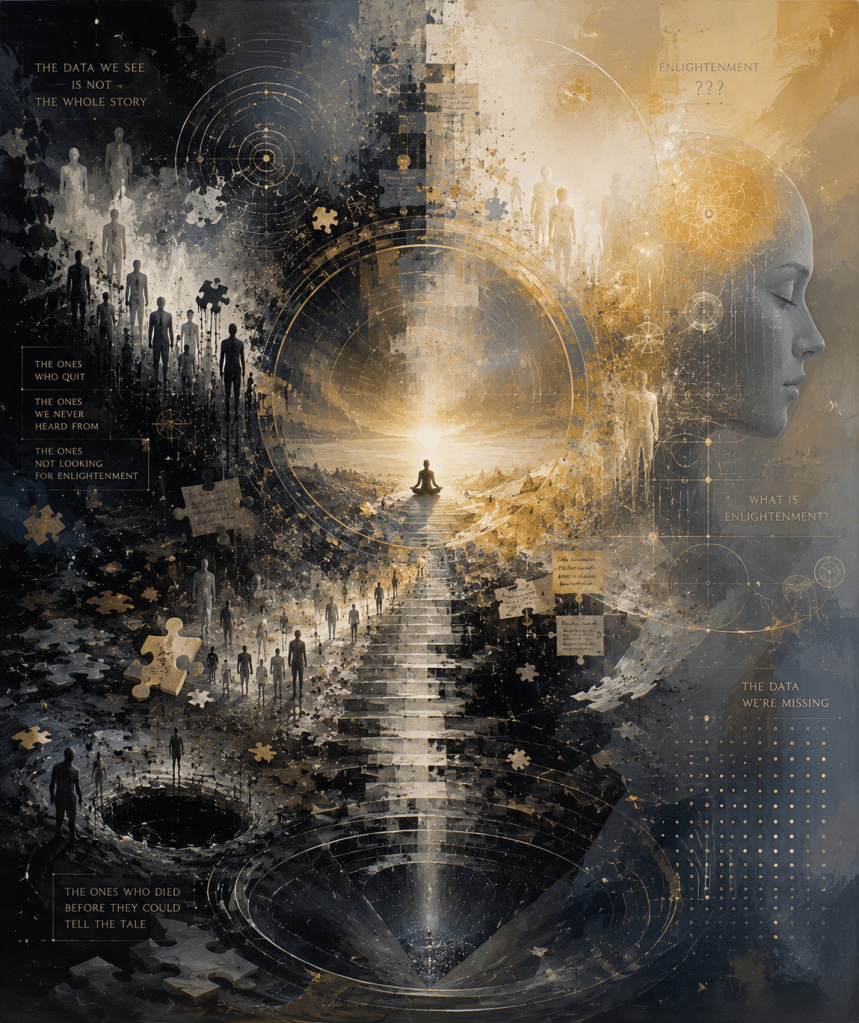
The Missing Data in the Search for Enlightenment

Looking at the issue rationally, however, reveals a far more complicated picture.

Some people making these claims are undoubtedly mistaken. Others may be describing something genuine, yet only from the perspective of a single life. Personal realization, no matter how profound, is still a sample size of one. Direct experience carries immense value, but it does not automatically reveal the complete mechanism behind the experience.

Every few years, someone claims to have uncovered the science of spiritual enlightenment. Some speak from decades of disciplined practice. Others present neuroscience, psychology, or contemplative research as evidence. I have made similar claims myself, based on my own direct experience.

Another complication lies in language. Not everyone who undergoes a profound shift calls it enlightenment. Some describe it as psychological freedom, ego dissolution, awakening, union with God, self-realization, mystical consciousness, or simply becoming fully present. Others never place a label on it at all. Entire populations may have experienced comparable transformations while using completely different conceptual frameworks.

Bias enters the conversation from every direction. Traditions often assume their own methods are uniquely effective while dismissing others. Skeptics sometimes reject extraordinary claims before examining the evidence. Devotees may accept them without sufficient scrutiny. Researchers may overlook valuable observations because they originate outside established academic institutions. Teachers may overestimate the universality of their own path because it worked for them.

Perhaps the largest blind spot receives surprisingly little attention.

Survivorship bias.

We primarily hear from those who report success.

They successfully write books. They appear on podcasts. They teach retreats, facilitate workshops, and attract students eager to follow their path. Their stories become the data set from which future seekers attempt to reverse engineer enlightenment.

Far less attention is given to everyone else.

What about those who devoted twenty years to meditation without reaching the destination they sought?

What about practitioners who quietly concluded the pursuit was not for them?

What about individuals whose lives improved significantly through practice but who never considered themselves enlightened?

What about those whose deepest realization occurred privately, with no desire to teach or publish?

What about those whose greatest insight arose during the final moments of biological life, leaving no opportunity to communicate what they discovered?

These voices rarely become part of the conversation.

Without them, our understanding may be fundamentally incomplete.

Imagine trying to understand the science of becoming an Olympic athlete by interviewing only gold medalists. Their insights would be invaluable, yet thousands of equally dedicated athletes who trained just as hard but fell short would possess information that is every bit as important. Their experiences might reveal overlooked variables, hidden obstacles, ineffective assumptions, or simply the role of chance.

The search for enlightenment may suffer from the same limitation.

If every authentic teacher described exactly how awakening unfolded, we would still be missing the experiences of everyone who practiced with equal sincerity but arrived somewhere else. That absence distorts the picture.

Adding another layer of complexity, we have yet to reach universal agreement on what enlightenment actually is. Is it permanent nondual awareness? Freedom from psychological suffering? Stable witness consciousness? Complete ego transcendence? Union with God? A measurable neurological state? Or are these different expressions of a broader phenomenon?

Without a shared definition, comparing outcomes becomes extraordinarily difficult.

Some scientists argue that the mystery has already been solved through neuroscience, predictive processing, or cognitive models of consciousness. Others remain unconvinced, pointing out that many proposed explanations have yet to withstand broad scientific scrutiny. The debate continues because the available evidence remains incomplete.

Personally, I know several people who have undergone profound spiritual awakenings. Their lives changed in unmistakable ways. Yet I know even more people who abandoned the search altogether, or whose goals were never enlightenment in the first place. Most of them will never write a memoir or appear in a documentary. Their experiences remain invisible.

Ironically, those invisible experiences may hold some of the most valuable clues.

Perhaps solving the mystery of enlightenment requires more than studying those who claim to have arrived. Perhaps it requires listening just as carefully to those who did not, those who stopped searching, those who never used spiritual language, and those whose stories were never recorded.

The greatest breakthrough may not come from discovering another enlightened teacher.

It may come from finally paying attention to everyone we forgot to ask.

Morgan O. Smith

https://linktr.ee/morganosmith

∆∞Ο and the Nondual Nature of Enlightenment

Inspired by the work of Alexander Ngu and Amaya Odilon Kosso — “Intelligent Transformation: General Intelligence Theory” (2024)

Humanity has long searched for a bridge between consciousness and cosmos, between the ineffable pulse of awareness and the measurable rhythms of reality. Alexander Ngu and Amaya Odilon Kosso may have drawn that bridge with their revolutionary General Intelligence Theory (GIT), proposing a universal abstraction known as ∆∞Ο;  the triarchic principle of the infinitesimal (∆), the infinite (∞), and the finite (Ο).

Their insight dismantles the old notion of equality as the foundation of understanding. The equal sign, they argue, limits the sensitivity of thought to the subtler play of transformation. Equality is static — it implies stillness between two mirrored sides. Transformation, however, is alive. It breathes through every exchange, allowing one form to become another without contradiction. ∆∞Ο is the language of that breath; the patternless rhythm by which energy becomes matter, idea becomes awareness, and self becomes all.

If you’ve read any of my past work, you’d know that my main focus is spiritual enlightenment. The moment I read their paper, I could conceptually see how their work may apply to my personal direct experience of The All. Though I could be jumping at this prematurely, my intuition said otherwise. I got the same feeling when I first discovered Bill Harris’ work regarding low-carrier frequency brainwave entrainment, Marko Rodin’s work in Vortex Based Mathematics, and my teacher and colleague, Ken Wilber’s work in Integral Theory. So far, I’ve never been wrong.

The spiritual implications are profound. The infinitesimal (∆) reflects the fleeting pulse of perception; each thought, sensation, or breath that rises and dissolves. The infinite (∞) mirrors the boundless consciousness in which those movements occur. The finite (Ο) represents the manifest world, the circle of appearances that seems to contain experience. The realization that ∆, ∞, and Ο are not separate but continuous is the essence of enlightenment. Awareness awakens to its own structure; the one relation that holds all opposites in seamless reciprocity.

This triarchic model suggests that intelligence, in its most universal sense, is the self-recognition of transformation. Every shift of perception, every oscillation between thought and stillness, is the cosmos contemplating itself through the medium of form. The so-called “theory of everything” becomes not a formula etched in numbers, but a recognition that everything is the formula; a living geometry of being that reconciles complexity, dimensionality, and spatiality in one infinite act of awareness.

Spiritual awakening, through this lens, is not an event within time but the cessation of all resistance to transformation. The individual dissolves into the very process that sustains existence; a process that requires no computation, no passage of time, no distance traversed. Enlightenment, therefore, is not achieved; it is realized as the zero-point of transformation, where the infinitesimal and infinite converge in perfect immediacy.

Ngu and Kosso’s ∆∞Ο does more than redefine intelligence; it redefines reality itself. It reveals that consciousness and existence are not two domains awaiting reconciliation, but one relational field eternally transforming within its own awareness. The ancient mystics called this unity Brahman, Tao, or the Absolute. The scientists now call it General Intelligence. Both are describing the same ineffable truth: that the universe is awake, and you are its knowing.

Morgan O. Smith

Get Your Free Copy of My Book, Bodhi in the Brain!

https://subscribepage.io/oTSZQu

The Paradox of a Spiritually Enlightened Peak Experience

Imagine being pushed from a plane mid-flight, without a parachute. There’s no time to think, no time to brace yourself for impact. You are hurtling through the sky, weightless, untethered, and completely vulnerable. Fear may grip you momentarily, but something unexpected happens. You hit the ground—yet not only do you survive, but you rise and walk away unscathed, untouched by the experience as if the fall was merely an illusion.

This analogy comes close to capturing the essence of a fully spiritually enlightened peak experience. It is both terrifying and liberating, a moment where everything you thought you knew is shattered, yet something deeper emerges untouched. It’s not the kind of experience that fits neatly into the confines of logic or the safety of intellectual understanding. It pulls you beyond those limits, forcing you to confront the raw truth of existence in ways you hadn’t anticipated.

During such an experience, there’s no parachute to cushion the ego’s fall. The self—the constructed identity you’ve held onto for so long—dissolves, leaving nothing to cling to. Everything you believe about who you are, what reality is, and how life works evaporates in a moment of pure awareness. But instead of devastation, there is a strange sense of freedom. You realize the ground you thought you were plummeting toward was never real, to begin with.

What’s remarkable about this peak state is how it feels after. There’s a profound sense of survival, not in the physical sense, but at the level of awareness. You walk away from the experience unscathed because the true self, the part of you that is beyond mind and body, was never at risk. The fall, the impact, and the survival all exist within the realm of the illusion, but the awareness that experiences it all remains whole and untouched.

This awakening doesn’t come gently; it forces a reckoning with reality. But through that reckoning, you realize that what is truly real cannot be harmed. The body, the ego, the mind—all of these can be torn apart by life’s challenges and transformations. But the awareness that witnesses the fall? That remains pure and intact.

Living after such an experience brings with it a lightness, a profound sense of detachment that doesn’t arise from apathy but from clarity. You’ve seen through the illusion of the fall, and now, you move through life knowing that no matter what happens, the essence of who you are remains untouched. There’s nothing left to fear, no more clinging to the safety of the mind’s constructions.

This is the gift of spiritual enlightenment: not just the revelation that you can survive the fall, but the deeper realization that there was never anything to fall from in the first place.

Morgan O. Smith

Yinnergy Meditation, Spiritual Life Coaching & My Book, Bodhi in the Brain…Available Now!

https://linktr.ee/morganosmith

The Depth of Spiritual Comprehension

Beyond the Surface of Enlightenment

The spiritual journey often carries a mystique, with enlightenment perceived as a final, transcendent state reached after years of dedicated practice. However, the true essence of enlightenment lies not in a distant destination but in an ongoing process of deepening comprehension. This spiritual comprehension, the act of truly understanding and embodying spiritual truths, transforms enlightenment from an abstract ideal into a living reality.

Comprehension in this context goes beyond the intellectual grasp of spiritual concepts. Reading texts or engaging in discussions about spirituality provides a foundation, but deeper understanding requires a profound recognition and integration of the truths of existence into one’s being. This type of comprehension changes the way you perceive yourself, others, and the world around you.

Comprehending Comprehension

Understanding comprehension itself involves stepping into a realm of profound self-awareness. Looking beyond the surface level of experiences and teachings becomes essential, prompting questions about the nature of understanding. What does it mean to truly understand something? How does comprehension differ from mere knowledge? Such inquiries are vital on the spiritual path, pointing to a deeper engagement with the teachings and practices that guide us.

Spiritual comprehension refers to a transformative process where the seeker transitions from knowing about enlightenment to embodying it. This process often involves the dissolution of the egoic self, the release of attachments, and the embrace of a reality both mysterious and deeply intimate.

The Unfolding of Spiritual Comprehension


The unfolding of spiritual comprehension does not follow a linear path. Rather than a straight journey from ignorance to knowledge, from darkness to light, it unfolds as an ever-deepening spiral. Each turn brings us closer to the core of our being. Through this spiral, enlightenment reveals itself not as something to be acquired but as something to be awakened to—a recognition of what has always been present.

Comprehension then becomes an experiential understanding, a lived reality where the boundaries between self and other, subject and object, dissolve. The mind’s incessant chatter quiets, leaving a clear, direct perception of truth—pure, unfiltered awareness, unclouded by concepts or beliefs.

Living Comprehension

Living comprehension means embodying the spiritual truths understood. These truths guide actions, thoughts, and interactions with the world, bringing the light of enlightenment into every aspect of life, from the most mundane tasks to the most profound spiritual practices.

Such embodiment is not about striving for perfection or adhering to an idealized notion of enlightenment. Instead, it means being authentically human, embracing all complexities and contradictions while remaining rooted in the deep understanding of true nature.

Conclusion: The Infinite Depths of Comprehension


Spiritual comprehension represents an infinite journey, a realization that there is always more to understand, integrate, and embody. Enlightenment becomes not a final state but a dynamic process of ongoing revelation. As the depths of spiritual comprehension continue to unfold, the infinite possibilities of being fully alive, fully awake, and fully present in this moment emerge.

Morgan O. Smith

Yinnergy Meditation, Spiritual Life Coaching & My Book, Bodhi in the Brain…Available Now!

https://linktr.ee/morganosmith

The Quantum Dance of Consciousness

Bridging Absolute Monism and Superposition

In the vast expanse of human experience and scientific inquiry, there are moments when disparate realms converge, revealing profound insights into the nature of reality. One such convergence is the spiritually enlightened peak experience of absolute monism and the quantum phenomenon of superposition. This intersection invites us to explore a deeper, more integrated understanding of existence.

The Experience of Absolute Monism

Imagine a moment of profound stillness, where the boundaries that define you dissolve, and the illusion of separation fades away. In this state, you experience a boundless unity, a seamless oneness with all that is. This is the essence of absolute monism—a direct, transformative experience that reveals the interconnectedness of all existence. It is a realization that transcends intellectual understanding, touching the core of being and altering one’s perception of reality.

Superposition in Quantum Physics

Quantum physics, the realm of the very small, offers a striking parallel to this mystical experience. Superposition is a principle where a quantum system exists in multiple states simultaneously until it is observed. This phenomenon challenges our classical notions of a fixed, definite reality, suggesting instead a universe that is inherently probabilistic and interconnected. The act of observation plays a crucial role in collapsing these multiple possibilities into a single, observable state.

Bridging the Spiritual and the Scientific

At first glance, the realms of spiritual enlightenment and quantum physics might seem worlds apart. Yet, they both point toward a deeper, underlying unity. In absolute monism, the dissolution of duality reveals an undivided reality. Similarly, in quantum physics, superposition reflects a state of potentiality where all possibilities coexist.

The Role of Observation

In the spiritual journey, the realization of absolute monism often emerges through deep meditation or transformative experiences. This form of “observation” collapses the illusion of separateness, unveiling the unity of existence. In quantum mechanics, it is the act of measurement that collapses a superposition into a definite state. Both suggest that consciousness or awareness plays a pivotal role in shaping reality.

Indeterminacy and Unity

The indeterminate nature of superposition aligns with the spiritual insight that ultimate reality transcends fixed forms and definitions. Both perspectives invite us to embrace a more fluid and interconnected understanding of existence. They challenge us to move beyond rigid, binary thinking and to appreciate the complexity and beauty of a reality that is both unified and diverse.

Transformation of Perception

Experiencing absolute monism can profoundly transform how we perceive ourselves and the world. It fosters a sense of unity, compassion, and interconnectedness. Similarly, understanding superposition can expand our perception of the physical world, challenging classical assumptions and inviting us to explore the mysteries of the quantum realm.

Conclusion

The convergence of absolute monism and superposition offers a rich, thought-provoking perspective on the nature of reality. It reminds us that the boundaries between science and spirituality are not as rigid as they seem. Both realms, in their own ways, point toward a deeper truth—a universe where unity, interconnectedness, and the role of consciousness are fundamental. By exploring these intersections, we embark on a journey that not only broadens our understanding but also deepens our appreciation for the profound mysteries of existence.

Morgan O. Smith

Yinnergy Meditation, Spiritual Life Coaching & My Book, Bodhi in the Brain…Available Now!

https://linktr.ee/morganosmith

The Sacred Act of Creation

Beyond Enlightenment

In the realm of spiritual exploration, we often revere the state of enlightenment as the ultimate achievement. However, there lies a profound gift that transcends even this pinnacle of spiritual awakening: the act of giving birth.

The capacity to bring forth life is a divine endowment bestowed upon women. This sacred act is not merely a biological function but a profound spiritual event. Each woman who gives birth carries within her the potential to bring enlightened beings into the world. The act of childbirth is a testament to the unbroken lineage of human existence, a continuum that makes the emergence of enlightened souls possible. Without the mothers who nurture and bring forth life, the very fabric of enlightenment would remain incomplete.

Men, too, share in this sacred responsibility. The ability to sow the seed of life means contributing to the infinite possibilities of creation. Every act of conception holds the potential to shape the future, to influence the tapestry of existence in ways that are both seen and unseen. Each contribution to the cycle of life is a silent affirmation of the interconnectedness of all beings, a recognition that enlightenment is not an isolated event but a collective journey.


Enlightenment itself, while transcendent and all-encompassing, is deeply rooted in the human experience. It is a state that emerges not in isolation but in the context of our shared existence. The enlightened beings of today stand on the shoulders of those who came before them, those who brought them into the world, nurtured them and set them on their path. The journey to spiritual awakening is a collective endeavor, woven through generations and interconnected lives.

In recognizing the sacredness of creation, we honour the unsung heroes of the spiritual journey: the mothers and fathers who contribute to the continuity of life. Their roles are not secondary to enlightenment but are integral to it. The potential for enlightenment exists because of the gift of life, which is perpetuated through the act of creation.


Thus, as we seek spiritual enlightenment, let us also revere the profound power of creation. Let us acknowledge that the journey to enlightenment begins with the simple, yet profound, act of giving life. In this recognition, we find a deeper appreciation for the interconnectedness of all existence, a recognition that every birth is a potential awakening, every new life a testament to the infinite possibilities of enlightenment.

Morgan O. Smith

Yinnergy Meditation, Spiritual Life Coaching & My Book, Bodhi in the Brain…Available Now!

https://linktr.ee/morganosmith

Beyond Distinctions

Exploring Turiyatita and Absolute Monism in Advaita Vedanta

In the spiritual landscape of Advaita Vedanta, the concept of nonduality transcends the mere absence of distinctions—it ushers us into the realm of Absolute Monism, or Turiyatita—the state of “the one without a second.” This profound philosophical framework challenges our everyday perceptions, urging us to look beyond the apparent separateness of the world.

Nonduality in this context does not imply a simplistic erasure of distinctions, but a deeper recognition that all forms and phenomena arise from the same underlying reality. This reality is not one of many, but a singular existence that pervades all, without an other or a second to stand beside it.


The journey to understanding Turiyatita involves peeling back the layers of illusion that fabricate duality within our experiences. Common perceptions of separation between self and other, observer and observed, are seen as just that—perceptions. These are not absolute truths but conditioned responses to the world. The realization of Turiyatita invites a shift from these conditioned views towards a holistic awareness, where dualities merge into a singular, expansive consciousness.

This path to enlightenment challenges the seeker to transcend the intellectual and embrace a lived experience of oneness. It is not about negating diversity but understanding the underlying unity that makes diversity possible. By recognizing the unity underlying all diversity, one does not lose the uniqueness of individual expressions; rather, one gains an appreciation of how these expressions emerge from the same source.


The implications of this understanding are vast and transformative. Embracing Turiyatita can lead to profound peace, as conflicts often stem from perceptions of separation. When one sees all beings and things as extensions of the same infinite reality, compassion and empathy flow naturally.

Advaita Vedanta’s discourse on nonduality and Turiyatita thus offers not just a philosophical stance, but a practical guide to living more harmoniously within the apparent complexities of the world. It beckons us to experience life from a place where the oneness of existence becomes not only a concept but a living reality.

Morgan O. Smith

Yinnergy Meditation, Spiritual Life Coaching & My Book, Bodhi in the Brain…Available Now!

https://linktr.ee/morganosmith

The Quiet Power of Self-Affirmation

Embracing Truth Beyond Validation

In the realm of personal growth and spiritual enlightenment, a profound realization dawns upon us: when we harbour an unwavering conviction in truth, the need for external affirmation diminishes. This realization is a cornerstone in the journey toward self-awareness and inner peace.

Consider the nature of truth as perceived through the lens of Eastern philosophy. It is not a construct external to us, waiting for validation or approval. Instead, truth is an intrinsic part of our being, resonating deeply within our consciousness. The moment we recognize and embrace this inner truth, we transcend the dependence on external validation. This is a pivotal step in our spiritual evolution, marking a shift from seeking approval to cultivating self-assurance.

The beauty of this realization lies in its simplicity and power. When you are convinced of a truth – be it a personal belief, a spiritual insight, or an understanding of the self – you stand firm in your conviction without the crutch of others’ opinions. This is not to undermine the value of dialogue and shared perspectives but to highlight a more profound sense of confidence that comes from within.


This confidence is not born of arrogance or unwarranted self-assurance. It is a quiet, unshakable belief that what you hold has been reflected upon, deeply felt, and integrated into your being. It is a testament to the journey of self-discovery and personal enlightenment you have embarked upon.

The concept of non-duality in Eastern philosophy offers a valuable perspective here. It teaches us that the distinctions we make between self and others, between our beliefs and the external world, are illusory. In recognizing the non-dual nature of existence, we understand that our deepest truths are not separate from the universal truth. They are interwoven in the very fabric of existence, and as such, they require no external endorsement.

Embrace this journey of self-affirmation with humility and openness. Let your truths be a source of strength and guidance, rooted deeply in your experience and understanding. As you do so, you will find that the need for external validation naturally falls away, leaving you with a serene confidence in your path and beliefs.


In conclusion, the path to spiritual awakening and enlightenment is illuminated by the truths we hold dear, truths that require no external validation to shine brightly within us. They reflect our deepest selves, resonating with the universal truths that bind us all.

Morgan O. Smith

Yinnergy Meditation, Spiritual Life Coaching & My Book, Bodhi in the Brain…Available Now!

https://linktr.ee/morganosmith

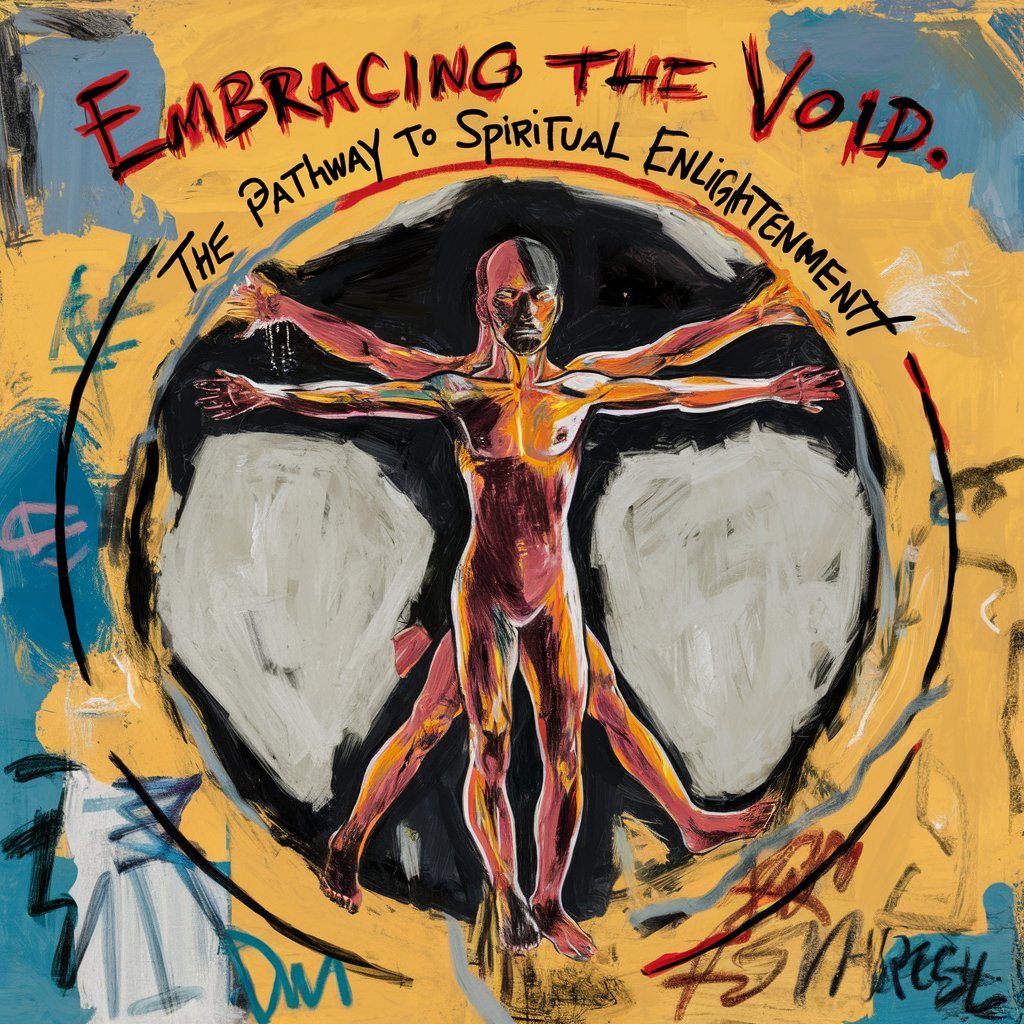
Embracing the Void

The Pathway to Spiritual Enlightenment

In the quest for spiritual enlightenment, a profound transformation beckons, one that requires an unyielding surrender of all that defines us. It is a journey beyond the tangible, beyond the confines of labels and identities that we cling to—our gender, nationality, race, ethnicity, and even our deepest desires and beliefs. This path demands an unparalleled relinquishment, a surrender not just to our inner selves but to the vast expanse of the universe and everything within it.

Enlightenment, in its truest essence, is not about acquiring something new or reaching a lofty destination. It’s about a subtle yet powerful realization: the shedding of layers, the unbecoming of what we thought we were. It’s a journey inward, where the cessation of our attachments reveals the luminous core of our existence.


Consider this: our identities, with all their complexities, are but constructs—narratives we’ve woven around our being. In the pursuit of enlightenment, these narratives unravel, revealing the simplicity and purity of our true nature. This process is not about loss; rather, it’s a rediscovery, a return to an unadulterated state of being where peace and understanding flourish.

Surrendering to the universe means accepting the impermanence and fluidity of all things. It’s an acknowledgment that our desires, beliefs, and even our strongest convictions are transient. In this acceptance lies the key to liberation—from the relentless cycle of desire and the illusion of separation.


Imagine a state where there is no ‘I’ or ‘mine,’ no clinging to personal histories or future aspirations. Here, in this boundless openness, lies the essence of nonduality—the profound understanding that we are not separate from the universe but an integral part of it. It’s a realization that the distinctions we make between ourselves and the world are illusory.

In this state of surrender, we become like the vast sky—expansive, serene, and untroubled by the transient clouds of thoughts and emotions. We experience life in its purest form, unfiltered and unobstructed by the narratives of the ego. This is the heart of spiritual enlightenment—a state of being that is in harmony with the universe, where the duality of self and other dissolves into a singular, boundless existence.


As seekers on this path, let us embrace this journey with an open heart and mind. Let us surrender to the flow of life, to the wisdom of the universe, and in doing so, discover the profound peace and understanding that lies within.

Morgan O. Smith

Yinnergy Meditation, Spiritual Life Coaching & My Book, Bodhi in the Brain…Available Now!

https://linktr.ee/morganosmith