Worship Your Idols Until Your Idols Are No Longer Needed

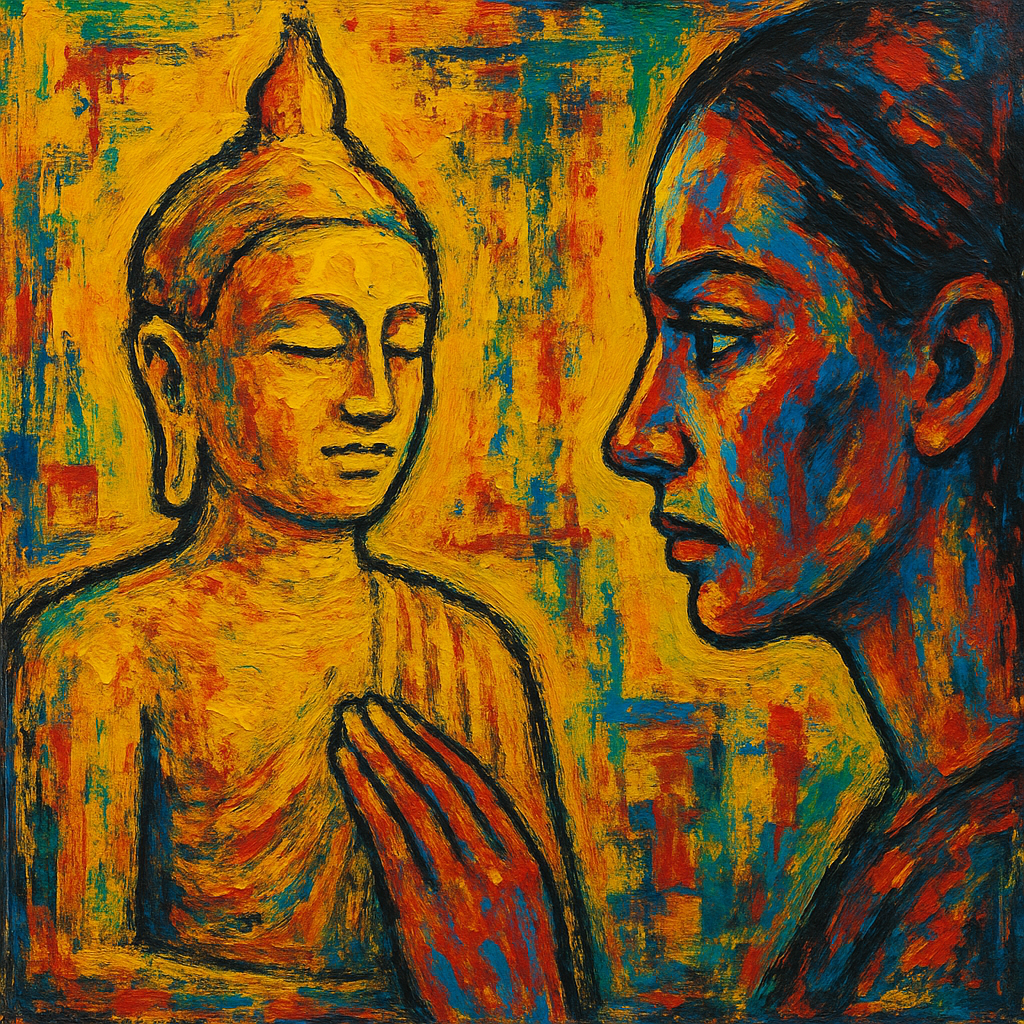
Worship your idols until your idols are no longer needed.

Another way to say this is:

Focus on your objectives until you’re forced to look within.

There is nothing inherently wrong with having idols.

There is nothing inherently wrong with ambition, achievement, recognition, wealth, status, influence, romance, physical beauty, intellectual mastery, spiritual attainment, or the desire to become extraordinary.

Sometimes the road beyond desire must first travel directly through it.

We often imagine spiritual maturity as the immediate rejection of worldly pursuits. Renounce the ego. Abandon ambition. Stop chasing things. Detach from outcomes. Transcend desire.

Yet premature renunciation can become another form of avoidance.

You can claim that money does not matter when you have never had any.

You can dismiss recognition when you secretly crave it.

You can condemn power because you have never experienced what it feels like to possess it.

You can declare yourself detached from relationships while quietly fearing intimacy.

You can criticize ambition while wondering whether you were capable of achieving what you wanted.

Sometimes you have to meet the idol before you can discover what it cannot give you.

The Idol Is Not Necessarily the Problem

An idol is anything onto which we project the promise of completion.

It might be a person.

A career.

A relationship.

A spiritual teacher.

A certain amount of money.

A perfect body.

A degree.

A mystical experience.

A following.

A business.

Enlightenment itself can become an idol.

The object changes, but the psychological movement remains remarkably similar:

When I obtain that, I will finally be complete.

This is what gives the idol its power.

The object itself may have value. Money can create freedom. Relationships can bring intimacy. Achievement can develop discipline. Knowledge can expand perspective. Meditation can transform how consciousness relates to experience.

The illusion begins when we ask something finite to provide what only the recognition of our fundamental nature can reveal.

We are not merely pursuing the object.

We are pursuing a feeling we believe the object will produce.

Freedom.

Security.

Love.

Wholeness.

Significance.

Peace.

The object becomes a symbol for an internal condition.

This is why getting what you want can sometimes be more spiritually disruptive than failing to get it.

Failure allows the fantasy to survive.

Success puts the fantasy on trial.

When Success Becomes a Spiritual Crisis

Suppose you spend twenty years believing that reaching a particular objective will finally make you happy.

Then you reach it.

For a while, there may be exhilaration. There should be. Something meaningful has happened.

But eventually ordinary consciousness returns.

You wake up as yourself.

The mind still moves.

Old insecurities may remain.

Fear still visits.

The body still ages.

Relationships still require work.

The applause fades.

Yesterday’s achievement becomes today’s normal.

Then an unsettling question appears:

Is this it?

That question can be more transformative than years of abstract spiritual philosophy.

You received what you asked life for, yet something remains unresolved.

The idol has fulfilled its purpose.

Not because it saved you, but because it failed to.

Its failure becomes instruction.

Desire Can Educate You

Certain desires disappear through understanding rather than suppression.

A child may desperately want a particular toy. Telling the child that the toy cannot provide lasting happiness will probably accomplish very little. The child needs the toy.

Then something fascinating happens.

The child gets it.

Plays with it.

Loves it.

Eventually puts it down.

What philosophy could not accomplish, experience did.

Adults are not fundamentally different.

Our toys become more sophisticated.

Titles.

Cars.

Followers.

Properties.

Credentials.

Partners.

Awards.

Spiritual experiences.

We give them adult names, but psychologically we may still be saying:

Maybe this will finally be enough.

There is wisdom in discovering for yourself what “enough” actually means.

This does not mean deliberately becoming materialistic or compulsively pursuing every desire that enters the mind. Some desires are destructive, and maturity includes discernment.

The deeper point is that genuine transcendence is different from repression.

Repression says:

I am not supposed to want this.

Transcendence says:

I understand what this can and cannot give me.

Those are radically different states of consciousness.

Even the Spiritual Path Has Idols

Spiritual seekers sometimes exchange socially acceptable idols for spiritually acceptable ones.

The pursuit of money becomes the pursuit of awakening.

Status becomes spiritual authority.

Achievement becomes attainment.

Possessions become experiences.

Comparison with coworkers becomes comparison with meditators.

Who has had kundalini awaken?

Who has experienced samadhi?

Who has reached jhana?

Who has dissolved the ego?

Who has seen God?

Who is enlightened?

The costume changes while the machinery of becoming continues operating underneath it.

The ego can pursue its own disappearance.

That is one of the great paradoxes of spiritual practice.

There may come a point when even enlightenment must be surrendered as an objective.

Not because awakening is meaningless, but because the imagined individual who intends to possess enlightenment may itself become the final idol.

You cannot own the Absolute.

You cannot place infinity on your spiritual résumé.

The Objective Eventually Turns You Around

Pursue your objectives consciously.

Build something.

Learn.

Create.

Love.

Risk failure.

Develop your gifts.

Become excellent at something.

Explore what human life is capable of expressing.

But pay attention.

Notice what happens when you get what you wanted.

Notice how quickly the mind moves the finish line.

Notice when “I’ll be happy when…” quietly becomes another “when.”

Notice how every arrival eventually becomes another departure point.

The external journey gradually begins pointing somewhere unexpected.

Back toward the one who has been searching.

Who wants this?

What exactly am I hoping to receive from it?

What would happen if I obtained everything I wanted?

What remains when achievement, identity, status, belief, memory, personality and aspiration are temporarily set aside?

What is aware of all of this?

At some point the search changes direction.

You stop asking only:

What else can I acquire?

You begin asking:

Who is the one trying to become complete?

That question opens a very different door.

When the Idol Falls From the Altar

The mature relationship with an idol does not necessarily require destroying it.

You simply stop worshipping it.

Money can remain money.

Success can remain success.

A relationship can remain a relationship.

A teacher can remain a teacher.

Meditation can remain meditation.

Achievement can remain achievement.

They no longer carry the impossible responsibility of completing you.

You can enjoy them without confusing them with your Being.

You can participate without becoming psychologically imprisoned by participation.

You can succeed without needing success to tell you who you are.

You can fail without failure becoming a verdict on your existence.

Something profound changes when the world is no longer required to complete the one experiencing it.

Perhaps this is one meaning of freedom.

Not escaping the world.

Not rejecting desire.

Not pretending that objectives do not matter.

Rather, seeing their proper place.

Worship your idols if you must.

Study them.

Pursue them.

Stand before them.

Perhaps even achieve what they represent.

Then look carefully at what remains.

Eventually, the idol may cease to be an idol.

Not because someone convinced you that worship was foolish, but because experience revealed the limitation of what you were worshipping.

The objective did not betray you.

It brought you exactly where it was ultimately capable of bringing you.

To the edge of itself.

From there, there is only one direction left to look.

Within.

Morgan O. Smith

https://linktr.ee/morganosmith

The Missing Data in the Search for Enlightenment

Looking at the issue rationally, however, reveals a far more complicated picture.

Some people making these claims are undoubtedly mistaken. Others may be describing something genuine, yet only from the perspective of a single life. Personal realization, no matter how profound, is still a sample size of one. Direct experience carries immense value, but it does not automatically reveal the complete mechanism behind the experience.

Every few years, someone claims to have uncovered the science of spiritual enlightenment. Some speak from decades of disciplined practice. Others present neuroscience, psychology, or contemplative research as evidence. I have made similar claims myself, based on my own direct experience.

Another complication lies in language. Not everyone who undergoes a profound shift calls it enlightenment. Some describe it as psychological freedom, ego dissolution, awakening, union with God, self-realization, mystical consciousness, or simply becoming fully present. Others never place a label on it at all. Entire populations may have experienced comparable transformations while using completely different conceptual frameworks.

Bias enters the conversation from every direction. Traditions often assume their own methods are uniquely effective while dismissing others. Skeptics sometimes reject extraordinary claims before examining the evidence. Devotees may accept them without sufficient scrutiny. Researchers may overlook valuable observations because they originate outside established academic institutions. Teachers may overestimate the universality of their own path because it worked for them.

Perhaps the largest blind spot receives surprisingly little attention.

Survivorship bias.

We primarily hear from those who report success.

They successfully write books. They appear on podcasts. They teach retreats, facilitate workshops, and attract students eager to follow their path. Their stories become the data set from which future seekers attempt to reverse engineer enlightenment.

Far less attention is given to everyone else.

What about those who devoted twenty years to meditation without reaching the destination they sought?

What about practitioners who quietly concluded the pursuit was not for them?

What about individuals whose lives improved significantly through practice but who never considered themselves enlightened?

What about those whose deepest realization occurred privately, with no desire to teach or publish?

What about those whose greatest insight arose during the final moments of biological life, leaving no opportunity to communicate what they discovered?

These voices rarely become part of the conversation.

Without them, our understanding may be fundamentally incomplete.

Imagine trying to understand the science of becoming an Olympic athlete by interviewing only gold medalists. Their insights would be invaluable, yet thousands of equally dedicated athletes who trained just as hard but fell short would possess information that is every bit as important. Their experiences might reveal overlooked variables, hidden obstacles, ineffective assumptions, or simply the role of chance.

The search for enlightenment may suffer from the same limitation.

If every authentic teacher described exactly how awakening unfolded, we would still be missing the experiences of everyone who practiced with equal sincerity but arrived somewhere else. That absence distorts the picture.

Adding another layer of complexity, we have yet to reach universal agreement on what enlightenment actually is. Is it permanent nondual awareness? Freedom from psychological suffering? Stable witness consciousness? Complete ego transcendence? Union with God? A measurable neurological state? Or are these different expressions of a broader phenomenon?

Without a shared definition, comparing outcomes becomes extraordinarily difficult.

Some scientists argue that the mystery has already been solved through neuroscience, predictive processing, or cognitive models of consciousness. Others remain unconvinced, pointing out that many proposed explanations have yet to withstand broad scientific scrutiny. The debate continues because the available evidence remains incomplete.

Personally, I know several people who have undergone profound spiritual awakenings. Their lives changed in unmistakable ways. Yet I know even more people who abandoned the search altogether, or whose goals were never enlightenment in the first place. Most of them will never write a memoir or appear in a documentary. Their experiences remain invisible.

Ironically, those invisible experiences may hold some of the most valuable clues.

Perhaps solving the mystery of enlightenment requires more than studying those who claim to have arrived. Perhaps it requires listening just as carefully to those who did not, those who stopped searching, those who never used spiritual language, and those whose stories were never recorded.

The greatest breakthrough may not come from discovering another enlightened teacher.

It may come from finally paying attention to everyone we forgot to ask.

Morgan O. Smith

https://linktr.ee/morganosmith

The Pathless Arrival

No Path Leads to What Has No Distance

The moment a seeker sets out on the path, a paradox quietly begins to unfold. Every step forward seems to promise arrival, yet what one hopes to reach has never been absent. The illusion of a distance to cross is what fuels the journey, and still, that distance does not exist.

Awakening is not a reward at the end of a road; it is the recognition that the road itself was always part of the illusion. The mind measures, compares, calculates progress, but the truth it seeks cannot be measured, compared, or progressed toward. Presence has no edge, no centre, no circumference. Nothing stands apart from it, nothing can be added to it, and nothing can be taken away.

Those who search often feel both exhaustion and longing, as if running toward a horizon that continually retreats. Yet horizons retreat only because they were never there to begin with. What is sought is closer than breath, closer than thought; it is what makes breath and thought possible.

To realize this is not to abandon the journey, but to recognize its true nature. Every path walked, every practice undertaken, every longing felt, each is a movement within what has never moved. The path is not a bridge toward truth but a gesture of truth itself, echoing as experience.

When this becomes clear, striving gives way to simplicity. Effort yields to intimacy. What you are searching for does not arrive because it has never been absent. No path leads to what has no distance.

Morgan O. Smith

Get Your Free Copy of My Book, Bodhi in the Brain!

https://subscribepage.io/oTSZQu

Did I Have a Spiritual Awakening?

If the question lingers, “Did I have a spiritual awakening?” it often points to a deeper truth: perhaps it has not yet happened. Those who have passed through the unmistakable shift into awakened awareness do not wrestle with that doubt. There is a quiet certainty, not born of belief, but of direct experience.

Language can vary. Some may never utter the phrase spiritual awakening or enlightenment. They may frame it through their own culture, symbolism, or personal metaphors. Yet no matter the vocabulary, the essence remains beyond question.

When the event has truly unfolded, it is like rising from sleep. You do not analyze whether you are awake; you simply are. The recognition is immediate, complete, and irreversible. What remains is the unfolding of life through the clarity of that seeing.

Awakening is not a theory to adopt or an idea to flirt with. It is the dismantling of the imagined self, the collapse of boundaries, and the revelation of a reality that was always here, quietly waiting to be noticed.

Morgan O. Smith

Get Your Free Copy of My Book, Bodhi in the Brain!

https://subscribepage.io/oTSZQu

The Wild That Waits Beneath the Surface

Between the cracks of a hardened exterior, something untamed begins to grow. What appears rigid, guarded, and impenetrable often hides the very pulse of life yearning to break through. Beneath the layers we construct to survive—defense mechanisms, cultivated personas, rehearsed identities—there exists a terrain untouched by conditioning. A wildness that remembers.

This is not the chaos of recklessness, but the primal intelligence of what is unfiltered and true. A force that doesn’t ask permission to bloom, yet waits patiently for silence, for softness, for the moment the surface begins to fracture. Then, without warning, the wild arrives.

Those fractures are not failures. They are doorways. Every heartbreak, every moment of doubt, every dismantling of certainty is a thinning of the veil—a soft opening. And what comes through is not ruin but rebirth.

What is wild has always been whole. The mind may resist it—accustomed to order, craving control—but the heart knows its rhythm. The body remembers its language. And once touched by it, you no longer strive to be “put together.” You begin to trust the spaces where things fall apart.

Growth doesn’t require perfection. It demands honesty. And the most fertile soil is often found not in polished appearances, but in the broken places where the untamed is allowed to root.

Let the wild speak. Let it stretch through the fractures of who you thought you had to be. That’s where life gets real. That’s where healing begins.

Morgan O. Smith

Get Your Free Copy of My Book, Bodhi in the Brain!

https://subscribepage.io/oTSZQu

The Illusion of Idols

Worshipping Reflections of Ourselves

Longing for something greater, people shape deities from their deepest desires. Whether in objects, people, or ideals, devotion is placed upon symbols that mirror the unclaimed beauty within. The mind projects worth onto what seems external, never realizing that every idol is a reflection of an aspect of the self yet to be acknowledged.

Attachments form because something appears to be missing. A void is felt, and the world is searched for something to fill it. Objects become sacred, ideals turn into absolute truths, and figures of admiration rise to divine status. Not because they hold any inherent power, but because they embody what is believed to be absent in oneself.

A silent agreement is made: idols do not judge. Unlike the conflicted mind, they hold no contradictions, no inner turmoil, no weaknesses. Worship becomes an escape, a temporary relief from the weight of self-doubt. Celebrities, leaders, and public figures appear to stand beyond the chaos of thought, seemingly free from the struggles of ordinary existence. Until the illusion collapses, revealing that they too are bound by the same unseen chains.

Every idol, whether shaped in metal or memory, is nothing more than an echo of the forgotten self. The search for something to worship is the search for the parts of oneself that have been disowned. What is revered in another is what has not yet been embraced within.

The longing for something outside is merely the mind seeking its own wholeness. The moment this is realized, idols fall away, and what was once sought in another is found in the silence of one’s own being.

Morgan O. Smith

Get Your Free Copy of My Book, Bodhi in the Brain!

https://subscribepage.io/oTSZQu

The Undeniable Pulse of Divine Ecstasy

Bliss is not an abstract concept, nor is it an illusion crafted by desire. It is a living, breathing pulse that reverberates through every fiber of existence, touching both the seen and unseen layers of being. This is not mere emotion; it is a force, an electrifying current that courses through the body and beyond, illuminating the vastness of consciousness itself.

A moment of true bliss shatters all description. It is a tidal wave of sensation, dissolving the mind’s ability to grasp or articulate. The body trembles beneath its weight, the senses heightened to a degree beyond the ordinary. A whisper against the skin becomes a sacred hymn, and the simplest breath expands into an infinite embrace. The entire being stretches beyond physical constraints, dissolving into something greater—an uncontained vastness that breathes, moves, and sings through every dimension.

This experience is not a flight from embodiment, but rather a paradoxical immersion within it. The finite and the infinite collide, birthing a sensation both rooted in flesh and entirely beyond it. Every cell awakens to a sacred rhythm, moving to a song played by the unseen hands of the cosmos. Love ceases to be a concept and instead becomes the very air inhaled, the very space occupied.

To speak of bliss is to attempt to give voice to the silent symphony of existence. It is the cosmic dance performed by the smallest particle, each movement echoing through the entire field of creation. It is the resonance of all things entwined, merging and separating in an endless interplay of light and shadow. Every wave is both individual and part of the collective, a singular note in a melody that has no end.

This state of being is neither contained nor restricted. It cannot be owned, held, or confined to a singular experience. It arrives as a gift—momentary, yet eternal. A reminder of what has always been. While the mind, veiled by the noise of conditioned thought, may obscure it, bliss remains untouched, ever-present beneath the surface. It is the undercurrent of existence, waiting to be remembered.

To awaken to bliss is not to reach for something distant, but to surrender the illusions that obscure its presence. It is the undeniable truth of being, forever humming beneath the distractions of thought. To experience it fully is to awaken from the dream of separateness and recognize that this ecstasy, this luminous presence, has been here all along.

Morgan O. Smith

Yinnergy Meditation/Neurofeedback, Spiritual Life Coaching & My Book, Bodhi in the Brain…Available Now!

https://linktr.ee/morganosmith

Why the Multiverse Exists

Love Cannot Be Contained Within Just One Universe

The idea that existence is confined to a single universe underestimates the nature of reality itself. If love is boundless, so must be the cosmos that holds it. The multiverse is not merely a theoretical construct but an inevitability of infinite potential expressing itself in countless ways.

Love, as the ultimate force, does not recognize limitations. The notion that there must be only one universe assumes a linear, finite approach to existence – one that contradicts the essence of expansion and creation. If the cosmos were truly singular, it would imply a kind of containment, a boundary to possibility. But love, consciousness, and beingness defy such boundaries.

The existence of multiple universes reflects the unrestricted nature of awareness. Just as a single thought branches into endless variations, existence itself unfolds in ways that allow all possibilities to be explored. If reality were confined to one expression, what would happen to those unrealized paths? Are they discarded, or do they manifest elsewhere?

Many who have touched profound states of consciousness report an awareness that extends beyond a singular world. Mystical experiences often unveil a reality where time collapses, identities dissolve, and infinite perspectives are revealed. The multiverse is not just a theoretical playground for physicists – it mirrors the limitless nature of our awareness.

If love seeks to know itself in all forms, why would it limit itself to one expression? The multiverse is the natural outcome of an existence driven by exploration, self-discovery, and infinite creativity. A singular reality would contradict the very essence of what it means to be.

Just as a river does not restrict itself to one direction, reality does not confine itself to one universe. The multiverse exists because love refuses to be contained.

Morgan O. Smith

Yinnergy Meditation, Spiritual Life Coaching & My Book, Bodhi in the Brain…Available Now!

https://linktr.ee/morganosmith

The Environmental Evolution of Being

Put Yourself in an Environment That Forces You to Evolve

Evolution is not a passive process. It requires friction, challenge, and a deliberate shift in how we engage with the world around us. Too often, we find ourselves clinging to the familiar – a comfort zone that insulates us from growth. But the truth is, stagnation often masquerades as comfort, and transformation rarely occurs in spaces that feel safe and predictable. To truly evolve, you must immerse yourself in environments that demand more of you than you believed possible.

Imagine a seed placed on barren soil. No matter how much potential it holds, without the right environment, it cannot thrive. The same principle applies to human consciousness. When you place yourself in an environment that challenges your assumptions, disrupts your routines, and stretches your understanding of who you are, evolution becomes inevitable.

Surround yourself with individuals who inspire you through their authenticity, resilience, and wisdom. Seek experiences that make you question your current perspective. Choose spaces that encourage vulnerability while fostering accountability. These environments act as mirrors, reflecting aspects of yourself that may have gone unnoticed or unacknowledged. Growth arises when you embrace what you see, even when it feels uncomfortable.

It is not the environment alone that transforms; it is your willingness to engage with it fully. A forest does not teach you to climb, but the presence of towering trees invites you to rise above. The ocean does not command you to swim, but its vastness compels you to move beyond your limits. Similarly, environments rich with opportunity and challenge do not demand evolution – they inspire it.

This process requires discernment. Not every difficult situation is fertile ground for growth. Some environments drain, diminish, or distort your sense of self. The key is to distinguish between spaces that stretch you and those that stifle you. Recognize the difference between discomfort that promotes expansion and harm that reinforces contraction.

Ask yourself: What environments am I currently choosing, and how are they shaping my trajectory? Are they calling me to deepen my understanding, expand my horizons, or confront the parts of myself that remain unseen? Or are they keeping me tethered to outdated patterns of thinking and being? These questions hold the power to shift your reality.

To evolve is to risk. It is to step into uncertainty with the faith that growth lies on the other side. No great transformation ever came from staying the same. If you feel the urge to grow, listen to it. Put yourself in the soil of challenge, water it with intention, and let your potential rise to meet the environment that beckons you forward.

Morgan O. Smith

Yinnergy Meditation, Spiritual Life Coaching & My Book, Bodhi in the Brain…Available Now!

https://linktr.ee/morganosmith

A Mind Fully Expressed

The human brain holds untapped dimensions of potential, yet most individuals navigate life using only fragments of its capability. This limitation is not due to biology but to patterns of thinking and perception shaped by societal conditioning, habitual behaviours, and resistance to change. The question arises: What does it mean to fully activate the brain? And how can this lead to a fully expressed mind?

A fully activated brain does not signify busyness or overstimulation. Instead, it represents a harmonious integration of logic, creativity, intuition, and awareness. When these dimensions align, the mind ceases to operate in fragmented dualities—right versus wrong, success versus failure—and begins to function as an instrument of boundless expression.

Achieving this state requires more than intellectual stimulation or the accumulation of knowledge. Practices such as meditation, neuroplastic exercises, and deep creative play open pathways to dormant brain regions. These practices cultivate a unified consciousness where clarity replaces confusion, and insight transcends limitation.

Activation begins by challenging the mind’s default settings. Unlearn the need for control, question the narratives you’ve inherited, and observe the interplay between thought and emotion without attachment. By dissolving mental rigidity, space emerges for new possibilities to take root.

A fully expressed mind doesn’t simply solve problems; it creates realities. When the brain functions as an integrated whole, life transforms into a canvas for profound exploration, innovation, and growth. Every action, from the simplest interaction to the grandest creation, becomes a reflection of an awakened state of being.

This level of brain activation is not reserved for the mystics, the prodigies, or the geniuses. It is the birthright of every human being willing to dismantle the barriers within and embrace the unknown. The fully expressed mind is a testament to the infinite nature of consciousness, a reminder that the boundaries we perceive are self-imposed illusions.

Are you ready to unlock this potential? The journey requires courage, but the reward is a life that radiates authenticity, creativity, and boundless freedom.

Morgan O. Smith

Yinnergy Meditation, Spiritual Life Coaching & My Book, Bodhi in the Brain…Available Now!

https://linktr.ee/morganosmith