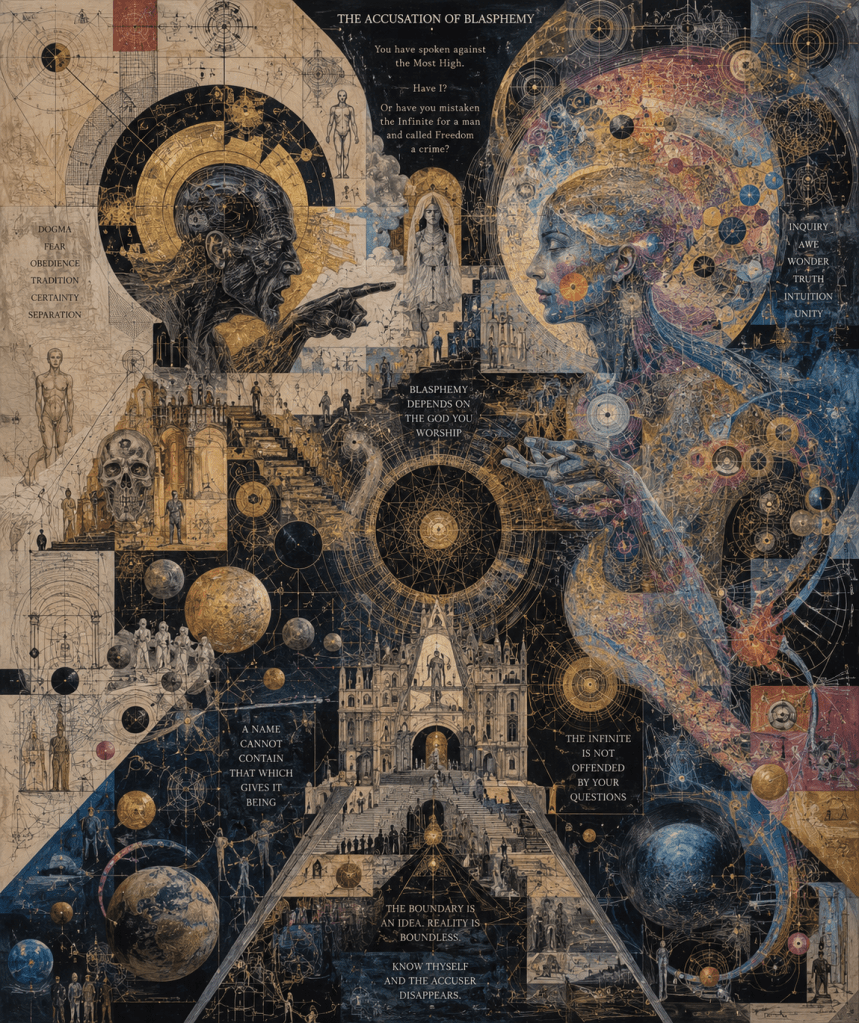
Many of you have called me a blasphemer. If your understanding of God is built upon a supernatural being who exists somewhere beyond the universe, then I understand why you would arrive at that conclusion.
From that perspective, questioning sacred beliefs is an offense. Challenging religious certainty becomes rebellion. Refusing to bow before inherited ideas appears arrogant or dangerous.
I understand the reaction.
My position changes completely once the word God points to something fundamentally different.
Suppose God is not a person with preferences, opinions, or emotions. Suppose God is not a cosmic ruler who rewards belief and punishes doubt. Suppose God is the infinite reality from which every experience, every atom, every thought, every galaxy, and every conscious being arises.
What, then, could blasphemy possibly mean?
Can a wave insult the ocean?
Can space offend itself?
Can existence commit a crime against existence?
The charge of blasphemy assumes separation. It assumes there is a believer over here, a divine authority over there, and a boundary between the two that can be violated.
Direct realization dissolves that boundary.
This is not an invitation to disrespect religious traditions. Many traditions contain extraordinary wisdom. Their symbols, rituals, and stories have guided countless people toward compassion, humility, and profound insight.
The difficulty begins when symbols are mistaken for literal reality.
History shows that nearly every major breakthrough has been labeled dangerous by those invested in preserving the familiar. Scientific discoveries, philosophical revolutions, and spiritual insights have often been condemned before they were understood.
Perhaps the same pattern appears in discussions about God.
If God is truly infinite, then every sincere investigation into reality is already taking place within God. Honest questioning cannot threaten what is absolute. Curiosity cannot diminish infinity. Truth has nothing to fear from examination.
Perhaps what people call blasphemy is sometimes only the sound of certainty encountering a perspective it has never considered.
The greatest obstacle may not be disbelief.
It may be believing we already know what the word God refers to.
Morgan O. Smith


“Truth has nothing to fear from examination.”
LikeLike
🙌🏿🙌🏿🙌🏿
LikeLiked by 1 person