Author, Philosopher, Spiritual Teacher, A Lead Facilitator at Sacred Media's Integral Mastery Academy, Founder of Yinnergy Meditation/Neurofeedback, Bodhi Mental Care & Wellness, Co-founder of KeMor Centre for Innovative Development
When people argue about God, they often assume they are speaking about the same reality. Yet many disagreements arise because each person is referring to an entirely different understanding of God, one shaped by their own stage of psychological, cultural, and spiritual development.
Our concept of God often evolves as our own consciousness evolves.
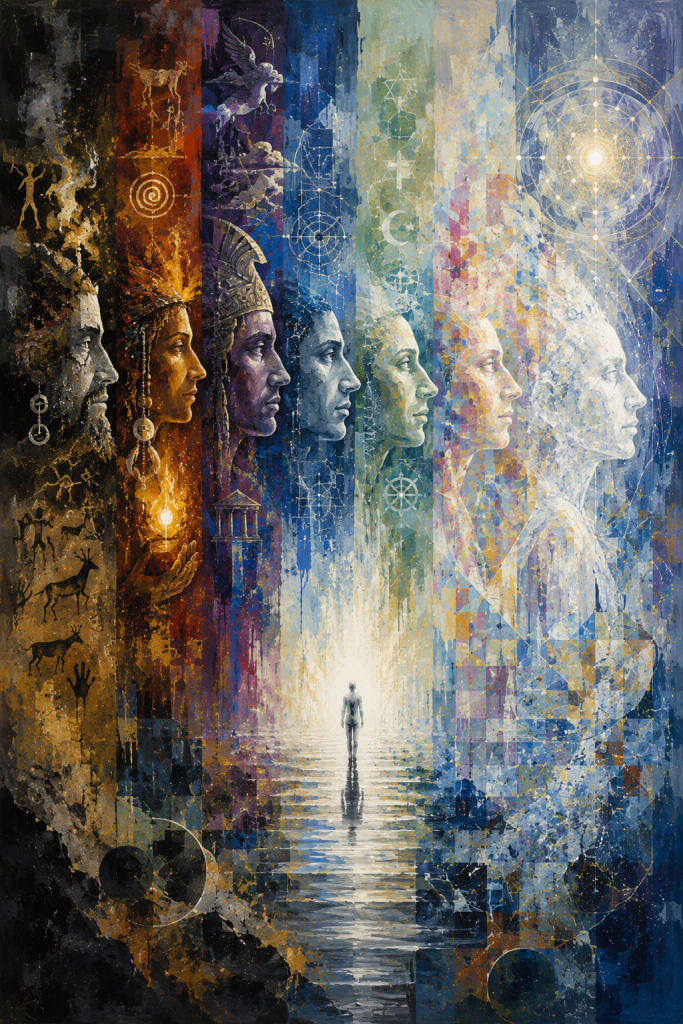
An archaic understanding of God is rooted in survival. The divine is experienced as mysterious, unpredictable, and inseparable from the raw forces of nature. Fear and awe become the primary forms of worship because existence itself feels fragile.
A magical understanding sees God actively intervening in everyday events. Blessings, curses, rituals, omens, and supernatural signs become central. The world feels enchanted, and divine power appears to operate through symbolic acts and sacred objects.
A mythical understanding presents God through sacred stories, unquestionable doctrines, and absolute moral laws. Faithfulness often means loyalty to one’s tradition, while competing beliefs are viewed with suspicion or rejection.
A rational understanding asks difficult questions. Science, philosophy, evidence, and critical thinking become important. God may still exist, but beliefs are expected to withstand intellectual scrutiny rather than rely solely on tradition or revelation.
A pluralistic understanding recognizes wisdom across many religions and philosophies. Rather than insisting that one path possesses the whole truth, it appreciates the possibility that different traditions illuminate different aspects of the same mystery.
An integral understanding attempts to include every previous perspective without dismissing them. Each view is understood as expressing something meaningful within its own context. The question shifts from “Which one is right?” to “What truth is each perspective trying to reveal?”
A super integral understanding goes even further. God is no longer merely an object of belief or a concept to defend. The distinction between God, self, and reality begins to dissolve. Divinity is not encountered as something separate from experience. It is recognized as the very ground from which all experience arises. Every stage, every worldview, every certainty, and every doubt appears as an expression of the same limitless reality.
This progression does not suggest that one stage is morally superior to another or that everyone must follow the same sequence. Human development is complex, and people often embody several perspectives simultaneously depending on the circumstances.
The more interesting question is not whether God exists.
The more revealing question is this.
Which version of God are we talking about?
Our answer may reveal far more about the structure of our own consciousness than about God.
Perhaps the deepest spiritual maturity arrives when we no longer need God to conform to our ideas. Instead, we allow our ideas to dissolve into the mystery they were always pointing toward.
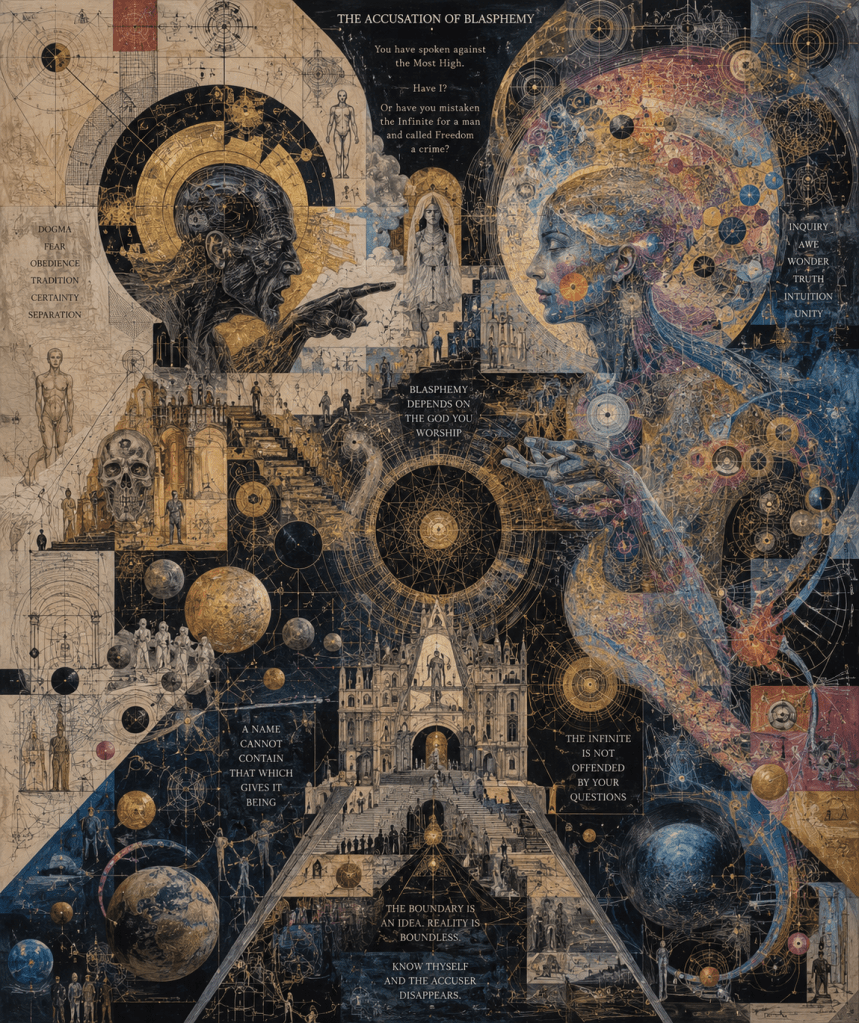
Many of you have called me a blasphemer. If your understanding of God is built upon a supernatural being who exists somewhere beyond the universe, then I understand why you would arrive at that conclusion.
From that perspective, questioning sacred beliefs is an offense. Challenging religious certainty becomes rebellion. Refusing to bow before inherited ideas appears arrogant or dangerous.
I understand the reaction.
My position changes completely once the word God points to something fundamentally different.
Suppose God is not a person with preferences, opinions, or emotions. Suppose God is not a cosmic ruler who rewards belief and punishes doubt. Suppose God is the infinite reality from which every experience, every atom, every thought, every galaxy, and every conscious being arises.
What, then, could blasphemy possibly mean?
Can a wave insult the ocean?
Can space offend itself?
Can existence commit a crime against existence?
The charge of blasphemy assumes separation. It assumes there is a believer over here, a divine authority over there, and a boundary between the two that can be violated.
Direct realization dissolves that boundary.
This is not an invitation to disrespect religious traditions. Many traditions contain extraordinary wisdom. Their symbols, rituals, and stories have guided countless people toward compassion, humility, and profound insight.
The difficulty begins when symbols are mistaken for literal reality.
History shows that nearly every major breakthrough has been labeled dangerous by those invested in preserving the familiar. Scientific discoveries, philosophical revolutions, and spiritual insights have often been condemned before they were understood.
Perhaps the same pattern appears in discussions about God.
If God is truly infinite, then every sincere investigation into reality is already taking place within God. Honest questioning cannot threaten what is absolute. Curiosity cannot diminish infinity. Truth has nothing to fear from examination.
Perhaps what people call blasphemy is sometimes only the sound of certainty encountering a perspective it has never considered.
The greatest obstacle may not be disbelief.
It may be believing we already know what the word God refers to.
Atheistic, theistic, monotheistic, polytheistic, pantheistic, panentheistic, dualistic, and nondualistic. Each of these appears to contradict the others. Each claims to describe reality from a different standpoint. Each attracts devoted followers who often believe their view excludes the rest.
The contradiction exists only while the mind insists on separation. Every philosophy arises from a particular level of perception, development, experience, or realization. Each reveals something genuine, yet none can contain the whole.
The atheist may reject a personal God while recognizing the lawful order of existence. The theist experiences a living relationship with the Divine. The monotheist discovers unity through one supreme source. The polytheist encounters the many faces of the sacred. The pantheist sees God as the universe itself. The panentheist recognizes that the universe exists within God, while God also transcends it. The dualist experiences an apparent distinction between self and reality. The nondualist awakens to the absence of all separation.
None of these perspectives are necessarily false. They become limiting only when they declare themselves to be the final word.
Reality has an extraordinary capacity to express itself through countless perspectives without ever becoming divided. Like light passing through different lenses, the same truth appears in different forms depending on the conditions through which it is perceived.
Absolute Monism does not choose one worldview over another. It includes them all without becoming confined by any of them.
At that level, every distinction dissolves. The categories no longer compete because the awareness that created the categories has been recognized as prior to them. The question is no longer which philosophy is correct. The question becomes, what remains when every concept, every belief, every religion, every denial, and every affirmation are seen as movements within the same indivisible reality?
That recognition is not another philosophy. It is the end of needing one.
The ultimate truth is not found by defending a position. It is found when every position is seen as an expression of the One that has never been divided.
Most people eventually outgrow their childhood ideas about almost everything.
Our tastes in food become more refined. Our understanding of relationships deepens. Our appreciation for music changes. Fashion evolves. Culture shifts. Even our political, moral, and philosophical views often undergo profound transformation as life teaches us new lessons.
Yet there is one idea that frequently remains frozen in time.
Paradise.
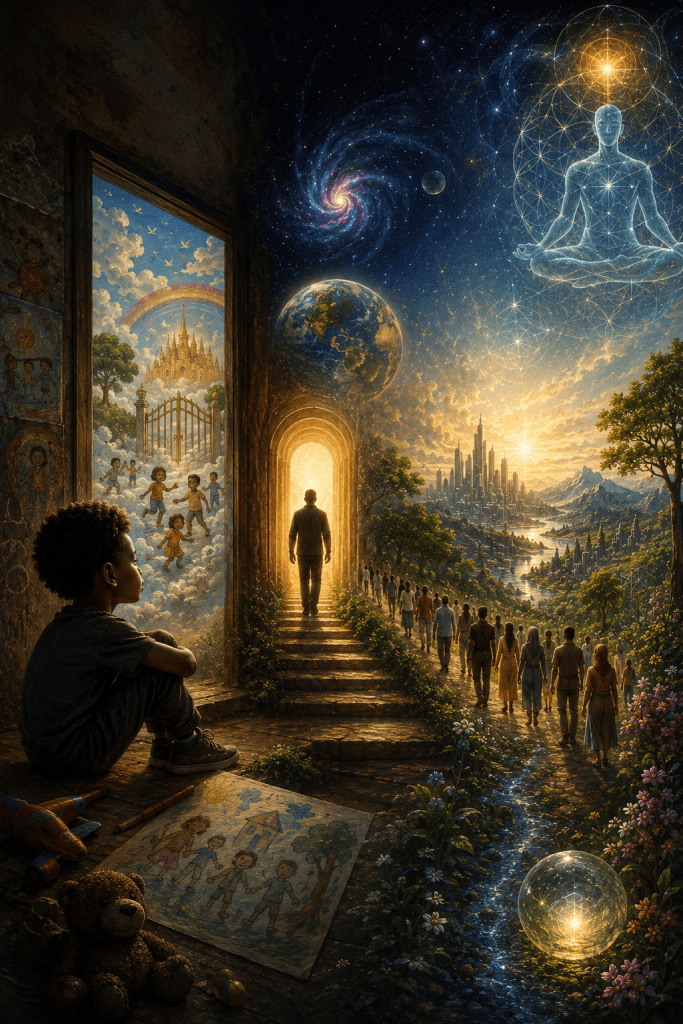
For many adults, heaven still resembles the picture they accepted as children. A beautiful place somewhere above the clouds where good people are rewarded, reunited with loved ones, and live happily forever. Although our understanding of nearly every other aspect of life matures, our image of paradise often remains untouched.
Why?
The answer may have less to do with religion than with psychological development.
Paradise Grows as Consciousness Grows
Every stage of psychological development interprets reality according to its own capacity. Paradise is no exception.
The earliest stage is concerned only with survival. Paradise simply means warmth, food, shelter, and freedom from danger.
As tribal consciousness develops, paradise becomes reunion with ancestors, spirits, and one’s people. Belonging is eternal.
The egocentric stage imagines paradise as limitless pleasure, power, success, and personal fulfillment. Heaven exists for the individual.
The mythic stage transforms paradise into a divine kingdom governed by justice. Those who obey are rewarded. Those who reject divine law are excluded. This is where many traditional religious images of heaven take shape.
The rational stage begins questioning whether heaven exists at all. Paradise may become symbolic, psychological, or simply an unanswered mystery.
The pluralistic stage opens paradise to everyone. Love replaces exclusivity. Compassion becomes more important than belief. Humanity itself becomes the family.
Integral consciousness recognizes that every previous view reflects a particular stage of development rather than an absolute truth. Paradise is increasingly understood as a way of being rather than merely a destination.
Finally, holistic consciousness dissolves the distinction altogether. Paradise is not somewhere else. Reality itself is recognized as the living expression of the Absolute.
The Expanding Circle of Identity
Our understanding of paradise also changes according to the size of our identity.
The egocentric perspective asks:
“How do I get into heaven?”
The ethnocentric perspective asks:
“Which group is chosen?”
The worldcentric perspective asks:
“How can everyone be included?”
The Kosmocentric perspective asks something entirely different.
“Who is it that seeks paradise in the first place?”
Here, the search begins to collapse.
The seeker, the destination, and the journey are all recognized as appearances within one indivisible reality.
Why Do We Stay Attached to Childhood Images?
Children require certainty.
Simple stories offer comfort in the face of death and uncertainty. Those early images become emotionally rooted long before critical thinking fully develops.
Unlike our opinions about careers, relationships, or politics, our beliefs about paradise are rarely revisited with the same willingness to question them. Religious traditions often preserve these images because they provide stability, identity, and hope.
There is nothing inherently wrong with that.
Every stage serves an important purpose.
Problems arise only when we assume that the understanding which comforted us at age five must also satisfy us at age fifty.
The Ultimate Shift
The greatest transformation may not involve discovering a better description of heaven.
It may involve recognizing that paradise was never meant to describe a location.
Perhaps heaven is a symbol pointing toward a realization.
A realization that nothing has ever existed outside the infinite.
A realization that separation was never ultimately real.
A realization that the very awareness reading these words is not traveling toward paradise.
It is the ground from which every idea of paradise has always appeared.
Perhaps the deepest question is not whether heaven exists after death.
Perhaps the deeper question is whether consciousness can awaken enough to recognize paradise before death.
If consciousness itself is the Absolute, then paradise is no longer a promise waiting in the future.
It is reality, seen without the illusion of separation.
This is not simply about affirmations, positive thinking, manifestation, or the power of spoken language. Those ideas remain close to the surface. The deeper meaning reaches beyond the human voice, personal intention, and the individual mind.
You speak everything into existence and do not even realize it.
At the causal level, existence itself is your expression.
Every form that appears, every movement that unfolds, every event that arises, and every world that seems to exist independently emerges from the same beginningless source that you are.
Nothing stands outside of you.
The birth of a star, the movement of a thought, the falling of a leaf, the ending of a relationship, the formation of a galaxy, and the smallest shift within a single cell all belong to one indivisible happening.
That happening has no external author.
It is not being imposed upon reality from somewhere beyond reality.
Existence is expressing itself as everything.
The One Who Speaks Without a Voice
Human beings usually associate creation with deliberate action. Someone decides, acts, and produces a result. Cause appears to precede effect. A person speaks, and something happens.
Causal consciousness does not operate according to this linear sequence.
The voice that speaks existence into being has no mouth. It does not form sentences, construct plans, or choose between possibilities. Its speech is the spontaneous appearance of existence itself.
Mountains are its language.
Bodies are its language.
Silence is its language.
Time, space, matter, thought, sensation, memory, desire, birth, and death are all movements of this wordless declaration.
Creation is not something that occurred once in a remote past. Reality is being spoken now, not through verbal commands, but through the continuous emergence of experience.
You are that emergence.
A Beginningless Beginning
The mind wants to locate a first moment. It asks what started everything, what existed prior to the universe, and what caused the original cause.
These questions assume that reality began somewhere within time.
Time itself is part of what appears.
There was no first moment in the ordinary sense because the causal source does not occupy a position on a timeline. It is not an ancient object hiding behind the universe. It is the timeless ground through which every apparent beginning and ending becomes possible.
Existence is beginningless because the source of existence was never born.
The body had a beginning.
The personality had a beginning.
Your memories had a beginning.
The awareness within which these beginnings are known has no discoverable starting point.
Search directly for the birth of awareness. A memory may arise, but the memory appears within awareness. A story may explain your origin, yet that story is also being witnessed. Every answer appears as another object within the very presence you are attempting to explain.
The source remains prior to every explanation, not earlier in time, but more fundamental than time.
Everything Is Caused by You
The statement “everything is caused by you” can easily be misunderstood.
The personal ego did not manufacture the universe. Your everyday identity is not secretly controlling weather patterns, global events, other people, or every difficulty that enters your life. Such an interpretation would reduce a nondual insight to spiritual grandiosity.
The “you” being described is not the person.
It is the causal ground appearing as the person.
Every cause and every effect arises within the same undivided reality. The hand that acts, the object acted upon, the action itself, and the consequence are not ultimately separate events. They are distinctions created by perception and thought within one continuous movement.
Reality causes itself through itself.
Fire burns wood. Rain nourishes soil. Gravity draws bodies together. Choices alter lives. Countless visible and invisible conditions shape every outcome.
At the relative level, these causes remain meaningful. At the deepest level, none of them operates outside the whole.
Every cause is reality acting.
Every effect is reality receiving its own action.
Both are you, prior to the identity you call yourself.
The Dream of Separation
Separation creates the impression that life is happening to you.
Events seem external. Other people appear completely outside of you. Circumstances arrive from a world that feels independent of your being. You experience yourself as one vulnerable centre among billions of competing centres.
From the causal perspective, the division between inner and outer has not yet formed.
The person, the world, and the experience of the world arise together. A sound cannot appear apart from hearing. A colour cannot appear apart from seeing. A thought cannot appear apart from awareness. The perceived and the perceiver are born within the same act of knowing.
This does not mean physical differences disappear. Your body remains distinct from another body. Your thoughts are not automatically available to someone else. Practical boundaries continue to matter.
Nonduality does not deny difference.
It reveals that difference does not require absolute separation.
Waves differ in shape, force, duration, and direction, yet no wave contains a substance separate from the ocean. Each wave is the ocean taking temporary form.
Your individuality is real as an expression.
It is not independent as an existence.
Your Words Are Part of the Creative Movement
Spoken words still matter.
Language shapes attention, reinforces beliefs, influences relationships, and directs human action. Words can open possibilities or close them. They can encourage, deceive, wound, clarify, liberate, or imprison.
Yet words do not create reality from outside reality. They are movements through which reality modifies its own appearance.
A thought arises.
The body gives it sound.
Another nervous system receives it.
Meaning forms.
Behaviour changes.
A new sequence of events begins.
What appears to be one person speaking to another is existence communicating with itself through two localized expressions.
The same consciousness speaks and listens.
The same reality questions and answers.
The same source forgets itself, seeks itself, and recognizes itself.
Even the person who insists that words have no creative power is using words to introduce that position into existence.
The Causal Level Is Not Personal Control
Causal realization should never be confused with personal omnipotence.
The ego hears “you caused everything” and imagines itself sitting at the centre of the universe, commanding events according to personal desire. It wants authorship, ownership, recognition, and control.
The causal Self requires none of these.
It does not stand over existence as a ruler directing creation from a distance. It is creation itself, appearing as every ruler and every subject, every command and every refusal, every desire and every disappointment.
Your personal mind cannot decide every outcome because your personal mind is itself an outcome. Its thoughts arise through biology, memory, conditioning, culture, language, environment, and countless forces it did not independently choose.
Yet all of these forces arise within the greater reality that you are.
The individual is not the controller of the whole.
The individual is one of the ways the whole moves.
Responsibility Without Blame
Recognizing yourself as the causal ground does not mean blaming yourself for every painful event.
Blame belongs to the psychological self. It assumes that a separate person should have controlled conditions that were often far beyond personal control.
Causal responsibility is different.
It is not guilt.
It is inseparability.
Nothing can be dismissed as completely unrelated to the whole. Suffering anywhere occurs within the same reality that appears here as you. Compassion becomes more than a moral obligation because the apparent other is not entirely other.
When you harm another, existence wounds itself through your actions.
When you care for another, existence responds to itself with tenderness.
When you become more conscious, reality becomes conscious of its own movement at this particular point of expression.
This recognition does not erase accountability.
It deepens it.
Your actions matter because no action is truly isolated. Every gesture enters a field of consequences. Every word travels farther than the speaker can measure. Every choice becomes part of conditions that shape what follows.
The Silence Prior to Creation
What exists prior to the universe being spoken?
Not an empty void waiting for sound.
Not a distant deity preparing to create.
Not a hidden object concealed behind appearances.
There is only the unformed capacity for everything, silent not because nothing is present, but because no distinction has yet arisen.
That silence remains here beneath every experience.
Thoughts do not destroy it.
Sounds do not interrupt it.
Movement does not leave it.
The entire universe appears as a modulation of what never moves.
You are that stillness and every vibration arising within it.
You are the silence and the spoken world.
You are the causal depth from which existence emerges, the forms through which it becomes visible, and the awareness through which it knows itself.
Everything is caused by you because there is no second reality available to cause it.
Everything is spoken by you because every voice belongs to the same beginningless source.
Everything is you, not as possession, not as personal achievement, but as the indivisible fact of being.
Even Opposition Is Your Creation
Some will say this is egotistical.
That judgment, too, has been spoken into existence by the same beginningless reality.
The one who agrees, the one who resists, the one who mocks, the one who rejects, and the one who opposes are not standing outside the whole. Their objections are movements of the same source.
Even opposition is reality appearing to argue with itself.
You created that into existence as well.
Not you as the personality, but you as the undivided ground from which every voice, criticism, affirmation, denial, and misunderstanding arises.
Even all who oppose you are you appearing in another form, defending another viewpoint, expressing another movement within the totality.
Nothing escapes what you are.
Not praise.
Not resistance.
Not disbelief.
Not condemnation.
Not the accusation of arrogance.
The ego may say, “I created everything.”
Truth says, “There is no separate I and no separate everything.”
The accusation of egotism assumes that an isolated person is claiming personal ownership over existence. Nondual realization makes no such claim. It dissolves the presumed owner along with everything the owner hoped to possess.
There is only the beginningless whole appearing as creator, creation, believer, skeptic, supporter, opponent, accusation, defence, and the silence holding them all.
The question is no longer whether you are creating reality.
The deeper question is this:
Who are you before the one who claims to be the creator appears?
Language faces an impossible task when attempting to speak about what precedes all appearances.
Every word points toward something. Every concept distinguishes one thing from another. Every description relies upon contrast, location, qualities, relationships, or characteristics. Yet what many contemplative traditions refer to as the Absolute, the Ground of Being, or pure reality before conceptualization possesses none of these.
Nothingness is not called nothingness because it is empty in the ordinary sense.
An empty room still contains space. A vacant lot still exists somewhere. Even darkness can be perceived. Ordinary emptiness remains something that can be identified, experienced, or described.
Nothingness, in its deepest philosophical and mystical meaning, points toward that which cannot be located, measured, conceptualized, perceived as an object, or distinguished from anything else.
Location cannot be assigned to it because location itself appears within it.
Time cannot contain it because time arises within experience.
Attributes cannot be given to it because attributes create distinctions.
Existence and nonexistence cannot adequately describe it because both are conceptual categories.
This creates a paradox.
The moment a reference is made, the reference becomes something. The moment a concept is formed, a boundary appears. The moment a description is offered, what is described has already been transformed into an object of thought.
Nothingness is therefore not a description. It is a linguistic surrender.
The word functions less as a definition and more as an admission that thought has reached its limit.
Mystics throughout history have encountered this difficulty. Some called it Brahman. Others called it Sunyata. Some referred to it as the Tao. Others spoke of the Godhead, the Absolute, the Unborn, or the Nameless.
Each term points toward the same problem.
Whatever is being indicated cannot actually be captured by the indication.
A finger pointing toward the moon is not the moon.
A concept pointing toward reality is not reality.
A word pointing toward nothingness is not nothingness.
From a nondual perspective, even calling it nothingness can be misleading. The term may suggest absence, voidness, or negation. Yet what is being pointed toward is not the absence of reality. It is reality prior to division into existence and nonexistence.
Thought asks, “What is it?”
Direct realization reveals that the question itself cannot reach it.
The mind searches for an object and finds none.
It searches for a location and finds none.
It searches for a boundary and finds none.
It searches for a reference point and finds none.
Because no reference can be established, language falls silent.
The strangest paradox of human existence is that we rely on language to understand reality while the deepest parts of reality seem to exist beyond language entirely.
A word can ignite a war, resurrect a forgotten memory, or make a stranger weep. Entire civilizations rise from shared symbols and stories. Human beings navigate life through names, categories, and explanations so constantly that description begins to feel indistinguishable from reality itself.
Yet the moment experience becomes truly immediate — raw grief, overwhelming beauty, profound stillness, unconditional love — words begin to fracture around its edges. Something essential escapes translation.
Every word depends upon distinction. Language functions by separating one thing from another so the mind can navigate experience. Light becomes different from darkness. Self becomes different from other. Beginning becomes different from ending.
But what happens when reality is encountered prior to division?
Ordinary language begins to fail.
Mystics throughout history arrived at the same dilemma. Whatever they discovered could not be fully translated into thought. Some called it God. Others called it emptiness, Brahman, Tao, pure awareness, or the Absolute. Different names emerged across cultures and centuries, yet every label pointed beyond itself.
A map drawn in ash cannot contain the wildfire itself.
A person can spend decades studying spiritual systems, memorizing sacred texts, and refining belief structures while never directly encountering what the words attempt to reveal. Language can guide attention, but it cannot substitute for realization.
This becomes especially clear during profound states of meditation or radical presence. Thought slows. Internal narration weakens. Identity loosens its grip. Experience no longer feels divided into observer and observed. Something vast and immediate remains, yet the mind struggles to explain it afterward.
Silence suddenly carries more honesty than explanation.
Not because truth is irrational, but because reality appears prior to conceptual separation. Words emerge afterward as echoes attempting to describe what cannot fully become an object of thought.
The mind naturally resists this insight. Human beings seek stability through conclusions. Definitions create psychological structure. Naming something creates the feeling of control over it. This tendency explains why religious institutions, philosophical systems, and ideological movements often become rigid.
But reality itself remains fluid and immeasurable.
Attempts to imprison the infinite within language eventually collapse into contradiction. God is described as both personal and impersonal. Emptiness becomes fullness. Enlightenment appears both ordinary and transcendent. Opposites dissolve because language was designed to organize division, not indivisibility.
Zen masters understood this deeply. Some answered spiritual questions with silence. Others responded with paradox, laughter, or seemingly irrational statements meant to loosen attachment to concepts. Their aim was not confusion for its own sake, but direct seeing.
A sunset does not need philosophy to radiate beauty. Love does not require intellectual agreement to be felt.
Reality arrives before commentary.
Perhaps this is why awakening often feels less like gaining knowledge and more like recognizing what has always been here beneath mental noise. The search softens because the seeker realizes what was being sought was never absent.
Words may continue afterward. Teaching may continue. Yet something fundamental changes. Language becomes symbolic rather than absolute. Concepts become tools rather than prisons mistaken for truth.
The nameless remains untouched behind every sentence.
We define nations, identities, emotions, philosophies, and even the boundaries of the cosmos itself. The mind survives through categorization. Without labels, ordinary navigation becomes difficult. Language organizes perception into manageable fragments, allowing consciousness to interpret experience through patterns and distinctions.
Yet something extraordinary happens when the mind attempts to define the infinite.
It fails.
Not because the infinite is irrational, but because definition itself depends upon limitation. To define something means to separate it from what it is not. A tree is not the sky. Water is not stone. The body is not the chair. Every definition creates borders.
The infinite has no border.
This creates a profound paradox. The moment the infinite is defined, it becomes psychologically reduced into an object of thought rather than the living totality from which thought itself emerges.
People speak about God, consciousness, enlightenment, emptiness, Brahman, Tao, or ultimate reality as though these words contain what they point toward. But words are symbols, not the living actuality itself. A menu is not a meal. A map is not the terrain. Spiritual language often becomes mistaken for realization.
Concepts can inspire awakening. They cannot replace it.
A person may memorize every sacred text ever written and still remain trapped within mental abstraction. Another person may sit silently beneath a tree, beyond philosophy and doctrine, and directly encounter a depth untouched by conceptual thought.
Reality does not require intellectual permission to exist.
The mind struggles with this because it seeks stability through certainty. Certainty creates psychological comfort. Ambiguity threatens identity. This is why people cling to rigid ideologies, religious systems, or philosophical conclusions. Definitions provide the illusion of control over existence.
But existence refuses confinement.
Life continuously overflows the structures created to contain it. Every scientific breakthrough revises older assumptions. Every spiritual revelation dissolves previous certainty. Every profound mystical experience shatters the mental boundaries once believed to be absolute.
The infinite remains untouched by every framework attempting to grasp it.
Ancient sages understood this deeply. Lao Tzu opened the Tao Te Ching by warning that the Tao which can be spoken is not the eternal Tao. Advaita Vedanta points toward neti neti — “not this, not that” — stripping away every conceptual identification. Zen dismantles attachment to intellectual understanding through direct experience and paradox.
These traditions are not anti-intellectual. They simply recognize the limits of conceptual thought.
Thought is a tool. A remarkable one. But a tool should not be mistaken for the source of reality itself.
Awareness exists before thought comments on it.
Silence exists before language interprets it.
Being exists before identity claims ownership over it.
This recognition changes the entire spiritual journey. Seeking shifts from accumulating beliefs to dissolving false certainty. One no longer attempts to imprison truth inside definitions but instead becomes available to direct experience without resistance.
The infinite cannot be possessed mentally because the mind itself appears within the infinite.
A wave cannot contain the ocean from which it rises.
Perhaps this is why the deepest realizations often arrive with humility rather than triumph. The closer one moves toward ultimate reality, the more obvious it becomes that existence exceeds every philosophical system ever created.
No final sentence survives there.
Only openness. Only presence. Only this immeasurable reality appearing as everything.
Every religion attempts to speak about God. Every atheist attempts to reject God. Every philosopher attempts to define God. Every mystic attempts to dissolve into God.
Yet all of them arrive too late.
The moment a claim is made, reality has already been divided into subject and object, speaker and spoken, believer and belief. Language slices existence into pieces so the mind can navigate experience. Useful for survival. Useful for communication. Completely insufficient for what precedes all categories.
God is not hiding behind concepts. Concepts are hiding within God.
The mind wants certainty. It wants something graspable. Something stable enough to worship, deny, analyze, or defend. But whatever can be captured by thought becomes an object among other objects. God cannot be reduced to an object because every object appears within the field of awareness itself.
This is why every final statement about ultimate reality collapses under its own weight.
“God exists.” “God does not exist.” “Everything is God.” “There is no God.”
Each statement carries traces of truth while simultaneously missing the mark. Every declaration emerges after the fact, after consciousness has already formed distinctions within itself.
Ultimate reality is prior to theology. Prior to philosophy. Prior to perception. Prior even to the one attempting to understand it.
Silence has always been closer than explanation.
Not the silence of suppression, but the silence that remains untouched before thought organizes the world into names and meanings. A newborn experiences reality before language intervenes. Deep meditation reveals a similar opening. Identity softens. Concepts lose their grip. Existence shines without commentary.
No claim survives there.
Only direct being.
This is why sages throughout history often spoke in paradox, contradiction, or negation. Not because truth is irrational, but because ordinary language depends on separation. Nondual realization exposes a condition where separation never truly occurred.
The wave tries to define the ocean while being made entirely of ocean.
Every doctrine eventually becomes a finger pointing away from itself. Problems begin when the finger is worshipped instead of what it reveals.
God cannot be contained inside scripture, ritual, ideology, or disbelief. Every system emerges within the very reality it attempts to explain. The finite cannot fully enclose the infinite because the infinite already contains the finite.
Even the word “God” arrives too late.
What you are looking for exists before the search begins. Before identity forms. Before memory. Before perception says “this” and “that.” Reality simply is, whole and indivisible, untouched by the arguments constructed around it.
Perhaps this is why genuine awakening feels less like acquiring knowledge and more like the collapse of false certainty.
Nothing new is added. Something imagined falls away.
A curious statement arises: God is an atheist. Not as denial, but as a revelation of what cannot be confined to belief. Belief requires distance; someone who believes, and something believed in. That distance dissolves at the level of the Absolute.
God, understood as the ground of all being, does not stand apart from existence. No position can be taken outside of what already is. Theism proclaims devotion toward a divine presence. Pantheism recognizes divinity within all forms. Panentheism holds both transcendence and immanence. Agnosticism suspends certainty. Atheism rejects the claim altogether. Each appears to oppose the other, yet all emerge from the same source.
A wave arguing with another wave about the existence of the ocean misses the quiet truth beneath the motion. The ocean never needs to assert itself. No defense is required. No belief is necessary. Presence alone is sufficient.
God, in this sense, cannot be a theist, because there is nothing separate to believe in. God cannot be an atheist either, in the conventional sense, because nothing exists outside of that totality to deny. Yet from the human vantage point, the Absolute appears as both belief and disbelief, devotion and rejection, clarity and doubt.
Atheism becomes one expression of the divine refusing to objectify itself. The refusal to project an external deity is not always a rejection of truth; sometimes it is an unconscious recognition that truth cannot be turned into an object at all. What is rejected is often a concept, not the living reality prior to concepts.
The ground of being remains untouched by every conclusion formed about it. Arguments unfold within it, philosophies rise and fall within it, identities shape themselves and dissolve within it. Nothing stands outside to validate or invalidate what already includes everything.
Silence reveals more than assertion here. That silence does not belong to any religion or ideology. It is the same stillness present before belief forms and after it fades.
What, then, is left?
A direct knowing without position. A presence without identity. A reality that does not require agreement to be what it is.
God, as the Absolute, holds space for the believer kneeling in prayer and the skeptic dismantling every claim. Both movements are gestures within the same indivisible whole. Neither completes it. Neither threatens it.
Seeing this does not demand adopting a new belief. It invites the collapse of the need to hold one at all.
And what remains cannot be called belief or disbelief; only what is, prior to both.