Which God Do You Believe In?
When people argue about God, they often assume they are speaking about the same reality. Yet many disagreements arise because each person is referring to an entirely different understanding of God, one shaped by their own stage of psychological, cultural, and spiritual development.
Our concept of God often evolves as our own consciousness evolves.
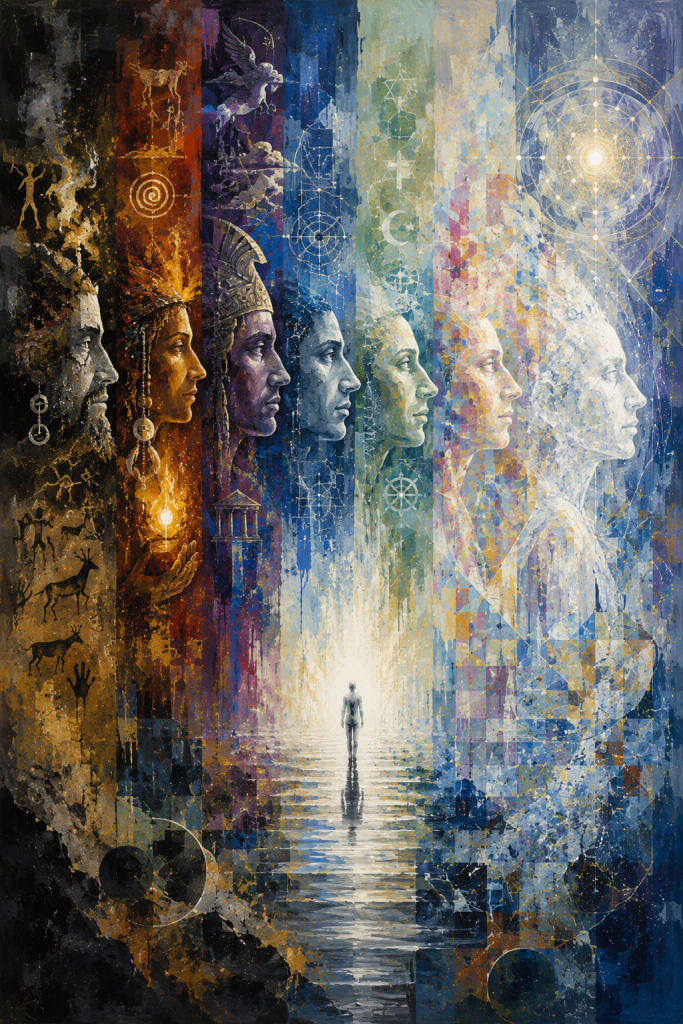
An archaic understanding of God is rooted in survival. The divine is experienced as mysterious, unpredictable, and inseparable from the raw forces of nature. Fear and awe become the primary forms of worship because existence itself feels fragile.
A magical understanding sees God actively intervening in everyday events. Blessings, curses, rituals, omens, and supernatural signs become central. The world feels enchanted, and divine power appears to operate through symbolic acts and sacred objects.
A mythical understanding presents God through sacred stories, unquestionable doctrines, and absolute moral laws. Faithfulness often means loyalty to one’s tradition, while competing beliefs are viewed with suspicion or rejection.
A rational understanding asks difficult questions. Science, philosophy, evidence, and critical thinking become important. God may still exist, but beliefs are expected to withstand intellectual scrutiny rather than rely solely on tradition or revelation.
A pluralistic understanding recognizes wisdom across many religions and philosophies. Rather than insisting that one path possesses the whole truth, it appreciates the possibility that different traditions illuminate different aspects of the same mystery.
An integral understanding attempts to include every previous perspective without dismissing them. Each view is understood as expressing something meaningful within its own context. The question shifts from “Which one is right?” to “What truth is each perspective trying to reveal?”
A super integral understanding goes even further. God is no longer merely an object of belief or a concept to defend. The distinction between God, self, and reality begins to dissolve. Divinity is not encountered as something separate from experience. It is recognized as the very ground from which all experience arises. Every stage, every worldview, every certainty, and every doubt appears as an expression of the same limitless reality.
This progression does not suggest that one stage is morally superior to another or that everyone must follow the same sequence. Human development is complex, and people often embody several perspectives simultaneously depending on the circumstances.
The more interesting question is not whether God exists.
The more revealing question is this.
Which version of God are we talking about?
Our answer may reveal far more about the structure of our own consciousness than about God.
Perhaps the deepest spiritual maturity arrives when we no longer need God to conform to our ideas. Instead, we allow our ideas to dissolve into the mystery they were always pointing toward.
Morgan O. Smith
 Morgan O. Smith