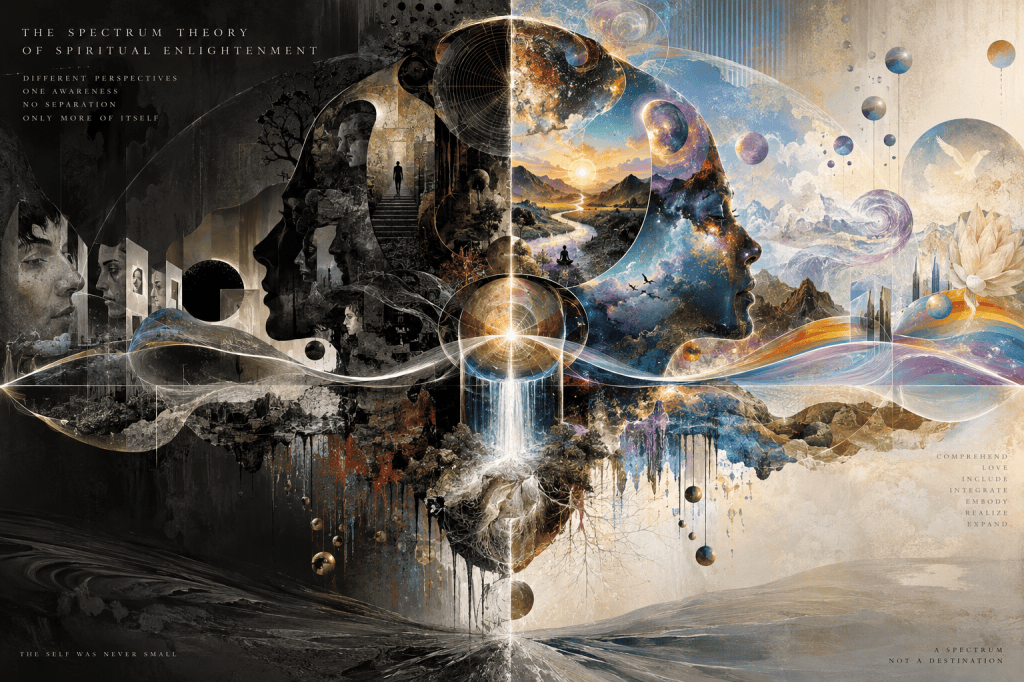
Spiritual enlightenment may be better understood as a spectrum.
This challenges one of the oldest assumptions surrounding enlightenment: that someone either has it or does not.
Enlightened. Unenlightened.
Awake. Asleep.
Self-realized. Ignorant.
Such divisions may be useful when describing a radical shift in consciousness, but they become inadequate when we begin examining the enormous differences between people who have undergone profound spiritual realization.
Two individuals may both recognize the nondual nature of reality and still differ tremendously in their capacity for love, emotional integration, intellectual complexity, perspective-taking, creativity, compassion, self-awareness and their ability to function within the complexity of human life.
This suggests something important.
Realization may happen, while enlightenment continues to unfold.
Enlightenment Is Not Simply What You Experience
Mystical experience alone cannot adequately define enlightenment.
A person may experience ego dissolution, timelessness, boundlessness, unity, emptiness or the disappearance of the subject-object boundary. These experiences can radically alter one’s understanding of reality.
Yet experience eventually encounters interpretation.
The human organism must somehow understand what occurred.
A Christian mystic may interpret unity through Christ. An Advaita practitioner may interpret it through Brahman. A Buddhist may describe emptiness. A neuroscientist may speak about changes within the brain’s construction of selfhood.
The experience may contain striking similarities while the interpretation reflects the developmental capacity of the person experiencing it.
This raises a provocative possibility:
What if enlightenment is not measured solely by how deeply you can disappear, but also by how much reality you can contain when you return?
The Capacity to Hold More
Perhaps spiritual development can partly be understood as increasing capacity.
The more you can comprehend.
The more you can love.
The more perspectives you can hold simultaneously.
The more contradiction you can tolerate without immediately forcing reality into either-or categories.
The more emotional intensity you can experience without becoming completely possessed by it.
The more uncertainty you can encounter without manufacturing certainty simply to make yourself comfortable.
The more of yourself you can observe without defending an identity.
The more of another person you can understand without requiring them to resemble you.
Something begins expanding.
Not necessarily the Self, because from the nondual perspective the Self was never small.
What expands is the human capacity to consciously express what has always been unlimited.
Depth and Breadth Are Different
Someone can go extraordinarily deep while remaining relatively narrow.
This distinction deserves attention.
A profound meditator might enter states of consciousness inaccessible to most people while still possessing rigid cultural assumptions.
A brilliant philosopher might understand dozens of perspectives intellectually while remaining emotionally defended.
A deeply compassionate person may possess extraordinary interpersonal wisdom without having experienced nondual realization.
A mystic may recognize the Absolute while still carrying unresolved psychological conditioning.
These are different dimensions of development.
Calling all of them simply “spiritual advancement” obscures what is actually happening.
A more complete model of enlightenment would therefore require several dimensions.
Depth concerns how completely consciousness penetrates the apparent separation between observer and observed.
Breadth concerns how many perspectives, systems, cultures, disciplines and modes of knowing can be included within one’s understanding.
Integration concerns how thoroughly unconscious, emotional and psychological material becomes incorporated rather than denied, projected or spiritually bypassed.
Embodiment concerns whether realization actually changes how someone lives, relates, creates, responds and participates in the world.
We could express the basic model as:
Enlightenment = Depth × Breadth × Integration × Embodiment
This is not intended as a literal mathematical equation. It is a conceptual instrument.
Its purpose is to prevent one extraordinary dimension from being mistaken for the whole.
Absolute Realization, Relative Development
Here lies an apparent paradox.
The Absolute does not develop.
If nonduality is ultimately true, then there cannot be more or less of the Absolute. There cannot be 40 percent Brahman, 72 percent emptiness or 95 percent pure awareness.
What is fundamental simply is.
Yet the organism through which realization expresses itself certainly develops.
The nervous system develops.
Language develops.
Emotional intelligence develops.
Perspective-taking develops.
Ethical sensitivity develops.
Creativity develops.
Conceptual sophistication develops.
The ability to tolerate complexity develops.
This means absolute realization and relative development should not be confused.
Someone may recognize what is timeless while still being a very particular human being shaped by history, biology, culture, trauma, education and psychological conditioning.
Enlightenment does not necessarily erase the relative human structure.
It changes the relationship to it.
The Number of Perspectives You Can Become
Perspective-taking may be one of the most overlooked dimensions of spiritual maturity.
Early consciousness tends to experience its own perspective as reality itself.
“This is what happened.”
“This is what God wants.”
“This is who I am.”
“This is who you are.”
Greater awareness begins noticing something strange.
Every perspective reveals something while simultaneously concealing something.
Move positions and reality changes.
The child sees one world.
The parent sees another.
The scientist sees another.
The artist sees another.
The mystic sees another.
The atheist sees another.
The person who hurt you sees another.
None necessarily possesses the complete picture.
Spiritual maturity may therefore involve becoming increasingly capable of moving between perspectives without being imprisoned by any of them.
Eventually something even stranger becomes apparent.
The perspectives themselves are occurring within awareness.
Then the question changes from:
Which perspective is ultimately correct?
to:
What is it that can become all of these perspectives without being limited to any of them?
That question points directly toward nonduality.
Love as Expanded Identity
Love also changes when viewed through this model.
Love is usually understood emotionally. We love certain people because they matter to us.
Nondual realization introduces another possibility.
What happens when the boundary defining “me” becomes less convincing?
Compassion may no longer arise merely because one has been instructed to care about others.
Another person’s suffering begins to matter because “other” has become philosophically and experientially unstable.
Their consciousness is no longer entirely foreign territory.
The expansion of love may therefore correspond with an expansion of identity.
First, myself.
Then my family.
My community.
My people.
Humanity.
Sentient life.
Life itself.
Existence.
Eventually the circle collapses because there is nowhere outside it.
Love becomes less about extending kindness from one separate being toward another and more about reality recognizing itself through apparent difference.
Enlightenment Does Not Make You Finished
Perhaps one of the most dangerous ideas surrounding enlightenment is the belief that awakening makes further development unnecessary.
That belief can transform realization into another identity.
“I am enlightened.”
Now the ego possesses the absence of ego.
A remarkably clever maneuver.
Genuine realization may actually make development more demanding because fewer psychological hiding places remain convincing.
There can still be conditioning to examine.
Relationships to repair.
Knowledge to acquire.
Blind spots to discover.
Emotional capacities to strengthen.
Perspectives to encounter.
Humanity to embody.
Awakening does not necessarily end development.
It may remove the central illusion around which development previously revolved.
A Spectrum Without a Final Number
The spectrum model should not become another spiritual ranking system.
Its purpose is not to assign enlightenment scores.
The moment we begin arguing that one person is “Level 8 enlightened” while another is “Level 5,” we risk rebuilding hierarchy around something that fundamentally undermines the separate self seeking status.
The spectrum is multidimensional.
Someone may possess extraordinary contemplative depth but limited psychological integration.
Another person may demonstrate remarkable compassion and embodiment while having little interest in metaphysics.
Another may possess tremendous intellectual breadth but little experiential realization.
Development can be uneven.
That unevenness is precisely why a spectrum model becomes useful.
It allows us to stop pretending that enlightenment must produce identical human beings.
The Strange Conclusion
The deepest realization may reveal that nothing needs to become enlightened.
What you fundamentally are was never trapped.
Awareness itself was never confused.
The Absolute never forgot itself.
The person was the apparent location through which forgetting and remembering occurred.
Yet something continues after that recognition.
The human expression can become wider.
More integrated.
More sensitive.
More capable of holding contradiction.
More capable of intimacy.
More capable of uncertainty.
More capable of seeing through its own assumptions.
More capable of allowing perspectives that once threatened its identity.
More capable of loving without possession.
Perhaps enlightenment contains two movements that appear contradictory only when confused with one another.
One movement reveals that there is nowhere to go.
The other reveals that development has no obvious endpoint.
The Absolute is complete.
Its expression through a human life is not.
This may be one of the great paradoxes of spiritual enlightenment:
You can realize that you are already everything while continuing to discover how much more of everything you are capable of consciously containing.
Morgan O. Smith