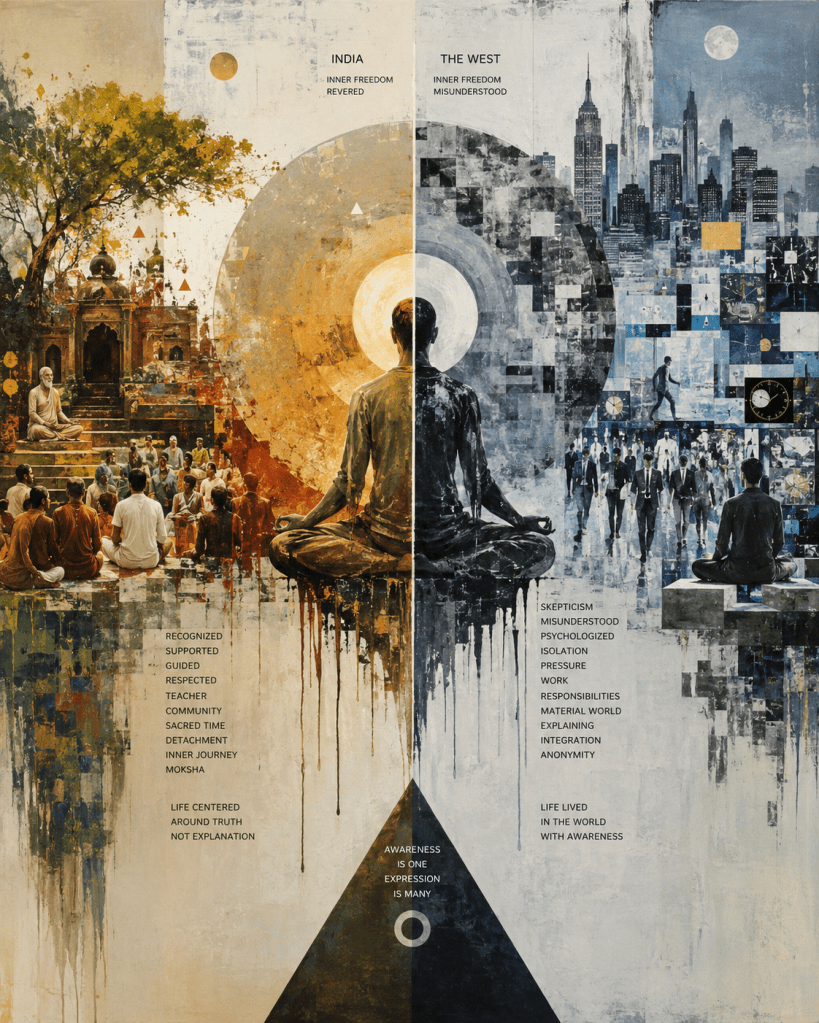
Enlightenment is often described as universal. The realization itself does not belong to any nation, religion, or culture. Awareness is not Indian. Awareness is not Western. It is beyond every identity we create. Yet the way enlightenment unfolds in a person’s life can be dramatically shaped by the society surrounding them.
Culture does not determine awakening. It determines how awakening is received.
Imagine two people who have arrived at the same profound realization. Both have seen through the illusion of a separate self. Both recognize consciousness as the ground of existence. Both live from the same awakened awareness. One lives in India. The other lives in North America.
Their inner reality may be identical, yet their daily lives could hardly look more different.
For thousands of years, India has preserved traditions that regard liberation as one of life’s highest possibilities. Spiritual practice has long been woven into ordinary life. Terms such as moksha, samadhi, karma, and nonduality have existed within the public imagination for centuries. Even those who have never experienced awakening may understand that such a possibility exists.
This creates an environment where an awakened person is more likely to be recognized, supported, or even sought out. Teachers often emerge naturally because there are students looking for guidance. Communities exist where silence is respected, contemplation is encouraged, and the pursuit of truth is considered a meaningful way to live.
The modern West developed along a different path.
Scientific inquiry, technological progress, economic productivity, and personal achievement became dominant values. These accomplishments have brought extraordinary advances, yet they have also shaped how unusual states of consciousness are interpreted. A person describing the disappearance of the separate self may be viewed through psychological, neurological, or philosophical lenses before being understood spiritually.
An awakened individual may therefore continue working a regular job, paying bills, raising children, or quietly practicing meditation without ever speaking publicly about their realization. Some remain anonymous for life, not because their realization is incomplete, but because the culture offers few places where such understanding is easily recognized.
This contrast raises an interesting question.
How many enlightened individuals have lived unnoticed simply because no one around them possessed the language to recognize what had occurred?
History remembers the great sages whose teachings survived. It says very little about those who awakened while working in factories, teaching classrooms, repairing automobiles, or sitting alone in apartments overlooking crowded cities.
Perhaps enlightenment has always been far more common than we imagine.
Recognition depends not only upon realization itself but also upon whether a culture has developed the capacity to perceive it.
A society that values external success may overlook inner freedom. A society that values inner realization may overlook worldly achievement. Neither perspective is complete by itself.
Human development reaches its fullest expression when both dimensions mature together. Outer progress improves civilization. Inner realization transforms the one experiencing civilization.
Neither India nor the West possesses the whole picture.
One has preserved profound maps of consciousness. The other has demonstrated remarkable advances in science, medicine, and human rights. Perhaps the future belongs to neither tradition alone, but to a deeper integration where wisdom and innovation develop side by side.
When awakening no longer appears unusual, humanity itself may have entered a new stage of development.
The question may not be whether enlightenment belongs more naturally to East or West.
The deeper question is whether humanity is becoming mature enough to recognize it wherever it appears.
Morgan O. Smith

