The Day I Understood Yoga
There are experiences that give you new information, and there are experiences that dismantle the very structure through which information is understood.
My spiritual awakening belonged to the latter.
Something happened that I could never have understood through philosophy alone. My body began moving involuntarily. Different parts of my body moved in different directions without any conscious intention on my part. From the outside, someone might have thought I was experiencing some form of seizure. From within the experience, however, something completely different was occurring.
I wasn’t experiencing a body that had simply gone out of control.
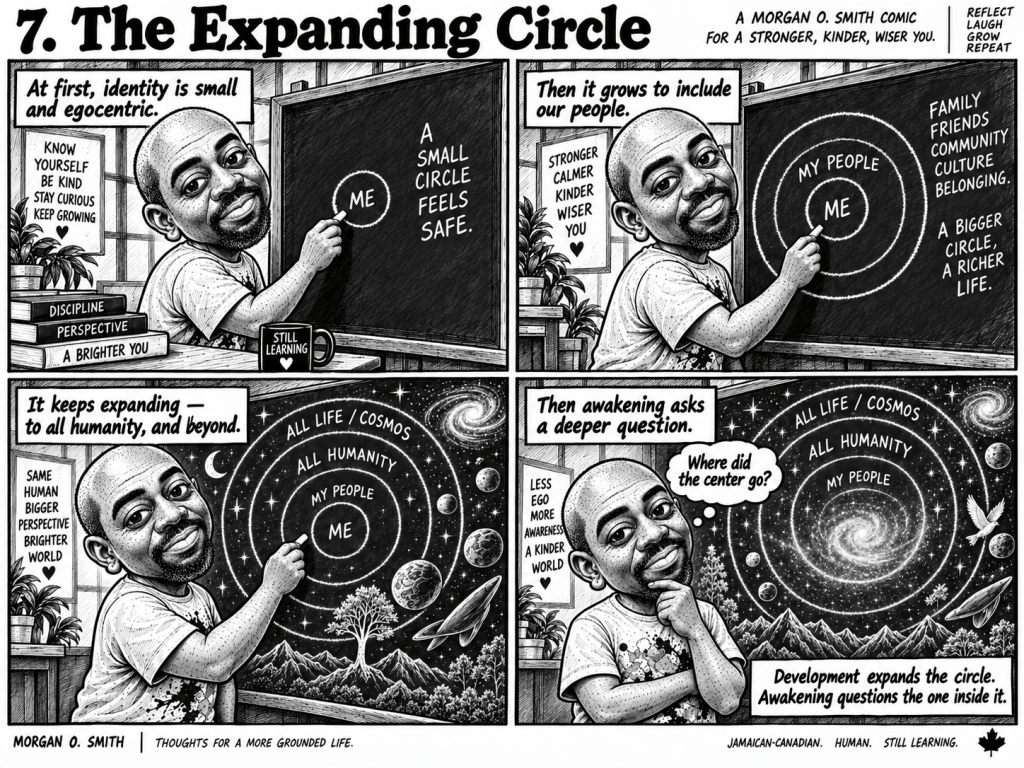
I was experiencing the disappearance of the distinction between my body and the universe.
When I moved, the universe moved.
When the universe moved, I moved.
There was no separation between the two.
For the first time, I understood Yoga.
Not yoga merely as a collection of physical postures.
Not yoga as stretching, breathing, flexibility, or exercise.
I understood Yoga with a capital Y.
The Universe Was Not Somewhere Else
Ordinary consciousness is organized around an assumption so fundamental that we rarely notice it.
I am here.
The world is there.
My body occupies this particular location. Other objects occupy other locations. I look outward from somewhere behind my eyes and experience a universe surrounding me.
That arrangement feels completely natural.
During my awakening, it disappeared.
Every location seemed to occupy the same nonlocal space.
That statement sounds contradictory because language depends upon distinctions. A location is supposed to be different from another location. Here cannot simultaneously be there. My body cannot simultaneously occupy every possible position.
Yet the experience wasn’t conceptual.
It was immediate.
Space no longer seemed divided into separate locations in the ordinary way. The usual distinction between an observer located somewhere and a universe extending outward from that observer was absent.
There was no meaningful boundary where “me” ended and “universe” began.
Every Asana at Once
Something even stranger accompanied this.
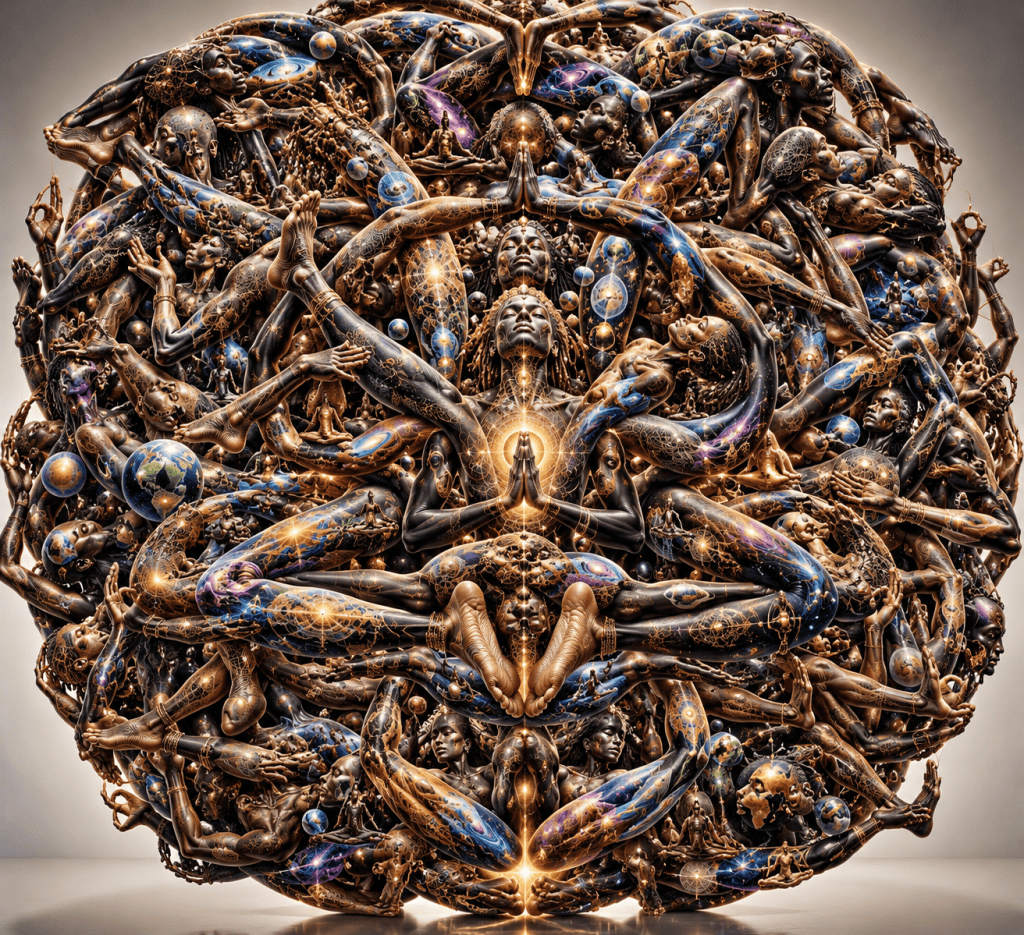
As my body moved spontaneously, I had the overwhelming experience that I was performing every asana simultaneously.
I do not mean that my physical body literally assumed every possible yoga posture at the same moment. That would obviously be physically impossible.
The experience was deeper than physical positioning.
Every movement felt universal.
Every posture seemed contained within movement itself.
My body was not experienced as an isolated biological organism changing positions against the background of a stationary universe. Body, space, movement, and universe were one seamless occurrence.
There wasn’t a Morgan performing an asana.
There was simply movement.
And somehow that movement belonged to everything.
Perhaps Union Is Not Quite the Right Word
The Sanskrit root commonly associated with Yoga, yuj, carries meanings related to joining, yoking, harnessing, and union.
For years, I understood the spiritual meaning of Yoga through that framework.
The individual becomes united with the Divine.
The self becomes united with the Absolute.
The practitioner becomes united with existence.
After my awakening, even the word “union” seemed insufficient.
Union still subtly assumes two.
Two things exist separately and then come together.
But what happens when the distinction between them disappears completely?
What if the individual and the universe do not become one?
What if they were never actually two?
That was much closer to what I experienced.
I did not experience myself merging with the universe as though Morgan were one substance and the cosmos another.
The distinction itself became meaningless.
There was no inside looking outside.
No subject observing an object.
No separate mover controlling movement.
No isolated body existing within an external universe.
There was simply what was happening.
Who Is Moving Whom?
Consider something as ordinary as raising your hand.
Usually we experience the sequence like this:
“I decided to raise my hand.”
Then the hand rises.
There appears to be an internal agent producing an external action.
But examine movement closely enough and a strange question emerges.
Where exactly is the mover?
A thought announcing an intention may appear.
Muscles contract.
The arm rises.
Sensations change.
The visual field changes.
But where is the separate entity responsible for making the entire process happen?
During my awakening, this question wasn’t answered intellectually.
The question disappeared because the assumed division behind it disappeared.
When the body moved, the universe moved.
When the universe moved, the body moved.
These weren’t two synchronized events.
They were the same event.
That distinction matters enormously.
Synchronization usually describes two separate systems moving together.
What I experienced wasn’t synchronization between myself and existence.
It was identity.
The Body as an Activity of the Universe
We normally say, “My body.”
Notice what those two words imply.
There is supposedly a “me” who possesses a body.
But what exactly is the body?
Carbon, oxygen, hydrogen, nitrogen, calcium, phosphorus, water, microorganisms, electrical activity, chemical reactions, inherited genetic information, food, sunlight indirectly captured through plants, minerals formed through ancient geological processes, and elements forged within stars.
At what point does any of this become separate from the universe?
The boundary is practical.
It is biologically useful.
It allows an organism to navigate its environment, protect itself, seek nourishment, reproduce, communicate, and survive.
But practical distinction does not necessarily equal ultimate separation.
Perhaps the body isn’t something placed inside the universe.
Perhaps the body is something the universe is doing.
A wave isn’t an object placed inside an ocean.
The wave is the ocean behaving as a wave.
This human organism may be understood similarly.
Not something existence contains, but something existence is presently doing.
The Neuroscience Does Not Cancel the Mystery
There is also a neurological dimension to experiences like this.
The brain continuously integrates proprioception, vision, touch, vestibular information, motor intention, memory, and spatial information to generate our ordinary experience of being a body located somewhere.
Various systems contribute to this process, including the parietal cortex, temporoparietal regions, insula, somatosensory systems, vestibular networks, motor systems, cerebellum, thalamus, and networks associated with self-referential processing.
Profound alterations in how these systems communicate could conceivably accompany experiences in which bodily boundaries, agency, spatial location, or the distinction between self and environment radically change.
That possibility fascinates me.
But neuroscience and metaphysics are answering different questions.
Discovering the neural correlates of nondual consciousness would tell us something important about what the nervous system is doing when such experiences occur.
It would not automatically tell us what reality ultimately is.
Suppose scientists eventually discovered an exact neural signature accompanying the dissolution of subject-object consciousness.
That discovery would still leave an extraordinary question unanswered:
Does the altered brain create an illusion of unity, or does ordinary brain organization create an illusion of separation?
Neuroscience alone cannot easily settle that question.
The Witness Must Eventually Disappear Too
There can also be a subtle stage on the contemplative path where one discovers oneself as the Witness.
Thoughts arise, but I am aware of them.
Sensations arise, but I am aware of them.
The body moves, but I am aware of the body moving.
Eventually even this can preserve a subtle duality.
There is still awareness on one side and something being witnessed on the other.
Awareness versus experience.
Witness versus witnessed.
Subject versus object.
The radical implication of nonduality goes further.
What happens when even the Witness cannot be located separately from what is witnessed?
There is seeing, but no separate seer.
There is hearing, but no separate hearer.
There is movement, but no separate mover.
There is awareness, yet no independent entity standing outside experience possessing awareness.
This is where language begins to fail because grammar itself wants a subject performing an action.
Nonduality does not cooperate very well with grammar.
Yoga Before the Word Yoga
Perhaps this is why my experience transformed my understanding of Yoga.
Yoga ceased being something I practiced.
For that extraordinary period, Yoga described reality itself.
Nothing needed to be joined because nothing was actually separate.
The body did not need to unite with the universe.
The body was already the expression of the universe.
Awareness did not need to reach the Absolute.
The apparent distance between awareness and the Absolute had vanished.
The seeker did not finally capture what had been sought.
The separation between seeker and sought collapsed.
This also changed how I understood spiritual practice.
Meditation may begin as something a person does.
Someone sits.
Someone watches the breath.
Someone observes thoughts.
Someone searches for stillness.
Someone seeks awakening.
But eventually the most interesting question may become:
Who exactly is doing all of this?
Follow that question deeply enough and the spiritual journey begins turning back upon the one supposedly travelling it.
When the Universe Moved
Words will never reproduce what happened.
“Oneness” doesn’t capture it.
“Unity” doesn’t capture it.
“Cosmic consciousness” doesn’t capture it.
Even “nonduality” remains a concept pointing toward something that precedes conceptual division.
The closest expression I have remains remarkably simple:
When I moved, the universe moved.
When the universe moved, I moved.
Eventually even that statement contains one distinction too many.
There was no “I” on one side and “universe” on the other.
There was movement.
There was stillness.
There was awareness.
There was no awareness.
There was existence.
There was no existence.
And none of them were separate.
That was when I finally understood Yoga.
Not as something the human being does to become united with existence.
But as the recognition that existence was never divided in the first place.
Morgan O. Smith