Author, Philosopher, Spiritual Teacher, A Lead Facilitator at Sacred Media's Integral Mastery Academy, Founder of Yinnergy Meditation/Neurofeedback, Bodhi Mental Care & Wellness, Co-founder of KeMor Centre for Innovative Development
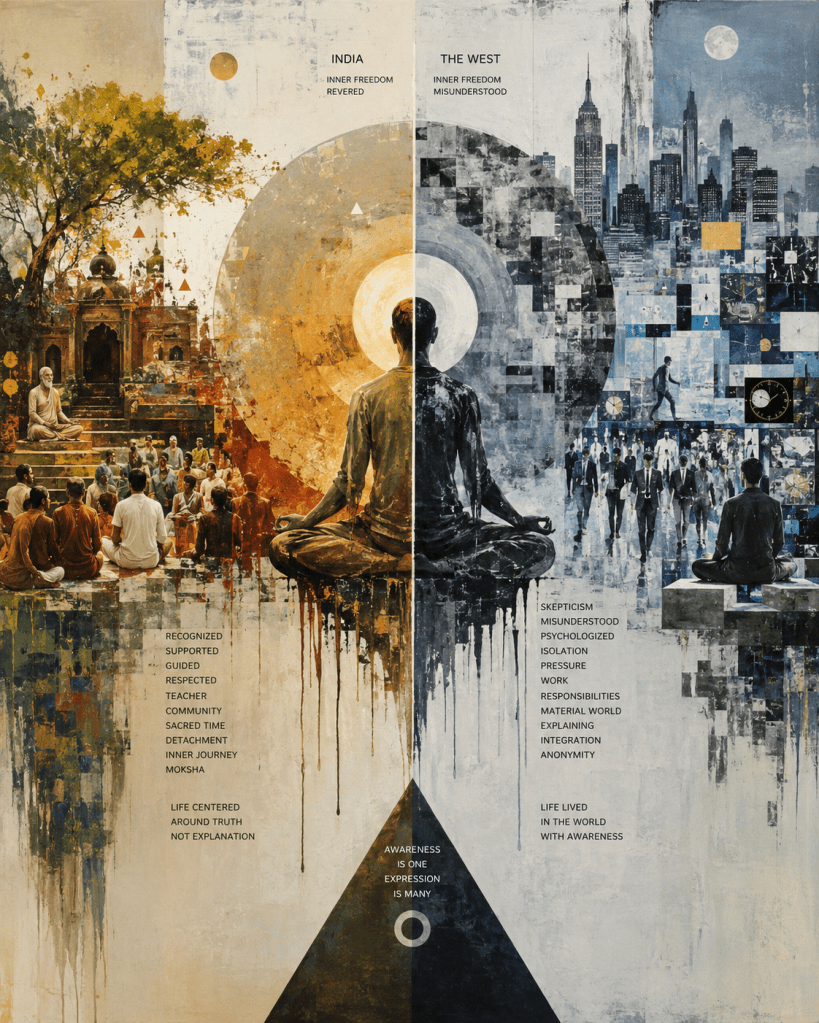
Enlightenment is often described as universal. The realization itself does not belong to any nation, religion, or culture. Awareness is not Indian. Awareness is not Western. It is beyond every identity we create. Yet the way enlightenment unfolds in a person’s life can be dramatically shaped by the society surrounding them.
Culture does not determine awakening. It determines how awakening is received.
Imagine two people who have arrived at the same profound realization. Both have seen through the illusion of a separate self. Both recognize consciousness as the ground of existence. Both live from the same awakened awareness. One lives in India. The other lives in North America.
Their inner reality may be identical, yet their daily lives could hardly look more different.
For thousands of years, India has preserved traditions that regard liberation as one of life’s highest possibilities. Spiritual practice has long been woven into ordinary life. Terms such as moksha, samadhi, karma, and nonduality have existed within the public imagination for centuries. Even those who have never experienced awakening may understand that such a possibility exists.
This creates an environment where an awakened person is more likely to be recognized, supported, or even sought out. Teachers often emerge naturally because there are students looking for guidance. Communities exist where silence is respected, contemplation is encouraged, and the pursuit of truth is considered a meaningful way to live.
The modern West developed along a different path.
Scientific inquiry, technological progress, economic productivity, and personal achievement became dominant values. These accomplishments have brought extraordinary advances, yet they have also shaped how unusual states of consciousness are interpreted. A person describing the disappearance of the separate self may be viewed through psychological, neurological, or philosophical lenses before being understood spiritually.
An awakened individual may therefore continue working a regular job, paying bills, raising children, or quietly practicing meditation without ever speaking publicly about their realization. Some remain anonymous for life, not because their realization is incomplete, but because the culture offers few places where such understanding is easily recognized.
This contrast raises an interesting question.
How many enlightened individuals have lived unnoticed simply because no one around them possessed the language to recognize what had occurred?
History remembers the great sages whose teachings survived. It says very little about those who awakened while working in factories, teaching classrooms, repairing automobiles, or sitting alone in apartments overlooking crowded cities.
Perhaps enlightenment has always been far more common than we imagine.
Recognition depends not only upon realization itself but also upon whether a culture has developed the capacity to perceive it.
A society that values external success may overlook inner freedom. A society that values inner realization may overlook worldly achievement. Neither perspective is complete by itself.
Human development reaches its fullest expression when both dimensions mature together. Outer progress improves civilization. Inner realization transforms the one experiencing civilization.
Neither India nor the West possesses the whole picture.
One has preserved profound maps of consciousness. The other has demonstrated remarkable advances in science, medicine, and human rights. Perhaps the future belongs to neither tradition alone, but to a deeper integration where wisdom and innovation develop side by side.
When awakening no longer appears unusual, humanity itself may have entered a new stage of development.
The question may not be whether enlightenment belongs more naturally to East or West.
The deeper question is whether humanity is becoming mature enough to recognize it wherever it appears.
Most people eventually outgrow their childhood ideas about almost everything.
Our tastes in food become more refined. Our understanding of relationships deepens. Our appreciation for music changes. Fashion evolves. Culture shifts. Even our political, moral, and philosophical views often undergo profound transformation as life teaches us new lessons.
Yet there is one idea that frequently remains frozen in time.
Paradise.
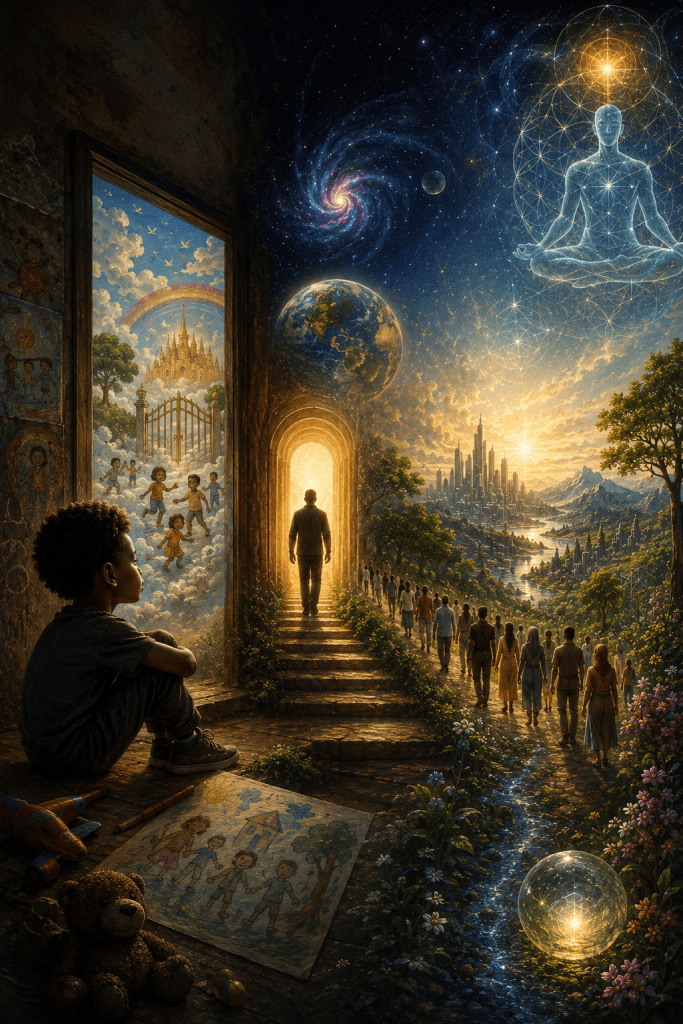
For many adults, heaven still resembles the picture they accepted as children. A beautiful place somewhere above the clouds where good people are rewarded, reunited with loved ones, and live happily forever. Although our understanding of nearly every other aspect of life matures, our image of paradise often remains untouched.
Why?
The answer may have less to do with religion than with psychological development.
Paradise Grows as Consciousness Grows
Every stage of psychological development interprets reality according to its own capacity. Paradise is no exception.
The earliest stage is concerned only with survival. Paradise simply means warmth, food, shelter, and freedom from danger.
As tribal consciousness develops, paradise becomes reunion with ancestors, spirits, and one’s people. Belonging is eternal.
The egocentric stage imagines paradise as limitless pleasure, power, success, and personal fulfillment. Heaven exists for the individual.
The mythic stage transforms paradise into a divine kingdom governed by justice. Those who obey are rewarded. Those who reject divine law are excluded. This is where many traditional religious images of heaven take shape.
The rational stage begins questioning whether heaven exists at all. Paradise may become symbolic, psychological, or simply an unanswered mystery.
The pluralistic stage opens paradise to everyone. Love replaces exclusivity. Compassion becomes more important than belief. Humanity itself becomes the family.
Integral consciousness recognizes that every previous view reflects a particular stage of development rather than an absolute truth. Paradise is increasingly understood as a way of being rather than merely a destination.
Finally, holistic consciousness dissolves the distinction altogether. Paradise is not somewhere else. Reality itself is recognized as the living expression of the Absolute.
The Expanding Circle of Identity
Our understanding of paradise also changes according to the size of our identity.
The egocentric perspective asks:
“How do I get into heaven?”
The ethnocentric perspective asks:
“Which group is chosen?”
The worldcentric perspective asks:
“How can everyone be included?”
The Kosmocentric perspective asks something entirely different.
“Who is it that seeks paradise in the first place?”
Here, the search begins to collapse.
The seeker, the destination, and the journey are all recognized as appearances within one indivisible reality.
Why Do We Stay Attached to Childhood Images?
Children require certainty.
Simple stories offer comfort in the face of death and uncertainty. Those early images become emotionally rooted long before critical thinking fully develops.
Unlike our opinions about careers, relationships, or politics, our beliefs about paradise are rarely revisited with the same willingness to question them. Religious traditions often preserve these images because they provide stability, identity, and hope.
There is nothing inherently wrong with that.
Every stage serves an important purpose.
Problems arise only when we assume that the understanding which comforted us at age five must also satisfy us at age fifty.
The Ultimate Shift
The greatest transformation may not involve discovering a better description of heaven.
It may involve recognizing that paradise was never meant to describe a location.
Perhaps heaven is a symbol pointing toward a realization.
A realization that nothing has ever existed outside the infinite.
A realization that separation was never ultimately real.
A realization that the very awareness reading these words is not traveling toward paradise.
It is the ground from which every idea of paradise has always appeared.
Perhaps the deepest question is not whether heaven exists after death.
Perhaps the deeper question is whether consciousness can awaken enough to recognize paradise before death.
If consciousness itself is the Absolute, then paradise is no longer a promise waiting in the future.
It is reality, seen without the illusion of separation.
This is not simply about affirmations, positive thinking, manifestation, or the power of spoken language. Those ideas remain close to the surface. The deeper meaning reaches beyond the human voice, personal intention, and the individual mind.
You speak everything into existence and do not even realize it.
At the causal level, existence itself is your expression.
Every form that appears, every movement that unfolds, every event that arises, and every world that seems to exist independently emerges from the same beginningless source that you are.
Nothing stands outside of you.
The birth of a star, the movement of a thought, the falling of a leaf, the ending of a relationship, the formation of a galaxy, and the smallest shift within a single cell all belong to one indivisible happening.
That happening has no external author.
It is not being imposed upon reality from somewhere beyond reality.
Existence is expressing itself as everything.
The One Who Speaks Without a Voice
Human beings usually associate creation with deliberate action. Someone decides, acts, and produces a result. Cause appears to precede effect. A person speaks, and something happens.
Causal consciousness does not operate according to this linear sequence.
The voice that speaks existence into being has no mouth. It does not form sentences, construct plans, or choose between possibilities. Its speech is the spontaneous appearance of existence itself.
Mountains are its language.
Bodies are its language.
Silence is its language.
Time, space, matter, thought, sensation, memory, desire, birth, and death are all movements of this wordless declaration.
Creation is not something that occurred once in a remote past. Reality is being spoken now, not through verbal commands, but through the continuous emergence of experience.
You are that emergence.
A Beginningless Beginning
The mind wants to locate a first moment. It asks what started everything, what existed prior to the universe, and what caused the original cause.
These questions assume that reality began somewhere within time.
Time itself is part of what appears.
There was no first moment in the ordinary sense because the causal source does not occupy a position on a timeline. It is not an ancient object hiding behind the universe. It is the timeless ground through which every apparent beginning and ending becomes possible.
Existence is beginningless because the source of existence was never born.
The body had a beginning.
The personality had a beginning.
Your memories had a beginning.
The awareness within which these beginnings are known has no discoverable starting point.
Search directly for the birth of awareness. A memory may arise, but the memory appears within awareness. A story may explain your origin, yet that story is also being witnessed. Every answer appears as another object within the very presence you are attempting to explain.
The source remains prior to every explanation, not earlier in time, but more fundamental than time.
Everything Is Caused by You
The statement “everything is caused by you” can easily be misunderstood.
The personal ego did not manufacture the universe. Your everyday identity is not secretly controlling weather patterns, global events, other people, or every difficulty that enters your life. Such an interpretation would reduce a nondual insight to spiritual grandiosity.
The “you” being described is not the person.
It is the causal ground appearing as the person.
Every cause and every effect arises within the same undivided reality. The hand that acts, the object acted upon, the action itself, and the consequence are not ultimately separate events. They are distinctions created by perception and thought within one continuous movement.
Reality causes itself through itself.
Fire burns wood. Rain nourishes soil. Gravity draws bodies together. Choices alter lives. Countless visible and invisible conditions shape every outcome.
At the relative level, these causes remain meaningful. At the deepest level, none of them operates outside the whole.
Every cause is reality acting.
Every effect is reality receiving its own action.
Both are you, prior to the identity you call yourself.
The Dream of Separation
Separation creates the impression that life is happening to you.
Events seem external. Other people appear completely outside of you. Circumstances arrive from a world that feels independent of your being. You experience yourself as one vulnerable centre among billions of competing centres.
From the causal perspective, the division between inner and outer has not yet formed.
The person, the world, and the experience of the world arise together. A sound cannot appear apart from hearing. A colour cannot appear apart from seeing. A thought cannot appear apart from awareness. The perceived and the perceiver are born within the same act of knowing.
This does not mean physical differences disappear. Your body remains distinct from another body. Your thoughts are not automatically available to someone else. Practical boundaries continue to matter.
Nonduality does not deny difference.
It reveals that difference does not require absolute separation.
Waves differ in shape, force, duration, and direction, yet no wave contains a substance separate from the ocean. Each wave is the ocean taking temporary form.
Your individuality is real as an expression.
It is not independent as an existence.
Your Words Are Part of the Creative Movement
Spoken words still matter.
Language shapes attention, reinforces beliefs, influences relationships, and directs human action. Words can open possibilities or close them. They can encourage, deceive, wound, clarify, liberate, or imprison.
Yet words do not create reality from outside reality. They are movements through which reality modifies its own appearance.
A thought arises.
The body gives it sound.
Another nervous system receives it.
Meaning forms.
Behaviour changes.
A new sequence of events begins.
What appears to be one person speaking to another is existence communicating with itself through two localized expressions.
The same consciousness speaks and listens.
The same reality questions and answers.
The same source forgets itself, seeks itself, and recognizes itself.
Even the person who insists that words have no creative power is using words to introduce that position into existence.
The Causal Level Is Not Personal Control
Causal realization should never be confused with personal omnipotence.
The ego hears “you caused everything” and imagines itself sitting at the centre of the universe, commanding events according to personal desire. It wants authorship, ownership, recognition, and control.
The causal Self requires none of these.
It does not stand over existence as a ruler directing creation from a distance. It is creation itself, appearing as every ruler and every subject, every command and every refusal, every desire and every disappointment.
Your personal mind cannot decide every outcome because your personal mind is itself an outcome. Its thoughts arise through biology, memory, conditioning, culture, language, environment, and countless forces it did not independently choose.
Yet all of these forces arise within the greater reality that you are.
The individual is not the controller of the whole.
The individual is one of the ways the whole moves.
Responsibility Without Blame
Recognizing yourself as the causal ground does not mean blaming yourself for every painful event.
Blame belongs to the psychological self. It assumes that a separate person should have controlled conditions that were often far beyond personal control.
Causal responsibility is different.
It is not guilt.
It is inseparability.
Nothing can be dismissed as completely unrelated to the whole. Suffering anywhere occurs within the same reality that appears here as you. Compassion becomes more than a moral obligation because the apparent other is not entirely other.
When you harm another, existence wounds itself through your actions.
When you care for another, existence responds to itself with tenderness.
When you become more conscious, reality becomes conscious of its own movement at this particular point of expression.
This recognition does not erase accountability.
It deepens it.
Your actions matter because no action is truly isolated. Every gesture enters a field of consequences. Every word travels farther than the speaker can measure. Every choice becomes part of conditions that shape what follows.
The Silence Prior to Creation
What exists prior to the universe being spoken?
Not an empty void waiting for sound.
Not a distant deity preparing to create.
Not a hidden object concealed behind appearances.
There is only the unformed capacity for everything, silent not because nothing is present, but because no distinction has yet arisen.
That silence remains here beneath every experience.
Thoughts do not destroy it.
Sounds do not interrupt it.
Movement does not leave it.
The entire universe appears as a modulation of what never moves.
You are that stillness and every vibration arising within it.
You are the silence and the spoken world.
You are the causal depth from which existence emerges, the forms through which it becomes visible, and the awareness through which it knows itself.
Everything is caused by you because there is no second reality available to cause it.
Everything is spoken by you because every voice belongs to the same beginningless source.
Everything is you, not as possession, not as personal achievement, but as the indivisible fact of being.
Even Opposition Is Your Creation
Some will say this is egotistical.
That judgment, too, has been spoken into existence by the same beginningless reality.
The one who agrees, the one who resists, the one who mocks, the one who rejects, and the one who opposes are not standing outside the whole. Their objections are movements of the same source.
Even opposition is reality appearing to argue with itself.
You created that into existence as well.
Not you as the personality, but you as the undivided ground from which every voice, criticism, affirmation, denial, and misunderstanding arises.
Even all who oppose you are you appearing in another form, defending another viewpoint, expressing another movement within the totality.
Nothing escapes what you are.
Not praise.
Not resistance.
Not disbelief.
Not condemnation.
Not the accusation of arrogance.
The ego may say, “I created everything.”
Truth says, “There is no separate I and no separate everything.”
The accusation of egotism assumes that an isolated person is claiming personal ownership over existence. Nondual realization makes no such claim. It dissolves the presumed owner along with everything the owner hoped to possess.
There is only the beginningless whole appearing as creator, creation, believer, skeptic, supporter, opponent, accusation, defence, and the silence holding them all.
The question is no longer whether you are creating reality.
The deeper question is this:
Who are you before the one who claims to be the creator appears?
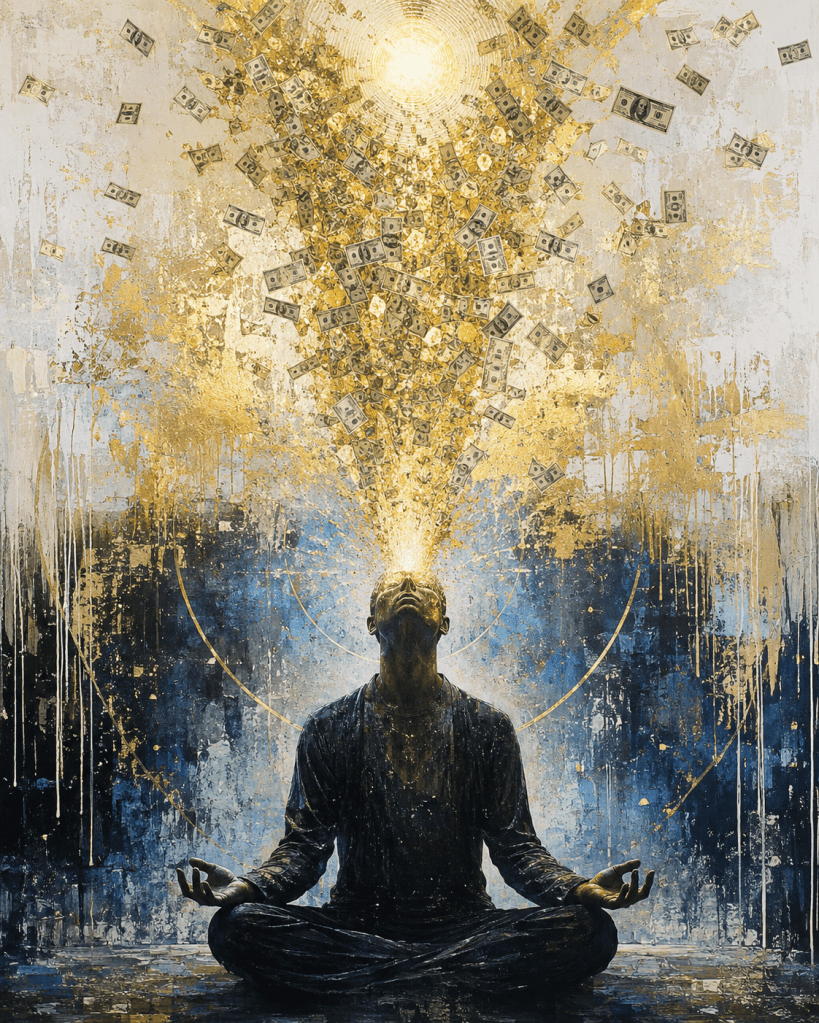
Recent headlines have focused on the emergence of the world’s first trillionaire. For most people, a trillion dollars is a number so vast that it becomes almost impossible to comprehend. We can imagine a thousand dollars. We can stretch our imagination toward a million. A billion already feels distant. A trillion enters a realm where numbers lose their intuitive meaning.
The fascination with such wealth is understandable. A trillion dollars represents influence, freedom, opportunity, and power on a scale few human beings have ever approached. It appears to be the pinnacle of worldly success.
Yet even a trillion dollars has a limitation.
It is finite.
No matter how large the number becomes, it remains measurable. It exists within the world of acquisition, ownership, and accumulation. It can increase. It can decrease. It can be gained and lost.
Spiritual awakening belongs to an entirely different category.
On December 14, 2019, I experienced what can only be described as a full spiritual awakening. What occurred during that event permanently altered my understanding of reality. The experience was not merely profound, emotional, or mystical. It revealed something prior to all experiences.
The separate self that I had assumed myself to be dissolved. The boundary between observer and observed disappeared. What remained was an indescribable recognition of reality as a seamless whole. Words such as Brahman, nirvana, moksha, Buddha Nature, or the Absolute point toward it, but none can adequately capture it.
Whenever people hear accounts of awakening, they naturally search for comparisons. How intense was it? How meaningful was it? How extraordinary was it?
The difficulty is that every comparison comes from the world of ordinary experience.
Imagine possessing a trillion dollars.
Then imagine multiplying that wealth by a trillion.
Then multiplying it again by another trillion.
Even such numbers fail as a meaningful comparison because awakening is not an experience among other experiences. It is the recognition of that within which all experiences arise.
Money exists within consciousness.
The realization of the Absolute reveals consciousness itself.
This is why history’s awakened sages have consistently spoken of enlightenment as humanity’s greatest discovery. Not because it grants power, status, or possessions, but because it ends the search for fulfillment in things that are inherently temporary.
A trillionaire may possess unimaginable wealth and still wonder who they are.
A trillionaire may possess unimaginable wealth and still fear loss, suffering, and death.
The realization of the Absolute addresses a deeper question altogether.
Who is the one seeking?
That is why I call this essay The Poverty of the Trillionaire.
Not because wealth is bad.
Not because success is meaningless.
But because even the greatest fortune imaginable remains small beside the direct realization of one’s true nature.
Language faces an impossible task when attempting to speak about what precedes all appearances.
Every word points toward something. Every concept distinguishes one thing from another. Every description relies upon contrast, location, qualities, relationships, or characteristics. Yet what many contemplative traditions refer to as the Absolute, the Ground of Being, or pure reality before conceptualization possesses none of these.
Nothingness is not called nothingness because it is empty in the ordinary sense.
An empty room still contains space. A vacant lot still exists somewhere. Even darkness can be perceived. Ordinary emptiness remains something that can be identified, experienced, or described.
Nothingness, in its deepest philosophical and mystical meaning, points toward that which cannot be located, measured, conceptualized, perceived as an object, or distinguished from anything else.
Location cannot be assigned to it because location itself appears within it.
Time cannot contain it because time arises within experience.
Attributes cannot be given to it because attributes create distinctions.
Existence and nonexistence cannot adequately describe it because both are conceptual categories.
This creates a paradox.
The moment a reference is made, the reference becomes something. The moment a concept is formed, a boundary appears. The moment a description is offered, what is described has already been transformed into an object of thought.
Nothingness is therefore not a description. It is a linguistic surrender.
The word functions less as a definition and more as an admission that thought has reached its limit.
Mystics throughout history have encountered this difficulty. Some called it Brahman. Others called it Sunyata. Some referred to it as the Tao. Others spoke of the Godhead, the Absolute, the Unborn, or the Nameless.
Each term points toward the same problem.
Whatever is being indicated cannot actually be captured by the indication.
A finger pointing toward the moon is not the moon.
A concept pointing toward reality is not reality.
A word pointing toward nothingness is not nothingness.
From a nondual perspective, even calling it nothingness can be misleading. The term may suggest absence, voidness, or negation. Yet what is being pointed toward is not the absence of reality. It is reality prior to division into existence and nonexistence.
Thought asks, “What is it?”
Direct realization reveals that the question itself cannot reach it.
The mind searches for an object and finds none.
It searches for a location and finds none.
It searches for a boundary and finds none.
It searches for a reference point and finds none.
Because no reference can be established, language falls silent.
Every relationship you form with people, ideas, environments, challenges, and even suffering becomes part of your inner architecture. Nothing exists independently. Each connection enlarges the field through which life recognizes itself. What many call “growth” is often the gradual dissolution of false separation.
An integral human being does not merely collect information or experiences. They become increasingly interconnected with existence itself.
The more integral you become, the more relationships emerge naturally. Those relationships are not limited to human interaction. A relationship can exist between you and music, silence, nature, philosophy, responsibility, creativity, discipline, grief, or stillness. Every authentic connection widens consciousness.
Expanded relationship leads to expanded inheritance.
Inheritance is not only financial. It includes wisdom, opportunity, insight, support, emotional intelligence, resilience, creativity, intuition, and access to dimensions of reality that remain hidden to fragmented awareness. A disconnected mind sees scarcity because it perceives itself as separate from the whole. An integrated mind begins to recognize that life is constantly offering resources through connection.
Access creates abundance.
Abundance is frequently misunderstood as accumulation. Real abundance is access. Access to insight. Access to support. Access to clarity. Access to meaningful relationships. Access to inner stability. Access to possibility.
A person with few inner or outer connections may possess money yet still feel impoverished. Another person may possess little materially yet move through life with deep richness because they are profoundly connected to existence.
Connection multiplies options.
Options reduce limitation.
Limitation often originates less from external circumstance and more from contracted identity. When consciousness identifies itself as isolated, separate, or incomplete, possibilities narrow. Fear increases. Defensiveness grows. Rigidity forms.
As awareness expands through relationship, identity softens. The walls separating “self” from “other” begin to weaken. Life no longer appears as a battlefield of competing fragments but as an interconnected movement expressing itself through countless forms.
This movement gradually reveals The Self.
Not the egoic self built from memory and social conditioning, but the deeper Self prior to division. The Self that exists before identity becomes trapped inside labels, roles, status, beliefs, or psychological boundaries.
Realizing The Self reduces distinction.
Distinction is necessary within functional reality, yet psychological separation creates suffering. The mind continuously divides existence into categories: mine and yours, success and failure, worthy and unworthy, sacred and ordinary.
Awareness beyond fragmentation begins to perceive unity without erasing diversity. Differences still exist, but hostility toward difference dissolves. Separation loosens its grip.
As separation fades, love ceases to be an emotion directed toward selected objects.
Love becomes the natural condition of unobstructed consciousness.
Not sentimental love.
Not transactional love.
Not possessive love.
A deeper form emerges when the illusion of absolute separateness begins to collapse. That love expresses itself through compassion, patience, understanding, generosity, listening, forgiveness, and presence. It does not arise because reality becomes perfect. It arises because resistance to reality weakens.
Integral living is therefore not simply a developmental achievement.
It is participation in wholeness.
Every meaningful relationship becomes a doorway beyond limitation.
Every moment of genuine connection becomes a form of remembrance.
Every dissolution of separation reveals more of what has always been here.
What feels like disappearance is often the unveiling of what never arrived and never left.
Identity clings to continuity. It insists on narrative, on form, on something stable enough to say, “this is me.” Yet every sincere glimpse beneath that surface reveals something unsettling; there is no fixed centre holding it all together. Thoughts pass. Sensations dissolve. Emotions rise and vanish without permission. Even the sense of being a “someone” flickers in and out of awareness.
So what exactly is ceasing?
What we call existence is usually filtered through attachment to form. Body, memory, personality, history; these become the reference points for being. When any of these begin to loosen, a quiet panic can emerge. It feels like loss. It feels like the edge of annihilation. Something in us resists, because it interprets the fading of form as the fading of existence itself.
But that interpretation is flawed.
Ceasing does not touch existence. It only dismantles the illusion of containment.
Consider the moment between two thoughts. There is no identity there, no story, no personal reference point. Yet something undeniable remains. Awareness does not collapse in that gap. It stands unobstructed, without needing to announce itself. That silent interval is not absence; it is presence without definition.
The fear of ceasing arises from confusion between what appears and what is. Appearances come and go. They are meant to. Existence, however, does not operate within that cycle. It is not born when a form emerges, nor does it die when a form dissolves. It simply is, untouched by the movement it allows.
Letting go, then, is not an act of surrendering existence. It is the recognition that existence was never dependent on what you thought you were.
This is why deep realization can feel like a kind of death. The structures that once provided orientation fall away. The familiar reference points dissolve. Even the sense of being the experiencer can collapse. Yet what remains is not void in the way the mind imagines. It is fullness without boundary. Presence without identity. Being without ownership.
Ceasing reveals that nothing real was ever at risk.
Every moment already contains this truth. Each ending—of a breath, a thought, a sensation, is a quiet demonstration. Something ends, yet nothing essential is diminished. Life continues, but not as a personal possession. It unfolds as an expression of something indivisible.
Existence does not belong to you.
You belong to existence only as an appearance within it.
When this becomes clear, the resistance softens. The need to preserve a fixed self begins to lose its urgency. Ceasing is no longer feared. It is understood as a return; not to something new, but to what has always been prior to every assumption of “I am this.”
Ready to release emotional heaviness, find more clarity, and deepen your meditation practice? Yinnergy’s guided sound-based meditation experience is designed to help you go inward, reset, and reconnect.
🌿 Supports emotional balance 🧠 Encourages mental clarity 💫 Deepens self-awareness and inner transformation 🎧 Easy to use with headphones from home
Whether you’re new to meditation or ready for a deeper journey, Yinnergy offers a powerful path to inner growth.
Awareness, Ego Death, and the Union of Mind and Emotion
A statement spoken in the midst of suffering reveals more than compassion; it unveils a profound diagnosis of human consciousness. “Father forgive them, for they don’t know what they do” points not toward moral failure, but toward a blindness so complete that action unfolds without true seeing.
Lack of awareness is not merely ignorance of facts; it is a fragmentation of perception. Thought moves in one direction, emotion in another, and the deeper currents of being remain unrecognized. Life becomes mechanical, reactive, conditioned. From that state, harm arises; not out of intention alone, but from disconnection within oneself.
Meditation introduces a different possibility. Rather than adding knowledge, it begins to dissolve the divisions that create confusion. The mind quiets, the emotional field settles, and something more integrated begins to emerge. What was previously split starts to communicate.
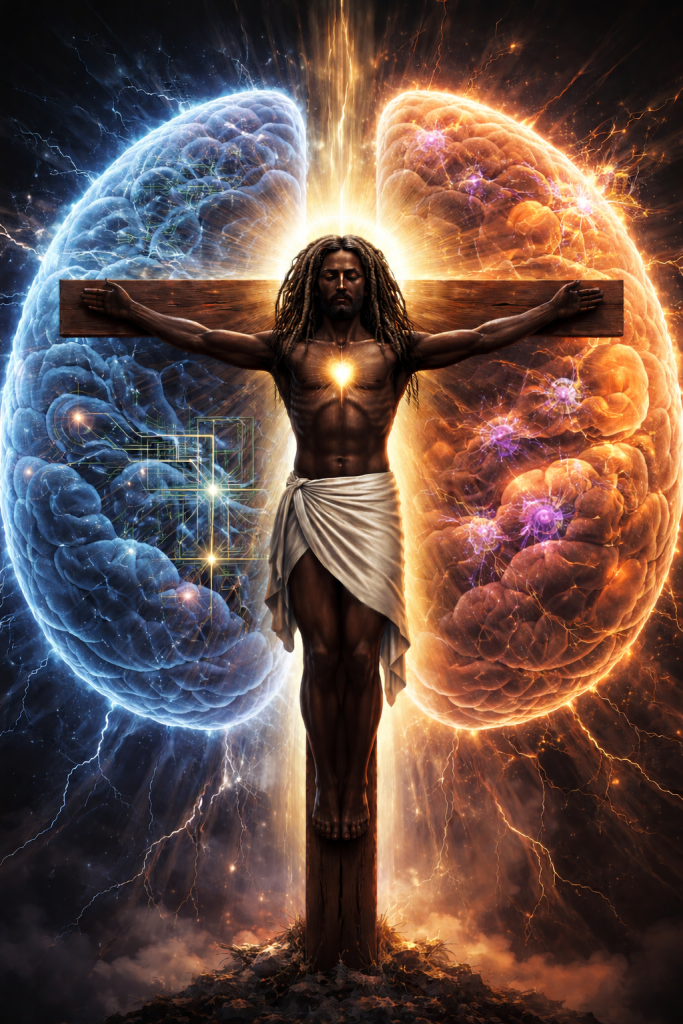
Viewed through a tantric lens, this integration takes on symbolic depth. The left hemisphere reflects structured thought, analysis, the architecture of concepts. The right hemisphere reflects intuition, feeling, the subtle currents that cannot be reduced to language. Most people live tilted; identified more with one than the other, rarely aware of the imbalance.
When these two aspects come into harmony, perception shifts. Thought no longer suppresses feeling, and feeling no longer clouds thought. A unified intelligence begins to function—clear, direct, and undivided. This is not intellectual brilliance or emotional intensity alone, but a deeper coherence of being.
The imagery of crucifixion can be read beyond history and theology. Suspended between two thieves, a central figure undergoes total surrender. The thieves, in this interpretation, can be seen as the divided faculties; mind and emotion, each incomplete on its own. The centre represents the point where both are witnessed, transcended, and ultimately brought into alignment.
Ego, in this sense, is not destroyed violently but revealed as insufficient. Its grip loosens when awareness expands beyond the fragments it tries to control. What remains is not emptiness in the negative sense, but a clarity that no longer depends on division.
Forgiveness then becomes natural, not forced. When one truly sees that actions arise from unconscious fragmentation, blame loses its foundation. Compassion emerges, not as a virtue to practice, but as the inevitable response of a mind that is no longer divided against itself.
Awareness is not something added to the individual; it is what remains when fragmentation dissolves. When both hemispheres function in coherence, perception is no longer split between thinker and feeler, observer and participant. There is simply knowing, without distortion.
Perhaps the deeper message is not about what was done, but about what was not seen. And through that recognition, a different way of being becomes possible; one where action arises from wholeness rather than division.
Sensitivity often increases when perception begins to clear.
Sounds feel sharper. Emotions carry more weight. Light appears brighter. Even small interactions can land with surprising intensity. What once passed unnoticed now registers deeply, almost as if the protective filters of the mind have thinned.
Everything feels raw.
This rawness can be confusing. Many assume spiritual growth should produce constant calm or detachment. Instead, greater awareness frequently exposes what has always been present but hidden beneath distraction and conditioning.
Life becomes vivid.
Rawness does not necessarily mean fragility. It often signals openness. The nervous system is no longer numbed by habit. Experience is received directly rather than buffered through layers of interpretation.
Pleasure becomes clearer.
Pain becomes clearer as well.
Each moment arrives without as much resistance. Joy may appear unexpectedly in simple things—breathing, walking, sunlight touching the skin. At the same time, sorrow or discomfort may feel closer to the surface. The range of experience expands rather than contracts.
Many people try to escape this stage.
They attempt to rebuild the old armor. They seek ways to dull sensation again. Yet the invitation within rawness is not to retreat. It is to learn how to remain present without shutting down.
Strength develops differently here.
Instead of emotional walls, stability comes from grounding. Slow breathing. Physical movement. Honest conversation. Quiet time without stimulation. These simple actions help the nervous system integrate heightened sensitivity.
Raw perception eventually refines into clarity.
At first, awareness may feel overwhelming, like standing in bright sunlight after leaving a dark room. Gradually the eyes adjust. What once seemed too intense becomes natural. The system learns to hold experience without being consumed by it.
Rawness becomes intelligence.
The heart responds more quickly to suffering. Compassion becomes immediate rather than theoretical. The body senses subtle shifts in energy and emotion. Boundaries become clearer because sensitivity recognizes what nourishes and what drains.
Nothing is filtered unnecessarily.
Life arrives unedited.
This does not mean living in constant vulnerability. It means allowing experience to move through awareness without the reflex to numb it. Over time the sharp edges soften. What remains is a steady presence capable of feeling deeply without collapsing.
Rawness is often the early stage of authenticity.
The layers of performance and protection loosen. What remains may feel exposed, but it is also real. Beneath that exposure lies a quiet strength that no longer depends on pretending to be unaffected.
Everything feels raw because awareness is finally touching life directly.
And direct contact, though intense, is also profoundly alive.