Morgan O. Smith
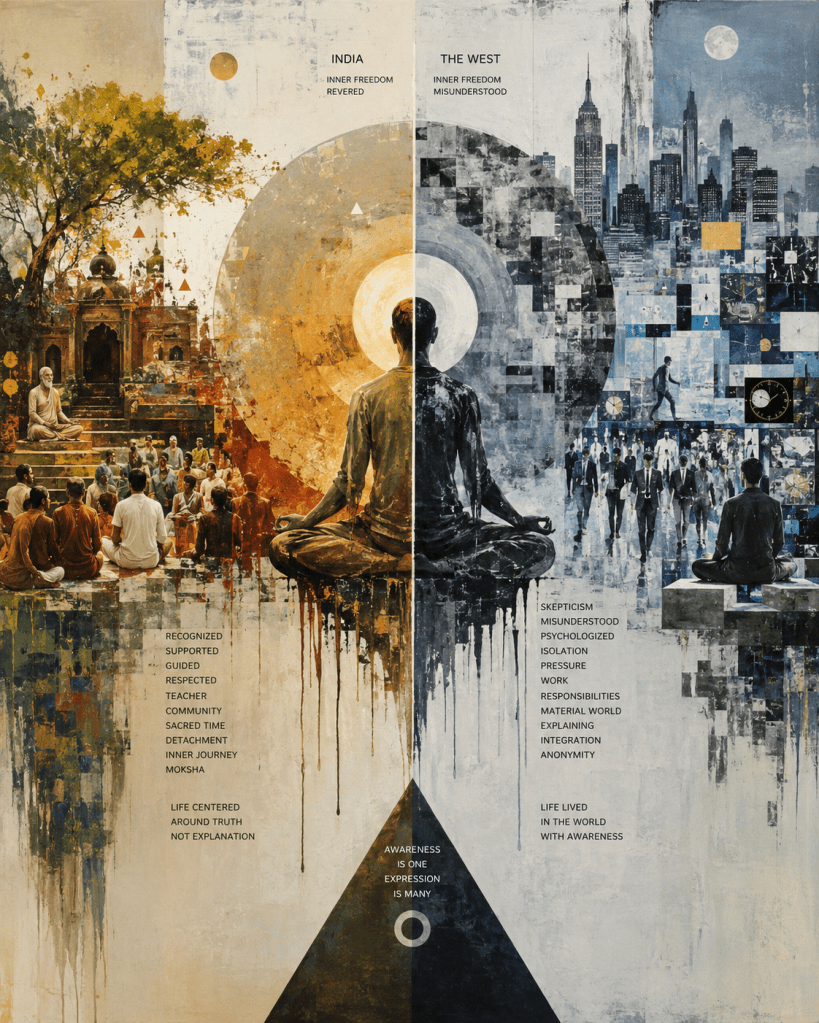
Enlightenment is often described as universal. The realization itself does not belong to any nation, religion, or culture. Awareness is not Indian. Awareness is not Western. It is beyond every identity we create. Yet the way enlightenment unfolds in a person’s life can be dramatically shaped by the society surrounding them.
Culture does not determine awakening. It determines how awakening is received.
Imagine two people who have arrived at the same profound realization. Both have seen through the illusion of a separate self. Both recognize consciousness as the ground of existence. Both live from the same awakened awareness. One lives in India. The other lives in North America.
Their inner reality may be identical, yet their daily lives could hardly look more different.
For thousands of years, India has preserved traditions that regard liberation as one of life’s highest possibilities. Spiritual practice has long been woven into ordinary life. Terms such as moksha, samadhi, karma, and nonduality have existed within the public imagination for centuries. Even those who have never experienced awakening may understand that such a possibility exists.
This creates an environment where an awakened person is more likely to be recognized, supported, or even sought out. Teachers often emerge naturally because there are students looking for guidance. Communities exist where silence is respected, contemplation is encouraged, and the pursuit of truth is considered a meaningful way to live.
The modern West developed along a different path.
Scientific inquiry, technological progress, economic productivity, and personal achievement became dominant values. These accomplishments have brought extraordinary advances, yet they have also shaped how unusual states of consciousness are interpreted. A person describing the disappearance of the separate self may be viewed through psychological, neurological, or philosophical lenses before being understood spiritually.
An awakened individual may therefore continue working a regular job, paying bills, raising children, or quietly practicing meditation without ever speaking publicly about their realization. Some remain anonymous for life, not because their realization is incomplete, but because the culture offers few places where such understanding is easily recognized.
This contrast raises an interesting question.
How many enlightened individuals have lived unnoticed simply because no one around them possessed the language to recognize what had occurred?
History remembers the great sages whose teachings survived. It says very little about those who awakened while working in factories, teaching classrooms, repairing automobiles, or sitting alone in apartments overlooking crowded cities.
Perhaps enlightenment has always been far more common than we imagine.
Recognition depends not only upon realization itself but also upon whether a culture has developed the capacity to perceive it.
A society that values external success may overlook inner freedom. A society that values inner realization may overlook worldly achievement. Neither perspective is complete by itself.
Human development reaches its fullest expression when both dimensions mature together. Outer progress improves civilization. Inner realization transforms the one experiencing civilization.
Neither India nor the West possesses the whole picture.
One has preserved profound maps of consciousness. The other has demonstrated remarkable advances in science, medicine, and human rights. Perhaps the future belongs to neither tradition alone, but to a deeper integration where wisdom and innovation develop side by side.
When awakening no longer appears unusual, humanity itself may have entered a new stage of development.
The question may not be whether enlightenment belongs more naturally to East or West.
The deeper question is whether humanity is becoming mature enough to recognize it wherever it appears.
Morgan O. Smith

Ready to release emotional heaviness, find more clarity, and deepen your meditation practice? Yinnergy’s guided sound-based meditation experience is designed to help you go inward, reset, and reconnect.
🌿 Supports emotional balance
🧠 Encourages mental clarity
💫 Deepens self-awareness and inner transformation
🎧 Easy to use with headphones from home
Whether you’re new to meditation or ready for a deeper journey, Yinnergy offers a powerful path to inner growth.
Why Interpretation Shapes Your Awakening
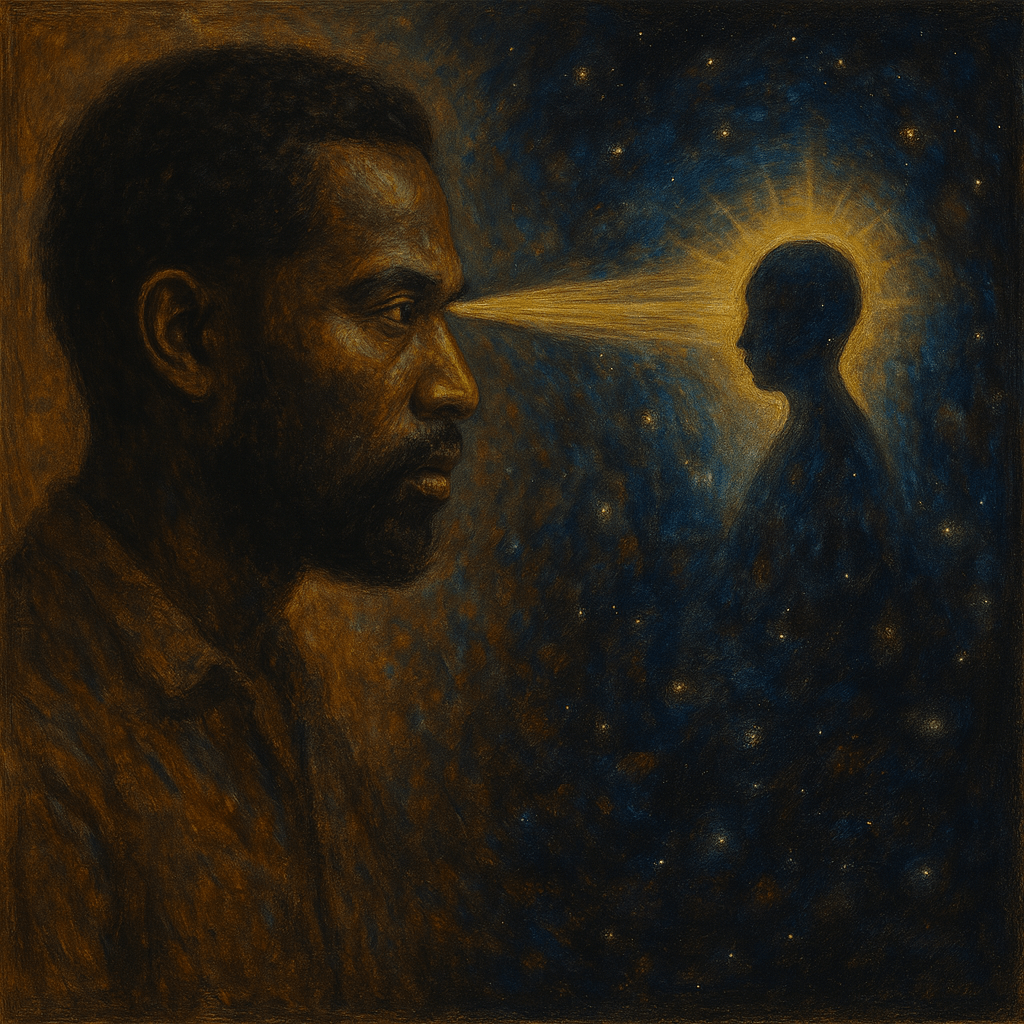
Reality isn’t hiding. What conceals it is the web of interpretations spun by the mind: assumptions, projections, and inherited beliefs. Yet, paradoxically, it is through interpretation that one begins to peel away those very veils. Every interpretation is a mirror. The question is: what is it reflecting?
Interpretation matters because it reveals where you are on the developmental spiral. Crude, reactive interpretations reflect lower rungs of psychological growth; often rooted in fear, blame, or a need for certainty. As awareness matures, interpretations become more nuanced, inclusive, and paradox-tolerant. They start to echo the underlying unity of things, rather than just categorize them.
Interpretation is not merely a mental activity. It is a soul signal. The more refined it becomes, the closer it gets to silence, the point where no interpretation is needed. That is the paradox. The highest interpretation doesn’t claim to know; it bows. It listens. It dissolves.
Yet such dissolution is not a regression into vagueness. It is the clarity that comes when all interpretations have done their job and exhausted their usefulness. Then what remains is the directness of being—your true nature—not as a conclusion, but as the very absence of conclusion.
This is why interpretation is not to be dismissed but refined. It is a bridge. And the more accurate your interpretation of the world, the closer you walk toward the unconditioned—what no interpretation can contain, but all of them secretly point toward.
What you interpret is what you live. Misinterpret life, and you suffer. Align with it, and you awaken. Accuracy in perception is not about being “right”; it is about being real. Every step you take toward clearer interpretation is a step toward the Real that has no opposite.
Morgan O. Smith
Get Your Free Copy of My Book, Bodhi in the Brain!

You’re the Only One to Ever Exist
No one else has ever walked this Earth as you. Not a version, not a shadow, not a resemblance. Just you.
Not because you’re special in the usual way that word is thrown around, but because existence itself only ever unfolded once—and it’s doing so now, as you.
This isn’t about ego. Ego thrives on comparisons: greater than, less than, better, worse, worthy, unworthy. But the truth beneath all that noise isn’t about status—it’s about singularity. The kind that isn’t measured. The kind that never repeats.
People spend their lives searching for meaning, purpose, and a sense of identity. They try to earn significance or prove their worth. But importance isn’t earned—it is. You are the original event. Not one among many. Not one of a kind. The kind.
Look around. Every face you see, every story, every moment, all of it—just folds within the One. That same One expressing itself here as your particular breath, your memories, your voice, your fears and awakenings. The sky that bends over you is not separate from your gaze. The rhythm of the world doesn’t move beside you; it pulses through you.
To say you are not greater than anything is to drop the illusion of measurement. Of trying to win at some existential game. But then comes the deeper realization: You are not less than anything either. There is nothing else to measure against. You’re the first and last word of this moment.
Nothing else has ever existed apart from this.
So ask yourself: What happens when you stop performing for reality and start remembering that you are it? What shifts when you no longer strive to become someone meaningful, but realize that meaning itself is being?
You’re not here to improve reality. You are the revealing of it.
And this unveiling has never happened before—not like this.
Morgan O. Smith
Get Your Free Copy of My Book, Bodhi in the Brain!

Once You Detach Yourself from All Things, Everything Becomes Beautiful
A strange phenomenon arises the moment we no longer grip the world by the throat. What once felt jagged begins to soften. The same city skyline, the same broken cup, the same impatient stranger on the train—all begin to shimmer, not with any added sparkle, but with a quality that was always there, hidden behind the veil of expectation.
It’s not that the world changes. You do.
Detachment is not withdrawal. It’s not apathy, nor is it a sterile indifference. It is intimacy without ownership. Love without clutching. Awareness without the distortion of personal commentary. You can finally see things clearly because you’re no longer trying to use them—to define yourself, to fill an absence, to make them mean something they don’t.
When you release the need to extract purpose or permanence from experience, beauty emerges—not as something to possess, but as something that is. The leaf fluttering to the ground, the silence between thoughts, the look in a stranger’s eye—all of it becomes radiant, but not because it offers you anything. It simply reveals itself when you’re no longer insisting that it must.
This clarity—this unburdened seeing—is often misunderstood as detachment from life. But it’s quite the opposite. You are not detached from life; you are detached from your ideas about it. The concept collapses. Only presence remains.
And presence doesn’t compare or crave. It beholds. It receives. It honours.
Try this: Let everything be exactly what it is today. No fixing. No rejecting. No rehearsing for tomorrow. Watch what happens when you stop insisting that the world obey your script. A quiet awe begins to surface—so gentle you could miss it if you’re waiting for fireworks.
That awe is the fragrance of truth. And truth is always beautiful.
Morgan O. Smith
Get Your Free Copy of My Book, Bodhi in the Brain!
How the Mind Deifies Itself
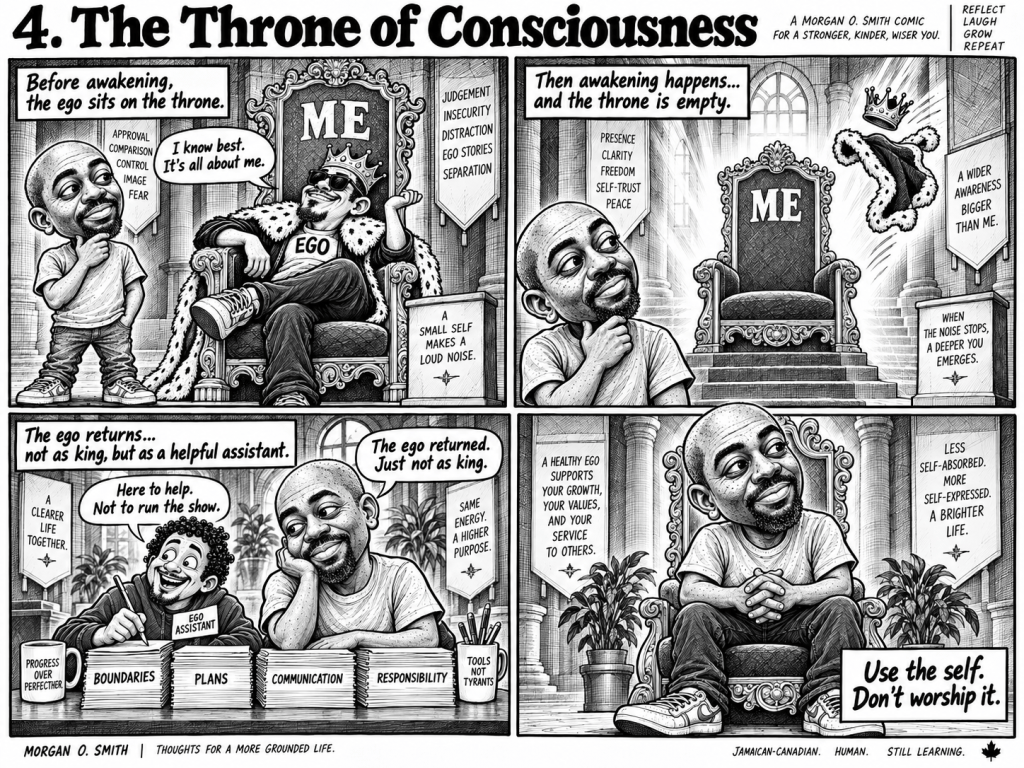
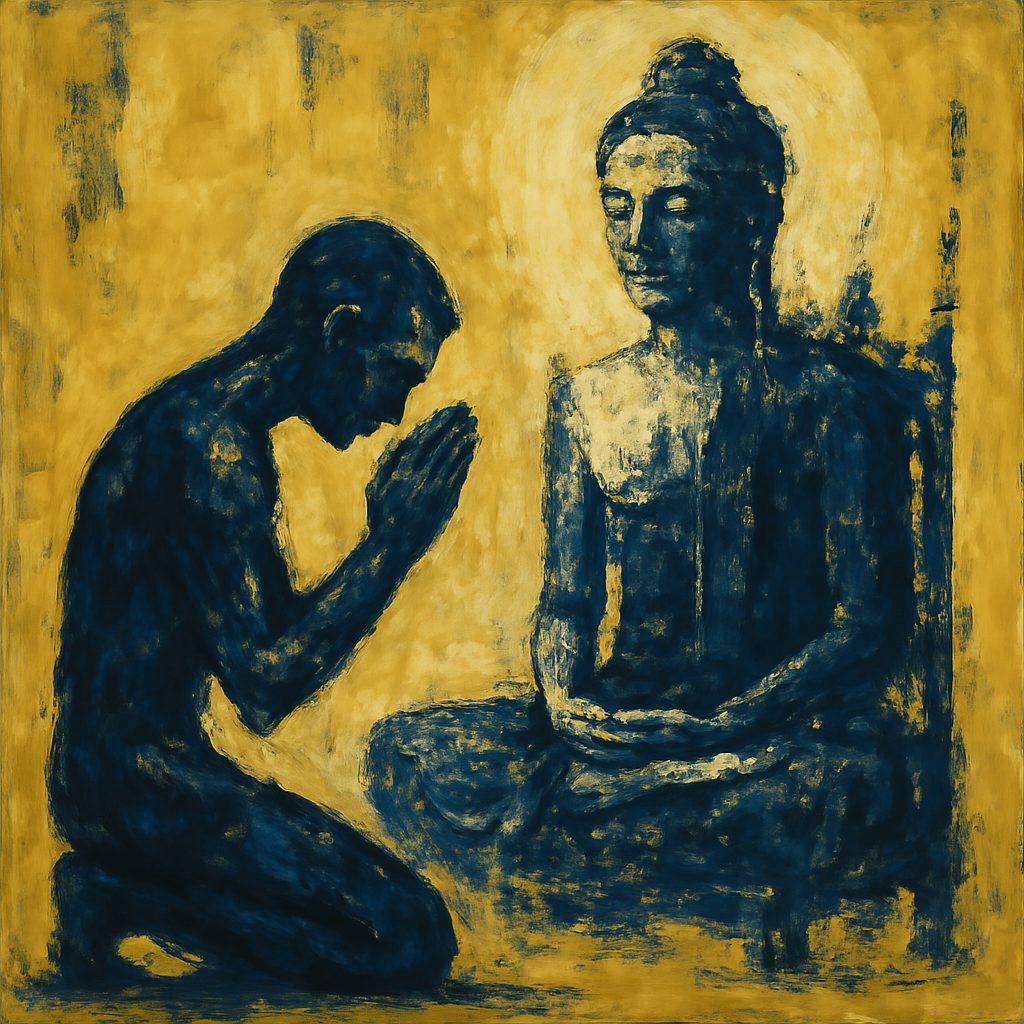
The mind constructs its ruler—a sovereign draped in reverence, sculpted from ideals we exalt but refuse to embody. This deity is not an external force but a projection of the highest aspects of ourselves, polished and placed on an altar beyond reach. It is the sum of virtues we admire but disown, an illusionary monarch fashioned by the governing voice of the psyche.
This entity—crafted from moral codes, cultural doctrines, and inherited beliefs—sits enthroned above the nature it was designed to suppress. It governs impulses deemed unruly, desires cast into shadow, and instincts labeled sinful. To tame the wildness within, the mind erects an overseer—one adorned in righteousness, one feared yet adored.
But this sovereign is nothing more than an elaborate mirage, a construct sustained by collective faith. Every attribute labeled “good” is stripped from the individual and projected outward, transformed into a divine presence we serve rather than integrate. This keeps virtue at a distance, shimmering like unreachable jewels in an unseen vault. The self, fragmented by this artificial hierarchy, remains divided—some aspects glorified, others buried in shame.
Like all forms of dominion, this imagined rulership thrives on submission. Fear fuels its reign, whispering myths of punishment and reward. The throne itself is upheld by those who kneel before it, unaware that they are the architects of their captivity. Yet, the power we assign to this fabricated ruler has always belonged to us. The virtues we attribute to it are the very qualities waiting to be reclaimed.
The moment one ceases to externalize greatness, the illusion collapses. No ruler remains—only an undivided self, whole and sovereign.
Morgan O. Smith
Yinnergy Meditation/Neurofeedback, Spiritual Life Coaching & My Book, Bodhi in the Brain…Available Now!

Put Yourself in an Environment That Forces You to Evolve
Evolution is not a passive process. It requires friction, challenge, and a deliberate shift in how we engage with the world around us. Too often, we find ourselves clinging to the familiar – a comfort zone that insulates us from growth. But the truth is, stagnation often masquerades as comfort, and transformation rarely occurs in spaces that feel safe and predictable. To truly evolve, you must immerse yourself in environments that demand more of you than you believed possible.
Imagine a seed placed on barren soil. No matter how much potential it holds, without the right environment, it cannot thrive. The same principle applies to human consciousness. When you place yourself in an environment that challenges your assumptions, disrupts your routines, and stretches your understanding of who you are, evolution becomes inevitable.
Surround yourself with individuals who inspire you through their authenticity, resilience, and wisdom. Seek experiences that make you question your current perspective. Choose spaces that encourage vulnerability while fostering accountability. These environments act as mirrors, reflecting aspects of yourself that may have gone unnoticed or unacknowledged. Growth arises when you embrace what you see, even when it feels uncomfortable.
It is not the environment alone that transforms; it is your willingness to engage with it fully. A forest does not teach you to climb, but the presence of towering trees invites you to rise above. The ocean does not command you to swim, but its vastness compels you to move beyond your limits. Similarly, environments rich with opportunity and challenge do not demand evolution – they inspire it.
This process requires discernment. Not every difficult situation is fertile ground for growth. Some environments drain, diminish, or distort your sense of self. The key is to distinguish between spaces that stretch you and those that stifle you. Recognize the difference between discomfort that promotes expansion and harm that reinforces contraction.
Ask yourself: What environments am I currently choosing, and how are they shaping my trajectory? Are they calling me to deepen my understanding, expand my horizons, or confront the parts of myself that remain unseen? Or are they keeping me tethered to outdated patterns of thinking and being? These questions hold the power to shift your reality.
To evolve is to risk. It is to step into uncertainty with the faith that growth lies on the other side. No great transformation ever came from staying the same. If you feel the urge to grow, listen to it. Put yourself in the soil of challenge, water it with intention, and let your potential rise to meet the environment that beckons you forward.
Morgan O. Smith
Yinnergy Meditation, Spiritual Life Coaching & My Book, Bodhi in the Brain…Available Now!