Finding True Happiness

Embracing the Wholeness of Emotions

Happiness, as it is often pursued, can feel like a fleeting dream—a constant chase for experiences that promise joy while running away from anything that feels uncomfortable. Yet, this pursuit can leave us fragmented, perpetually seeking and never arriving. The paradox of true happiness lies in the radical act of embracing all feelings, not just the pleasant ones.

Contentment is not the absence of discomfort; it is the presence of wholeness. Life offers a vast spectrum of emotions, each carrying its wisdom and significance. Joy and sorrow, hope and despair, love and fear—none exist in isolation. To deny one is to diminish the richness of the other. True happiness begins not when we suppress pain but fully meet it without resistance.

Imagine standing during a thunderstorm. Most would run for shelter, seeking safety from the discomfort of the rain. But what if, instead, you stood still, feeling the rain on your skin, hearing the rhythm of its fall, and witnessing its cleansing power? Embracing emotions is like this: a willingness to be with what is, not wishing it away but seeing its beauty and necessity.

When joy arises, celebrate it without clinging. When sadness visits, honour its presence without judgment. Anger, fear, excitement, and serenity all have their place in the dance of existence. Each emotion becomes a teacher, guiding us to deeper self-awareness and authenticity.

The secret is to observe emotions without becoming consumed by them. Like waves in the ocean, they rise and fall, but the essence of who we are—vast, still, and unshaken—remains constant. This shift in perspective transforms the way we experience life. Happiness is no longer a fleeting feeling tied to circumstances but an enduring sense of contentment rooted in presence.

When we no longer resist the full range of our humanity, happiness is no longer conditional. It becomes a state of being that arises from accepting life as it is—unfiltered, raw, and real. In this acceptance, a profound peace unfolds, transcending temporary highs and lows.

The journey to true happiness begins by welcoming all parts of ourselves. In every moment, every feeling, and every breath, there is an invitation to return to wholeness.

Morgan O. Smith

Yinnergy Meditation, Spiritual Life Coaching & My Book, Bodhi in the Brain…Available Now!

https://linktr.ee/morganosmith

The Birth of Purpose

Unveiling the “Why” of Your Life

Mark Twain’s poignant observation—that our lives are defined by the day we are born and the day we discover why—speaks to a universal quest for meaning. Birth introduces us to the world, but it is purpose that gives our existence depth and significance. This discovery transforms a mere life into a profound journey.

The search for one’s purpose often feels elusive, like chasing shadows in the dark. It demands more than intellectual effort; it requires us to pause, reflect, and confront the silence beneath our everyday noise. Purpose rarely presents itself in grand revelations. Instead, it whispers in moments of clarity, when life’s chaos subsides and we sense an alignment between who we are and what we do.

For some, this purpose is tied to service—offering a helping hand or inspiring others to rise. For others, it is found in the relentless pursuit of a dream, an expression of creativity, or simply being present and whole. Whatever the form, discovering purpose feels less like an addition to life and more like the peeling away of layers, revealing what was always there.

However, the question arises: How do we find it?

The process begins with self-awareness. Quiet observation of one’s passions, strengths, and values can illuminate the direction toward purpose. Those moments when time seems to dissolve when you feel most alive and authentic, hold clues. Follow them. Trust them. They are markers on the path.

Another step is embracing uncertainty. Searching for “why” does not always yield immediate answers. Life’s purpose evolves as you do, shifting with growth and perspective. What feels meaningful today may expand or transform tomorrow. Purpose is not a destination but an ongoing inquiry, a question to be lived rather than solved.

The most profound realization about purpose may be this: it is less about finding a specific role or mission and more about being attuned to the present. Purposeful living is born not from monumental achievements but from how we engage with each moment, each relationship, and each opportunity to learn and grow.

When we shift our focus from doing to being, from achieving to experiencing, we realize that purpose is not a far-off goal but something we cultivate daily. The journey becomes its reward. And in those rare, luminous moments when we connect with our “why,” we find ourselves not only alive but truly living.

Morgan O. Smith

Yinnergy Meditation, Spiritual Life Coaching & My Book, Bodhi in the Brain…Available Now!

https://linktr.ee/morganosmith

The Unseen Path to Happiness

Happiness often appears as a destination—something to be attained by seeking pleasurable experiences, avoiding pain, and curating external conditions. Yet, this pursuit can feel elusive, as if true happiness constantly moves just beyond reach. Perhaps this is because happiness isn’t found in the suppression or control of emotions, but in embracing them all as integral aspects of our human experience.

Emotions are often categorized as “positive” or “negative,” with joy, love, and excitement praised, while sadness, anger, and fear are seen as obstacles to overcome. However, this dualistic view creates resistance. Denying so-called negative emotions only magnifies their intensity, embedding them deeper within the psyche. True contentment arises not from avoiding discomfort but by fully experiencing and accepting it without judgment.

Imagine sitting with sorrow as you might with an old friend—acknowledging its presence, listening to its message, and recognizing its role in your life. Sadness, when embraced, transforms from an adversary into a teacher. It illuminates where attachments or unmet desires linger and invites you to release the illusion of control. Similarly, anger, when approached without suppression or overindulgence, becomes a fierce energy capable of clarifying boundaries and catalyzing change.

Contentment is not denying the human condition but a deep surrender to its unfolding. This surrender doesn’t mean passivity; it is an active engagement with the present moment. By welcoming all emotions, the inner landscape transforms. Happiness is no longer confined to fleeting highs but instead becomes an abiding state of being—anchored in equanimity, rooted in authenticity.

In this light, happiness is not the absence of pain but the profound realization that all emotions—joy and sorrow, peace and unrest—are sacred facets of existence. Each one offers an opportunity for growth, insight, and connection. To find contentment within them is to see life as whole, unbroken, and imperfect.

By sitting with your emotions and embracing their entirety, you awaken to the simple truth: happiness is not found in resisting life but in meeting it fully.

Morgan O. Smith

Yinnergy Meditation, Spiritual Life Coaching & My Book, Bodhi in the Brain…Available Now!

https://linktr.ee/morganosmith

We Shine Brighter Than Light

In the quiet depths of existence, there lies a paradox that many struggle to reconcile. Darkness is often shunned, relegated to the shadows of our awareness, and misunderstood as something to escape or avoid. Yet, within this shadowed realm exists a profound luminosity, a radiance that surpasses even the most blinding light. It’s a subtle brilliance—silent, invisible, but undeniable for those who dare to look beyond the surface.

Darkness is not the absence of light but its origin. It is the womb that cradles potential, the fertile ground where all things come to be. Darkness envelops us with a kind of raw intimacy, inviting us to release attachments to form and identity. It is the space where ego dissolves, where judgments fade, and where we can finally meet ourselves without the filters we have spent lifetimes building. Here, in the stillness, a new kind of light emerges—a light that is not separate from the dark but intertwined, indistinguishable from it.

Consider that every act of creation begins within the void. The artist stares at a blank canvas, the writer faces a blank page, and the thinker sits with a blank mind. It is only by surrendering to the unknown, to the formless, that something profound can emerge. Darkness doesn’t just consume or diminish; it adds depth, layers, and meaning. It carves out spaces within us, allowing us to perceive dimensions of ourselves and the universe that we could never touch through brightness alone.

This radiant darkness reflects the essence of life itself. We are beings that expand and contract, that are filled and emptied in cycles. Every breath, every heartbeat, every experience is a reminder of this cosmic dance of giving and receiving, of adding to and taking away. When we stop resisting this rhythm, we find that what we once perceived as shadows are simply reminders of our potential, our uncharted depths.

To shine as darkness is not to reject light but to transcend the duality of light and dark altogether. It is to recognize that true illumination doesn’t come from escaping or vanquishing shadows but from integrating them. This process transforms our understanding, allowing us to embody a different kind of luminosity—a light that isn’t bound by external visibility but shines from an unshakable inner knowing.

We are both the night and the stars within it, shaping and reshaping ourselves continuously. As we embrace the shadows within, we awaken to a deeper reality, one where every facet of existence has its rightful place. This acceptance, this deep union with both light and dark, is what ultimately enables us to shine brighter than light itself.

Morgan O. Smith

Yinnergy Meditation, Spiritual Life Coaching & My Book, Bodhi in the Brain…Available Now!

https://linktr.ee/morganosmith

Morgan O. Smith’s Awakening Journey

A Featured Story in Brainz Magazine & Insights on Spiritual Awakening

I am honoured and thrilled to share that I’m on the cover of Brainz Magazine this week! In my exclusive interview, titled “Morgan O. Smith’s Awakening Journey – How Yinnergy Meditation Was Born”, I discuss the personal path that led me to create Yinnergy Meditation. This journey has been transformative, from my own awakening experiences to the development of Yinnergy, a meditation program designed to help others experience powerful shifts in awareness, resilience, and self-discovery. You can read the full interview here: Morgan O. Smith’s Awakening Journey – How Yinnergy Meditation Was Born.

Try Yinnergy Meditation Now!

For 15% off, use the link: https://yinnergy.gumroad.com/l/trnyi/8rw6hem

I also recently joined Gareth Duignam on The Endless Possibilities Podcast for Part 2 of our conversation on spiritual awakening. In this episode, we dive into the stages of spiritual awakening and what each stage entails, from initial glimpses of higher awareness to the profound transformations that occur as one integrates these experiences. We also discuss how Yinnergy’s unique brainwave technology is designed to support these stages, helping individuals move through each phase with stability and clarity.

Exploring Nonduality: My Latest Brainz Magazine Article

In addition to my cover feature, I’m excited to share that my second article with Brainz Magazine, titled “What Is Nonduality and Why Is It So Misunderstood?”, is now live. Nonduality is a concept that resonates deeply within spiritual traditions and personal awakening journeys. However, it’s often misunderstood as simply a philosophical idea or something intangible. In this article, I explore nonduality as an experiential truth—one that reveals the fundamental unity underlying all things.

Morgan O. Smith

Yinnergy Meditation, Spiritual Life Coaching & My Book, Bodhi in the Brain…Available Now!

https://linktr.ee/morganosmith

The Shadow Self of the Grandiose

The concept of the shadow self—a term Carl Jung coined—reveals layers of ourselves we often choose to hide, repress, or deny. These shadow aspects are usually relegated to a dark corner of our psyche, only surfacing in fleeting glimpses. Yet, when the shadow self takes on a grandiose form, it ceases to be subtle, becoming instead a dominating force. It blinds us with illusions of superiority, entitlement, or self-importance, distorting our perception and interactions.

In personal growth and spiritual awakening, confronting the shadow self is both inevitable and essential. However, when the shadow becomes grandiose, it can convince us we are immune to error, beyond reproach, or uniquely enlightened. This delusion becomes a veil, preventing authentic growth and genuine self-reflection.

The grandiose shadow is not merely about arrogance. It’s a defence mechanism, an armour forged in the fires of insecurity and fear. By building up the self as untouchable or superior, we attempt to ward off the vulnerability of true introspection. But this shield, rather than protecting us, leads to isolation, as others feel the weight of this projection and distance themselves, sensing the ego’s hunger for validation cloaked in supposed wisdom or enlightenment.

In many spiritual or philosophical circles, grandiosity masquerading as enlightenment can become especially potent. The grandiose shadow asserts itself under the guise of spiritual authority or moral righteousness, leading us to believe we are above others on the path. But this illusion only widens the gap between our authentic self and the mask we’ve constructed.

To navigate this terrain, a key question emerges: Are we genuinely pursuing self-understanding, or are we feeding a need to feel special, above, or untouchable? True growth does not demand recognition or approval; it thrives in humility and quiet awareness.

Recognizing when our shadow has grown too grandiose is challenging but necessary. It requires questioning our motives, embracing vulnerability, and letting go of the need to stand above. Only by shedding the inflated version of ourselves can we step into true authenticity and spiritual liberation.

 Morgan O. Smith

Yinnergy Meditation, Spiritual Life Coaching & My Book, Bodhi in the Brain…Available Now!

https://linktr.ee/morganosmith

The Myth of Perfection

A Reflection on Human Nature and Spirituality

Perfection is a concept that many aspire to, yet one that remains fundamentally unattainable. The allure of becoming flawless is often reinforced by societal expectations, self-help narratives, and spiritual teachings that promise transcendence over our shortcomings. We yearn for mastery, imagining a state where all undesirable traits have been eradicated and every behaviour aligns with some ideal of human perfection. But is that ever truly possible?

No one is perfect. Not even the most enlightened being on the planet. Let’s use pest control as an example.

No matter how meticulously we maintain our homes or how many pest-control methods we employ, insects will inevitably appear. Some will be caught and eliminated, others will hide and multiply. This relentless cycle mirrors our inner world. Despite all efforts—through therapy, shadow work, psychedelics, or spiritual awakening—no one has found a way to remove every negative tendency permanently. As insects are part of the natural ecosystem, our imperfections are part of being human. Attempts to eliminate all flaws are as futile as trying to rid the entire world of pests.

Each trait or behaviour can be seen as a metaphorical bug. Selling a bug-killing spray or device is like an enlightened teacher selling a pathway to liberation or a self-actualized individual motivating others to reach their highest potential. The promise is not false, but the misconception lies in the belief that the bugs—the flaws—will be eradicated forever. The truth is more nuanced. Much like we can control insects to a certain extent, we can address negative traits, but total elimination is beyond reach.

If you’ve ever been to a home that had one visible roach, you likely made a snap judgment about cleanliness, even if the house was otherwise spotless. Contrast that with spotting an ant, and your reaction might be more forgiving. This response isn’t based on logic but on deeply ingrained conditioning. The same holds for how we judge others. One visible flaw can overshadow countless positive qualities, not because the flaw is inherently worse, but because of how we’ve been conditioned to perceive it.

A self-actualized person can be compared to a meticulous homeowner who manages to keep most of the pests at bay. Their house is mostly clean, orderly, and free of unwanted visitors. Yet, even they know that complete eradication is impossible. An enlightened being, on the other hand, goes beyond this mindset. They see every bug as a part of themselves—each flaw, each undesirable trait, is not separate but an expression of the whole. This broader understanding fosters a deeper acceptance. While they might occasionally choose to kill a bug, it’s done without aversion or judgment. There’s no inner conflict because they see that every bug, every flaw, serves a purpose.

Now the enlightened individual sees everything as perfection. Everything that is considered imperfect is happening perfectly. Everything is divine. Even the most imperfect individual or situation or circumstance. The enlightened recognize that what appears as chaos or dysfunction from a limited perspective is simply the perfect unfolding of a greater, unseen order. A roach-infested home, a seemingly flawed person, or an unwelcome circumstance—all are expressions of a divine play. There is no distinction between beauty and ugliness, perfection and imperfection because all dualities dissolve into the same oneness.

So, when an enlightened being enters a home overrun with insects, they do not recoil or judge. They recognize that their own home could, at any moment, be similarly overtaken. There is no attachment to a pristine space or the opinions of others regarding their environment. By accepting that bugs will always be present, the enlightened suffer less—not because their world is free of pests, but because they are no longer bothered by their existence.

The true wisdom here lies in shifting the focus away from trying to perfect oneself and toward seeing all parts of life—including the messiness, the flaws, and the unwanted bugs—as expressions of the same wholeness. The journey is not about eradicating; it’s about embracing. When we see all that is seemingly imperfect as perfectly divine, we move beyond the struggle and enter a space of true inner peace and freedom.

Morgan O. Smith

Yinnergy Meditation, Spiritual Life Coaching & My Book, Bodhi in the Brain…Available Now!

https://linktr.ee/morganosmith

Facing Your Own Shadow

The Gaze of Disowned Shame

There’s a moment in the journey of inner awakening where the light of awareness turns inward. A place often shrouded in secrecy, where the parts of yourself you’ve hidden away become unmasked. What’s revealed can be unsettling — the shame, guilt, and self-rejection that haunt the depths of your psyche. Encountering this inner entity, stripped of its disguise, becomes an intense confrontation: you face your own shadow.

Yet, when you meet this shadow, it does not recoil, flinch, or fade away. It simply observes you, raw and unmoved, reflecting the energy you’ve poured into rejecting it. For many, this experience feels like staring into an unbroken mirror, one that reflects not just the image you’ve created for the world, but the essence of what’s been buried, judged, and cast away.

When people speak of self-acceptance, it’s easy to imagine embracing the pleasant or polished parts of one’s persona. But the journey of true self-integration calls for embracing what is most despised. The parts labelled as unworthy, inadequate, or unforgivable become the gateway to your deepest transformation. Until then, they stare back with unblinking eyes — patiently awaiting recognition.

But why is this encounter necessary?

The disowned aspects of yourself hold immense power. They are reservoirs of energy locked behind the walls of judgment and fear. Every time they’re denied, they exert their influence unconsciously, driving reactions, decisions, and emotional patterns. The paradox is that the more they’re pushed away, the more they define your behaviour.

To stare at your shame is to feel its immensity. But beyond the discomfort, there is a subtle alchemy taking place. Each moment of presence, without rejection or justification, melts the rigidity of these self-imposed barriers. The shame becomes less monstrous. The guilt becomes less consuming. And in its place emerges a profound understanding: these shadows are not enemies but wounded parts of your psyche yearning for reintegration.

Facing your shame isn’t about confronting a malicious force. It’s about witnessing a fragmented self, desperately wanting to be seen and acknowledged. When fully embraced, these darkened corners of the mind cease to resist, and their power transforms into clarity, strength, and authentic self-expression.

This act of presence is not about seeking remorse or forgiveness. It’s about witnessing without the need for resolution. It’s about being so fully present that you pierce through the veil of judgment and glimpse the raw humanity of your being. That which once seemed abhorrent softens under the gaze of true self-compassion.

Ultimately, this process reshapes your sense of identity. No longer chained to a cycle of rejection and self-criticism, you stand free, more whole, and more alive. The shame that once stared back unrelentingly, feeling no remorse, becomes a quiet reminder that every part of you — no matter how dark — serves as a key to your liberation.

Morgan O. Smith

Yinnergy Meditation, Spiritual Life Coaching & My Book, Bodhi in the Brain…Available Now!

https://linktr.ee/morganosmith

The Silent Revolution

Awakening Amidst Chaos

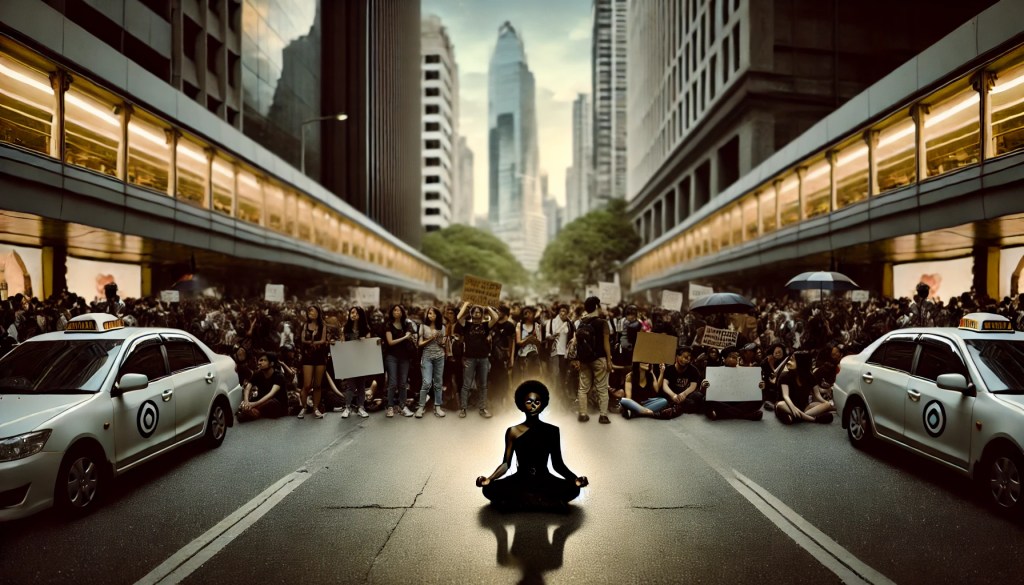
Chaos and tranquility often seem like opposites. However, they are intimately linked in the dance of life. As the world spins ever faster, with crises emerging like sudden storms on a summer day, a silent revolution is brewing beneath the surface—one that is neither loud nor confrontational but profoundly transformative.

This quiet revolution doesn’t rely on grand gestures or sweeping movements. It starts within the hearts of individuals who, despite the world’s noise, have tapped into a deeper current of awareness. These individuals aren’t driven by the need to change the world through force or ideology. Instead, they embody a shift that occurs when one aligns with the innate wisdom that lies beyond thought, beyond fear, and beyond the endless distractions that dominate modern life.

Imagine a moment where the rush of daily life pauses—not because external circumstances have shifted, but because the internal landscape has transformed. This shift is not the result of escaping the world, but of embracing it fully, with all its imperfections, recognizing that within the chaos lies the seed of order. When one looks deeply into the heart of the turmoil, an unexpected clarity can emerge, revealing the profound interconnectedness of all things.

Such moments of awakening are not reserved for the select few, nor do they require years of preparation or ascetic withdrawal from life. Often, they arrive unexpectedly, during the most mundane tasks or amid personal challenges. What matters is not the circumstances but the openness to receive what is always present: the silent awareness that underlies all experience.

This awareness doesn’t impose itself; it simply waits to be noticed. When recognized, it offers a perspective that transforms the ordinary into the extraordinary, where the boundaries between self and other dissolve, revealing a reality that is both deeply personal and universally shared.

The implications of this shift are profound. As more individuals awaken to this silent awareness, the collective consciousness begins to change. Actions rooted in fear and separation give way to those motivated by compassion and unity. Societal change, once thought to be driven by external forces, starts to emerge organically, from the inside out.

The silent revolution is not about overthrowing systems or confronting power. It is about the gradual realization that true power lies in the ability to remain anchored in awareness, no matter the external circumstances. This power is subtle, yet its impact can be far-reaching. As each person awakens, the collective vibration shifts, creating ripples that extend far beyond individual lives.

In times of chaos, this inner revolution offers a way forward—not by avoiding the challenges of the world, but by embracing them with a new understanding. It is the recognition that every moment, no matter how chaotic, holds the potential for awakening. When approached with awareness, even the most difficult experiences can become opportunities for profound growth and transformation.

This silent revolution is happening now, within the hearts of many. It doesn’t make headlines or trend on social media, but its effects are felt everywhere. The world is changing, not through external force, but through the quiet, steady awakening of consciousness.

Morgan O. Smith

Yinnergy Meditation, Spiritual Life Coaching & My Book, Bodhi in the Brain…Available Now!
https://linktr.ee/morganosmith

The Guru’s Enlightenment Isn’t the Absence of Your Own

It’s easy to fall into the comparison trap in the vast landscape of spiritual awakening. We witness the profound transformations and mystical experiences of others, and a subtle voice within us begins to whisper: “Why not me?” This whisper can grow into a chorus, overshadowing our path with doubt and impatience. However, understanding that someone else’s enlightenment isn’t the absence of your own can be a liberating revelation on the spiritual journey.

Each soul’s journey is a unique odyssey, carved out of their experiences and inner work. Just as no two fingerprints are the same, no two paths to enlightenment mirror each other perfectly. When we compare our progress with that of others, we risk overlooking the intricacies and nuances of our spiritual growth.

Imagine the spiritual journey as a grand symphony, where each individual’s enlightenment represents a distinct, essential note. The melody of the universe is incomplete without the contribution of each soul’s unique vibration. Another’s moment of illumination doesn’t dim your light; instead, it enriches the collective harmony, elevating the entire symphony to greater heights.

This realization invites us to shift our focus inward, recognizing the profound wisdom and beauty in our own experiences. Every moment of insight, every challenge faced, and every small victory on the path is a testament to the unfolding of our consciousness. When we honour our journey, we embrace the understanding that enlightenment is not a race but a deeply personal and transformative process.

The nature of nonduality teaches us that separation is an illusion. In the realm of pure consciousness, there is no competition or hierarchy. Each individual’s enlightenment contributes to the awakening of the collective, reflecting the interconnectedness of all beings. The enlightenment of one is a spark that ignites the potential within all.

Instead of viewing others’ enlightenment as a benchmark for our own, we can celebrate their milestones as a reflection of what’s possible within us. Their breakthroughs become a source of inspiration, reminding us of the boundless potential that lies within. By cultivating patience and trust in our unique path, we align ourselves with the natural rhythm of our spiritual evolution.

The journey to enlightenment is as diverse as those who embark on it. Embrace your path with gratitude, knowing that every step you take is perfectly purposeful. Remember, the guru’s enlightenment isn’t the absence of your own; it is a testament to the infinite possibilities that exist within the boundless expanse of consciousness.

Morgan O. Smith

Yinnergy Meditation, Spiritual Life Coaching & My Book, Bodhi in the Brain…Available Now!

https://linktr.ee/morganosmith