Author, Philosopher, Spiritual Teacher, A Lead Facilitator at Sacred Media's Integral Mastery Academy, Founder of Yinnergy Meditation/Neurofeedback, Bodhi Mental Care & Wellness, Co-founder of KeMor Centre for Innovative Development
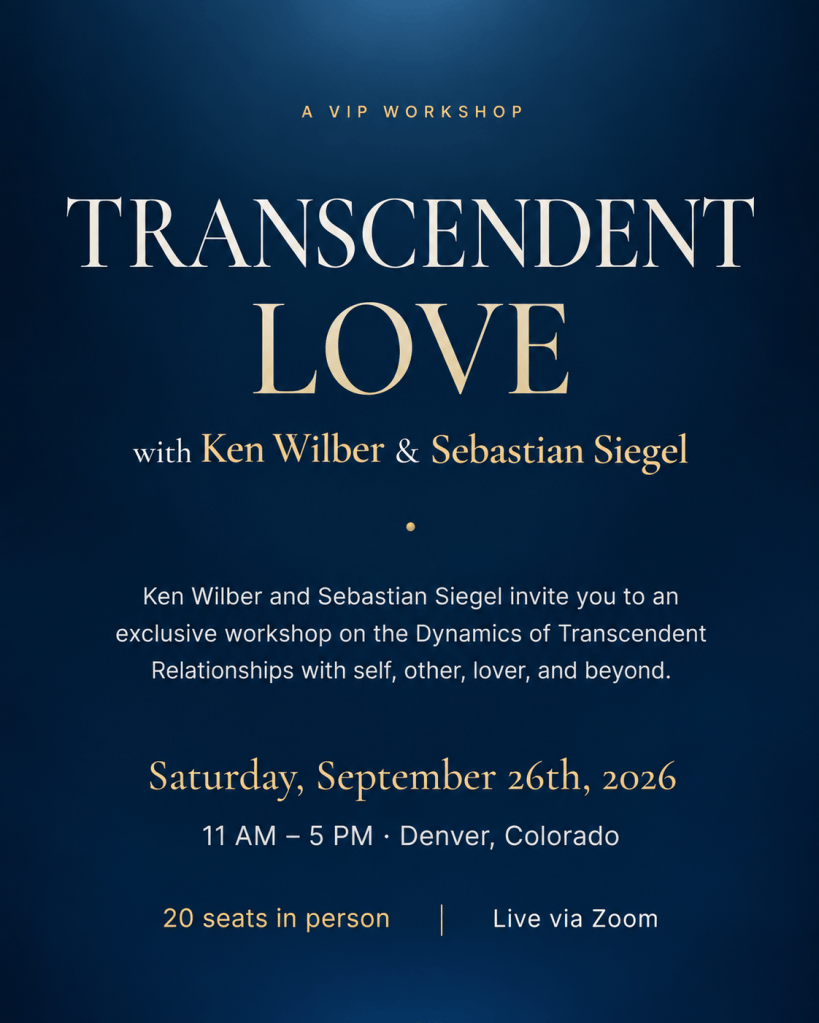
I’ll be hosting the Zoom experience for Transcendent Love this Saturday, September 26, as Ken Wilber and Sebastian Siegel come together for a special exploration of:
“Relationship as Pathway to Awakening”
This event celebrates the transcendent love story of Grace and Grit while opening a deeper dialogue around relationship as a pathway to awakening, including our relationship with self, other, lover, and beyond.
The day will include an intimate conversation, reflection, Q&A, and a live in-person screening of Grace and Grit, featuring Mena Suvari and Stuart Townsend.
📅 Saturday, September 26, 2026 🕚 11:00 AM – 5:00 PM Mountain Daylight Time 📍 Denver, Colorado + Live via Zoom
I’ll be present throughout the day as the main Zoom host. During the film, the Zoom room will remain open as a shared space where our online community can reflect, exchange thoughts, explore themes from the book and film, or simply watch quietly and reconnect afterward.
I’ll also be selecting some of the top questions from our Zoom participants to pass along to Ken and Sebastian during the Q&A.
Grace and Grit is currently available on several streaming platforms, including Tubi, Pluto TV, The Roku Channel, Plex, Amazon Prime, Apple TV, YouTube, and others, depending on your region.
Looking forward to connecting with everyone joining us online for what should be a meaningful day of love, relationship, awakening, and Integral exploration.
What if many of humanity’s earliest ideas about God reveal as much about the psychological development of human beings as they do about the Divine?
The archaic, magical, and mythical God did not simply appear from nowhere. These images of God emerged through human consciousness at particular stages of individual and collective development.
A God who demands obedience.
A God who rewards loyalty and punishes disobedience.
A God who belongs to one tribe and fights against another.
A God who controls storms, harvests, fertility, illness, victory, and defeat.
A God who must be pleased through sacrifice.
A God who watches human behaviour and keeps score.
A God who condemns outsiders while protecting the chosen.
These conceptions make considerably more sense when understood through developmental psychology.
We Could Only Imagine God Through the Consciousness Available to Us
Human beings interpret reality through the cognitive, emotional, moral, and cultural capacities available to them.
A child does not understand authority the same way an adult does. A tribal society does not necessarily conceptualize identity the same way a modern pluralistic society does. A consciousness organized primarily around survival, kinship, magical causation, or mythic belonging will naturally interpret ultimate reality through those structures.
God becomes understandable by becoming psychologically recognizable.
When human authority is organized around powerful chiefs and kings, God becomes the greatest King.
When social order depends upon obedience, God becomes the ultimate Lawgiver.
When tribal survival depends upon distinguishing “us” from “them,” God becomes our God rather than their God.
When natural events cannot yet be understood through scientific causation, thunder, drought, disease, eclipses, fertility, and catastrophe can become expressions of supernatural intention.
Human beings did not necessarily fabricate these experiences from nothing. Mystical experiences, altered states, dreams, intuitions, visions, awe, terror, transcendence, and encounters with the unknown may have been entirely genuine.
The interpretation of those experiences, however, passed through the developmental structures available to the person and culture experiencing them.
That distinction changes everything.
The Experience of the Sacred Is Not the Same as Its Interpretation
Someone can have an extraordinary experience while interpreting it through a relatively limited worldview.
This remains true today.
A profound state of consciousness does not automatically produce profound interpretation.
A person can experience ego dissolution and interpret it psychologically, neurologically, Buddhistly, Christianly, Vedantically, magically, or through some entirely personal cosmology.
The experience and the explanation are not identical.
Ancient humanity faced the same problem.
A genuine encounter with something overwhelming, boundless, numinous, or transpersonal could subsequently be translated into the language of spirits, gods, ancestors, demons, cosmic battles, divine commandments, or supernatural intervention.
The sacred encounter may have been profound.
The conceptual container could still have been developmentally limited.
Then the Collective Reinforced the God It Could Understand
Individual consciousness does not develop separately from culture.
Once a particular image of God becomes embedded within a community, that image can be reinforced through stories, rituals, institutions, authority structures, family systems, and social expectations.
Eventually, questioning the image of God becomes almost indistinguishable from questioning the community itself.
This is where developmental structures become collective structures.
The mythical God is no longer simply believed.
The mythical God organizes reality.
He determines morality, identity, belonging, sexuality, authority, social hierarchy, acceptable knowledge, and sometimes who deserves protection or punishment.
The collective then reproduces the developmental worldview that produced its God.
Children inherit it before possessing the cognitive capacity to examine it.
Adults defend it because their identity has formed around it.
Institutions preserve it because their authority may depend upon it.
What began as an interpretation of the sacred can eventually become an unquestionable description of reality.
God Evolves Because Our Capacity to Conceive God Evolves
This does not necessarily mean God evolves.
Our conception of God evolves.
That difference is crucial.
The Absolute may not become more sophisticated because human beings become more sophisticated.
Human beings become capable of recognizing dimensions of reality that previous structures of consciousness could not adequately conceptualize.
God as tribal protector can become God as universal Creator.
God as cosmic ruler can become God as unconditional Love.
God as separate supernatural Being can become Ground of Being.
God as object can dissolve into God as the very condition within which subject and object arise.
Eventually, even the word God begins to become problematic.
Advaita speaks of Brahman.
Mahayana Buddhism points toward emptiness.
Taoism warns that the Tao that can be named is not the eternal Tao.
Christian mystics speak of a God beyond concepts.
Apophatic traditions approach the Divine through negation, stripping away every description until nothing conceptual remains to grasp.
At sufficient depth, the question changes.
Instead of asking, “What kind of being is God?”
we begin asking,
“Why did we assume Ultimate Reality was a being at all?”
The Death of the Mythical God Is Not Necessarily the Death of God
This may explain one of the great tensions between religion, atheism, mysticism, and developmental spirituality.
Modern rational consciousness examines the mythical God and finds contradictions.
Where is this supernatural ruler?
Why would an omnipotent being require worship?
Why would an infinite intelligence possess human emotions such as jealousy?
Why would the creator of billions of galaxies privilege one tribe, scripture, denomination, or historical period?
Why would eternal truth depend upon accepting propositions produced within a particular ancient culture?
These are powerful criticisms.
Yet atheism can sometimes reject the developmental representation of God while assuming it has rejected every possible meaning of the Divine.
The mystic makes a different move.
Rather than defending the old image, the mystic penetrates beneath it.
The question is no longer whether an invisible cosmic personality exists somewhere beyond the universe.
The inquiry becomes consciousness itself.
Being itself.
Existence itself.
Awareness itself.
Nothingness.
Infinity.
The mystery that remains when every concept has collapsed.
Perhaps Humanity Created God in Its Own Developmental Image
The famous claim that human beings created God in their own image may contain more truth than either believers or atheists usually recognize.
But the statement does not settle the question of Ultimate Reality.
It opens it.
Human beings may repeatedly construct images of the Divine according to their developmental capacity while something immeasurably deeper remains prior to every construction.
The mistake is not necessarily believing in God.
The mistake may be confusing our representation of God with whatever the word God is attempting to indicate.
A magical consciousness creates a magical God.
A mythical consciousness creates a mythical God.
A rational consciousness critiques that God.
A pluralistic consciousness discovers many Gods.
An integral consciousness begins recognizing the developmental structures producing all of these perspectives.
Mystical consciousness eventually encounters something stranger still:
Reality does not need our concepts.
The Absolute does not require mythology.
Brahman does not need to become an object of belief.
Perhaps spiritual maturation ultimately requires allowing our image of God to die repeatedly.
Not because there is nothing beyond it.
Because every God the mind can construct remains smaller than that which cannot be contained by mind.
And perhaps what humanity called God was never the old man above the clouds.
Perhaps that was simply as far as consciousness could see at the time.
The Ego Is Not the Enemy: What Actually Dies During Spiritual Awakening?
Few concepts in spirituality have been misunderstood as thoroughly as the ego.
We are repeatedly told to transcend the ego, destroy the ego, become egoless, or surrender the self. The implication is that spiritual maturity requires becoming less of a person, less defined, less assertive, and somehow psychologically smaller.
I see it differently.
A profound spiritual awakening does not require a weak ego. It may require an exceptionally developed one.
The problem is not that we have an ego. The problem is what the ego believes itself to be.
Ego Means a Sense of Self
At its most basic level, the ego refers to the sense of self.
It is the psychological structure through which we organize experience around the perception of “I,” “me,” and “mine.” It allows us to establish boundaries, make decisions, assume responsibility, navigate relationships, pursue goals, withstand social pressure, and function as individuals within the world.
When someone says, “He has a big ego,” they are usually not talking about the existence of a strong sense of self. They are describing narcissism, defensiveness, arrogance, grandiosity, insecurity, or excessive self-importance.
Those are qualities that can characterize an ego.
They are not the definition of ego itself.
This distinction matters because spiritual communities sometimes confuse psychological weakness with spiritual transcendence.
A person can be passive, poorly differentiated, unable to establish boundaries, dependent upon approval, easily manipulated, and afraid of confrontation while imagining these characteristics to be signs of egolessness.
They may be nothing of the sort.
Sometimes what appears to be egolessness is simply an ego that has not sufficiently developed.
You Need a Self Before You Can Transcend the Self
A healthy sense of self is necessary for functioning within a difficult world.
This becomes especially important for anyone carrying leadership, spiritual, community, social, or global responsibilities. Without sufficient psychological structure, other people’s expectations, projections, demands, criticisms, and agendas can overwhelm you.
The world can trample over a poorly developed self.
Meditation, when properly integrated, should not merely dissolve psychological structure. It can strengthen our capacity to remain centred while encountering stress, emotional activation, social pressure, uncertainty, and outside influence.
Paradoxically, spiritual practice can make the ego both stronger and more transparent.
Stronger does not necessarily mean louder.
It can mean more stable.
Less reactive.
Less easily manipulated.
Less dependent upon validation.
More capable of holding contradiction.
More capable of surrender.
This produces one of the great paradoxes of awakening:
The ego may need to become strong enough to let go of itself.
Egoic Death Is Not the Same as Ego Death
I make an important distinction between egoic death and ego death.
Egoic death refers to the collapse, surrender, or transformation of defensive ego structures. Identification with certain beliefs, roles, wounds, narratives, attachments, fears, and psychological defenses may loosen dramatically.
Something about “me” dies.
Yet the basic sense that there is still a “me” experiencing reality can remain.
Ego death, as I use the term, is more radical.
During a profound nondual awakening, the sense of being a separate subject can disappear altogether. There is no longer an individual standing apart from experience, observing reality from somewhere behind the eyes.
The subject-object structure collapses.
There is seeing, but no separate seer.
There is awareness, but no independently existing owner of awareness.
There is existence, but the familiar psychological centre claiming, “I am the one to whom existence is happening,” is absent.
That is what I mean by ego death.
The difference is enormous.
A person can undergo an extraordinary emotional, mystical, psychedelic, religious, or psychological transformation without experiencing the complete dissolution of the subject-object boundary.
Not every dramatic spiritual experience is a nondual awakening.
Not every loss of psychological defenses is ego death.
The Ego Dies, Then It Has to Come Back
Permanent inability to function as a self is not the goal.
After a profound awakening, the practical personality returns because life requires it.
Your name returns.
Your responsibilities return.
Your relationships return.
Your preferences return.
Your history remains accessible.
Someone still has to answer the phone, pay the bills, make decisions, protect boundaries, honour commitments, create, teach, lead, and respond when another human being calls your name.
The ego resurrects itself as a functional structure.
But something can be fundamentally different.
Before awakening, the ego can appear to be a solid psychological object at the centre of existence.
After awakening, it can become increasingly transparent.
The self still functions, but its apparent solidity has been penetrated.
You can use the self without completely mistaking yourself for it.
The ego returns, but it does not necessarily return to the throne.
Stages of Development Are Not States of Awakening
This distinction is essential.
Psychological development and spiritual awakening are two different dimensions of a human being.
A person can have profound mystical states while remaining psychologically immature.
Another person can be extraordinarily mature, ethical, rational, compassionate, and psychologically integrated without ever experiencing nondual awakening.
Development does not automatically produce awakening.
Awakening does not automatically produce development.
Psychological stages describe the increasing complexity and capacity of the ego.
Each movement represents a transformation in how the self organizes reality, interprets experience, understands other people, constructs meaning, and relates to increasingly complex perspectives.
States of consciousness describe something different:
Turiya and turiyatita point toward dimensions associated with spiritual realization and enlightenment rather than merely greater psychological complexity.
Development asks:
How mature, complex, inclusive, and perspectivally capable is the self?
Awakening asks:
What is ultimately true about the self?
Those are not the same question.
You Can Wake Up Without Growing Up
This distinction explains something that otherwise seems contradictory.
How can someone have an authentic mystical awakening and still hold immature beliefs?
Because the state that was experienced and the psychological structure interpreting that state are not necessarily at the same level of development.
A person may enter an extraordinary state of consciousness and later interpret it through a Magic worldview.
Another may interpret a similar state Mythically.
Another Rationally.
Another Pluralistically.
Another Integrally.
The awakening may be profound while the interpretation of the awakening remains constrained by the developmental structure available to the person.
This is why spiritual experience alone does not automatically produce psychological maturity.
Someone can experience oneness and still be narcissistic.
Someone can experience emptiness and still lack healthy boundaries.
Someone can experience profound love and still hold ethnocentric beliefs.
Someone can experience the dissolution of the separate self and later reconstruct an identity around being “the awakened one.”
The ego is remarkably capable of claiming ownership of the experience in which its own separate existence temporarily disappeared.
That is one of the great ironies of spiritual awakening.
The Ego Can Grow Beyond Egocentricity
Another common misunderstanding is equating ego with egocentricity.
They are not synonymous.
Egocentricity describes a particular organization of identity in which one’s own needs, interests, desires, fears, and perspective dominate.
Development can progressively widen that identity:
I am one of us. My people, culture, religion, nation, group, or community matter.
The worldcentric self expands further:
My concern includes all human beings regardless of race, sex, class, nationality, culture, religion, creed, or social identity.
Kosmocentric identity expands beyond humanity:
My concern includes life, consciousness, the planet, the universe, and existence itself.
Something fascinating happens here.
From one perspective, the ego becomes smaller because self-centredness decreases.
From another perspective, the ego becomes enormous because what the person includes within the meaning of “self” has expanded dramatically.
The boundaries of identity become increasingly porous.
This is why calling a worldcentric or kosmocentric person “egoless” can be misleading.
They still require a functioning ego.
They still need boundaries.
They still need discernment.
They still need the ability to say yes and no.
They still need enough psychological strength to withstand manipulation, criticism, projection, conflict, responsibility, and pressure.
What has changed is the circumference of concern.
The self has expanded beyond its previous boundaries.
The Bigger the Ego Becomes, the More Transparent It Can Become
There is another paradox here.
At lower levels of development, the ego can feel like a small but extremely solid object.
Everything revolves around protecting it.
My status.
My identity.
My beliefs.
My group.
My worldview.
My importance.
My security.
My story.
As development proceeds, the ego can become larger while simultaneously becoming less solid.
More perspectives can be included.
More contradictions can be tolerated.
More identities can be understood.
More complexity can be held without psychological collapse.
Eventually the ego becomes capable of questioning the very structure through which it has been interpreting reality.
This is where psychological development can become extraordinarily important for spiritual realization.
A highly developed ego may possess enough complexity to recognize the limitations of its own perspective.
The self becomes capable of seeing itself as a perspective rather than simply assuming that its perspective is reality itself.
That is a major shift.
What Does a Highly Developed Ego Look Like?
Perhaps the highest development of ego is not an ego that dominates every room.
It is an ego capable of holding many rooms.
A highly developed person can recognize multiple perspectives without immediately collapsing them into their own.
They can understand why another person sees reality differently.
They can distinguish perspective from truth claims.
They can hold paradox without immediately demanding resolution.
They can examine their own assumptions.
They can move between subjective, interpersonal, cultural, systemic, spiritual, global, and kosmic perspectives.
They can possess strong boundaries without becoming rigid.
They can exercise authority without requiring superiority.
They can experience criticism without psychological collapse.
They can surrender without becoming submissive.
They can become transparent without becoming weak.
At increasingly integral and super-integral stages, the ego becomes capable of holding multiple perspectives simultaneously.
This is a very different picture of ego development from the stereotype of the dominant personality.
Perhaps the strongest ego is the one that no longer needs to constantly prove its strength.
Development Expands the Self. Awakening Sees Through It.
This is where psychological development and spiritual awakening finally encounter one another.
Development progressively asks the ego to become larger, more complex, more inclusive, and more capable of perspective-taking.
Awakening eventually asks something completely different:
Who is this “I” that has been developing?
Development can take us from egocentric identity toward ethnocentric, worldcentric, and kosmocentric identity.
The circle becomes larger.
Awakening questions the centre of the circle itself.
Who is standing there?
Who is experiencing?
Who is aware?
Where exactly is the boundary between the observer and the observed?
At the highest psychological stages, the ego may become capable of seeing reality through multiple perspectives simultaneously.
At the deepest levels of awakening, something even more radical can be recognized.
The apparent observer is itself part of what is being observed.
From one nondual perspective, all existence is The Self.
From another, there is No Self anywhere to be found.
These statements appear contradictory only while we assume that Self must mean the individual personality.
The Self of nonduality is not the autobiographical self.
It is not the personality.
It is not your name, history, occupation, nationality, race, sex, religion, ideology, accomplishments, wounds, preferences, or social identity.
The startling recognition is that what you ultimately are cannot be contained within the psychological structure you previously called yourself.
Advaita can express this realization as Self.
Buddhist traditions may approach it through emptiness and no-self.
The language differs.
The ordinary assumption of an independently existing psychological subject is being challenged at its root.
The Ultimate Expansion of Self Becomes No-Self
There is an intriguing convergence between the highest reaches of development and the deepest reaches of awakening.
Development expands identity.
Awakening dissolves the assumption that identity possesses an independently existing centre.
At first:
I am me.
Then:
I am one of us.
Then:
All human beings are within my circle of concern.
Then:
Life, consciousness, the planet, and the cosmos are within my circle of concern.
Nondual awakening can take the inquiry somewhere even stranger:
Where is the boundary separating “me” from existence in the first place?
From the perspective of Self, everything is Myself.
From the perspective of no-self, there is no separate “myself” anywhere.
Absolute inclusion and absolute emptiness begin pointing toward the same mystery from opposite directions.
The ego cannot manufacture this realization simply by becoming more psychologically developed.
But a developed ego may be far better equipped to integrate what happens when its assumed centrality collapses.
Do Not Destroy What You Have Not Finished Developing
This may be one of the most important cautions in serious spiritual work.
Trying to destroy the ego prematurely can become another form of avoidance.
Someone who needs boundaries may try to become egoless.
Someone who needs confidence may practice self-erasure.
Someone who needs psychological integration may pursue transcendence.
Someone who needs to learn how to say no may interpret surrender as saying yes to everyone.
Someone who needs a coherent identity may attempt to dissolve identity altogether.
Someone who needs to develop personal agency may mistake passivity for spiritual surrender.
This can become especially dangerous around spiritual authority.
A poorly developed sense of self may make someone highly susceptible to manipulation while they interpret their inability to resist authority as humility.
That is not necessarily transcendence.
Spiritual awakening should not require becoming incapable of being human.
The work is subtler than that.
Develop the self.
Strengthen it.
Integrate it.
Expand it.
See through it.
Let it become transparent.
And when consciousness finally discovers what exists prior to the distinction between self and other, allow the ego to surrender completely.
Then let it return.
Not necessarily as the ruler of consciousness, but as one of its instruments.
Two Dimensions of Every Human Being
Psychological stages of development and states of awakening are two different facets of every individual.
One concerns the development of the self.
The other concerns awakening beyond the assumed limitations of that self.
One can grow horizontally and vertically through increasingly complex structures of identity, morality, cognition, perspective, and concern.
One can also awaken into increasingly profound states in which the ordinary construction of self and reality becomes transparent or disappears altogether.
Neither dimension should be mistaken for the other.
A sophisticated worldview does not prove enlightenment.
A profound mystical experience does not prove psychological maturity.
The extraordinary possibility is the development of both.
A human being can become psychologically strong without becoming psychologically rigid.
Deeply individual without becoming egocentric.
Worldcentric without losing personal boundaries.
Kosmocentric without abandoning practical responsibilities.
Capable of inhabiting multiple perspectives without losing discernment.
And spiritually awakened without becoming psychologically diminished.
Perhaps the mature spiritual question is therefore no longer:
“How do I get rid of my ego?”
A more interesting question is:
How fully can the self develop before it discovers that it was never the whole of what I am?
Beyond even that lies a question no psychological stage can answer for us:
When the sense of being a separate self disappears completely, what remains?
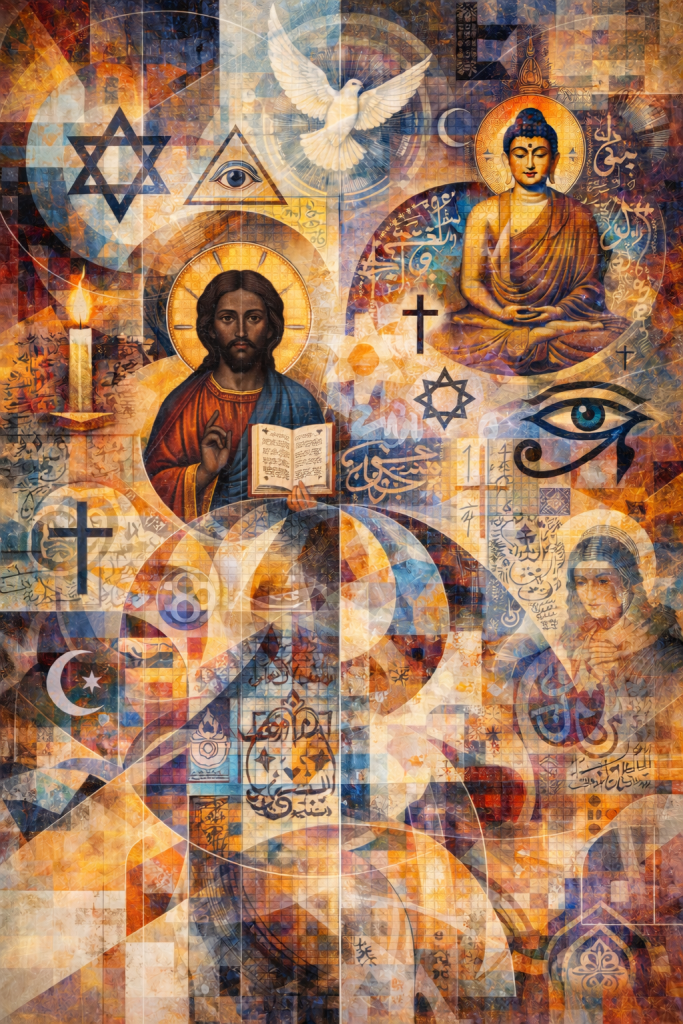
When people argue about God, they often assume they are speaking about the same reality. Yet many disagreements arise because each person is referring to an entirely different understanding of God, one shaped by their own stage of psychological, cultural, and spiritual development.
Our concept of God often evolves as our own consciousness evolves.
An archaic understanding of God is rooted in survival. The divine is experienced as mysterious, unpredictable, and inseparable from the raw forces of nature. Fear and awe become the primary forms of worship because existence itself feels fragile.
A magical understanding sees God actively intervening in everyday events. Blessings, curses, rituals, omens, and supernatural signs become central. The world feels enchanted, and divine power appears to operate through symbolic acts and sacred objects.
A mythical understanding presents God through sacred stories, unquestionable doctrines, and absolute moral laws. Faithfulness often means loyalty to one’s tradition, while competing beliefs are viewed with suspicion or rejection.
A rational understanding asks difficult questions. Science, philosophy, evidence, and critical thinking become important. God may still exist, but beliefs are expected to withstand intellectual scrutiny rather than rely solely on tradition or revelation.
A pluralistic understanding recognizes wisdom across many religions and philosophies. Rather than insisting that one path possesses the whole truth, it appreciates the possibility that different traditions illuminate different aspects of the same mystery.
An integral understanding attempts to include every previous perspective without dismissing them. Each view is understood as expressing something meaningful within its own context. The question shifts from “Which one is right?” to “What truth is each perspective trying to reveal?”
A super integral understanding goes even further. God is no longer merely an object of belief or a concept to defend. The distinction between God, self, and reality begins to dissolve. Divinity is not encountered as something separate from experience. It is recognized as the very ground from which all experience arises. Every stage, every worldview, every certainty, and every doubt appears as an expression of the same limitless reality.
This progression does not suggest that one stage is morally superior to another or that everyone must follow the same sequence. Human development is complex, and people often embody several perspectives simultaneously depending on the circumstances.
The more interesting question is not whether God exists.
The more revealing question is this.
Which version of God are we talking about?
Our answer may reveal far more about the structure of our own consciousness than about God.
Perhaps the deepest spiritual maturity arrives when we no longer need God to conform to our ideas. Instead, we allow our ideas to dissolve into the mystery they were always pointing toward.
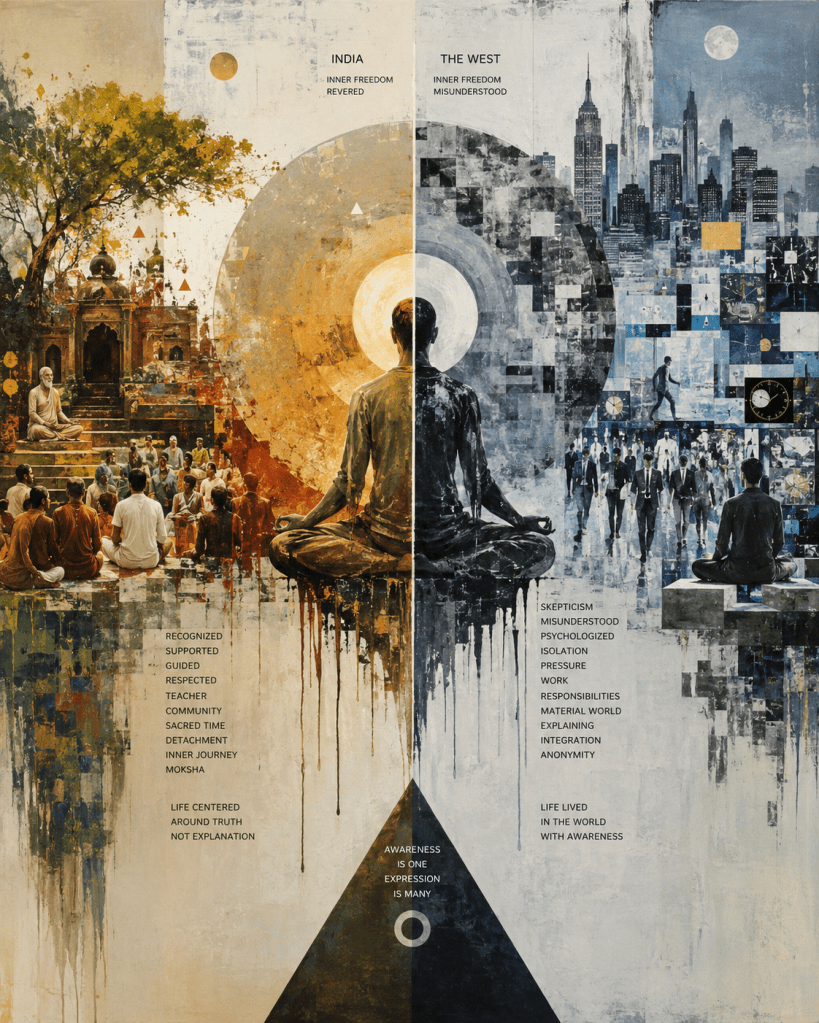
Enlightenment is often described as universal. The realization itself does not belong to any nation, religion, or culture. Awareness is not Indian. Awareness is not Western. It is beyond every identity we create. Yet the way enlightenment unfolds in a person’s life can be dramatically shaped by the society surrounding them.
Culture does not determine awakening. It determines how awakening is received.
Imagine two people who have arrived at the same profound realization. Both have seen through the illusion of a separate self. Both recognize consciousness as the ground of existence. Both live from the same awakened awareness. One lives in India. The other lives in North America.
Their inner reality may be identical, yet their daily lives could hardly look more different.
For thousands of years, India has preserved traditions that regard liberation as one of life’s highest possibilities. Spiritual practice has long been woven into ordinary life. Terms such as moksha, samadhi, karma, and nonduality have existed within the public imagination for centuries. Even those who have never experienced awakening may understand that such a possibility exists.
This creates an environment where an awakened person is more likely to be recognized, supported, or even sought out. Teachers often emerge naturally because there are students looking for guidance. Communities exist where silence is respected, contemplation is encouraged, and the pursuit of truth is considered a meaningful way to live.
The modern West developed along a different path.
Scientific inquiry, technological progress, economic productivity, and personal achievement became dominant values. These accomplishments have brought extraordinary advances, yet they have also shaped how unusual states of consciousness are interpreted. A person describing the disappearance of the separate self may be viewed through psychological, neurological, or philosophical lenses before being understood spiritually.
An awakened individual may therefore continue working a regular job, paying bills, raising children, or quietly practicing meditation without ever speaking publicly about their realization. Some remain anonymous for life, not because their realization is incomplete, but because the culture offers few places where such understanding is easily recognized.
This contrast raises an interesting question.
How many enlightened individuals have lived unnoticed simply because no one around them possessed the language to recognize what had occurred?
History remembers the great sages whose teachings survived. It says very little about those who awakened while working in factories, teaching classrooms, repairing automobiles, or sitting alone in apartments overlooking crowded cities.
Perhaps enlightenment has always been far more common than we imagine.
Recognition depends not only upon realization itself but also upon whether a culture has developed the capacity to perceive it.
A society that values external success may overlook inner freedom. A society that values inner realization may overlook worldly achievement. Neither perspective is complete by itself.
Human development reaches its fullest expression when both dimensions mature together. Outer progress improves civilization. Inner realization transforms the one experiencing civilization.
Neither India nor the West possesses the whole picture.
One has preserved profound maps of consciousness. The other has demonstrated remarkable advances in science, medicine, and human rights. Perhaps the future belongs to neither tradition alone, but to a deeper integration where wisdom and innovation develop side by side.
When awakening no longer appears unusual, humanity itself may have entered a new stage of development.
The question may not be whether enlightenment belongs more naturally to East or West.
The deeper question is whether humanity is becoming mature enough to recognize it wherever it appears.
Most people eventually outgrow their childhood ideas about almost everything.
Our tastes in food become more refined. Our understanding of relationships deepens. Our appreciation for music changes. Fashion evolves. Culture shifts. Even our political, moral, and philosophical views often undergo profound transformation as life teaches us new lessons.
Yet there is one idea that frequently remains frozen in time.
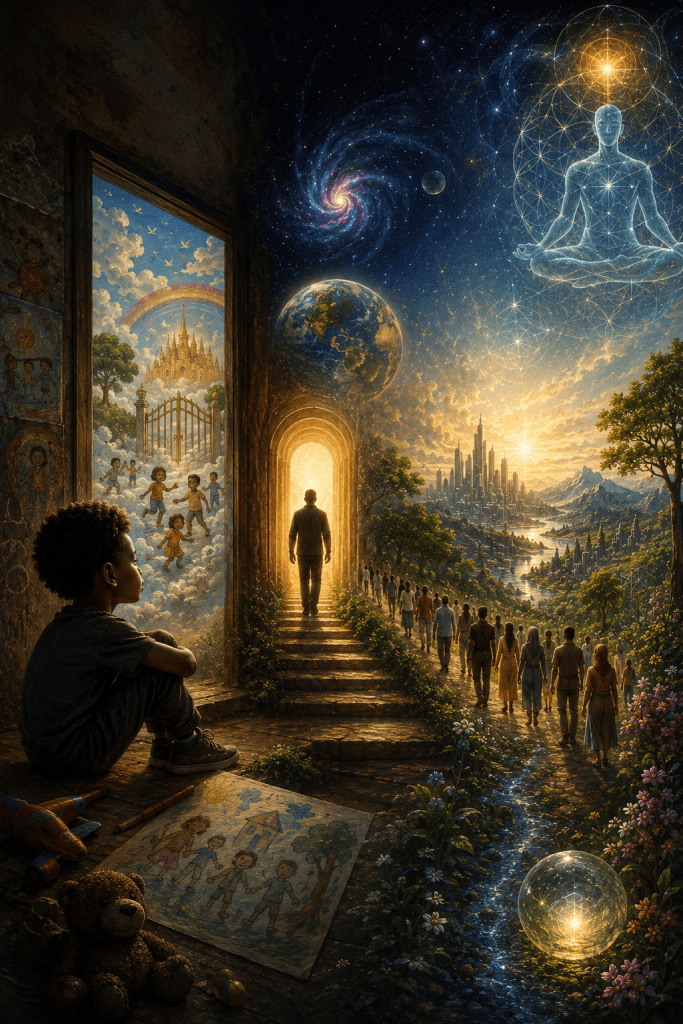
Paradise.
For many adults, heaven still resembles the picture they accepted as children. A beautiful place somewhere above the clouds where good people are rewarded, reunited with loved ones, and live happily forever. Although our understanding of nearly every other aspect of life matures, our image of paradise often remains untouched.
Why?
The answer may have less to do with religion than with psychological development.
Paradise Grows as Consciousness Grows
Every stage of psychological development interprets reality according to its own capacity. Paradise is no exception.
The earliest stage is concerned only with survival. Paradise simply means warmth, food, shelter, and freedom from danger.
As tribal consciousness develops, paradise becomes reunion with ancestors, spirits, and one’s people. Belonging is eternal.
The egocentric stage imagines paradise as limitless pleasure, power, success, and personal fulfillment. Heaven exists for the individual.
The mythic stage transforms paradise into a divine kingdom governed by justice. Those who obey are rewarded. Those who reject divine law are excluded. This is where many traditional religious images of heaven take shape.
The rational stage begins questioning whether heaven exists at all. Paradise may become symbolic, psychological, or simply an unanswered mystery.
The pluralistic stage opens paradise to everyone. Love replaces exclusivity. Compassion becomes more important than belief. Humanity itself becomes the family.
Integral consciousness recognizes that every previous view reflects a particular stage of development rather than an absolute truth. Paradise is increasingly understood as a way of being rather than merely a destination.
Finally, holistic consciousness dissolves the distinction altogether. Paradise is not somewhere else. Reality itself is recognized as the living expression of the Absolute.
The Expanding Circle of Identity
Our understanding of paradise also changes according to the size of our identity.
The egocentric perspective asks:
“How do I get into heaven?”
The ethnocentric perspective asks:
“Which group is chosen?”
The worldcentric perspective asks:
“How can everyone be included?”
The Kosmocentric perspective asks something entirely different.
“Who is it that seeks paradise in the first place?”
Here, the search begins to collapse.
The seeker, the destination, and the journey are all recognized as appearances within one indivisible reality.
Why Do We Stay Attached to Childhood Images?
Children require certainty.
Simple stories offer comfort in the face of death and uncertainty. Those early images become emotionally rooted long before critical thinking fully develops.
Unlike our opinions about careers, relationships, or politics, our beliefs about paradise are rarely revisited with the same willingness to question them. Religious traditions often preserve these images because they provide stability, identity, and hope.
There is nothing inherently wrong with that.
Every stage serves an important purpose.
Problems arise only when we assume that the understanding which comforted us at age five must also satisfy us at age fifty.
The Ultimate Shift
The greatest transformation may not involve discovering a better description of heaven.
It may involve recognizing that paradise was never meant to describe a location.
Perhaps heaven is a symbol pointing toward a realization.
A realization that nothing has ever existed outside the infinite.
A realization that separation was never ultimately real.
A realization that the very awareness reading these words is not traveling toward paradise.
It is the ground from which every idea of paradise has always appeared.
Perhaps the deepest question is not whether heaven exists after death.
Perhaps the deeper question is whether consciousness can awaken enough to recognize paradise before death.
If consciousness itself is the Absolute, then paradise is no longer a promise waiting in the future.
It is reality, seen without the illusion of separation.
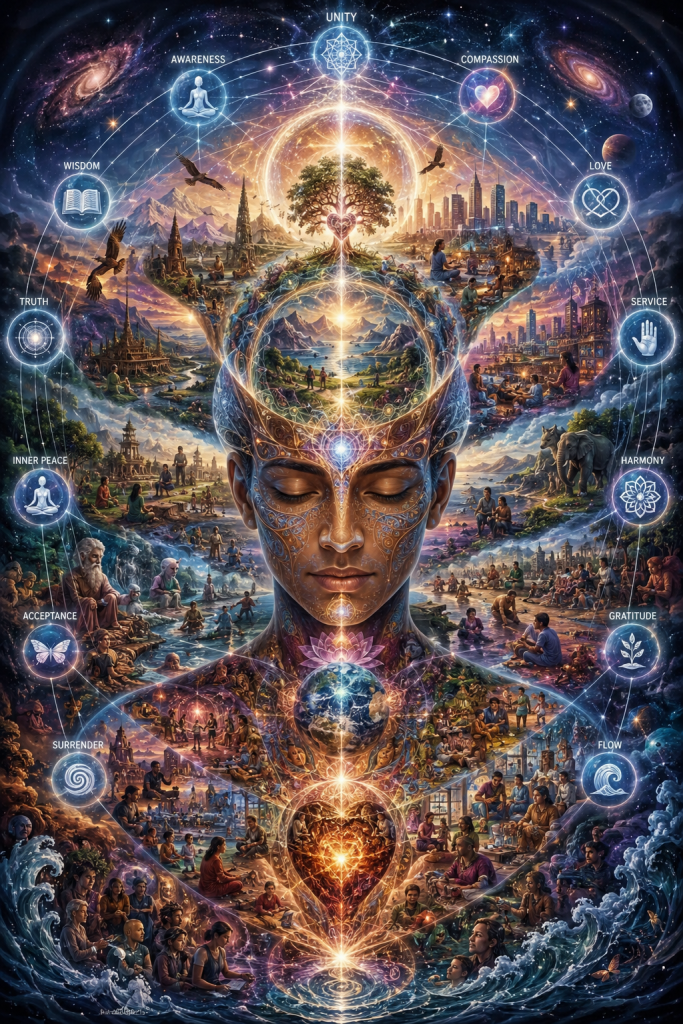
Every relationship you form with people, ideas, environments, challenges, and even suffering becomes part of your inner architecture. Nothing exists independently. Each connection enlarges the field through which life recognizes itself. What many call “growth” is often the gradual dissolution of false separation.
An integral human being does not merely collect information or experiences. They become increasingly interconnected with existence itself.
The more integral you become, the more relationships emerge naturally. Those relationships are not limited to human interaction. A relationship can exist between you and music, silence, nature, philosophy, responsibility, creativity, discipline, grief, or stillness. Every authentic connection widens consciousness.
Expanded relationship leads to expanded inheritance.
Inheritance is not only financial. It includes wisdom, opportunity, insight, support, emotional intelligence, resilience, creativity, intuition, and access to dimensions of reality that remain hidden to fragmented awareness. A disconnected mind sees scarcity because it perceives itself as separate from the whole. An integrated mind begins to recognize that life is constantly offering resources through connection.
Access creates abundance.
Abundance is frequently misunderstood as accumulation. Real abundance is access. Access to insight. Access to support. Access to clarity. Access to meaningful relationships. Access to inner stability. Access to possibility.
A person with few inner or outer connections may possess money yet still feel impoverished. Another person may possess little materially yet move through life with deep richness because they are profoundly connected to existence.
Connection multiplies options.
Options reduce limitation.
Limitation often originates less from external circumstance and more from contracted identity. When consciousness identifies itself as isolated, separate, or incomplete, possibilities narrow. Fear increases. Defensiveness grows. Rigidity forms.
As awareness expands through relationship, identity softens. The walls separating “self” from “other” begin to weaken. Life no longer appears as a battlefield of competing fragments but as an interconnected movement expressing itself through countless forms.
This movement gradually reveals The Self.
Not the egoic self built from memory and social conditioning, but the deeper Self prior to division. The Self that exists before identity becomes trapped inside labels, roles, status, beliefs, or psychological boundaries.
Realizing The Self reduces distinction.
Distinction is necessary within functional reality, yet psychological separation creates suffering. The mind continuously divides existence into categories: mine and yours, success and failure, worthy and unworthy, sacred and ordinary.
Awareness beyond fragmentation begins to perceive unity without erasing diversity. Differences still exist, but hostility toward difference dissolves. Separation loosens its grip.
As separation fades, love ceases to be an emotion directed toward selected objects.
Love becomes the natural condition of unobstructed consciousness.
Not sentimental love.
Not transactional love.
Not possessive love.
A deeper form emerges when the illusion of absolute separateness begins to collapse. That love expresses itself through compassion, patience, understanding, generosity, listening, forgiveness, and presence. It does not arise because reality becomes perfect. It arises because resistance to reality weakens.
Integral living is therefore not simply a developmental achievement.
It is participation in wholeness.
Every meaningful relationship becomes a doorway beyond limitation.
Every moment of genuine connection becomes a form of remembrance.
Every dissolution of separation reveals more of what has always been here.
The Absolute cannot be grasped by standing in a single place.
Any attempt to reduce it to one perspective—personal, relational, objective, mystical, or philosophical, inevitably distorts it. What gets mistaken for ultimate truth is often just a partial orientation mistaken for the whole.
To know the Absolute at full capacity requires more than a peak realization. It requires total perspectival inclusion.
From the first person, the Absolute is immediate presence; being as oneself. From the second person, it appears as intimacy, devotion, and encounter. From the third person, it becomes structure, law, and observable order. Each of these reveals something true, yet none is sufficient on its own.
A deeper shift occurs when perspective itself is examined.
The fourth perspective dissolves the centre. Experience continues, but ownership drops away. Awareness no longer belongs to anyone. Reality is no longer happening to a self or for a self. Knowing remains, yet no knower can be found.
Then even this gives way.
The fifth perspective removes the need for a field, a witness, or an explanatory ground altogether. The question of where experience occurs loses relevance. Nothing collapses. Nothing transcends. The demand for a final position simply falls apart.
At this point, God is no longer approached as an object of belief, a presence to merge with, or an awareness to stabilize in. God is known as that which remains valid across every mode of knowing without requiring allegiance to any of them.
This knowing must also scale developmentally.
Ego-centric concern gives way to ethnocentric identity, which yields to world-centric ethics, which eventually opens into kosmocentric inclusion. Each stage expands care, responsibility, and comprehension. None invalidates the others. Each must be seen through without being erased.
The same applies to the I, We, It, and Its dimensions of reality. Subjective experience, shared meaning, objective systems, and interobjective networks all reveal aspects of the Absolute. Excluding any one of them creates imbalance. Absolutizing any one of them creates delusion.
States of consciousness contribute their own disclosures. Waking reveals form and function. Dreaming reveals imagination and symbolic depth. Dreamless sleep reveals the absence of content. The witness reveals continuity without identity. Nonduality reveals the inseparability of all of it. None of these states owns the truth. Each exposes a different facet of what cannot be reduced.
Lines of development add further resolution. Cognitive clarity without emotional maturity distorts insight. Moral development without metaphysical depth flattens reality. Spiritual realization without psychological integration fragments embodiment. The Absolute is not known through excellence in one line alone.
Enlightenment, then, is not a single realization frozen in time.
It is the capacity to recognize the Absolute through every perspective without mistaking any perspective for the Absolute itself.
Such knowing does not claim finality. It does not announce arrival. It does not need to defend itself. It functions fluidly; able to speak personally, relationally, objectively, impersonally, and without position; depending on what the moment requires.
God is not found by climbing higher. God is known by nothing being excluded.
Most people think of darshan as a moment where a seeker looks upon a teacher, saint, or deity. Yet something far more nuanced unfolds beneath that outward exchange. The gaze, the silence, the presence, each thread of the encounter shapes consciousness in ways that depend on the inner maturity of the one receiving it.
A childlike stage approaches darshan with awe charged by emotion. The world feels animated by invisible forces, and a teacher appears to hold the keys to destiny itself. Nothing is questioned; everything is absorbed. Power seems to live outside the self, radiating from the figure who stands upon the altar or sits upon the asana.
A more developed stage begins to untangle symbol from projection. Presence is recognized not as magic, but as psychology refined into ritual. A teacher’s gaze becomes a mirror through which hidden material rises. Nervous systems synchronize, emotions unravel, archetypes awaken. What once felt supernatural becomes profoundly human, yet no less sacred for being understood.
A deeper stage meets darshan without seeking a blessing at all. Awareness recognizes its own reflection across an imagined divide. The teacher’s presence becomes a steady flame, revealing the same light in the one who looks. The moment turns transparent; subject and object thin into a single field. No transmission is required because nothing is actually transferred. Consciousness simply stands revealed to itself.
Darshan, then, is not a singular practice but a spectrum. It can soothe fear, unlock psychological insight, or open the doorway into the unbounded. Each layer is valid. Each layer meets the seeker where they stand. The mystery lies in how the same ritual changes meaning as consciousness evolves.
Perhaps the most profound realization is this: the power of darshan has never been contained within the one who gives it. The power rests in the depth of the one who receives.
Morgan O. Smith
Get Your Free Copy of My Book, Bodhi in the Brain!
Many spiritual paths appear radiant on the surface, filled with symbols, mantras, and promises of transcendence. Yet beneath the surface lies a crucial divide often overlooked: the difference between pre-rational and trans-rational spirituality. Both appear to reach beyond logic, yet one regresses beneath it while the other transcends it entirely. To the untrained eye, they can look identical.
The pre-rational domain is instinctive, emotional, and magical. It belongs to an earlier structure of consciousness that sees reality through myth, projection, and emotional fusion. The pre-rational individual feels connected to life, but that connection is often undifferentiated; there is no clear boundary between the self and the world. Intuition replaces discernment. Myth replaces direct knowing. This is the consciousness of the dreamer who mistakes imagination for revelation. Many who fall into this category speak the language of mysticism but remain bound by emotional dependency and unexamined belief.
The trans-rational individual, on the other hand, has journeyed through the rational mind, not around it. They have integrated logic, science, and self-reflection into their foundation. Their transcendence is not an escape from intellect but a movement beyond its limitations. The mind becomes a servant rather than a master. Awareness expands to include paradox, complexity, and the ineffable without denying the relative truth of reason. Where the pre-rational personality confuses fantasy with insight, the trans-rational sees through both fantasy and logic as partial mirrors of the Real.
Many spiritual communities confuse these two movements, what Ken Wilber calls the pre/trans fallacy. Mystical language, emotional intensity, or devotion can appear “advanced,” when in fact they may mask regression to earlier, unintegrated states. True trans-rational realization does not deny the world; it refines perception until all appearances reveal the same unbroken consciousness. It honours both matter and spirit as dimensions of the same reality, seeing no need to reject one for the other.
The pre-rational seeks comfort in transcendence; the trans-rational finds freedom in presence. The former escapes complexity; the latter embraces it as divine play. One dissolves into illusion; the other dissolves illusion itself. The difference is not about how high one climbs, but how fully one includes.
Morgan O. Smith
Join us for our free virtual Zoom/YouTube group meditation session tonight, Wednesday, November 12th, at 8:00 PM ET. Please have your headphones or earbuds ready for the full experience. Take an hour for yourself to unwind, breathe, and reconnect.