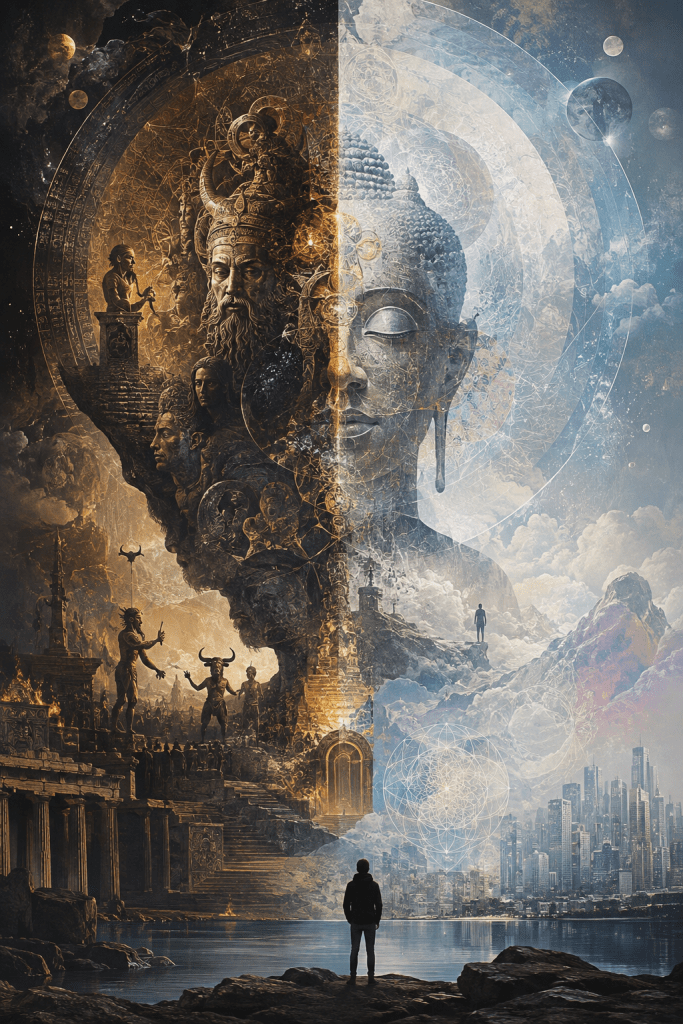
The Divine Through Every Stage of Being

Which God Do You Believe In?

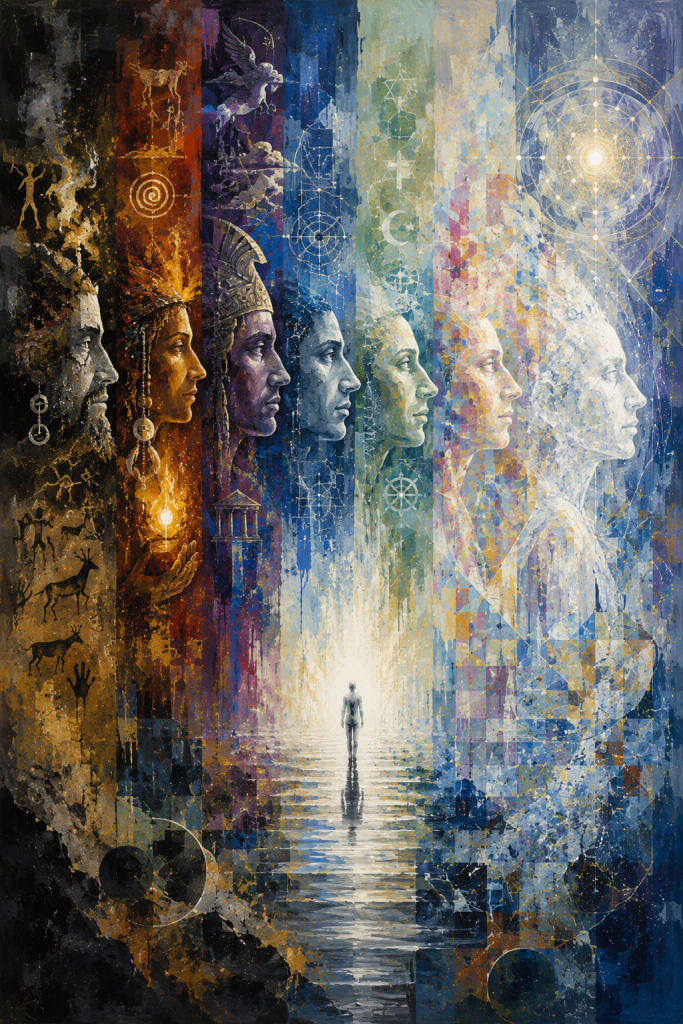
When people argue about God, they often assume they are speaking about the same reality. Yet many disagreements arise because each person is referring to an entirely different understanding of God, one shaped by their own stage of psychological, cultural, and spiritual development.

Our concept of God often evolves as our own consciousness evolves.

An archaic understanding of God is rooted in survival. The divine is experienced as mysterious, unpredictable, and inseparable from the raw forces of nature. Fear and awe become the primary forms of worship because existence itself feels fragile.

A magical understanding sees God actively intervening in everyday events. Blessings, curses, rituals, omens, and supernatural signs become central. The world feels enchanted, and divine power appears to operate through symbolic acts and sacred objects.

A mythical understanding presents God through sacred stories, unquestionable doctrines, and absolute moral laws. Faithfulness often means loyalty to one’s tradition, while competing beliefs are viewed with suspicion or rejection.

A rational understanding asks difficult questions. Science, philosophy, evidence, and critical thinking become important. God may still exist, but beliefs are expected to withstand intellectual scrutiny rather than rely solely on tradition or revelation.

A pluralistic understanding recognizes wisdom across many religions and philosophies. Rather than insisting that one path possesses the whole truth, it appreciates the possibility that different traditions illuminate different aspects of the same mystery.

An integral understanding attempts to include every previous perspective without dismissing them. Each view is understood as expressing something meaningful within its own context. The question shifts from “Which one is right?” to “What truth is each perspective trying to reveal?”

A super integral understanding goes even further. God is no longer merely an object of belief or a concept to defend. The distinction between God, self, and reality begins to dissolve. Divinity is not encountered as something separate from experience. It is recognized as the very ground from which all experience arises. Every stage, every worldview, every certainty, and every doubt appears as an expression of the same limitless reality.

This progression does not suggest that one stage is morally superior to another or that everyone must follow the same sequence. Human development is complex, and people often embody several perspectives simultaneously depending on the circumstances.

The more interesting question is not whether God exists.

The more revealing question is this.

Which version of God are we talking about?

Our answer may reveal far more about the structure of our own consciousness than about God.

Perhaps the deepest spiritual maturity arrives when we no longer need God to conform to our ideas. Instead, we allow our ideas to dissolve into the mystery they were always pointing toward.

Morgan O. Smith

https://linktr.ee/morganosmith

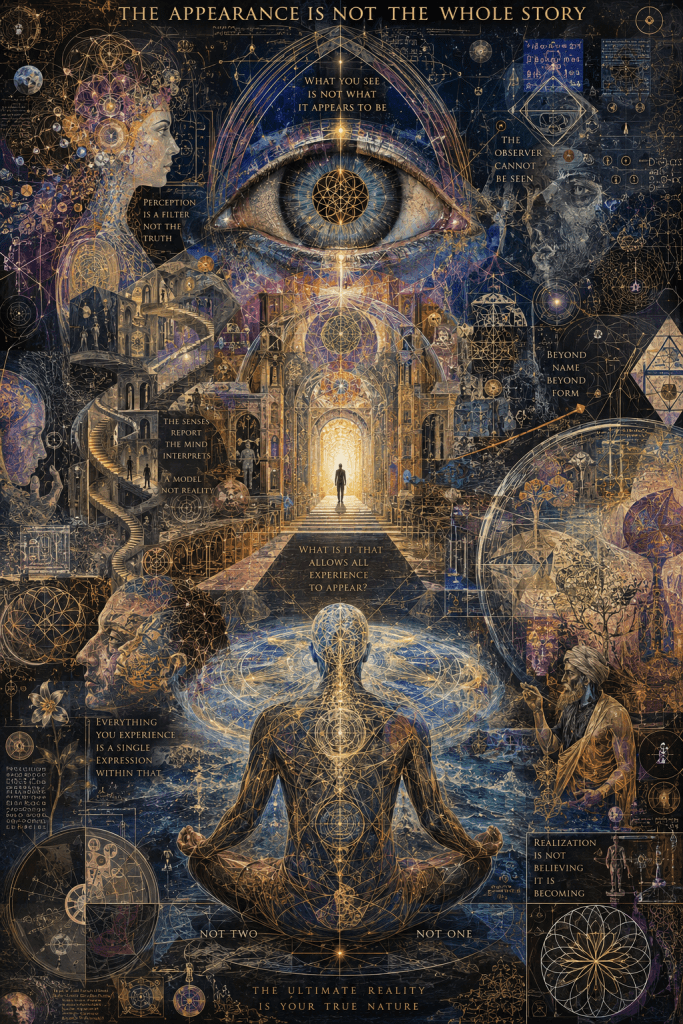
The Appearance Is Not the Whole Story

Some of you believe I am delusional or disconnected from reality because of the way I speak about consciousness. That conclusion makes sense if you assume I am denying the world you experience every day. I am not.

I am not saying that what you see, hear, smell, taste, touch, or feel internally is unreal. Those experiences undeniably occur. They shape your life, your relationships, your joys, and your suffering.

My point is something altogether different.

The mistake is assuming that experience is exactly what it appears to be.

Throughout history, humanity has repeatedly mistaken appearances for reality. The sun seemed to circle the Earth. Matter appeared solid and indivisible. Time felt absolute. Careful investigation revealed that each of these assumptions concealed a deeper truth.

Perhaps consciousness deserves the same level of investigation.

Ask yourself a simple question. What is it that allows every experience to appear at all?

Before you answer with the brain, the mind, or the senses, examine the question carefully. Those are themselves experiences. They are objects that appear within awareness. What is it that knows them?

That is the mystery worth solving.

No one can solve it for you.

I can tell you what I have realized, but my words are not your realization. Concepts may point, but they cannot replace direct recognition. Borrowed certainty only delays genuine discovery.

Many traditions have given this ultimate reality different names. God. Brahman. Allah. Source. Spirit. The Ground of Being. Each points toward something beyond language. Names are useful for conversation, but they are never the thing itself.

The destination cannot be captured by a label.

When this becomes more than an intellectual idea, something remarkable happens. The world does not disappear. Your senses continue to function. You still see, hear, smell, taste, touch, think, and feel.

What changes is your relationship to experience.

The world is no longer mistaken for the whole of reality. Every sight, every sound, every emotion, every thought becomes a single expression within something immeasurably greater.

The person you believed yourself to be also takes its proper place. Instead of standing apart from reality, it is recognized as one movement within it.

Nothing needs to be rejected.

Nothing needs to be escaped.

Only the assumption that appearances tell the whole story is questioned.

That investigation is not about adopting my conclusions or anyone else’s. It is about looking deeply enough that the answer reveals itself.

When it does, you may discover that what you have been searching for has never been absent.

Morgan O. Smith

https://linktr.ee/morganosmith

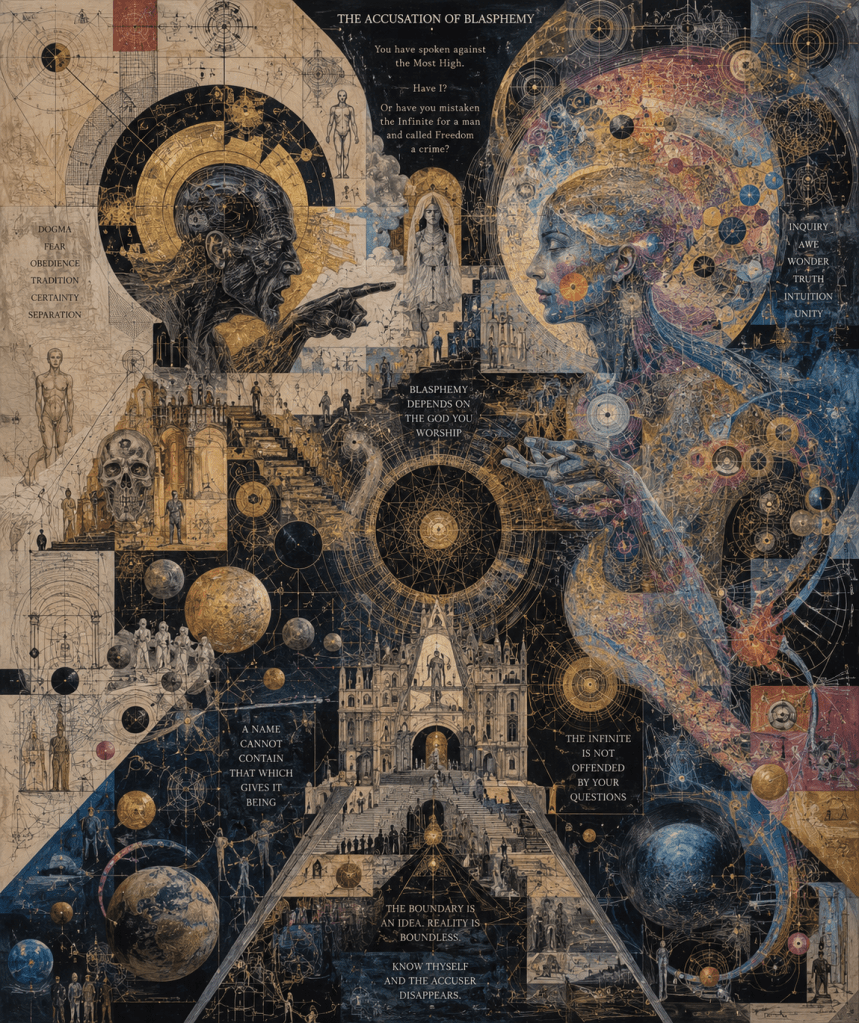
The Accusation of Blasphemy

Many of you have called me a blasphemer. If your understanding of God is built upon a supernatural being who exists somewhere beyond the universe, then I understand why you would arrive at that conclusion.

From that perspective, questioning sacred beliefs is an offense. Challenging religious certainty becomes rebellion. Refusing to bow before inherited ideas appears arrogant or dangerous.

I understand the reaction.

My position changes completely once the word God points to something fundamentally different.

Suppose God is not a person with preferences, opinions, or emotions. Suppose God is not a cosmic ruler who rewards belief and punishes doubt. Suppose God is the infinite reality from which every experience, every atom, every thought, every galaxy, and every conscious being arises.

What, then, could blasphemy possibly mean?

Can a wave insult the ocean?

Can space offend itself?

Can existence commit a crime against existence?

The charge of blasphemy assumes separation. It assumes there is a believer over here, a divine authority over there, and a boundary between the two that can be violated.

Direct realization dissolves that boundary.

This is not an invitation to disrespect religious traditions. Many traditions contain extraordinary wisdom. Their symbols, rituals, and stories have guided countless people toward compassion, humility, and profound insight.

The difficulty begins when symbols are mistaken for literal reality.

History shows that nearly every major breakthrough has been labeled dangerous by those invested in preserving the familiar. Scientific discoveries, philosophical revolutions, and spiritual insights have often been condemned before they were understood.

Perhaps the same pattern appears in discussions about God.

If God is truly infinite, then every sincere investigation into reality is already taking place within God. Honest questioning cannot threaten what is absolute. Curiosity cannot diminish infinity. Truth has nothing to fear from examination.

Perhaps what people call blasphemy is sometimes only the sound of certainty encountering a perspective it has never considered.

The greatest obstacle may not be disbelief.

It may be believing we already know what the word God refers to.

Morgan O. Smith

https://linktr.ee/morganosmith

When Every Worldview Is True

What if they are all true?

Atheistic, theistic, monotheistic, polytheistic, pantheistic, panentheistic, dualistic, and nondualistic. Each of these appears to contradict the others. Each claims to describe reality from a different standpoint. Each attracts devoted followers who often believe their view excludes the rest.

The contradiction exists only while the mind insists on separation. Every philosophy arises from a particular level of perception, development, experience, or realization. Each reveals something genuine, yet none can contain the whole.

The atheist may reject a personal God while recognizing the lawful order of existence. The theist experiences a living relationship with the Divine. The monotheist discovers unity through one supreme source. The polytheist encounters the many faces of the sacred. The pantheist sees God as the universe itself. The panentheist recognizes that the universe exists within God, while God also transcends it. The dualist experiences an apparent distinction between self and reality. The nondualist awakens to the absence of all separation.

None of these perspectives are necessarily false. They become limiting only when they declare themselves to be the final word.

Reality has an extraordinary capacity to express itself through countless perspectives without ever becoming divided. Like light passing through different lenses, the same truth appears in different forms depending on the conditions through which it is perceived.

Absolute Monism does not choose one worldview over another. It includes them all without becoming confined by any of them.

At that level, every distinction dissolves. The categories no longer compete because the awareness that created the categories has been recognized as prior to them. The question is no longer which philosophy is correct. The question becomes, what remains when every concept, every belief, every religion, every denial, and every affirmation are seen as movements within the same indivisible reality?

That recognition is not another philosophy. It is the end of needing one.

The ultimate truth is not found by defending a position. It is found when every position is seen as an expression of the One that has never been divided.

Morgan O. Smith

https://linktr.ee/morganosmith

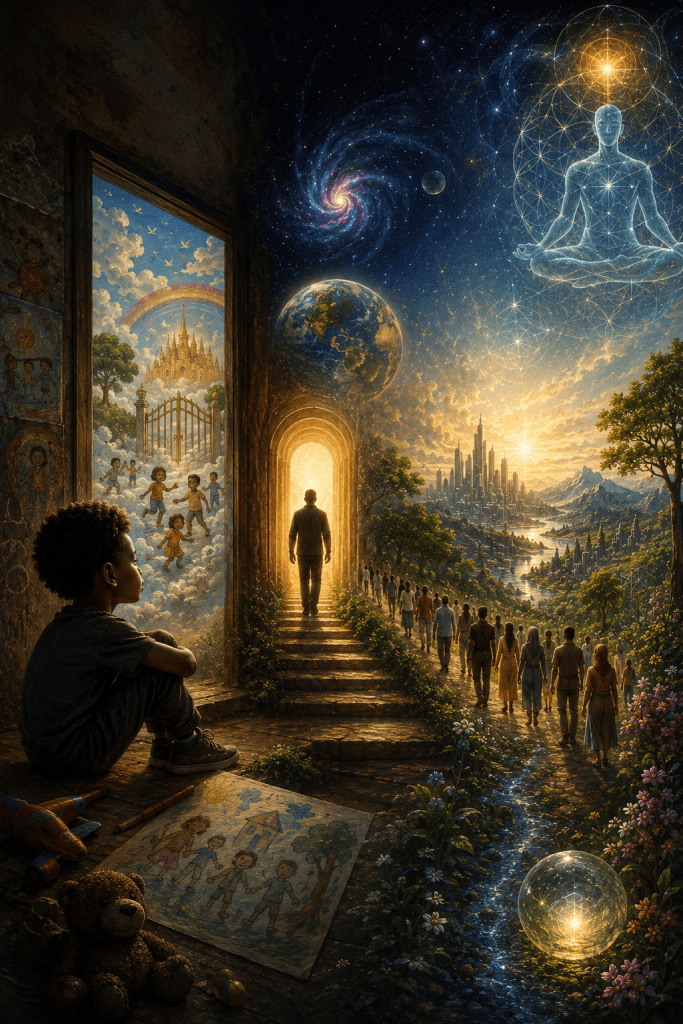
Have You Outgrown Your Childhood View of Heaven?

Most people eventually outgrow their childhood ideas about almost everything.

Our tastes in food become more refined. Our understanding of relationships deepens. Our appreciation for music changes. Fashion evolves. Culture shifts. Even our political, moral, and philosophical views often undergo profound transformation as life teaches us new lessons.

Yet there is one idea that frequently remains frozen in time.

Paradise.

For many adults, heaven still resembles the picture they accepted as children. A beautiful place somewhere above the clouds where good people are rewarded, reunited with loved ones, and live happily forever. Although our understanding of nearly every other aspect of life matures, our image of paradise often remains untouched.

Why?

The answer may have less to do with religion than with psychological development.

Paradise Grows as Consciousness Grows

Every stage of psychological development interprets reality according to its own capacity. Paradise is no exception.

The earliest stage is concerned only with survival. Paradise simply means warmth, food, shelter, and freedom from danger.

As tribal consciousness develops, paradise becomes reunion with ancestors, spirits, and one’s people. Belonging is eternal.

The egocentric stage imagines paradise as limitless pleasure, power, success, and personal fulfillment. Heaven exists for the individual.

The mythic stage transforms paradise into a divine kingdom governed by justice. Those who obey are rewarded. Those who reject divine law are excluded. This is where many traditional religious images of heaven take shape.

The rational stage begins questioning whether heaven exists at all. Paradise may become symbolic, psychological, or simply an unanswered mystery.

The pluralistic stage opens paradise to everyone. Love replaces exclusivity. Compassion becomes more important than belief. Humanity itself becomes the family.

Integral consciousness recognizes that every previous view reflects a particular stage of development rather than an absolute truth. Paradise is increasingly understood as a way of being rather than merely a destination.

Finally, holistic consciousness dissolves the distinction altogether. Paradise is not somewhere else. Reality itself is recognized as the living expression of the Absolute.

The Expanding Circle of Identity

Our understanding of paradise also changes according to the size of our identity.

The egocentric perspective asks:

“How do I get into heaven?”

The ethnocentric perspective asks:

“Which group is chosen?”

The worldcentric perspective asks:

“How can everyone be included?”

The Kosmocentric perspective asks something entirely different.

“Who is it that seeks paradise in the first place?”

Here, the search begins to collapse.

The seeker, the destination, and the journey are all recognized as appearances within one indivisible reality.

Why Do We Stay Attached to Childhood Images?

Children require certainty.

Simple stories offer comfort in the face of death and uncertainty. Those early images become emotionally rooted long before critical thinking fully develops.

Unlike our opinions about careers, relationships, or politics, our beliefs about paradise are rarely revisited with the same willingness to question them. Religious traditions often preserve these images because they provide stability, identity, and hope.

There is nothing inherently wrong with that.

Every stage serves an important purpose.

Problems arise only when we assume that the understanding which comforted us at age five must also satisfy us at age fifty.

The Ultimate Shift

The greatest transformation may not involve discovering a better description of heaven.

It may involve recognizing that paradise was never meant to describe a location.

Perhaps heaven is a symbol pointing toward a realization.

A realization that nothing has ever existed outside the infinite.

A realization that separation was never ultimately real.

A realization that the very awareness reading these words is not traveling toward paradise.

It is the ground from which every idea of paradise has always appeared.

Perhaps the deepest question is not whether heaven exists after death.

Perhaps the deeper question is whether consciousness can awaken enough to recognize paradise before death.

If consciousness itself is the Absolute, then paradise is no longer a promise waiting in the future.

It is reality, seen without the illusion of separation.

Morgan O. Smith

https://linktr.ee/morganosmith

God Is Prior to Every Claim Made About It

Every religion attempts to speak about God.
Every atheist attempts to reject God.
Every philosopher attempts to define God.
Every mystic attempts to dissolve into God.

Yet all of them arrive too late.

The moment a claim is made, reality has already been divided into subject and object, speaker and spoken, believer and belief. Language slices existence into pieces so the mind can navigate experience. Useful for survival. Useful for communication. Completely insufficient for what precedes all categories.

God is not hiding behind concepts.
Concepts are hiding within God.

The mind wants certainty. It wants something graspable. Something stable enough to worship, deny, analyze, or defend. But whatever can be captured by thought becomes an object among other objects. God cannot be reduced to an object because every object appears within the field of awareness itself.

This is why every final statement about ultimate reality collapses under its own weight.

“God exists.”
“God does not exist.”
“Everything is God.”
“There is no God.”

Each statement carries traces of truth while simultaneously missing the mark. Every declaration emerges after the fact, after consciousness has already formed distinctions within itself.

Ultimate reality is prior to theology.
Prior to philosophy.
Prior to perception.
Prior even to the one attempting to understand it.

Silence has always been closer than explanation.

Not the silence of suppression, but the silence that remains untouched before thought organizes the world into names and meanings. A newborn experiences reality before language intervenes. Deep meditation reveals a similar opening. Identity softens. Concepts lose their grip. Existence shines without commentary.

No claim survives there.

Only direct being.

This is why sages throughout history often spoke in paradox, contradiction, or negation. Not because truth is irrational, but because ordinary language depends on separation. Nondual realization exposes a condition where separation never truly occurred.

The wave tries to define the ocean while being made entirely of ocean.

Every doctrine eventually becomes a finger pointing away from itself. Problems begin when the finger is worshipped instead of what it reveals.

God cannot be contained inside scripture, ritual, ideology, or disbelief. Every system emerges within the very reality it attempts to explain. The finite cannot fully enclose the infinite because the infinite already contains the finite.

Even the word “God” arrives too late.

What you are looking for exists before the search begins. Before identity forms. Before memory. Before perception says “this” and “that.” Reality simply is, whole and indivisible, untouched by the arguments constructed around it.

Perhaps this is why genuine awakening feels less like acquiring knowledge and more like the collapse of false certainty.

Nothing new is added.
Something imagined falls away.

And what remains cannot be claimed.

Morgan O. Smith

God Without Belief

A curious statement arises: God is an atheist. Not as denial, but as a revelation of what cannot be confined to belief. Belief requires distance; someone who believes, and something believed in. That distance dissolves at the level of the Absolute.

God, understood as the ground of all being, does not stand apart from existence. No position can be taken outside of what already is. Theism proclaims devotion toward a divine presence. Pantheism recognizes divinity within all forms. Panentheism holds both transcendence and immanence. Agnosticism suspends certainty. Atheism rejects the claim altogether. Each appears to oppose the other, yet all emerge from the same source.

A wave arguing with another wave about the existence of the ocean misses the quiet truth beneath the motion. The ocean never needs to assert itself. No defense is required. No belief is necessary. Presence alone is sufficient.

God, in this sense, cannot be a theist, because there is nothing separate to believe in. God cannot be an atheist either, in the conventional sense, because nothing exists outside of that totality to deny. Yet from the human vantage point, the Absolute appears as both belief and disbelief, devotion and rejection, clarity and doubt.

Atheism becomes one expression of the divine refusing to objectify itself. The refusal to project an external deity is not always a rejection of truth; sometimes it is an unconscious recognition that truth cannot be turned into an object at all. What is rejected is often a concept, not the living reality prior to concepts.

The ground of being remains untouched by every conclusion formed about it. Arguments unfold within it, philosophies rise and fall within it, identities shape themselves and dissolve within it. Nothing stands outside to validate or invalidate what already includes everything.

Silence reveals more than assertion here. That silence does not belong to any religion or ideology. It is the same stillness present before belief forms and after it fades.

What, then, is left?

A direct knowing without position. A presence without identity. A reality that does not require agreement to be what it is.

God, as the Absolute, holds space for the believer kneeling in prayer and the skeptic dismantling every claim. Both movements are gestures within the same indivisible whole. Neither completes it. Neither threatens it.

Seeing this does not demand adopting a new belief. It invites the collapse of the need to hold one at all.

And what remains cannot be called belief or disbelief; only what is, prior to both.

Morgan O. Smith

The Paradox That Refuses to Break

For something to exist, it must appear somewhere. It must occupy a location, unfold across duration, relate to other things. Existence, as we commonly understand it, implies coordinates. A chair exists because it sits in space. A thought exists because it arises in time. Remove both, and what remains?

Many insist that the Divine transcends time and space. Yet transcendence poses a riddle. If something is truly beyond time and space, can it be said to exist at all? Existence, in every familiar sense, depends upon dimension, sequence, and relation. To be entirely outside those would seem to cancel the very idea of being.

Then comes the reversal.

If we claim the Absolute does not exist because it is beyond all coordinates, we still must ask: does nonexistence exist? The mind hesitates here. Nonexistence cannot be located, yet we speak of it. We conceive of absence. We reference nothingness. Somehow, even nothing appears within awareness.

Awareness does not vanish when an object disappears. When a sound fades, silence remains. When a thought dissolves, presence does not dissolve with it. Even the concept of “nothing” shows up as something known.

So what is happening?

Perhaps the difficulty arises from assuming that existence and nonexistence are opposites. That assumption belongs to a world of contrast—light and dark, birth and death, form and formlessness. But what if both poles arise within a deeper continuity?

Consider this possibility: the Divine exists as time and space. Every galaxy, every heartbeat, every passing second is not a creation separate from its source but an expression of it. The ticking clock is not evidence of distance from God; it is God measuring itself through movement. The extension of space is not apart from the Infinite; it is the Infinite stretching.

Yet the same reality is not confined to its expressions. Time unfolds within it, but it is not bound by succession. Space extends within it, but it is not limited by boundary. That which appears as the flow of moments is also the stillness in which moments arise.

From this vantage point, saying “God exists” is true. Saying “God does not exist” is equally true, if by existence we mean a definable object among other objects. The Absolute cannot be reduced to a thing inside the universe. Nor can it be excluded from the universe.

Existence and nonexistence collapse into a single indivisible fact: there is what is.

When the mind tries to categorize this, it fractures the whole into manageable concepts. It invents a creator separate from creation. It imagines a being located somewhere, ruling from a distance. Or it swings to the opposite extreme and denies any sacred dimension at all.

Both moves miss the intimacy of the matter.

The search for a name is the movement of the Infinite through a finite lens. Every label—God, Brahman, Source, Reality, Void—is a gesture. The gesture matters, but it never contains what it points toward.

You are not separate from this paradox. The very awareness reading these words is evidence of it. Thoughts move across your inner sky, yet something remains unmoving. Identity shifts across years, yet something does not age. The body occupies space and time, yet the sense of being here precedes every clock.

Perhaps what we call “God” is existence recognizing itself as both the field and the forms within it. Both the silence and the symphony. Both the presence of things and the apparent absence of them.

Existence does not need to choose between being and non-being. That choice belongs to the intellect.

What remains when even that choice dissolves?

Only this—undivided, immediate, self-knowing.

Call it what you will.

It is already what you are.

Morgan O. Smith

When Nothing Stands Above

How Can God Be a Higher Power When God Is Existence Itself?

Calling God a higher power quietly smuggles a ladder into reality. Someone stands below. Something stands above. Distance appears. Direction appears. Hierarchy sneaks in through language before thought has a chance to question it.

Yet if God is the only thing that exists, hierarchy collapses on contact.

A higher power implies comparison. Comparison requires at least two things. God plus something else. Creator plus creation. Observer plus observed. The moment this split is accepted, God becomes an object among objects, merely larger, stronger, or more authoritative than the rest. That version of divinity is impressive, but it is no longer ultimate.

Existence itself has no altitude.

If God is existence, then nothing stands outside it. No vantage point remains from which God could be viewed as higher or lower. The phrase higher power only makes sense from the perspective of a self that imagines itself separate, small, and contained. God appears higher because the self has first imagined itself as lower.

This is not a moral error. It is a perceptual one.

Power suggests force applied across distance. God-as-existence does not apply force. It does not act upon reality. It is reality acting as everything it appears to be. Gravity, breath, thought, confusion, devotion, resistance, clarity—all equally arise as expressions of the same indivisible field.

Nothing is empowered by God. Everything is empowered as God.

The need for a higher power often emerges from vulnerability. Humans face uncertainty, loss, fear, and finitude. A transcendent overseer offers comfort. Guidance feels safer when imagined as descending from above. Yet this comfort depends on separation. God must be elsewhere in order to rescue from here.

Nonduality removes the rescue narrative entirely.

What remains is intimacy without hierarchy. God is not watching life unfold. God is unfolding as life. No supervision. No intervention. No cosmic management style. Just continuous self-expression without a centre.

Prayer then shifts meaning. It no longer reaches upward. It settles inward, outward, everywhere at once. Not a request made to a higher authority, but a softening of resistance to what already is. Devotion becomes alignment rather than submission.

When God is understood as existence itself, the word higher loses relevance. Nothing can be higher than everything. Nothing can be closer than what is already happening.

God is not above you.

God is what is looking through your eyes, questioning the very idea of above and below.

Morgan O. Smith

Get Your Free Copy of My Book, Bodhi in the Brain!

https://subscribepage.io/oTSZQu

Knowing the Absolute from Every Angle

The Absolute cannot be grasped by standing in a single place.

Any attempt to reduce it to one perspective—personal, relational, objective, mystical, or philosophical, inevitably distorts it. What gets mistaken for ultimate truth is often just a partial orientation mistaken for the whole.

To know the Absolute at full capacity requires more than a peak realization. It requires total perspectival inclusion.

From the first person, the Absolute is immediate presence; being as oneself. From the second person, it appears as intimacy, devotion, and encounter. From the third person, it becomes structure, law, and observable order. Each of these reveals something true, yet none is sufficient on its own.

A deeper shift occurs when perspective itself is examined.

The fourth perspective dissolves the centre. Experience continues, but ownership drops away. Awareness no longer belongs to anyone. Reality is no longer happening to a self or for a self. Knowing remains, yet no knower can be found.

Then even this gives way.

The fifth perspective removes the need for a field, a witness, or an explanatory ground altogether. The question of where experience occurs loses relevance. Nothing collapses. Nothing transcends. The demand for a final position simply falls apart.

At this point, God is no longer approached as an object of belief, a presence to merge with, or an awareness to stabilize in. God is known as that which remains valid across every mode of knowing without requiring allegiance to any of them.

This knowing must also scale developmentally.

Ego-centric concern gives way to ethnocentric identity, which yields to world-centric ethics, which eventually opens into kosmocentric inclusion. Each stage expands care, responsibility, and comprehension. None invalidates the others. Each must be seen through without being erased.

The same applies to the I, We, It, and Its dimensions of reality. Subjective experience, shared meaning, objective systems, and interobjective networks all reveal aspects of the Absolute. Excluding any one of them creates imbalance. Absolutizing any one of them creates delusion.

States of consciousness contribute their own disclosures. Waking reveals form and function. Dreaming reveals imagination and symbolic depth. Dreamless sleep reveals the absence of content. The witness reveals continuity without identity. Nonduality reveals the inseparability of all of it. None of these states owns the truth. Each exposes a different facet of what cannot be reduced.

Lines of development add further resolution. Cognitive clarity without emotional maturity distorts insight. Moral development without metaphysical depth flattens reality. Spiritual realization without psychological integration fragments embodiment. The Absolute is not known through excellence in one line alone.

Enlightenment, then, is not a single realization frozen in time.

It is the capacity to recognize the Absolute through every perspective without mistaking any perspective for the Absolute itself.

Such knowing does not claim finality. It does not announce arrival. It does not need to defend itself. It functions fluidly; able to speak personally, relationally, objectively, impersonally, and without position; depending on what the moment requires.

God is not found by climbing higher.
God is known by nothing being excluded.

Morgan O. Smith

AI for Wellness and Spirituality Summit

February 9 & 10, 2026

https://aiforwellnessandspirituality.com/mosm