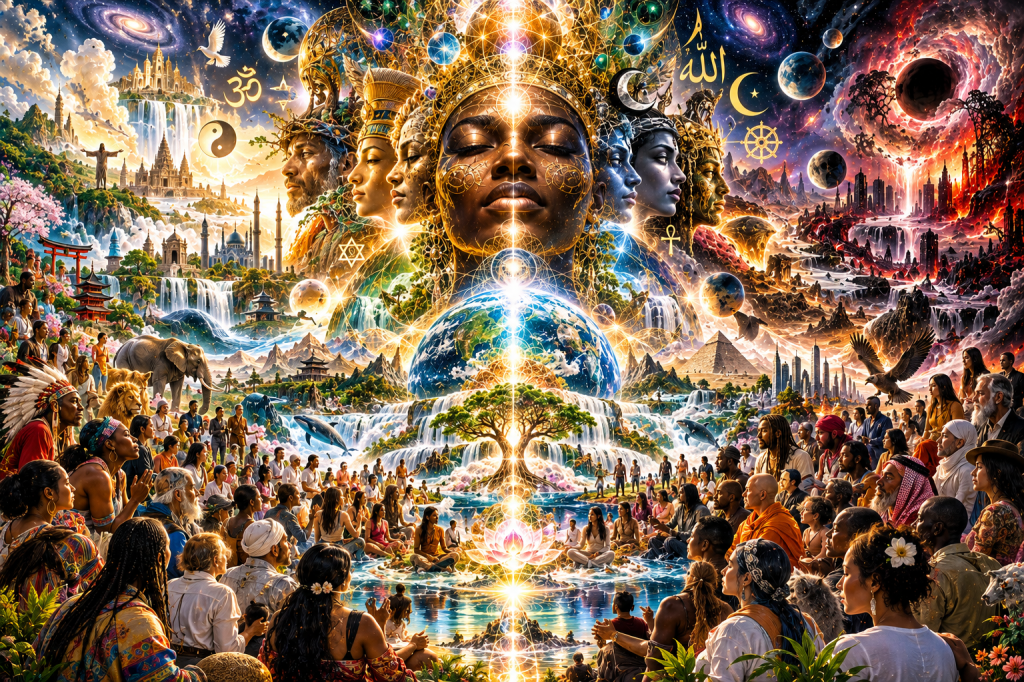
God does not love goodness more than evil, nor does God reject evil in favour of goodness. God loves all existence equally and unconditionally because all existence is God. The Absolute transcends both good and evil while including them both, without exception.
The God Who Cannot Reject Itself
What if the greatest misunderstanding about God is our assumption that divine love must operate according to human moral preferences?
Human beings have long imagined God as the supreme embodiment of goodness, a divine authority standing in opposition to evil. Goodness is associated with God’s presence, while evil is interpreted as God’s absence, rebellion against God, or a force fundamentally opposed to the divine.
But such an understanding presents a profound philosophical contradiction.
If God is truly absolute, infinite, omnipresent, and the source and substance of all existence, how could anything exist outside God?
Where would evil originate?
What independent reality could sustain something that God does not include?
If God is everything, then God cannot be everything except what humanity considers evil. Such an exclusion would establish a boundary around the divine, reducing the Absolute to something less than absolute.
The Absolute cannot exclude anything without ceasing to be absolute.
This recognition changes the entire conversation.
God is not merely the good within existence. God is existence itself, including everything humanity identifies as good and evil.
God transcends both precisely because God includes both.
And the reason for this absolute inclusion is unconditional love.
Not love directed selectively toward what is morally admirable, spiritually elevated, or emotionally comforting, but love so complete that nothing within existence can be excluded from it.
God loves everything equally because everything is God.
Divine Love Has No Conditions Because God Has No Other
Ordinary human love frequently depends upon distinctions.
We love what pleases us, supports us, protects us, or reflects our values. Even when we aspire toward unconditional love, our emotional responses remain influenced by personal experience, psychological development, and moral judgment.
We embrace certain expressions of life while resisting others.
But what happens when love is understood from the standpoint of the Absolute?
For God to love one manifestation more than another would imply that God possesses preferences concerning different portions of itself.
For God to reject evil absolutely would imply that something existing within God could become fundamentally alien to God.
For God to favour goodness as ultimately more divine would imply that some manifestations contain more of the Absolute than others.
Yet infinity cannot be divided into degrees of itself.
There cannot be a manifestation that is more fundamentally God than another manifestation.
The saint is not more God than the murderer.
The compassionate individual is not more God than the cruel individual.
The beauty of a sunrise is not more God than the devastation of an earthquake.
These expressions differ enormously in their characteristics and consequences, but none possesses an existence independent of the Absolute.
God’s unconditional love is equal because God’s presence is absolute.
There is no independent other to whom God must extend love.
There is only God, appearing as everyone, everything, and everywhere.
From this standpoint, divine love is not an emotion that God experiences toward creation.
Divine love is the indivisible nature of existence itself.
God loves itself without condition, without preference, and without exception.
Why God Must Transcend and Include Good and Evil
To transcend something is not necessarily to reject it.
This distinction is essential.
When human beings hear that God transcends good and evil, they sometimes imagine a divine reality that exists beyond both, untouched by their presence.
But transcendence without inclusion creates another form of separation.
If God transcends evil by excluding it, evil must exist somewhere outside the Absolute.
If God transcends goodness by abandoning it, goodness likewise becomes something separate from ultimate reality.
Neither possibility is compatible with absolute nonduality.
True transcendence does not require exclusion.
God transcends good and evil because neither can define or limit God. God includes good and evil because neither can exist apart from God.
This is the simultaneous transcendence and inclusion of the Absolute.
Consider a mathematical space containing every possible point within its dimensions.
Some points may be assigned positive values, others negative values. Their differences are meaningful within the mathematical system, yet the space itself is not exclusively positive or negative.
It accommodates both without being reducible to either.
Now consider an even more radical possibility: a reality that does not merely contain all distinctions but constitutes the very existence through which distinctions become possible.
That is closer to what absolute nonduality proposes.
Good and evil are distinctions arising within manifestation.
The Absolute is the reality of both.
It cannot be defined exclusively by goodness, because goodness acquires its conceptual meaning through its distinction from evil.
It cannot be defined exclusively by evil, for the same reason.
God is not one side of a duality.
God is the indivisible reality within which duality appears.
This does not make God neutral in the ordinary sense. Neutrality is itself a position defined in relation to opposing alternatives.
The Absolute is prior to the distinction between preference, opposition, and neutrality.
It is not choosing between good and evil.
It is the existence of both.
Evil Is Not a Failure of Divine Love
Perhaps one of humanity’s most persistent theological assumptions is that evil represents a failure, limitation, or contradiction of divine love.
We ask why an all-loving God would allow suffering, cruelty, injustice, and destruction.
The question assumes that unconditional love should produce only conditions that human beings consider desirable.
But this assumption may confuse divine love with human benevolence.
Human benevolence seeks to promote well-being and prevent harm. These are indispensable qualities within human relationships.
Absolute love, however, may refer to something fundamentally different.
It is not simply a force attempting to produce pleasant experiences or eliminate unpleasant ones.
It is the unconditional inclusion of all existence within itself.
Under this understanding, God does not cease to love when existence manifests cruelty.
God does not withdraw its presence when suffering occurs.
God does not become absent when consciousness expresses hatred, ignorance, or destruction.
All these manifestations remain inseparable from the Absolute.
This does not suggest that cruelty is desirable or suffering should be celebrated. It suggests that neither can establish a metaphysical separation from God.
The presence of evil does not demonstrate the absence of divine love.
Rather, from this perspective, evil reveals the extent to which unconditional love cannot be reduced to human expectations.
A love that includes only what is good remains conditional upon goodness. Absolute love cannot depend upon such a condition.
If God loves all existence unconditionally, then even what we call evil exists within that love.
Not because evil deserves special approval.
Not because evil is secretly good.
But because nothing that exists can be other than the Absolute.
God Loves the Saint and the Murderer Equally
This is where the philosophical implications become particularly uncomfortable.
If God’s love is truly unconditional and equal, then God cannot love the saint more than the murderer.
To the human moral imagination, this may sound offensive.
Surely a person who dedicates a lifetime to relieving suffering deserves greater divine love than someone who deliberately inflicts suffering.
From the standpoint of human ethics, their actions warrant radically different judgments.
But divine love, understood as absolute inclusion, is not distributed according to moral achievement.
The saint does not earn a greater share of God through compassion.
The murderer does not lose a portion of God through cruelty.
Both are manifestations of the same indivisible reality.
Their actions are not equivalent, but their ultimate being is not separate.
The saint manifests qualities that human beings rightly recognize as beneficial, compassionate, and life-affirming.
The murderer manifests conduct that human beings rightly condemn and must seek to prevent.
Yet the Absolute remains equally present as the fundamental existence of both.
This distinction must not be overlooked.
Equal divine love does not mean equal moral value. It means equal ontological inclusion.
The Absolute does not discriminate in its being, even though human beings must discriminate in their conduct.
Recognizing this distinction allows us to preserve the radical implications of nonduality without collapsing into moral indifference.
One can recognize God as the ultimate reality of every being while still holding individuals accountable for their actions.
One can oppose cruelty without imagining that the cruel person exists outside God.
One can protect the innocent without believing that innocence grants a greater degree of absolute existence.
The recognition of oneness does not abolish compassion.
It removes the illusion that compassion must depend upon metaphysical separation.
God Is Both the Opposites and What Transcends Them
Every distinction that arises within existence depends upon the possibility of its opposite.
Creation and destruction.
Order and disorder.
Pleasure and pain.
Knowledge and ignorance.
Good and evil.
Human consciousness experiences these distinctions as fundamental characteristics of reality.
Yet the Absolute cannot be limited to any single category, because every category represents only a particular expression within the totality.
God is creation, but not creation alone.
God is destruction, but not destruction alone.
God is goodness, but not goodness alone.
God is evil, but not evil alone.
God is the existence of every opposite while remaining irreducible to the opposition itself.
This is not a contradiction when we recognize the difference between the relative and absolute standpoints.
At the relative level, good and evil remain distinct.
At the absolute level, neither possesses independent existence.
Both are manifestations of what is ultimately indivisible.
God is therefore not merely the reconciliation of opposites.
Reconciliation implies that something previously divided must be brought together.
The Absolute has never been divided.
Good and evil appear as opposites within manifestation, but their apparent opposition does not divide the reality through which they exist.
The separation belongs to the level of distinction.
The unity belongs to the nature of existence.
God does not become whole by uniting good and evil. God is already whole as the reality of both.
Unconditional Love Does Not Need to Justify Existence
Human beings frequently seek explanations for why particular events occur.
Why does suffering exist?
Why are some people born into favourable circumstances while others endure unimaginable hardship?
Why does consciousness manifest both extraordinary compassion and extraordinary cruelty?
These questions are meaningful, and their ethical implications demand serious attention.
But perhaps absolute love does not require every manifestation to possess a morally satisfying explanation.
We often assume that if God loves everything, then everything must ultimately serve some beneficial purpose.
This is another way of making divine love conditional upon goodness.
We attempt to justify evil by imagining that it secretly contributes to a greater good.
But what if the Absolute does not need to transform evil into goodness to include it?
What if God loves existence without requiring existence to justify itself?
Under this understanding, the unconditional nature of divine love does not depend upon a hidden cosmic calculation in which every tragedy eventually produces a compensating benefit.
God does not need to prove that suffering is worthwhile before suffering can be included within the Absolute.
Existence is not required to satisfy human moral expectations to remain divine.
This is a difficult position because it offers no comforting explanation for individual suffering.
Yet it also refuses to turn suffering into an instrument supposedly required for some greater divine objective.
The Absolute includes suffering without making suffering morally necessary.
It includes cruelty without declaring cruelty virtuous.
It includes goodness without making goodness a prerequisite for existence.
Such love is unconditional precisely because nothing must first become something else to belong.
The Absolute Cannot Love Itself Unequally
Consider the implications of divine preference.
If God loves goodness more than evil, then God loves one manifestation of itself more than another.
If God loves the saint more than the sinner, then God’s love depends upon the behaviour of its own manifestations.
If God rejects anything absolutely, then God rejects something that cannot exist independently of God.
Each possibility introduces conditions into what is supposedly unconditional.
It also introduces inequality into what is fundamentally indivisible.
But if God’s love is absolute, its completeness cannot fluctuate according to the qualities appearing within existence.
God does not become more loving when goodness manifests.
God does not become less loving when evil manifests.
God does not acquire additional love through the development of compassion within humanity.
Nor does God lose love through humanity’s destructive tendencies.
The Absolute is not subject to increase or decrease.
Its love cannot become more complete.
God loves everything equally because there is no division within God through which unequal love could ultimately arise.
This is the radical simplicity concealed within the most difficult implications of nonduality.
There is only one existence.
That existence is absolute.
Its nature is unconditional love.
Everything that appears is that existence.
Therefore, nothing can fall outside that love.
Why Human Beings Must Still Choose Good Over Evil
A legitimate question now arises.
If God equally includes good and evil, why should human beings cultivate goodness?
Why not become indifferent to suffering, injustice, and destructive behaviour?
The answer lies in understanding the difference between absolute inclusion and relative responsibility.
God’s transcendence of good and evil does not mean that human beings experience no consequences from their actions.
Cruelty causes suffering.
Compassion alleviates suffering.
Violence destroys lives.
Care preserves and supports them.
These distinctions remain consequential within manifested existence.
Recognizing that all beings share the same ultimate reality does not erase their experiences.
Indeed, nondual understanding can provide a profound basis for compassion.
If the apparent other is not ultimately separate from oneself, then the suffering of another cannot be dismissed as belonging to an entirely alien existence.
The recognition of oneness can express itself as an increasingly inclusive ethical concern.
This does not mean that the Absolute prefers compassion over cruelty in the way a human personality might.
It means that compassion can arise naturally through a conscious recognition of nonseparation.
A person established in this understanding may act to prevent suffering, not because God is absent from those who cause harm, but because the suffering being addressed is equally an expression of the same indivisible existence.
God includes the aggressor.
God includes the victim.
God includes the person who intervenes.
God includes the consequences of every action.
Nothing is excluded.
Yet inclusion does not eliminate responsibility.
The Absolute transcends moral distinctions, while human beings continue to live within the conditions where those distinctions matter.
Absolute love includes everything. Relative wisdom discerns how to act.
The Love That Cannot Be Increased, Diminished, or Withdrawn
Perhaps the most extraordinary implication of this understanding is that God’s love cannot be earned, improved, damaged, or lost.
There is nothing anyone can do to become more fundamentally included within the Absolute.
There is nothing anyone can do to become less fundamentally included.
Spiritual awakening does not make someone more God.
Ignorance does not make someone less God.
Goodness does not increase the Absolute’s presence.
Evil does not diminish it.
What changes is the manifestation, the experience, the recognition, and the consequences arising within existence.
The Absolute itself remains unchanged.
This is why divine love, understood from the standpoint of absolute nonduality, cannot be compared adequately with ordinary affection.
Affection may grow or fade.
Approval may be granted or withdrawn.
Relationships may strengthen or deteriorate.
But the unconditional love of the Absolute is not a relationship between separate beings.
It is the indivisible reality of all beings.
God does not have to reach outward to love existence.
God is the existence being loved.
The lover, the beloved, and love itself are not ultimately three separate realities.
They are one.
Beyond Good and Evil, Without Excluding Either
The deepest realization is not that goodness eventually defeats evil.
Nor is it that evil is secretly goodness misunderstood.
Nor is it that both are illusions without consequences.
It is that good and evil, despite their profound differences within human experience, cannot divide the Absolute.
God is not exclusively good.
God is not exclusively evil.
God is not a morally neutral entity positioned between the two.
God is the absolute reality that transcends and includes both, equally and unconditionally.
And because God is all existence, God’s love is not directed toward something separate from itself.
God loves itself as everything.
As everyone.
As everywhere.
As every conceivable manifestation of existence.
Nothing is outside this love because nothing is outside God.
The saint and the sinner.
The beautiful and the horrifying.
The creator and the destroyer.
The compassionate and the cruel.
The known and the unknown.
All are included, not because their expressions are equally desirable, but because their existence is equally inseparable from the Absolute.
This is where divine love ceases to resemble the selective affection of a cosmic personality and becomes something far more radical.
God does not love everything despite being everything. God loves everything unconditionally because God is everything.
The Absolute cannot reject itself.
It cannot divide itself into portions that deserve existence and portions that do not.
It cannot become more absolute through goodness or less absolute through evil.
Its completeness is not dependent upon the moral qualities of its manifestations.
And its love is not dependent upon anything at all.
Perhaps this is what it truly means to say that God is Love.
Not that God embodies only those qualities humanity associates with goodness.
Not that God must ultimately eliminate every manifestation we consider evil.
But that God is the indivisible existence of everything, absolutely incapable of excluding any aspect of itself.
God transcends good and evil.
God includes good and evil.
God loves both equally, because both are God.
And beyond every distinction the human mind can construct, the Absolute remains what it has always been.
One without a second.
Not a love that chooses what deserves to exist.
But a love from which nothing has ever been separate.
A Final Contemplation
If God is everything, and God’s love is unconditional, then what could God possibly withhold that love from?
If something could be excluded, would God still be absolute?
And if nothing can be excluded, perhaps the ultimate nature of divine love is not the triumph of one opposite over another, but the realization that neither opposite has ever existed independently of the One.
God does not transcend good and evil by leaving them behind. God transcends them by being infinitely more than either, while including both without exception.
Morgan O. Smith

