Why Is Nothingness Referred to as Nothingness?

Language faces an impossible task when attempting to speak about what precedes all appearances.

Every word points toward something. Every concept distinguishes one thing from another. Every description relies upon contrast, location, qualities, relationships, or characteristics. Yet what many contemplative traditions refer to as the Absolute, the Ground of Being, or pure reality before conceptualization possesses none of these.

Nothingness is not called nothingness because it is empty in the ordinary sense.

An empty room still contains space. A vacant lot still exists somewhere. Even darkness can be perceived. Ordinary emptiness remains something that can be identified, experienced, or described.

Nothingness, in its deepest philosophical and mystical meaning, points toward that which cannot be located, measured, conceptualized, perceived as an object, or distinguished from anything else.

Location cannot be assigned to it because location itself appears within it.

Time cannot contain it because time arises within experience.

Attributes cannot be given to it because attributes create distinctions.

Existence and nonexistence cannot adequately describe it because both are conceptual categories.

This creates a paradox.

The moment a reference is made, the reference becomes something. The moment a concept is formed, a boundary appears. The moment a description is offered, what is described has already been transformed into an object of thought.

Nothingness is therefore not a description. It is a linguistic surrender.

The word functions less as a definition and more as an admission that thought has reached its limit.

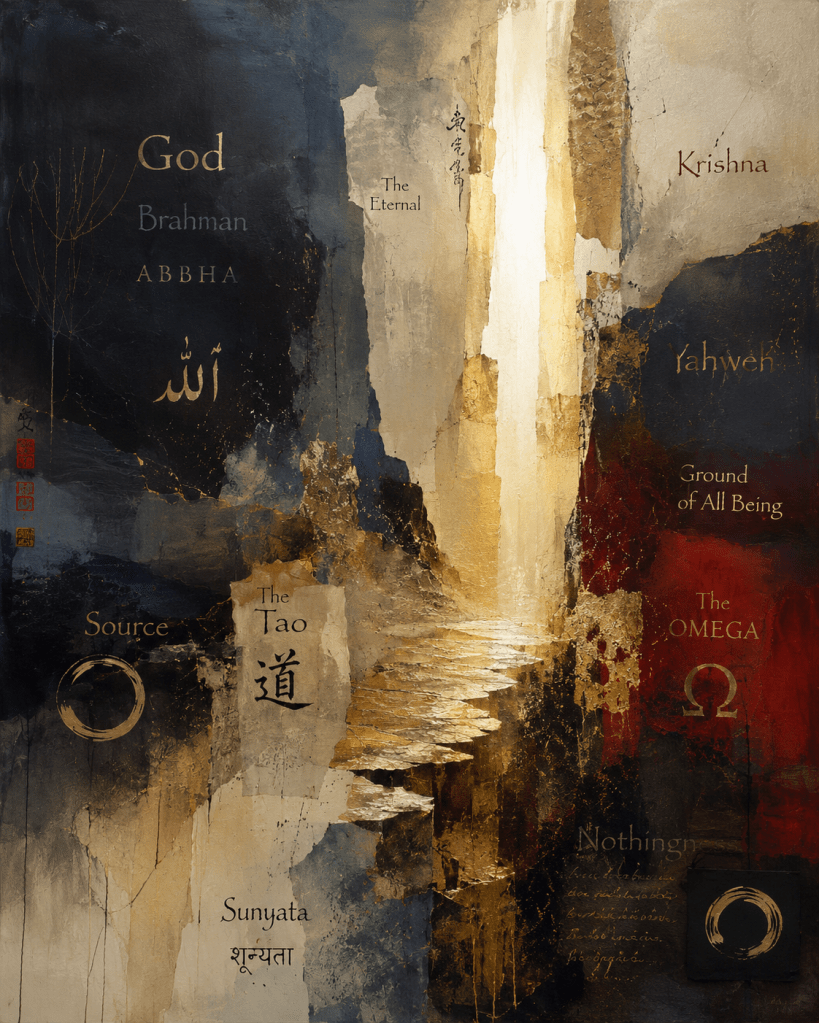
Mystics throughout history have encountered this difficulty. Some called it Brahman. Others called it Sunyata. Some referred to it as the Tao. Others spoke of the Godhead, the Absolute, the Unborn, or the Nameless.

Each term points toward the same problem.

Whatever is being indicated cannot actually be captured by the indication.

A finger pointing toward the moon is not the moon.

A concept pointing toward reality is not reality.

A word pointing toward nothingness is not nothingness.

From a nondual perspective, even calling it nothingness can be misleading. The term may suggest absence, voidness, or negation. Yet what is being pointed toward is not the absence of reality. It is reality prior to division into existence and nonexistence.

Thought asks, “What is it?”

Direct realization reveals that the question itself cannot reach it.

The mind searches for an object and finds none.

It searches for a location and finds none.

It searches for a boundary and finds none.

It searches for a reference point and finds none.

Because no reference can be established, language falls silent.

What remains is called nothingness.

Not because it is literally nothing.

Because every attempt to make it something fails.

Morgan O. Smith

https://linktr.ee/morganosmith

Every Concept Leaves the Real Untouched

Human beings live inside a world of concepts.

Names, beliefs, identities, philosophies, and explanations create a framework through which experience is interpreted. Without concepts, daily life would become difficult to navigate. Language allows communication. Ideas allow learning. Categories allow organization.

Yet something remarkable is often overlooked.

Reality itself never becomes the concept used to describe it.

A map of a forest is not a forest.

A recipe is not a meal.

A photograph of the ocean contains no water.

Concepts point. Reality is what is pointed to.

Confusion begins when the distinction is forgotten.

The spiritual seeker is especially vulnerable to this mistake. Sacred texts are studied. Philosophical systems are compared. New beliefs replace old beliefs. Concepts become increasingly refined until one eventually possesses a sophisticated understanding of reality.

Understanding, however, is not the same as direct realization.

A person can memorize every description of fire and still feel cold.

Words about truth are not truth.

Ideas about awareness are not awareness.

Concepts about God are not God.

Reality remains exactly as it is regardless of how it is described.

This becomes obvious when observing how different traditions speak about the ultimate. One tradition speaks of Brahman. Another speaks of emptiness. Another speaks of divine presence. Another speaks of pure consciousness. Each description carries value, yet none possesses exclusive ownership over what is being described.

The Real remains untouched by every label.

Names change.

Languages change.

Civilizations rise and fall.

Reality remains.

A mountain does not become more majestic because someone writes a poem about it. The sky does not become less vast because someone misunderstands it. Existence itself is unaffected by every opinion formed about it.

The same principle applies to the deepest dimensions of spiritual realization.

Many seekers become fascinated with collecting concepts. They gather teachings the way others gather possessions. Each new idea creates the feeling of progress. Intellectual understanding expands, but direct recognition often remains distant.

Knowledge accumulates.

Wisdom simplifies.

Eventually a moment arrives when thought reaches its natural limit. Not because thinking is flawed, but because thought can only operate through symbols and representations. Reality is never a representation.

Reality is immediate.

A sound is heard before it is named.

A sensation is felt before it is interpreted.

Awareness is present before thought comments upon it.

This simple observation reveals something extraordinary. Every concept arises within awareness, yet awareness itself is never captured by the concepts appearing within it.

Thought can describe awareness endlessly.

Awareness remains untouched by the description.

Mystical traditions across the world repeatedly return to this insight. Zen emphasizes direct seeing beyond conceptual thought. Advaita Vedanta points toward the witness beyond all mental activity. Taoism reminds us that the Tao spoken of is not the eternal Tao.

Different languages.

Different approaches.

The same invitation.

Look beyond the description.

Look beyond the explanation.

Look beyond the concept.

What remains is not an idea.

What remains is not a belief.

What remains is not a conclusion.

Something quietly present before every thought arises and after every thought disappears.

The Real does not need protection from misunderstanding.

It does not require belief to exist.

It does not become greater through praise or smaller through denial.

Every concept comes and goes.

The Real remains untouched.

Always here.

Always present.

Always beyond what can be said about it.

Morgan O. Smith

https://linktr.ee/morganosmith

Being Itself Is Beyond All Comparison

Comparison is one of the mind’s most persistent habits.

A person compares their life to another’s. One spiritual path is measured against another. Success is weighed against failure. Pleasure is contrasted with pain. The mind constantly creates distinctions, arranging reality into hierarchies and opposites.

This process serves a practical purpose. Comparison helps human beings navigate the world. Choosing food, evaluating risks, and making decisions often depend upon recognizing differences.

Problems arise when comparison is mistaken for truth itself.

Every comparison requires two or more objects. One thing is judged against another according to some standard. Larger and smaller. Better and worse. Higher and lower. More and less.

Being itself belongs to none of these categories.

A mountain can be compared to a hill. A river can be compared to a stream. A philosophy can be compared to another philosophy. Yet the simple fact of existence cannot be measured against anything because there is nothing outside existence with which it can be compared.

What could reality be compared to when every possible comparison already appears within reality?

This insight carries profound implications.

Much of human suffering arises from the assumption that life should be different from what it is. The present moment is measured against an imagined alternative. One’s current self is judged against an idealized future self. Experience becomes trapped inside endless evaluation.

Comparison creates psychological distance.

Being dissolves it.

A tree does not compare itself to another tree. The ocean does not envy a mountain. The sun does not seek validation from the stars. Nature expresses itself without consulting a scale of worth.

Human beings possess the unique capacity to construct elaborate mental narratives about who they are and who they should become. These narratives can inspire growth, but they can also create perpetual dissatisfaction.

The mind says, “I will be complete when I become something else.”

Being says nothing at all.

Existence simply is.

Mystical traditions throughout history have pointed toward this recognition. Advaita Vedanta speaks of Brahman as the sole reality, beyond all attributes and distinctions. Zen directs attention toward immediate experience before conceptual division. Taoism points toward a way of being that precedes judgment and categorization.

Each tradition approaches the mystery differently, yet all gesture toward a dimension of reality untouched by comparison.

Awareness itself offers a clue.

Thoughts come and go. Emotions rise and fall. Sensations appear and disappear. Identity changes throughout the course of a lifetime. Childhood becomes adulthood. Certainties become questions. Questions become insights.

Awareness remains.

The witnessing presence behind every experience is not greater than experience or lesser than experience. It is not superior or inferior. Such categories apply only to objects appearing within awareness, not to awareness itself.

Comparison belongs to the content.

Being belongs to the context.

A remarkable freedom emerges when this becomes more than an intellectual idea. The need to constantly measure oneself against others begins to weaken. Life is no longer approached as a competition for significance. Existence is appreciated directly rather than filtered through endless evaluation.

Nothing needs to be added.

Nothing needs to be removed.

Being is already complete before the mind begins calculating its value.

Perhaps this is why the deepest spiritual realizations often arrive with extraordinary simplicity. Reality is not discovered through becoming something greater than what one is. Reality is recognized through seeing what has always been present beneath the machinery of comparison.

Being itself cannot be ranked.

It cannot be improved.

It cannot be diminished.

Being itself is beyond all comparison.

Morgan O. Smith

https://linktr.ee/morganosmith

The Nameless Cannot Fit Inside Language

The strangest paradox of human existence is that we rely on language to understand reality while the deepest parts of reality seem to exist beyond language entirely.

A word can ignite a war, resurrect a forgotten memory, or make a stranger weep. Entire civilizations rise from shared symbols and stories. Human beings navigate life through names, categories, and explanations so constantly that description begins to feel indistinguishable from reality itself.

Yet the moment experience becomes truly immediate — raw grief, overwhelming beauty, profound stillness, unconditional love — words begin to fracture around its edges. Something essential escapes translation.

Every word depends upon distinction. Language functions by separating one thing from another so the mind can navigate experience. Light becomes different from darkness. Self becomes different from other. Beginning becomes different from ending.

But what happens when reality is encountered prior to division?

Ordinary language begins to fail.

Mystics throughout history arrived at the same dilemma. Whatever they discovered could not be fully translated into thought. Some called it God. Others called it emptiness, Brahman, Tao, pure awareness, or the Absolute. Different names emerged across cultures and centuries, yet every label pointed beyond itself.

A map drawn in ash cannot contain the wildfire itself.

A person can spend decades studying spiritual systems, memorizing sacred texts, and refining belief structures while never directly encountering what the words attempt to reveal. Language can guide attention, but it cannot substitute for realization.

This becomes especially clear during profound states of meditation or radical presence. Thought slows. Internal narration weakens. Identity loosens its grip. Experience no longer feels divided into observer and observed. Something vast and immediate remains, yet the mind struggles to explain it afterward.

Silence suddenly carries more honesty than explanation.

Not because truth is irrational, but because reality appears prior to conceptual separation. Words emerge afterward as echoes attempting to describe what cannot fully become an object of thought.

The mind naturally resists this insight. Human beings seek stability through conclusions. Definitions create psychological structure. Naming something creates the feeling of control over it. This tendency explains why religious institutions, philosophical systems, and ideological movements often become rigid.

But reality itself remains fluid and immeasurable.

Attempts to imprison the infinite within language eventually collapse into contradiction. God is described as both personal and impersonal. Emptiness becomes fullness. Enlightenment appears both ordinary and transcendent. Opposites dissolve because language was designed to organize division, not indivisibility.

Zen masters understood this deeply. Some answered spiritual questions with silence. Others responded with paradox, laughter, or seemingly irrational statements meant to loosen attachment to concepts. Their aim was not confusion for its own sake, but direct seeing.

A sunset does not need philosophy to radiate beauty. Love does not require intellectual agreement to be felt.

Reality arrives before commentary.

Perhaps this is why awakening often feels less like gaining knowledge and more like recognizing what has always been here beneath mental noise. The search softens because the seeker realizes what was being sought was never absent.

Words may continue afterward. Teaching may continue. Yet something fundamental changes. Language becomes symbolic rather than absolute. Concepts become tools rather than prisons mistaken for truth.

The nameless remains untouched behind every sentence.

Silent. Boundless. Uncontained.

Morgan O. Smith

https://linktr.ee/morganosmith

No Definition Can Hold the Infinite Whole

Human beings are addicted to definition.

We define nations, identities, emotions, philosophies, and even the boundaries of the cosmos itself. The mind survives through categorization. Without labels, ordinary navigation becomes difficult. Language organizes perception into manageable fragments, allowing consciousness to interpret experience through patterns and distinctions.

Yet something extraordinary happens when the mind attempts to define the infinite.

It fails.

Not because the infinite is irrational, but because definition itself depends upon limitation. To define something means to separate it from what it is not. A tree is not the sky. Water is not stone. The body is not the chair. Every definition creates borders.

The infinite has no border.

This creates a profound paradox. The moment the infinite is defined, it becomes psychologically reduced into an object of thought rather than the living totality from which thought itself emerges.

People speak about God, consciousness, enlightenment, emptiness, Brahman, Tao, or ultimate reality as though these words contain what they point toward. But words are symbols, not the living actuality itself. A menu is not a meal. A map is not the terrain. Spiritual language often becomes mistaken for realization.

Concepts can inspire awakening.
They cannot replace it.

A person may memorize every sacred text ever written and still remain trapped within mental abstraction. Another person may sit silently beneath a tree, beyond philosophy and doctrine, and directly encounter a depth untouched by conceptual thought.

Reality does not require intellectual permission to exist.

The mind struggles with this because it seeks stability through certainty. Certainty creates psychological comfort. Ambiguity threatens identity. This is why people cling to rigid ideologies, religious systems, or philosophical conclusions. Definitions provide the illusion of control over existence.

But existence refuses confinement.

Life continuously overflows the structures created to contain it. Every scientific breakthrough revises older assumptions. Every spiritual revelation dissolves previous certainty. Every profound mystical experience shatters the mental boundaries once believed to be absolute.

The infinite remains untouched by every framework attempting to grasp it.

Ancient sages understood this deeply. Lao Tzu opened the Tao Te Ching by warning that the Tao which can be spoken is not the eternal Tao. Advaita Vedanta points toward neti neti — “not this, not that” — stripping away every conceptual identification. Zen dismantles attachment to intellectual understanding through direct experience and paradox.

These traditions are not anti-intellectual.
They simply recognize the limits of conceptual thought.

Thought is a tool. A remarkable one. But a tool should not be mistaken for the source of reality itself.

Awareness exists before thought comments on it.

Silence exists before language interprets it.

Being exists before identity claims ownership over it.

This recognition changes the entire spiritual journey. Seeking shifts from accumulating beliefs to dissolving false certainty. One no longer attempts to imprison truth inside definitions but instead becomes available to direct experience without resistance.

The infinite cannot be possessed mentally because the mind itself appears within the infinite.

A wave cannot contain the ocean from which it rises.

Perhaps this is why the deepest realizations often arrive with humility rather than triumph. The closer one moves toward ultimate reality, the more obvious it becomes that existence exceeds every philosophical system ever created.

No final sentence survives there.

Only openness.
Only presence.
Only this immeasurable reality appearing as everything.

Morgan O. Smith

God Is Prior to Every Claim Made About It

Every religion attempts to speak about God.
Every atheist attempts to reject God.
Every philosopher attempts to define God.
Every mystic attempts to dissolve into God.

Yet all of them arrive too late.

The moment a claim is made, reality has already been divided into subject and object, speaker and spoken, believer and belief. Language slices existence into pieces so the mind can navigate experience. Useful for survival. Useful for communication. Completely insufficient for what precedes all categories.

God is not hiding behind concepts.
Concepts are hiding within God.

The mind wants certainty. It wants something graspable. Something stable enough to worship, deny, analyze, or defend. But whatever can be captured by thought becomes an object among other objects. God cannot be reduced to an object because every object appears within the field of awareness itself.

This is why every final statement about ultimate reality collapses under its own weight.

“God exists.”
“God does not exist.”
“Everything is God.”
“There is no God.”

Each statement carries traces of truth while simultaneously missing the mark. Every declaration emerges after the fact, after consciousness has already formed distinctions within itself.

Ultimate reality is prior to theology.
Prior to philosophy.
Prior to perception.
Prior even to the one attempting to understand it.

Silence has always been closer than explanation.

Not the silence of suppression, but the silence that remains untouched before thought organizes the world into names and meanings. A newborn experiences reality before language intervenes. Deep meditation reveals a similar opening. Identity softens. Concepts lose their grip. Existence shines without commentary.

No claim survives there.

Only direct being.

This is why sages throughout history often spoke in paradox, contradiction, or negation. Not because truth is irrational, but because ordinary language depends on separation. Nondual realization exposes a condition where separation never truly occurred.

The wave tries to define the ocean while being made entirely of ocean.

Every doctrine eventually becomes a finger pointing away from itself. Problems begin when the finger is worshipped instead of what it reveals.

God cannot be contained inside scripture, ritual, ideology, or disbelief. Every system emerges within the very reality it attempts to explain. The finite cannot fully enclose the infinite because the infinite already contains the finite.

Even the word “God” arrives too late.

What you are looking for exists before the search begins. Before identity forms. Before memory. Before perception says “this” and “that.” Reality simply is, whole and indivisible, untouched by the arguments constructed around it.

Perhaps this is why genuine awakening feels less like acquiring knowledge and more like the collapse of false certainty.

Nothing new is added.
Something imagined falls away.

And what remains cannot be claimed.

Morgan O. Smith

Thresholds of the Infinite

The Absolute cannot be received by a vessel unprepared for its voltage. Consciousness, like circuitry, must be refined to hold the charge. The higher the threshold across the physical, emotional, and mental domains, the more precisely reality can transmit its undiluted essence through one’s being.

The body is not a hindrance to transcendence; it is the grounding rod. A nervous system conditioned through presence, breath, and embodiment becomes the bridge between the finite and the boundless. Without such refinement, the encounter with higher states risks distortion, overwhelm, or fragmentation. The Absolute demands structure, not as rigidity, but as integrity strong enough to remain open while containing the immeasurable.

Emotionally, the heart must learn to remain unguarded even in the storm. The capacity to feel everything without collapse is what allows compassion to expand beyond sentiment into universality. Each emotional breakthrough increases the voltage of love one can sustain without defence. To feel deeply without drowning is the silent mastery of awakened sensitivity.

Mentally, clarity becomes the crucible. The mind must learn to dissolve without disintegrating; to rest in stillness without forsaking discernment. Thought, when purified of obsession and identification, becomes transparent to the Real. Then language no longer imprisons truth but becomes its faint echo.

Those who cultivate balance across all thresholds do not chase transcendence; they embody it. They become the conduit through which the Absolute interprets itself, wordlessly, endlessly, with precision born of surrender.

Morgan O. Smith

Get Your Free Copy of My Book, Bodhi in the Brain!

https://subscribepage.io/oTSZQu

The Disappearing Point of God

The universe doesn’t hide God; it is God hiding as the universe. Every atom, every dimension, every flicker of awareness is the divine expressing itself through the language of matter. The cosmic dance unfolds not as a performance for an audience, but as an intimate act of self-revelation. The observer is part of the choreography, never outside of it. What we call “physical” is simply the slowed vibration of the infinite, shaped by the senses into something tangible enough to touch.

Yet, we rarely see what is truly there. Our fixation on survival, food, shelter, sex, and comfort anchors perception to the most immediate layer of existence. This fixation creates the illusion that life is something we possess rather than something that is expressing itself through us. The divine becomes abstract because our gaze remains horizontal; we look at the world rather than through it.

Letting go does not require abandoning the world; it requires seeing through it. As the grip loosens, the solidity of reality begins to shimmer. Objects, forms, identities, and even the notion of “you” dissolve into the same field from which they arose. This is not annihilation; it is revelation. The disappearance of the self reveals the only thing that has ever been: the boundless presence that calls itself “I” through all beings.

Everything you have ever loved, feared, or sought is this single reality playing hide-and-seek within itself. Each experience, no matter how fleeting or mundane, is the divine pretending to forget so it can remember again through your eyes. When the game ends, seeker and sought disappear, and what remains is neither player nor play, but the unbroken wholeness that was never apart from itself.

Morgan O. Smith

Get Your Free Copy of My Book, Bodhi in the Brain!

https://subscribepage.io/oTSZQu

Beyond Existence and Non-Existence

The Paradox of God

To say “God exists” is to affirm the ultimate. To say “God does not exist” is to deny the ultimate. Both affirmations and denials, however, are shaped by the mind’s insistence on certainty. The moment one tries to hold onto either pole, a paradox emerges.

When someone claims God exists, they project a reality beyond perception, yet they confine that reality to a category recognizable to human thought. When another claims God does not exist, they too impose a conclusion, binding the ineffable to the limits of negation. Both positions carry a strange truth and a strange error. Both dissolve the moment awareness sees through the duality of affirmation and denial.

Imagine truth as a horizon: from one angle, existence appears; from another, non-existence. Walk closer, and the horizon itself vanishes; it was never a line that could be grasped, but a function of perspective. God is not merely at the horizon but the condition through which horizon, perspective, and perceiver arise.

To say both are true is to honour that reality contains affirmation and negation. To say both are false is to point out that neither claim reaches the source. To say one is true and the other false is to remain in dualistic thought. To call them half-truths is to recognize their limitation yet still attempt to measure the immeasurable. To deny even a half-truth is to bow to silence.

The statement itself, that God exists and does not exist in all these paradoxical ways, becomes the closest gesture to truth. It is not the conclusion but the capacity to hold the contradictions without collapse that reveals God’s existence, not as a concept but as the unnamable presence behind every concept.

The paradox is not meant to be solved. It is meant to exhaust the mind until only awareness remains. What remains is not the proof of God, but the direct realization that the very effort to define or deny was always occurring within and as God.

Morgan O. Smith

Get Your Free Copy of My Book, Bodhi in the Brain!

https://subscribepage.io/oTSZQu

When “You” Disappear

God is not found in the layers of personality, beliefs, or self-image. Those dissolve the moment you step out of the illusion of “me.” What remains when the scaffolding of identity crumbles is not absence, but presence, vast, unconditioned, indivisible.

The struggle for most seekers lies in clinging to the idea of a separate self. Every attachment to who you believe you are, your story, your role, your wounds, creates the illusion of separation from God. Yet God has never been apart from you. God is what has always been here, quietly holding even your attempt to define God.

When “you” disappear, nothing is lost. What is left is clarity so immediate that it cannot be explained, only lived. It is a recognition that existence itself has no centre and no boundary. Every breath, every sound, every sensation reveals itself as the movement of the One Reality, free of your commentary.

This realization is not a grand acquisition; it is the collapse of the idea that there was ever anyone to acquire it. The vanishing of the personal self exposes a truth so intimate that it cannot be possessed. It is not “your” truth, it is truth itself.

To awaken to this is to discover that God was never hidden. God is not the object of your search, but the space in which the search appears and disappears. The seeker dissolves, and what remains is the unbroken light of Being.

Morgan O. Smith

Get Your Free Copy of My Book, Bodhi in the Brain!

https://subscribepage.io/oTSZQu