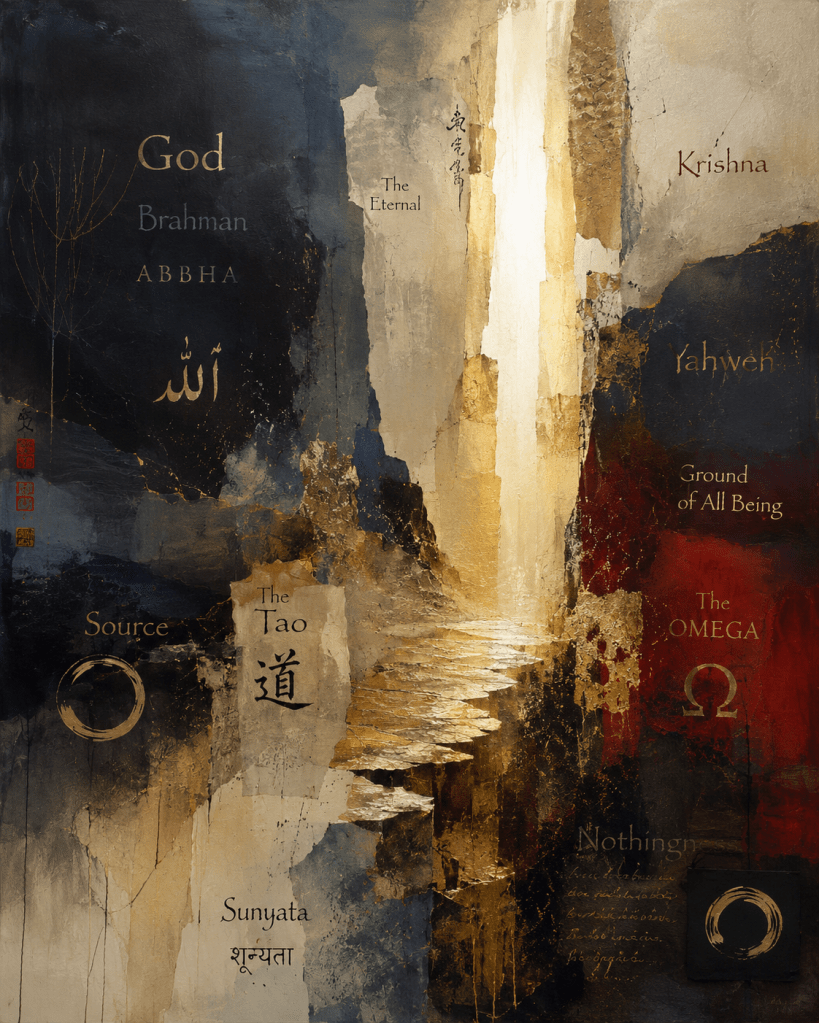
Human beings live inside a world of concepts.
Names, beliefs, identities, philosophies, and explanations create a framework through which experience is interpreted. Without concepts, daily life would become difficult to navigate. Language allows communication. Ideas allow learning. Categories allow organization.
Yet something remarkable is often overlooked.
Reality itself never becomes the concept used to describe it.
A map of a forest is not a forest.
A recipe is not a meal.
A photograph of the ocean contains no water.
Concepts point. Reality is what is pointed to.
Confusion begins when the distinction is forgotten.
The spiritual seeker is especially vulnerable to this mistake. Sacred texts are studied. Philosophical systems are compared. New beliefs replace old beliefs. Concepts become increasingly refined until one eventually possesses a sophisticated understanding of reality.
Understanding, however, is not the same as direct realization.
A person can memorize every description of fire and still feel cold.
Words about truth are not truth.
Ideas about awareness are not awareness.
Concepts about God are not God.
Reality remains exactly as it is regardless of how it is described.
This becomes obvious when observing how different traditions speak about the ultimate. One tradition speaks of Brahman. Another speaks of emptiness. Another speaks of divine presence. Another speaks of pure consciousness. Each description carries value, yet none possesses exclusive ownership over what is being described.
The Real remains untouched by every label.
Names change.
Languages change.
Civilizations rise and fall.
Reality remains.
A mountain does not become more majestic because someone writes a poem about it. The sky does not become less vast because someone misunderstands it. Existence itself is unaffected by every opinion formed about it.
The same principle applies to the deepest dimensions of spiritual realization.
Many seekers become fascinated with collecting concepts. They gather teachings the way others gather possessions. Each new idea creates the feeling of progress. Intellectual understanding expands, but direct recognition often remains distant.
Knowledge accumulates.
Wisdom simplifies.
Eventually a moment arrives when thought reaches its natural limit. Not because thinking is flawed, but because thought can only operate through symbols and representations. Reality is never a representation.
Reality is immediate.
A sound is heard before it is named.
A sensation is felt before it is interpreted.
Awareness is present before thought comments upon it.
This simple observation reveals something extraordinary. Every concept arises within awareness, yet awareness itself is never captured by the concepts appearing within it.
Thought can describe awareness endlessly.
Awareness remains untouched by the description.
Mystical traditions across the world repeatedly return to this insight. Zen emphasizes direct seeing beyond conceptual thought. Advaita Vedanta points toward the witness beyond all mental activity. Taoism reminds us that the Tao spoken of is not the eternal Tao.
Different languages.
Different approaches.
The same invitation.
Look beyond the description.
Look beyond the explanation.
Look beyond the concept.
What remains is not an idea.
What remains is not a belief.
What remains is not a conclusion.
Something quietly present before every thought arises and after every thought disappears.
The Real does not need protection from misunderstanding.
It does not require belief to exist.
It does not become greater through praise or smaller through denial.
Every concept comes and goes.
The Real remains untouched.
Always here.
Always present.
Always beyond what can be said about it.
Morgan O. Smith
 Morgan O. Smith