Every Concept Leaves the Real Untouched

Human beings live inside a world of concepts.

Names, beliefs, identities, philosophies, and explanations create a framework through which experience is interpreted. Without concepts, daily life would become difficult to navigate. Language allows communication. Ideas allow learning. Categories allow organization.

Yet something remarkable is often overlooked.

Reality itself never becomes the concept used to describe it.

A map of a forest is not a forest.

A recipe is not a meal.

A photograph of the ocean contains no water.

Concepts point. Reality is what is pointed to.

Confusion begins when the distinction is forgotten.

The spiritual seeker is especially vulnerable to this mistake. Sacred texts are studied. Philosophical systems are compared. New beliefs replace old beliefs. Concepts become increasingly refined until one eventually possesses a sophisticated understanding of reality.

Understanding, however, is not the same as direct realization.

A person can memorize every description of fire and still feel cold.

Words about truth are not truth.

Ideas about awareness are not awareness.

Concepts about God are not God.

Reality remains exactly as it is regardless of how it is described.

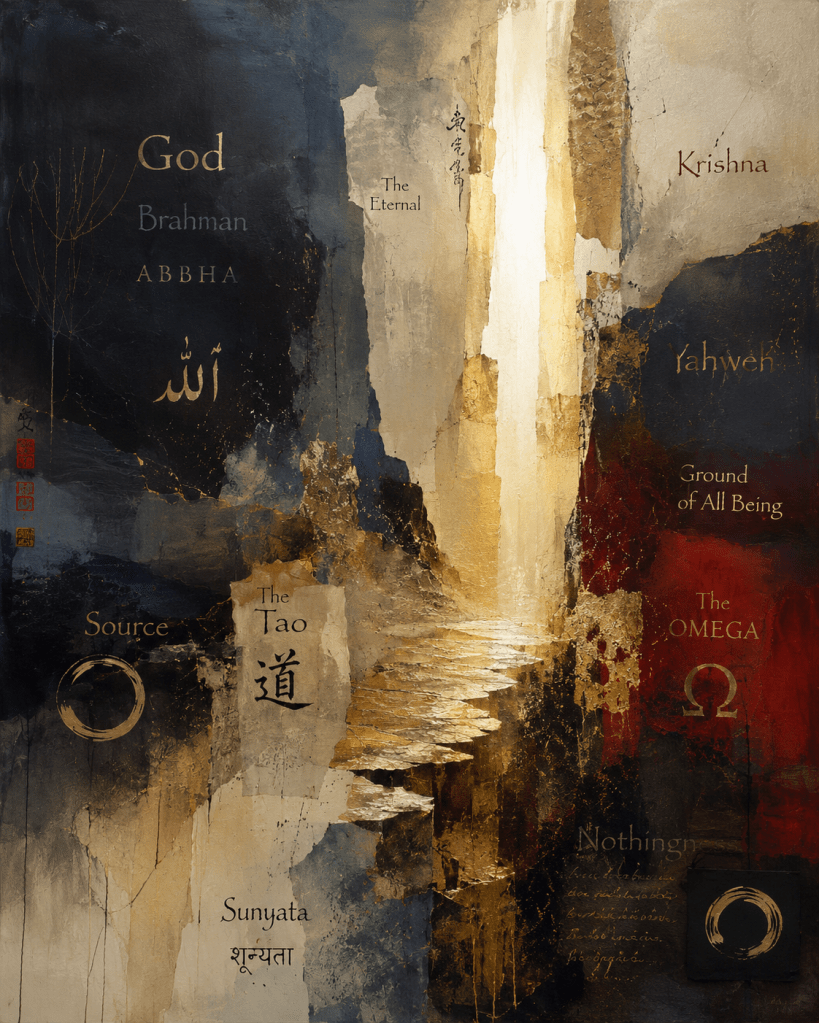
This becomes obvious when observing how different traditions speak about the ultimate. One tradition speaks of Brahman. Another speaks of emptiness. Another speaks of divine presence. Another speaks of pure consciousness. Each description carries value, yet none possesses exclusive ownership over what is being described.

The Real remains untouched by every label.

Names change.

Languages change.

Civilizations rise and fall.

Reality remains.

A mountain does not become more majestic because someone writes a poem about it. The sky does not become less vast because someone misunderstands it. Existence itself is unaffected by every opinion formed about it.

The same principle applies to the deepest dimensions of spiritual realization.

Many seekers become fascinated with collecting concepts. They gather teachings the way others gather possessions. Each new idea creates the feeling of progress. Intellectual understanding expands, but direct recognition often remains distant.

Knowledge accumulates.

Wisdom simplifies.

Eventually a moment arrives when thought reaches its natural limit. Not because thinking is flawed, but because thought can only operate through symbols and representations. Reality is never a representation.

Reality is immediate.

A sound is heard before it is named.

A sensation is felt before it is interpreted.

Awareness is present before thought comments upon it.

This simple observation reveals something extraordinary. Every concept arises within awareness, yet awareness itself is never captured by the concepts appearing within it.

Thought can describe awareness endlessly.

Awareness remains untouched by the description.

Mystical traditions across the world repeatedly return to this insight. Zen emphasizes direct seeing beyond conceptual thought. Advaita Vedanta points toward the witness beyond all mental activity. Taoism reminds us that the Tao spoken of is not the eternal Tao.

Different languages.

Different approaches.

The same invitation.

Look beyond the description.

Look beyond the explanation.

Look beyond the concept.

What remains is not an idea.

What remains is not a belief.

What remains is not a conclusion.

Something quietly present before every thought arises and after every thought disappears.

The Real does not need protection from misunderstanding.

It does not require belief to exist.

It does not become greater through praise or smaller through denial.

Every concept comes and goes.

The Real remains untouched.

Always here.

Always present.

Always beyond what can be said about it.

Morgan O. Smith
https://linktr.ee/morganosmith

Being Itself Is Beyond All Comparison

Comparison is one of the mind’s most persistent habits.

A person compares their life to another’s. One spiritual path is measured against another. Success is weighed against failure. Pleasure is contrasted with pain. The mind constantly creates distinctions, arranging reality into hierarchies and opposites.

This process serves a practical purpose. Comparison helps human beings navigate the world. Choosing food, evaluating risks, and making decisions often depend upon recognizing differences.

Problems arise when comparison is mistaken for truth itself.

Every comparison requires two or more objects. One thing is judged against another according to some standard. Larger and smaller. Better and worse. Higher and lower. More and less.

Being itself belongs to none of these categories.

A mountain can be compared to a hill. A river can be compared to a stream. A philosophy can be compared to another philosophy. Yet the simple fact of existence cannot be measured against anything because there is nothing outside existence with which it can be compared.

What could reality be compared to when every possible comparison already appears within reality?

This insight carries profound implications.

Much of human suffering arises from the assumption that life should be different from what it is. The present moment is measured against an imagined alternative. One’s current self is judged against an idealized future self. Experience becomes trapped inside endless evaluation.

Comparison creates psychological distance.

Being dissolves it.

A tree does not compare itself to another tree. The ocean does not envy a mountain. The sun does not seek validation from the stars. Nature expresses itself without consulting a scale of worth.

Human beings possess the unique capacity to construct elaborate mental narratives about who they are and who they should become. These narratives can inspire growth, but they can also create perpetual dissatisfaction.

The mind says, “I will be complete when I become something else.”

Being says nothing at all.

Existence simply is.

Mystical traditions throughout history have pointed toward this recognition. Advaita Vedanta speaks of Brahman as the sole reality, beyond all attributes and distinctions. Zen directs attention toward immediate experience before conceptual division. Taoism points toward a way of being that precedes judgment and categorization.

Each tradition approaches the mystery differently, yet all gesture toward a dimension of reality untouched by comparison.

Awareness itself offers a clue.

Thoughts come and go. Emotions rise and fall. Sensations appear and disappear. Identity changes throughout the course of a lifetime. Childhood becomes adulthood. Certainties become questions. Questions become insights.

Awareness remains.

The witnessing presence behind every experience is not greater than experience or lesser than experience. It is not superior or inferior. Such categories apply only to objects appearing within awareness, not to awareness itself.

Comparison belongs to the content.

Being belongs to the context.

A remarkable freedom emerges when this becomes more than an intellectual idea. The need to constantly measure oneself against others begins to weaken. Life is no longer approached as a competition for significance. Existence is appreciated directly rather than filtered through endless evaluation.

Nothing needs to be added.

Nothing needs to be removed.

Being is already complete before the mind begins calculating its value.

Perhaps this is why the deepest spiritual realizations often arrive with extraordinary simplicity. Reality is not discovered through becoming something greater than what one is. Reality is recognized through seeing what has always been present beneath the machinery of comparison.

Being itself cannot be ranked.

It cannot be improved.

It cannot be diminished.

Being itself is beyond all comparison.

Morgan O. Smith

https://linktr.ee/morganosmith

The Stage Beyond Oneness

When Even the Kosmos Falls Away

There comes a point when even the most expansive vision collapses—not from error, but from completion.

On the path of awakening, seekers often journey from the confines of selfhood to a union with all things. Ego dissolves, and what once felt separate now reveals itself as interconnected. Compassion grows. The heart blooms for all beings. One begins to live for the Whole.

But for some, even this union becomes too crowded.

Even the notion of “One” becomes too noisy.

This is the threshold where Kosmocentric awareness—a state of profound unity with all life and existence—gives way to something quieter, more radical. Not a deeper connection, but the quiet erasure of the very need for connection. Not expansion, but the release of expansion itself.

This is acentric awareness.

Not centered on the self.

Not centered on the world.

Not even centered on the All.

Acentricity does not point toward identification with something greater. It simply makes no identification at all. No vantage point. No witness. No center from which to perceive. It does not declare that all is One—it no longer needs such declarations. Truth requires no thesis here.

Reality just appears.

Without context.

Without a watcher.

Without the echo of a thought that says, “I am aware.”

Call it suchness.

Call it the absence of everything, shimmering as everything.

Call it the stillness that doesn’t oppose movement, because it was never still.

This isn’t transcendence. It isn’t detachment. It isn’t a stance. It’s the utter end of stance—the collapse of spiritual architecture, without the rubble. It doesn’t reject the world. It simply no longer perceives it as something to accept or reject.

And what does such a life look like?

Unremarkable.

Utterly simple.

Perhaps quiet, perhaps animated.

But always empty of claim, even the claim to be empty.

There are no teachings left to transmit. Not because truth has been mastered, but because it was never a possession. No more climbing. No more seeking. No more union. Not even rest—because rest would imply effort once existed.

This is the unborn silence that does not speak—not even through the mouths of sages.

It appears as a leaf falling, as someone stirring soup, as the sound of a crow at dusk.

And you might pass by it without knowing.

Because it doesn’t need to be known.

It just is.

And it is no one’s.

Morgan O. Smith

Get Your Free Copy of My Book, Bodhi in the Brain!

https://subscribepage.io/oTSZQu

Beyond the Veil of Emptiness

Unraveling the Mystique of Nothingness

In the contemplative realms of the philosophies of the East, the concept of ‘Nothingness’ often surfaces as a profound puzzle, a riddle wrapped in mystery. This notion, far from being a mere absence or void, invites us on a journey beyond the ordinary boundaries of thought and understanding.

When I refer to ‘Nothingness,’ I am pointing towards a reality that eludes the grasp of conventional ideas and definitions. It is not simply a negation of ‘something’ nor a space waiting to be filled. This Nothingness is a state of pure potentiality, unbound by the limitations of conceptual thinking. It is the silent backdrop against which the drama of existence unfolds, yet it is not separate from the play itself.

In the rich landscape of nondual understanding, Nothingness is not a destination to be reached or a concept to be understood. It is the very ground of being, the essence that permeates all existence. In the wisdom traditions of the East, this is often likened to the vastness of space – ever-present, all-encompassing, yet intangible and indefinable.


This exploration into Nothingness challenges the mind’s habitual tendency to label and categorize. It invites a surrender, a letting go of the need to understand or explain. Here, in this space of not-knowing, lies the potential for true spiritual awakening. It is in this realm where the mind is quieted that one may glimpse the ineffable truth of oneness.

In the dance of existence, Nothingness and form interplay seamlessly. Understanding this interplay is not an intellectual exercise but an experiential realization. It is a recognition that form arises from and returns to this formless void, like waves rising and falling in the ocean. This realization brings a sense of liberation, a freedom from the constraints of ego-driven perceptions.

Engaging with this concept of Nothingness requires a radical shift in perspective. It is about seeing beyond the apparent dualities of existence and non-existence, form and formlessness. In this understanding, one recognizes that the true nature of reality transcends these dichotomies.


In conclusion, the journey into Nothingness is not a journey outward to some external reality, but an inward voyage to the depths of one’s being. Here, in the heart of silence and stillness, the mystery of existence reveals itself not as a puzzle to be solved, but as a truth to be lived.

Morgan O. Smith

Yinnergy Meditation, Spiritual Life Coaching & My Book, Bodhi in the Brain…Available Now!

https://linktr.ee/morganosmith

The Pursuit of Absolute Nothingness

A Journey Towards Enlightened Emptiness

Introduction: In the dynamic, incessant stream of thoughts, preferences, and subjective biases that characterize the human experience, the concept of attaining a state of Absolute Nothingness captivates imaginations. Is it possible to achieve a mental and emotional vacuum where thoughts, biases, judgments, and self cease to exist?

Understanding Absolute Nothingness:

  • Absolute Nothingness isn’t simply the absence of thought, but a profound emptiness that transcends understanding and defies our typical notions of existence and selfhood.
    • Exploring philosophical and theological contexts (Buddhism’s Sunyata or Zen’s Mu) can unveil varied interpretations and methods to approach nothingness.
  • The Paradox of Pursuing Nothingness:
  • Engaging in a quest towards absolute emptiness ironically imposes a desire and a goal, an antithesis to the state of desirelessness intrinsic to nothingness.
    • Considering the Daoist perspective, acting without intention (Wu Wei) might provide insights on pursuing without pursuing, and attaining without seeking.
  • Dismantling the Self:
  • Dissolving the self involves peeling away layers of personal identity, biases, and preconceptions, effectively blurring the lines between self and non-self.
    • This dismantlement raises questions about existence, consciousness, and whether one can truly function without the scaffold of selfhood in a society constructed upon individual identity.
  • Navigating Through Socio-Cultural Paradigms:
  • The endeavour to transcend preferences, judgments, and selfhood might be perceived as antithetical to societal norms that emphasize individuality, accomplishment, and progress.
    • Achieving absolute nothingness within the structural and cultural boundaries of our world presents a paradox between isolation and immersion in societal dynamics.
  • Ethical and Moral Dimensions:
  • The state of having no judgments, preferences, or perspectives raises questions regarding moral and ethical obligations. Does transcending biases and perspectives dissolve moral compasses?
    • Exploring the ethical implications of an unbiased existence may unravel whether absolute neutrality coexists with moral responsibility.
  • Psychological and Neuroscientific Perspectives:
  • The psychological viability of achieving a state devoid of thought and self-perception opens an intriguing discourse. Can one’s mental health be preserved, or even enhanced, in a state of nothingness?
    • Neuroscientific inquiries might delve into the processes and consequences of perpetually inhibiting cognitive and emotional functionalities to sustain a blank slate of consciousness.
  • Relinquishing Time and Anticipation:
  • With no anticipation, worries, or references to the past or future, time dissolves into an irrelevant concept, creating a perpetual ‘now’ with neither history nor destiny.
    • Contemplating a timeless existence fosters a reflection on how human experiences, relationships, and endeavours are intimately entwined with temporal perception.

Conclusion: Absolute Nothingness, both as a philosophical concept and a spiritual aspiration, navigates through paradoxes, ethical conundrums, and existential inquiries, offering a mesmerizing void that invites and perplexes. The possibility and implications of achieving a state devoid of self-thought, and time present not only a spiritual journey but also a philosophical and scientific exploration into the profound depths of consciousness and existence.

Morgan O.  Smith

Yinnergy Meditation & My Book, Bodhi in the Brain…Available Now!

https://linktr.ee/morganosmith

You Are What You Eat, and Also What You Don’t

The Eastern Philosophy of Consumption and Abstention

In the intricate dance of life, we often hear the adage, “You are what you eat.” Rooted in the wisdom of many cultures, this phrase suggests that our physical and mental well-being is profoundly influenced by the food we consume. But just as importantly, the choices we make about what we refrain from eating also define us. In the vast expanse of Eastern philosophy, whether feasting or fasting, you are that.

The concept of ‘Ahara’ in Ayurveda, the ancient Indian science of life, teaches that everything we consume, be it food, thoughts, or experiences, becomes a part of our inner and outer constitution. It’s not merely about the nutrients we obtain, but the energy, the ‘prana’, that comes with it. A meal cooked with love nourishes the soul, just as a dish prepared in haste or anger might leave us feeling unsettled.

Conversely, the act of abstention or fasting, common in Eastern practices like Buddhism, Jainism, and Taoism, is not merely a physical exercise. Fasting is as much a mental and spiritual activity as it is a physical one. By abstaining, we aren’t merely depriving ourselves; we’re creating space. Space for reflection, for inner growth, and for reconnecting with the self.

In the Zen Buddhist tradition, the act of eating mindfully, paying attention to every morsel, and being grateful for the nourishment is a form of meditation. On the other hand, moments of abstention teach us about the impermanence of desires. As Lao Tzu stated in the Tao Te Ching, “To attain knowledge, add things every day. To attain wisdom, subtract things every day.”

In the end, the balance between consumption and abstention is a personal journey, an inner dialogue. It’s about recognizing that every choice we make, whether to indulge or to refrain, is a reflection of our inner state, our philosophies, and our connection to the world around us.

As we navigate through the rhythms of life, let us remember: that we are not just shaped by what we consume but also by what we choose to let go. And in that delicate balance lies the true essence of existence.

Morgan O. Smith

Yinnergy Meditation & My Book, Bodhi in the Brain…Available Now!

https://linktr.ee/morganosmith