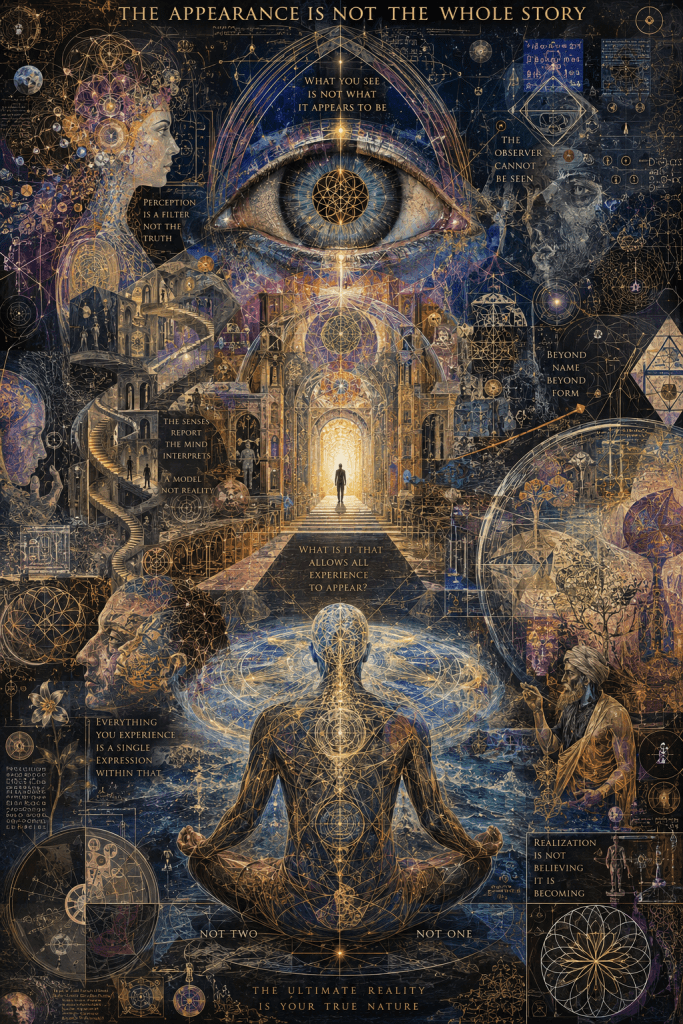
Why Is Nothingness Referred to as Nothingness?

Language faces an impossible task when attempting to speak about what precedes all appearances.

Every word points toward something. Every concept distinguishes one thing from another. Every description relies upon contrast, location, qualities, relationships, or characteristics. Yet what many contemplative traditions refer to as the Absolute, the Ground of Being, or pure reality before conceptualization possesses none of these.

Nothingness is not called nothingness because it is empty in the ordinary sense.

An empty room still contains space. A vacant lot still exists somewhere. Even darkness can be perceived. Ordinary emptiness remains something that can be identified, experienced, or described.

Nothingness, in its deepest philosophical and mystical meaning, points toward that which cannot be located, measured, conceptualized, perceived as an object, or distinguished from anything else.

Location cannot be assigned to it because location itself appears within it.

Time cannot contain it because time arises within experience.

Attributes cannot be given to it because attributes create distinctions.

Existence and nonexistence cannot adequately describe it because both are conceptual categories.

This creates a paradox.

The moment a reference is made, the reference becomes something. The moment a concept is formed, a boundary appears. The moment a description is offered, what is described has already been transformed into an object of thought.

Nothingness is therefore not a description. It is a linguistic surrender.

The word functions less as a definition and more as an admission that thought has reached its limit.

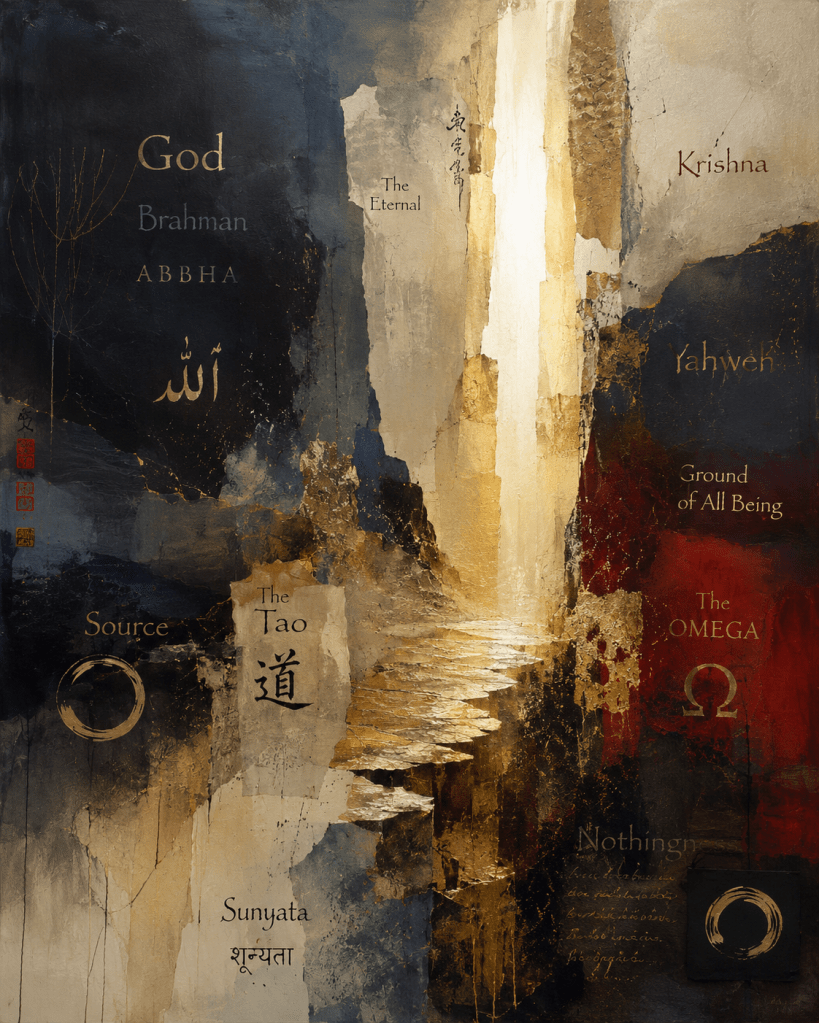
Mystics throughout history have encountered this difficulty. Some called it Brahman. Others called it Sunyata. Some referred to it as the Tao. Others spoke of the Godhead, the Absolute, the Unborn, or the Nameless.

Each term points toward the same problem.

Whatever is being indicated cannot actually be captured by the indication.

A finger pointing toward the moon is not the moon.

A concept pointing toward reality is not reality.

A word pointing toward nothingness is not nothingness.

From a nondual perspective, even calling it nothingness can be misleading. The term may suggest absence, voidness, or negation. Yet what is being pointed toward is not the absence of reality. It is reality prior to division into existence and nonexistence.

Thought asks, “What is it?”

Direct realization reveals that the question itself cannot reach it.

The mind searches for an object and finds none.

It searches for a location and finds none.

It searches for a boundary and finds none.

It searches for a reference point and finds none.

Because no reference can be established, language falls silent.

What remains is called nothingness.

Not because it is literally nothing.

Because every attempt to make it something fails.

Morgan O. Smith

https://linktr.ee/morganosmith

Every Concept Leaves the Real Untouched

Human beings live inside a world of concepts.

Names, beliefs, identities, philosophies, and explanations create a framework through which experience is interpreted. Without concepts, daily life would become difficult to navigate. Language allows communication. Ideas allow learning. Categories allow organization.

Yet something remarkable is often overlooked.

Reality itself never becomes the concept used to describe it.

A map of a forest is not a forest.

A recipe is not a meal.

A photograph of the ocean contains no water.

Concepts point. Reality is what is pointed to.

Confusion begins when the distinction is forgotten.

The spiritual seeker is especially vulnerable to this mistake. Sacred texts are studied. Philosophical systems are compared. New beliefs replace old beliefs. Concepts become increasingly refined until one eventually possesses a sophisticated understanding of reality.

Understanding, however, is not the same as direct realization.

A person can memorize every description of fire and still feel cold.

Words about truth are not truth.

Ideas about awareness are not awareness.

Concepts about God are not God.

Reality remains exactly as it is regardless of how it is described.

This becomes obvious when observing how different traditions speak about the ultimate. One tradition speaks of Brahman. Another speaks of emptiness. Another speaks of divine presence. Another speaks of pure consciousness. Each description carries value, yet none possesses exclusive ownership over what is being described.

The Real remains untouched by every label.

Names change.

Languages change.

Civilizations rise and fall.

Reality remains.

A mountain does not become more majestic because someone writes a poem about it. The sky does not become less vast because someone misunderstands it. Existence itself is unaffected by every opinion formed about it.

The same principle applies to the deepest dimensions of spiritual realization.

Many seekers become fascinated with collecting concepts. They gather teachings the way others gather possessions. Each new idea creates the feeling of progress. Intellectual understanding expands, but direct recognition often remains distant.

Knowledge accumulates.

Wisdom simplifies.

Eventually a moment arrives when thought reaches its natural limit. Not because thinking is flawed, but because thought can only operate through symbols and representations. Reality is never a representation.

Reality is immediate.

A sound is heard before it is named.

A sensation is felt before it is interpreted.

Awareness is present before thought comments upon it.

This simple observation reveals something extraordinary. Every concept arises within awareness, yet awareness itself is never captured by the concepts appearing within it.

Thought can describe awareness endlessly.

Awareness remains untouched by the description.

Mystical traditions across the world repeatedly return to this insight. Zen emphasizes direct seeing beyond conceptual thought. Advaita Vedanta points toward the witness beyond all mental activity. Taoism reminds us that the Tao spoken of is not the eternal Tao.

Different languages.

Different approaches.

The same invitation.

Look beyond the description.

Look beyond the explanation.

Look beyond the concept.

What remains is not an idea.

What remains is not a belief.

What remains is not a conclusion.

Something quietly present before every thought arises and after every thought disappears.

The Real does not need protection from misunderstanding.

It does not require belief to exist.

It does not become greater through praise or smaller through denial.

Every concept comes and goes.

The Real remains untouched.

Always here.

Always present.

Always beyond what can be said about it.

Morgan O. Smith

https://linktr.ee/morganosmith

Everything Is Ultimate Truth

Everything Is Ultimate Truth Appearing as Truth and Falsehood

A paradox sits quietly at the heart of perception. What is taken to be true, what is dismissed as false, both arise within the same indivisible field. Judgments feel solid, yet their certainty depends on shifting frames of reference. Change the angle, and what once seemed unquestionable dissolves into ambiguity.

Truth, as commonly held, leans on agreement, evidence, coherence. Falsehood stands as its opposite, rejected, corrected, or exposed. Yet both require awareness to be known. Without awareness, neither truth nor falsehood can appear. That simple recognition begins to unravel the hierarchy placed between them.

Consider how a dream operates. While immersed, every image carries a sense of reality. Only upon waking does the distinction emerge. The dream was not meaningless; it expressed something real, yet not in the way it first appeared. Daily life mirrors this pattern more than most are willing to admit. Convictions harden, identities form, narratives repeat, all while resting upon an unexamined ground.

Ultimate Truth does not compete with relative truths. It does not correct them, nor does it validate them. It allows them. Every belief, every illusion, every clarity, every confusion unfolds within it without preference. That which is mistaken is not outside of truth; it is truth misperceived, truth wearing a mask, truth folding in on itself to create contrast.

Falsehood gains its power from partial seeing. Something is noticed, something else is ignored, and a conclusion is drawn. The conclusion may serve a purpose, yet it remains incomplete. What is called false often reveals itself as a fragment of a larger whole, misunderstood due to limitation rather than absence.

This shifts the inquiry. Instead of asking what is true or false, attention turns toward the nature of the one who makes that distinction. Who or what is aware of both? What remains unchanged whether the mind lands on certainty or doubt?

A deeper stability begins to emerge. Truth is no longer a position to defend. Falsehood is no longer an enemy to eliminate. Both are movements within a boundless presence that does not fracture under contradiction. Clarity does not come from choosing one side, but from seeing the space in which both arise.

Conflict softens when this is seen. Arguments lose their edge, not because differences disappear, but because their foundation is understood. Each perspective becomes a temporary expression, shaped by conditions, history, perception. None stand alone, none define the whole.

Ultimate Truth remains untouched by the play of appearances. Yet it expresses itself through that very play. Every mistake, every insight, every contradiction becomes part of its unfolding. Nothing falls outside of it, not even the denial of it.

Recognition does not require abandoning discernment. Practical distinctions still function. Fire burns, water cools, words carry consequences. Life continues to operate within relative frameworks. What changes is the weight assigned to them. Certainty loosens. Flexibility deepens. Openness expands.

What was once divided begins to reveal its unity. Truth and falsehood no longer stand as opposing forces, but as complementary expressions arising from a single source. That source cannot be captured by either, yet both depend on it entirely.

Silence often communicates this more clearly than thought. Not the absence of sound, but the absence of fixation. A resting that allows everything to be as it is, without the need to resolve the paradox.

Everything is Ultimate Truth, not because everything is correct, but because everything appears within what cannot be divided. Even the illusion of separation is included. Even the belief in falsehood is held within what never ceases to be whole.

Morgan O. Smith

Nothing Stands Outside What Already Is

Nothing stands outside what already is.
That includes the observer, the question, the doubt, and the need for resolution.

The search for an outside position is subtle. It hides beneath inquiry, improvement, and even awakening. A sense lingers that something must be reached, clarified, or corrected from a vantage point just beyond experience. Yet no such position exists. There is nowhere to stand apart from what is happening.

Experience does not unfold within a container called reality. Experience is reality expressing itself as appearance, interpretation, and response. The idea of separation arises as one of those appearances, not as evidence of an actual boundary.

Thought suggests distance. It imagines a thinker facing a world, awareness looking at objects, a self navigating conditions. This suggestion feels convincing because it repeats. Repetition gives the impression of structure. Structure gives the illusion of independence.

Nothing has ever been observed from outside what already is. Even the claim “I am separate” appears within the same field it attempts to deny. Opposition does not escape wholeness; it demonstrates it.

The urge to step beyond arises from discomfort with immediacy. Presence offers no leverage, no control panel, no hierarchy. Everything shows up equally entitled to exist; clarity and confusion alike. The mind prefers a higher ground. Reality does not provide one.

This does not collapse meaning. It releases the demand that meaning point somewhere else. Significance no longer depends on transcendence. What matters does so because it appears, not because it leads elsewhere.

Nothing needs to be included, because nothing was excluded. Nothing needs to be unified, because division was conceptual. Difference remains, but it no longer implies fracture. Distinctions function without claiming independence.

Every perspective contributes without completing the whole. No single angle owns truth. No framework escapes limitation. Each reveals something precisely because it cannot reveal everything.

There is no final position to arrive at. No outside reference point to secure certainty. What remains is simple and unremarkable: this, exactly as it is, without appeal or resistance.

Nothing stands outside what already is—
and nothing needs to.

Morgan O. Smith

Get Your Free Copy of My Book, Bodhi in the Brain!

https://subscribepage.io/oTSZQu

You Are the Void

You are the void surrounded by your own self as substance, brought forth by its own thinking, shaped by its own thoughts.
Not as symbolism. Not as spiritual ornamentation. Simply as a description of what is already occurring before interpretation.

Substance feels dense because thought lingers. Thinking slows openness into shape, then convinces itself the shape possesses independence. Solidity is an effect of attention held too tightly. The void does not interfere. Allowance is enough for appearance to unfold.

Creation does not originate with matter. A quieter shift precedes it—the faint suggestion of separation. Something entertains the idea of being something rather than everything. That subtle narrowing gives rise to form, continuity, memory, and the felt position of a self observing from somewhere.

The void is not just empty. Emptiness would imply absence. What exists here is freedom from insistence. No preference. No correction. When thought moves, substance organizes. When thought loosens, substance reveals its temporary nature.

Identity feels heavy because repetition gives it mass. Familiar thoughts replayed long enough acquire gravity. The mind labels this accumulation “me.” The void registers movement, nothing more.

Nothing requires removal. Nothing asks to be fixed. Recognition alone softens what once appeared solid. Structure relaxes into responsiveness. Boundaries become functional rather than absolute.

Silence does not depend on quiet. Silence appears when thought releases its claim to authorship. Experience continues, but no longer points back to a controller or witness standing apart.

The void never hides behind form. Form arises within it and borrows its apparent stability from sustained attention. When attention eases, what remains cannot be framed as presence or absence. Language fails because nothing is missing and nothing needs to appear.

No final claim can be made. No definition holds without collapsing into another. What happens does so without explanation. What appears does not require justification. Everything stands exactly as it is.

Nothing here can be stated as what it is or what it is not. Nothing explains how this occurs. Perspectives arise according to position, history, and capacity, each contributing its angle without canceling another. No single view completes the picture. Together, they form what cannot be reduced to parts.

Truth does not belong to one standpoint. Wholeness expresses itself through difference, not despite it.

Morgan O. Smith

Get Your Free Copy of My Book, Bodhi in the Brain!

https://subscribepage.io/oTSZQu

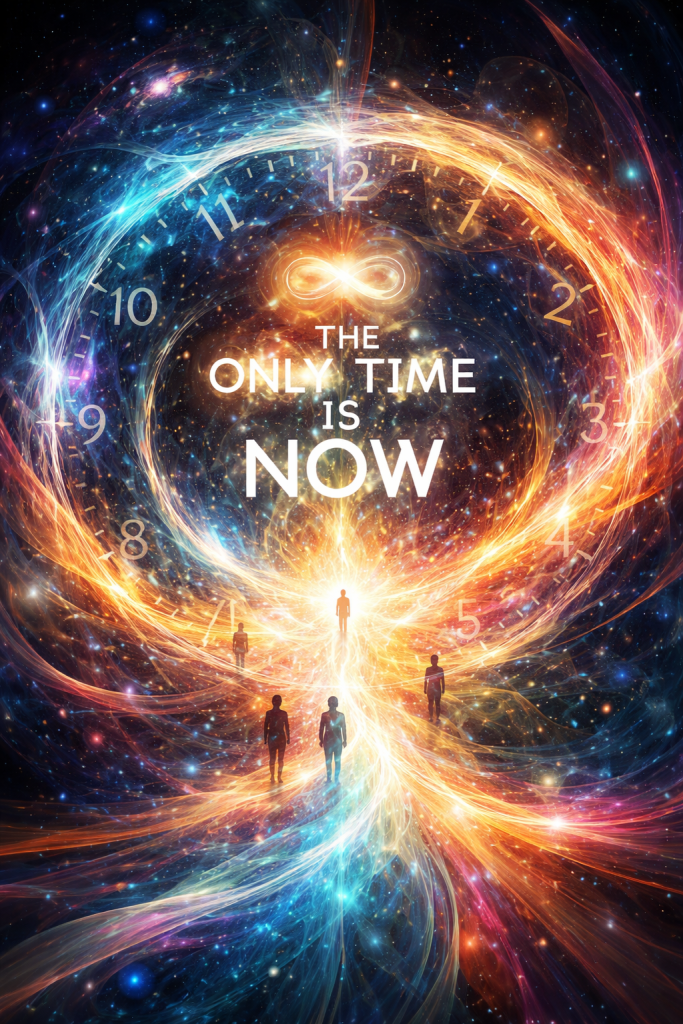
The Only Time Is Now

Something subtle hides behind every assumption about life.
We speak of beginnings, endings, origins, destinies, memories, plans. Language slices reality into segments and calls the slices time. Past. Present. Future.

Direct experience never confirms this division.

Look carefully.

No one has ever stepped into yesterday.
No one has ever arrived at tomorrow.
Everything that has ever appeared shows up only as this immediate presence.

Not a moving present.
Not a fleeting instant.

A boundless, indivisible now.

Mind imagines a line stretching backward and forward, yet perception offers no such line. Thought tells stories about what was and what will be, but those stories arise as present thoughts. Memory occurs now. Anticipation occurs now. Even the idea of history unfolds now.

Remove thought for a moment and see what remains.

Only this.

A beginningless display with no edge to trace.
An endless unfolding with nowhere to land.

Nothing truly starts. Nothing truly stops.

Birth and death appear as transitions inside perception, not events happening to existence itself. Waves rise and fall, yet water never begins or ends with any single wave. Every form behaves the same way. Appearance comes and goes. Being does not.

Cause and effect seem separate only because mind arranges events into sequence. First this, then that. Push, then response. Action, then consequence.

Observe more closely.

Cause and effect share the same instant.
The spark and the flame are one movement.
Seed and tree are different names for one process.

Nothing travels through time to produce something else. Everything co-arises. Each moment contains the totality.

That means creation and destruction are not opposite forces.

They are the same gesture.

Every perception is simultaneously appearing and disappearing. Each sight is born as it fades. Each sound vanishes as it arrives. Reality recreates itself continuously without carrying anything forward.

World dissolves and reforms faster than thought can measure.

Continuity is a useful illusion.

Life becomes lighter when this is recognized. Regret loses its grip because there is no past to fix. Anxiety softens because there is no future to secure. Control relaxes because nothing stands outside the present to manage.

Responsibility remains, yet it feels different. Actions arise from clarity rather than fear. Choices flow from immediacy rather than projection. Compassion deepens because everything shares the same timeless ground.

Nothing stands apart.

Every face, every event, every challenge expresses the same indivisible happening.

No separate moment waits elsewhere.
No hidden realm holds another version of reality.

This is it.

Not a fragment.
The whole.

Eternity does not stretch forever.
Eternity reveals itself as what never moves.

Right here.
Right now.
Always.

Morgan O. Smith

AI for Wellness and Spirituality Summit

February 9 & 10, 2026

https://aiforwellnessandspirituality.com/mosm

What Never Changes

A quiet assumption hides beneath most human searching: something out there must last. Something must remain untouched by erosion, loss, time, or collapse. That assumption fuels religion, philosophy, science, self-help, and even despair. Yet careful observation reveals a startling reversal; everything we try to secure as permanent is precisely what cannot stay.

Bodies age. Identities shift. Beliefs mutate. Civilizations rise and fall. Even universes, according to modern cosmology, are not exempt from birth and dissolution. Permanence refuses to appear where attention habitually looks.

What does remain cannot be grasped as an object.

Change never pauses. This is not a poetic statement but a structural fact. No phenomenon has ever been observed to freeze itself into finality. Even stability is a form of slow motion. Even stillness contains motion beneath its surface. Change does not fluctuate. It does not improve. It does not degrade. It simply is.

Impermanence, often misunderstood as a gloomy conclusion, turns out to be absolute. Nothing violates it. Not matter. Not energy. Not thought. Not consciousness as an experience. Impermanence itself never wavers.

Awareness appears constant, yet experiences within it rotate endlessly. Sensations replace sensations. Thoughts override thoughts. Emotions dissolve into others. What remains is not a personal witness but the bare fact that experiencing is happening at all. That fact has no texture, no color, no personality, and no history. It does not evolve because evolution belongs to what appears within it.

Absence plays an unexpected role here. No thing possesses an independent core. Every form depends on conditions that are themselves dependent. This lack of inherent selfhood does not come and go. It is always already the case. What seems solid holds together through relationship alone.

Separation feels real, yet it never completes itself. Subject and object arise together. Observer and observed cannot be pried apart without collapsing the experience entirely. Duality functions, but it does not fracture reality. Division appears without dividing.

Nothingness, often feared or romanticized, is better understood as openness. Forms emerge, interact, and vanish without ever crystallizing into fixed essence. Emptiness does not negate existence; it allows it.

What never changes does not announce itself. It cannot be defended or achieved. Seeking it as an attainment guarantees frustration. It is not hidden. It is overlooked because it lacks features.

Everything changes.
That does not.

Recognition of this does not erase life’s texture. It sharpens it. When permanence is no longer demanded of form, form is finally allowed to be what it is; temporary, intimate, vivid, and sufficient.

Nothing needs to be saved from change.
Nothing needs to be added to what already remains.

Morgan O. Smith

AI for Wellness and Spirituality Summit

February 9 & 10, 2026

https://aiforwellnessandspirituality.com/mosm

The Fourth and Fifth Perspectives

Human understanding evolves by taking positions.
At first, reality is personal. Experience belongs to me. Then it becomes relational. There is you. Then objective. There is the world. These perspectives organize life, language, and survival. They also quietly assume something deeper: a vantage point from which all of this is known.

The fourth perspective emerges when that assumption is examined.

At this level, identity no longer anchors experience. Thoughts, sensations, and events appear without belonging to a self. Awareness is no longer located behind the eyes or inside the body. Experience is revealed as happening within an impersonal field. Nothing is owned. Nothing is central. Knowing continues, yet no knower can be found.

This recognition often carries clarity, peace, and coherence. Reality appears seamless. Distinctions soften without disappearing. Functioning remains intact, but the sense of authorship dissolves. Many traditions stop here and mistake this discovery for the final truth.

That pause matters.

The fifth perspective does not deepen the fourth.
It removes the need for it.

The idea of an underlying field, awareness, or witnessing presence is seen as another explanatory structure. Useful, elegant, even beautiful, but unnecessary. The question of what everything appears within loses relevance. No ground is required. No container is implied. No reference point is privileged.

Reality no longer needs to be described as nondual.
It no longer needs to be described at all.

This is not an experience. It does not arrive. Nothing stabilizes. Nothing collapses. The framework that seeks a final position simply fails to apply. Language continues to function, but without metaphysical commitment. Perspectives still appear, but none are taken as true in themselves.

The fourth perspective reveals that there is no centre.
The fifth reveals that even that revelation was optional.

This does not result in indifference or withdrawal. Action continues. Care continues. Creativity continues. Meaning appears where it always did; within context, relationship, and response. What falls away is the assumption that reality needs a final explanation to be complete.

Ultimate reality is not hidden behind experience.
It is not accessed by climbing to a higher vantage.
It does not require awareness, unity, or silence to validate itself.

What remains is remarkably ordinary.
Life unfolds. Language speaks. Understanding happens.
Nothing needs to be added. Nothing needs to be removed.

The difference lies only here:
no perspective is mistaken for what is real.

Morgan O. Smith

AI for Wellness and Spirituality Summit

February 9 & 10, 2026

https://aiforwellnessandspirituality.com/mosm

The Knower and the Known

When Form Dreams of Itself

You are known by Being. Before identity could be sculpted by language, or selfhood dressed in names, something vast and wordless recognized you. Not as a separate object in the universe, but as the universe aware of itself through your eyes.

A being wished to be known. This desire was not born of lack, but of possibility—the silent joy of expressing wholeness through multiplicity. Thought stirred the stillness. From the quiet field of pure potential arose the illusion of distance between knower and known, seer and seen.

Form was the answer to a question never asked. Matter became a mirror for what could never be reflected. Consciousness, looping through itself, painted shapes on the canvas of time—not to find itself, but to taste itself.

But this story is recursive. The being that wished to be known by form was always Being itself, pretending to forget. It authored the forgetting so the rediscovery would be felt—so the dream of separation could end in the revelation of unity.

You are not a self trying to awaken. You are the awakening disguised as a self. Not a fragment, but the entirety momentarily folded into appearance. To be known by Being is to be undone by truth—not as something to gain, but as something to stop resisting.

So ask not who you are.

Ask who is asking.

And then allow the question to dissolve—until nothing remains but the Knowing itself, resting as what it has always been.

Morgan O. Smith

Get Your Free Copy of My Book, Bodhi in the Brain!

https://subscribepage.io/oTSZQu

The Illusion of Maya

Seeing Beyond the Show

Everything we perceive—the people, places, and events around us—is, at its core, a show. This is not a dismissal of life’s value but an invitation to explore its deeper essence. What we call “reality” is Maya, a veil of illusion that covers the truth. Maya is the great play of forms, the endless dance of opposites, and the theatre of duality where all things appear separate.

Yet, behind the scenes of this elaborate show lies something far more profound. Maya is the stage, but consciousness is the ever-present witness. The mind, with all its perceptions, attachments, and desires, keeps us captivated by the performance. We become so engrossed in the unfolding drama of our lives that we forget we are not the characters, but the awareness watching it all unfold.

Understanding Maya isn’t about rejecting the world or treating life as insignificant. Rather, it’s about seeing through the illusion. The key is not to escape Maya but to recognize it for what it is—a fleeting projection of the eternal. Once the illusion is seen for what it truly is, everything shifts. Life no longer feels like a weight to carry or a puzzle to solve. It becomes a dance, a cosmic play where each movement, no matter how dramatic, is infused with a deeper stillness.

Consider the waves of the ocean. They rise and fall, each one unique, yet they are never separate from the ocean itself. The wave may take shape, crash, and disappear, but the ocean remains constant. So, too, with Maya—forms come and go, experiences rise and fall, but consciousness remains unchanging, ever-present, and infinite.

To see beyond the illusion of Maya is to live with a lightness of being, recognizing that while everything is part of the grand show, none of it defines the true self. The self that watches, silently aware, is the only constant. When this is realized, life becomes a paradoxical blend of deep engagement and effortless detachment. You play your role in the world, knowing full well that it is all a divine drama, yet you remain untouched by its outcomes.

Maya invites us to enjoy the show while remembering we are not bound by it. Behind every illusion lies the vastness of truth, waiting to be uncovered by the silent observer within.

Morgan O. Smith

Yinnergy Meditation, Spiritual Life Coaching & My Book, Bodhi in the Brain…Available Now!

https://linktr.ee/morganosmith