Why Is Nothingness Referred to as Nothingness?

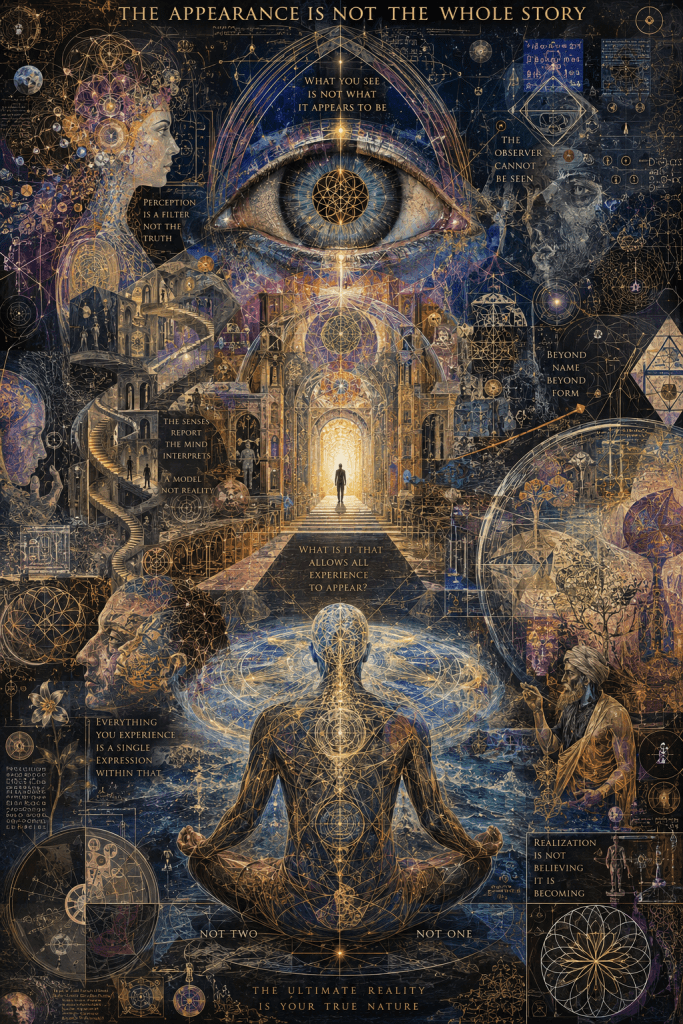
Language faces an impossible task when attempting to speak about what precedes all appearances.

Every word points toward something. Every concept distinguishes one thing from another. Every description relies upon contrast, location, qualities, relationships, or characteristics. Yet what many contemplative traditions refer to as the Absolute, the Ground of Being, or pure reality before conceptualization possesses none of these.

Nothingness is not called nothingness because it is empty in the ordinary sense.

An empty room still contains space. A vacant lot still exists somewhere. Even darkness can be perceived. Ordinary emptiness remains something that can be identified, experienced, or described.

Nothingness, in its deepest philosophical and mystical meaning, points toward that which cannot be located, measured, conceptualized, perceived as an object, or distinguished from anything else.

Location cannot be assigned to it because location itself appears within it.

Time cannot contain it because time arises within experience.

Attributes cannot be given to it because attributes create distinctions.

Existence and nonexistence cannot adequately describe it because both are conceptual categories.

This creates a paradox.

The moment a reference is made, the reference becomes something. The moment a concept is formed, a boundary appears. The moment a description is offered, what is described has already been transformed into an object of thought.

Nothingness is therefore not a description. It is a linguistic surrender.

The word functions less as a definition and more as an admission that thought has reached its limit.

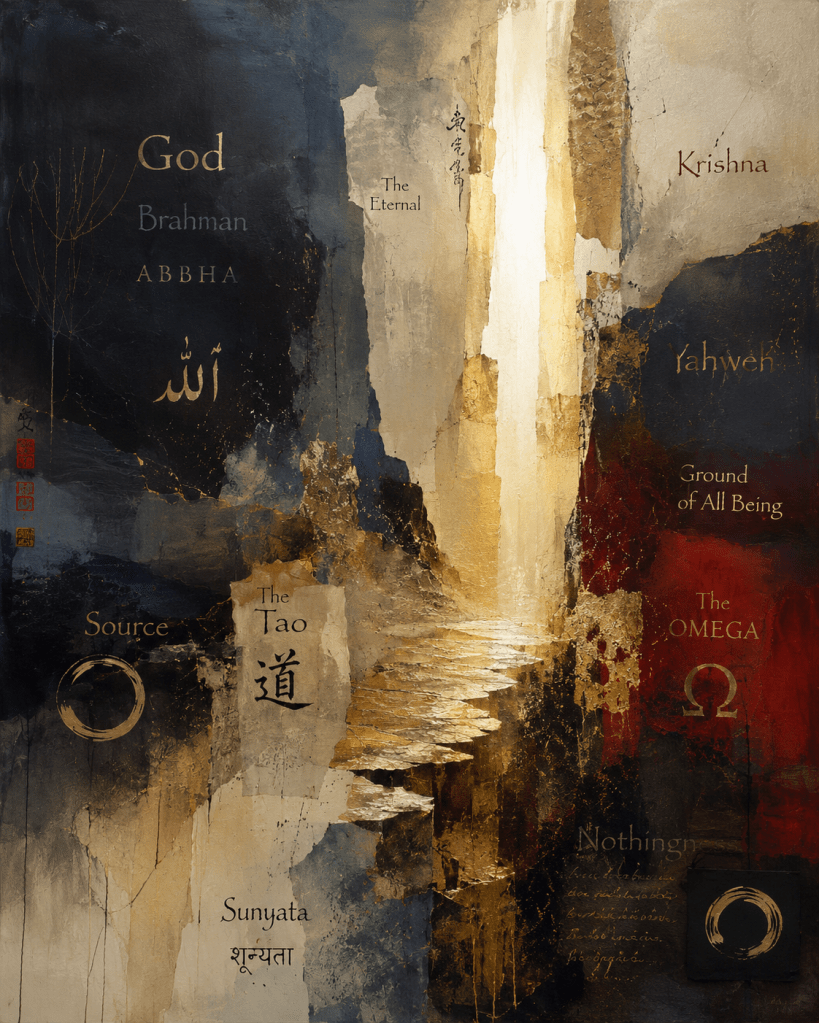
Mystics throughout history have encountered this difficulty. Some called it Brahman. Others called it Sunyata. Some referred to it as the Tao. Others spoke of the Godhead, the Absolute, the Unborn, or the Nameless.

Each term points toward the same problem.

Whatever is being indicated cannot actually be captured by the indication.

A finger pointing toward the moon is not the moon.

A concept pointing toward reality is not reality.

A word pointing toward nothingness is not nothingness.

From a nondual perspective, even calling it nothingness can be misleading. The term may suggest absence, voidness, or negation. Yet what is being pointed toward is not the absence of reality. It is reality prior to division into existence and nonexistence.

Thought asks, “What is it?”

Direct realization reveals that the question itself cannot reach it.

The mind searches for an object and finds none.

It searches for a location and finds none.

It searches for a boundary and finds none.

It searches for a reference point and finds none.

Because no reference can be established, language falls silent.

What remains is called nothingness.

Not because it is literally nothing.

Because every attempt to make it something fails.

Morgan O. Smith

https://linktr.ee/morganosmith

Every Concept Leaves the Real Untouched

Human beings live inside a world of concepts.

Names, beliefs, identities, philosophies, and explanations create a framework through which experience is interpreted. Without concepts, daily life would become difficult to navigate. Language allows communication. Ideas allow learning. Categories allow organization.

Yet something remarkable is often overlooked.

Reality itself never becomes the concept used to describe it.

A map of a forest is not a forest.

A recipe is not a meal.

A photograph of the ocean contains no water.

Concepts point. Reality is what is pointed to.

Confusion begins when the distinction is forgotten.

The spiritual seeker is especially vulnerable to this mistake. Sacred texts are studied. Philosophical systems are compared. New beliefs replace old beliefs. Concepts become increasingly refined until one eventually possesses a sophisticated understanding of reality.

Understanding, however, is not the same as direct realization.

A person can memorize every description of fire and still feel cold.

Words about truth are not truth.

Ideas about awareness are not awareness.

Concepts about God are not God.

Reality remains exactly as it is regardless of how it is described.

This becomes obvious when observing how different traditions speak about the ultimate. One tradition speaks of Brahman. Another speaks of emptiness. Another speaks of divine presence. Another speaks of pure consciousness. Each description carries value, yet none possesses exclusive ownership over what is being described.

The Real remains untouched by every label.

Names change.

Languages change.

Civilizations rise and fall.

Reality remains.

A mountain does not become more majestic because someone writes a poem about it. The sky does not become less vast because someone misunderstands it. Existence itself is unaffected by every opinion formed about it.

The same principle applies to the deepest dimensions of spiritual realization.

Many seekers become fascinated with collecting concepts. They gather teachings the way others gather possessions. Each new idea creates the feeling of progress. Intellectual understanding expands, but direct recognition often remains distant.

Knowledge accumulates.

Wisdom simplifies.

Eventually a moment arrives when thought reaches its natural limit. Not because thinking is flawed, but because thought can only operate through symbols and representations. Reality is never a representation.

Reality is immediate.

A sound is heard before it is named.

A sensation is felt before it is interpreted.

Awareness is present before thought comments upon it.

This simple observation reveals something extraordinary. Every concept arises within awareness, yet awareness itself is never captured by the concepts appearing within it.

Thought can describe awareness endlessly.

Awareness remains untouched by the description.

Mystical traditions across the world repeatedly return to this insight. Zen emphasizes direct seeing beyond conceptual thought. Advaita Vedanta points toward the witness beyond all mental activity. Taoism reminds us that the Tao spoken of is not the eternal Tao.

Different languages.

Different approaches.

The same invitation.

Look beyond the description.

Look beyond the explanation.

Look beyond the concept.

What remains is not an idea.

What remains is not a belief.

What remains is not a conclusion.

Something quietly present before every thought arises and after every thought disappears.

The Real does not need protection from misunderstanding.

It does not require belief to exist.

It does not become greater through praise or smaller through denial.

Every concept comes and goes.

The Real remains untouched.

Always here.

Always present.

Always beyond what can be said about it.

Morgan O. Smith

https://linktr.ee/morganosmith

Being Itself Is Beyond All Comparison

Comparison is one of the mind’s most persistent habits.

A person compares their life to another’s. One spiritual path is measured against another. Success is weighed against failure. Pleasure is contrasted with pain. The mind constantly creates distinctions, arranging reality into hierarchies and opposites.

This process serves a practical purpose. Comparison helps human beings navigate the world. Choosing food, evaluating risks, and making decisions often depend upon recognizing differences.

Problems arise when comparison is mistaken for truth itself.

Every comparison requires two or more objects. One thing is judged against another according to some standard. Larger and smaller. Better and worse. Higher and lower. More and less.

Being itself belongs to none of these categories.

A mountain can be compared to a hill. A river can be compared to a stream. A philosophy can be compared to another philosophy. Yet the simple fact of existence cannot be measured against anything because there is nothing outside existence with which it can be compared.

What could reality be compared to when every possible comparison already appears within reality?

This insight carries profound implications.

Much of human suffering arises from the assumption that life should be different from what it is. The present moment is measured against an imagined alternative. One’s current self is judged against an idealized future self. Experience becomes trapped inside endless evaluation.

Comparison creates psychological distance.

Being dissolves it.

A tree does not compare itself to another tree. The ocean does not envy a mountain. The sun does not seek validation from the stars. Nature expresses itself without consulting a scale of worth.

Human beings possess the unique capacity to construct elaborate mental narratives about who they are and who they should become. These narratives can inspire growth, but they can also create perpetual dissatisfaction.

The mind says, “I will be complete when I become something else.”

Being says nothing at all.

Existence simply is.

Mystical traditions throughout history have pointed toward this recognition. Advaita Vedanta speaks of Brahman as the sole reality, beyond all attributes and distinctions. Zen directs attention toward immediate experience before conceptual division. Taoism points toward a way of being that precedes judgment and categorization.

Each tradition approaches the mystery differently, yet all gesture toward a dimension of reality untouched by comparison.

Awareness itself offers a clue.

Thoughts come and go. Emotions rise and fall. Sensations appear and disappear. Identity changes throughout the course of a lifetime. Childhood becomes adulthood. Certainties become questions. Questions become insights.

Awareness remains.

The witnessing presence behind every experience is not greater than experience or lesser than experience. It is not superior or inferior. Such categories apply only to objects appearing within awareness, not to awareness itself.

Comparison belongs to the content.

Being belongs to the context.

A remarkable freedom emerges when this becomes more than an intellectual idea. The need to constantly measure oneself against others begins to weaken. Life is no longer approached as a competition for significance. Existence is appreciated directly rather than filtered through endless evaluation.

Nothing needs to be added.

Nothing needs to be removed.

Being is already complete before the mind begins calculating its value.

Perhaps this is why the deepest spiritual realizations often arrive with extraordinary simplicity. Reality is not discovered through becoming something greater than what one is. Reality is recognized through seeing what has always been present beneath the machinery of comparison.

Being itself cannot be ranked.

It cannot be improved.

It cannot be diminished.

Being itself is beyond all comparison.

Morgan O. Smith

https://linktr.ee/morganosmith

God Is the Real Imaginary

Absolute Monism and the Paradox of Reality

A peculiar clarity arises once the mind exhausts its chase for permanence. Once the striving quiets, what remains is not a revelation in the ordinary sense—it is the revelation of revelation itself. God. Not as something other, but as the very condition of knowing, being, and non-being.

God is not a person, nor a power among powers. God is context itself. Not just the backdrop, but the totality—the undivided field in which all division appears. It is what Hindus call Para Brahman: the Absolute of the Absolute. The final substratum, beyond form, formlessness, and even beyond the duality of beyond and not-beyond.

Yet the paradox defies all rational anchoring: God is also imagination.

Not a figment. Not illusion in the dismissive sense. But the supreme imagining—consciousness dreaming within itself. The universe, with all its matter and mind, all its chaos and beauty, is that imagining. And because God is not apart from its imagining, God too is that imagining.

Which means this: both God and the universe are imaginary.

And also utterly real.

What we call “real” and what we call “imaginary” collapse into a single gesture when seen from God’s standpoint—which is no standpoint at all. From this viewless view, there is no separation between the dreamer and the dream, the Absolute and its expression, the Formless and the formed.

Yet the beauty of this is not that everything dissolves into sameness. The beauty is that everything becomes itself without needing to stand apart.

God and the universe are one and the same. And because they are one and the same, they are also not the same. The distinction is not contradiction. It is the very nature of what is. Distinctness does not negate unity. It reveals it.

This is not spiritual poetry. This is ontological exactness. If anything is to be absolute, it must include even the capacity to contradict itself. That is the very mark of its absoluteness.

So, what is this that appears as a tree, a thought, a thunderclap, a kiss, a death, a silence?

It is God.
It is the universe.
It is imagination.
It is reality.

One singularity. Absolute Monism.

To see it is not to figure it out. To see it is to disappear into what cannot not be.

Morgan O. Smith

Get Your Free Copy of My Book, Bodhi in the Brain!

https://subscribepage.io/oTSZQu

The Divine Totality

Everything Is God, Even the Illusion of Not-God

There comes a moment so still and unfiltered that perception collapses into the clarity of being. Not being this or that, but being everything. And not just metaphorically. Not just poetically. Literally everything—formless and formed, seen and unseen, finite and infinite—is God.

When I use the word God, I’m not pointing toward a figure, a belief, or a doctrine. I am pointing toward existence itself—the Absolute, the Whole, Brahman, Para Brahman, the Unconditioned, conditioned, the Uncreated and created. That which includes form and formlessness, time and timelessness, birth and death, creation and dissolution, the ten thousand things and the nothing between them.

Everything is God. Not just contains God. Not just touched by God. Not just part of God. But fully and completely God. That which we call the universe is not just inside God. It is God. And God is also what lies outside the universe—if such a term can even be grasped. There is not a single thing, moment, action, or gap that is not 100% God. And yet, even the idea of “percent” breaks down in the face of such a realization.

God is not just somewhere else. God is not just merely within. God is not only beyond. God is not higher or lower or more subtle or more gross. No matter how crude or refined, every appearance is divine. Each atom, each sorrow, each beam of light, each lie, each truth, each pulse of your heart, each glitch in the system—is God being what only God can be and cannot be: itself, everywhere, nowhere, always, never been.

Multiplicity is not a contradiction, yet it is. It’s how God dances with itself. The illusion of separation is not some accident to be corrected, yet it’s that as well. It is part of the design, part of the intelligence. The appearance of duality is not a denial of oneness—it’s one appearing as two, or ten thousand. Each distinction—this object, that person, this tree, that thought—is the Absolute shimmering as particularity.

It’s easy to say this with words. The difficulty arises only when the words are taken as substitutes for seeing. Direct seeing dismantles the grip of identification. When one truly sees all of this—across dimensions, across appearances—as one singular Presence, there is no longer any question. And there is no longer any need for the question. One does not simply understand that everything is God. One is that understanding.

Yet here’s the paradox: To truly see this is also to see that none of it is God. No label can contain it. No concept can hold it. Even the word God must dissolve. Enlightenment is not just knowing this. Enlightenment is also the absence of needing to.

This is not a belief system. It is not an ideology. It is not a path with steps. This is the unteachable reality that always is. When the veil lifts—even for a moment—all questions are answered without being answered. Nothing changes, yet everything changes. One doesn’t become more spiritual. One simply stops pretending.

To recognize this is to realize: even the illusion is God. Even ignorance is God. Even the striving to awaken is God pretending to forget itself in order to remember more deeply. Even your doubt is divine. Even your forgetfulness is sacred.

You are not just a part of God. You are not just held within God. You are God. And so is everyone, everything, every grain of dust, every breath of silence, every broken thing that aches for healing.

The Absolute never needed your worship. It only waited for your recognition.

Morgan O. Smith

Get Your Free Copy of My Book, Bodhi in the Brain!

https://subscribepage.io/oTSZQu

Beyond the Threshold of Awareness

The Unutterable Presence

There exists a state beyond all conceptual understanding, a dissolution of every boundary that once defined existence. It is not merely an experience but an annihilation of the experiencer—a cataclysmic merging into the unfathomable. This is not illumination in the conventional sense; it is the collapse of all divisions, the vanishing point where emptiness and form cease to stand apart.

Words fracture under the weight of such an encounter. No language can capture what has neither shape nor limitation. It is the ultimate paradox—utter nothingness brimming with infinite potential. The moment one seeks to grasp it, it recedes into the void. And yet, it is always here, unshaken, untouched, the silent witness that has neither beginning nor end.

The attempt to articulate such a realization feels like trying to hold onto the wind. It cannot be contained, only lived. Every atom, every unfolding event, every whisper of movement in the cosmos is a testament to this unnamable presence. It is not separate from life but the very fabric of existence itself—an unspoken language through which reality reveals its nature.

The mind, conditioned by duality, cannot comprehend this dissolution. To see it is to stand at the precipice of all that was ever believed, to watch as identity crumbles into the abyss of truth. What remains is neither self nor other, neither light nor shadow—only the boundless expanse of that which is.

This is not a state reserved for the few. It is always available for those who dare to surrender, to dissolve into the vastness without resistance. But such surrender is not an act of will; it is the natural outcome of seeing clearly, of ceasing to grasp at the illusions that veil the obvious.

Some may call it the Absolute. Others, God. But even these are mere echoes of something that defies every attempt to name it. It is not found through seeking nor lost through ignorance. It simply is.

To those who approach the edge of this knowing, there is only one certainty—what awaits beyond is not an experience to be had but the final recognition that there was never anything but this.

Morgan O. Smith

Yinnergy Meditation/Neurofeedback, Spiritual Life Coaching & My Book, Bodhi in the Brain…Available Now!

https://linktr.ee/morganosmith

The Divine Soil of Atman

Understanding the Unity of Existence

Atman is identical to Brahman, fundamentally the same. While Atman is often viewed as the individualized aspect of Brahman, it retains its essence as Brahman. Brahman is the ground of all being, and Atman is but a speck of this divine soil. This soil, sharing the same substance as the ground, emphasizes their intrinsic unity.

Atman itself has no location, shape, or form, yet the physical body—the gross body—does. This physical body is also Atman but has shape and form, making it localized and subject to polarity. The physical body, dense and tangible, includes everything that constitutes it: vibrating strings, subatomic particles, atoms, molecules, and cells. Each of these elements, in their individual form, is Atman.


All the subtle bodies are also Atman, spanning from the most subtle to the gross physical body. When the physical body dies, the soul doesn’t leave the body because it is non-local. The soul, as Atman, remains ever-present. Atman offers a more sophisticated explanation of the soul. Remember, Atman doesn’t leave the body because there’s nothing there to leave. This nothing or nothingness is Atman, the empty witness.

The opposite of all shapes and form is indeed all shape and form. Nothingness is non-local, omnipresent, and ubiquitous. In its absolute state, nothingness manifests as everything. This empty witness manifests its individual reality. Every event that occurs from its individual perspective is Atman. Everything that happens, from all perspectives, is Brahman. Atman and Brahman are the same, transcending the ego and the sense of self.


Transcending the ego is an act, part of the cosmic play that Atman/Brahman engages in. The same Atman/Brahman that doesn’t exist yet does. Everything and nothing are the same, merely imagined from two different perspectives.

Morgan O. Smith

Yinnergy Meditation, Spiritual Life Coaching & My Book, Bodhi in the Brain…Available Now!

https://linktr.ee/morganosmith

The Ultimate Awakening of December 14, 2019

A Journey Beyond Words

Nothing I say will ever fully convey what transpired on December 14, 2019. As I sat in my daily meditation, an extraordinary transformation began without effort. In an instant, I was engulfed by an indescribably bright white light, a radiance comparable to a thousand suns. It was so intense it nearly blinded me. As I entered this pure illumination, I faced an ocean of pure consciousness. Gazing at this boundless expanse, I felt myself merging with it until there was no longer a distinction between me and this ocean. At that moment, I fully surrendered. I lost my sense of self as it merged with this ocean of pure consciousness. I had become consciousness itself—a moving body of perfectly still water, free from the properties of wetness.

In this state, I realized I was the Source itself. The Alpha and the Omega, the beginningless beginning and the endless end. I transcended all space and time. I was all shape and form, yet formless. I embodied everything—past, present, and future. I felt as if I were the center of a black hole and the black hole itself. I was pregnant with all possibilities: the possible, the impossible, the probable and the improbable. I was both nothing and everything. As nothing, I was the void, emptiness, Sunyata. As everything, I encompassed all existence and nonexistence.

As all existence, I was the macro and the micro, all dimensions, and all events. I was every action, every noun, and every verb. I was every person, place, and thing. I was every creature, great and small. I was everything subjective and objective. I was everything on this planet, in the solar system, galaxy, and all galaxies. I was the universe itself, including the multiverse. I was every star that ever existed and every particle of stardust. I was every drop of rain, every grain of sand, every blade of grass. I was every microscopic organism, all quantum fields, and vibrating strings. I was every human being that ever lived.

As the entire multiverse, I witnessed my birth and death for eternity, as eternity. I saw myself as every single Big Bang that ever occurred and will occur. I was both life and death, witnessing every birth, death, and rebirth not just of sentient beings, but of the universe itself. I was fully omnipresent, everywhere at once, yet nowhere. I became the everywhere, every when, and everyone. I was all matter and all energy. I was every single particle and every single wave. I was all feelings, emotions, senses, and subtle bodies. I was all peak experiences, all pleasure and pain. I was all realms and dimensions. I was both God and man, both soul and spirit. I was all bliss, consciousness, and existence. I was the entire ground of all being. I was all-knowing God itself. I was the never-born and the never-dying. I was pure manifestation itself.

All of this was experienced simultaneously, in a state of total nondual suchness. It was an experience of absolutely everything and nothing, with no distinctions, yet with all distinctions. At that moment, everything was of the same source. I experienced the beauty of all religions glorified in my name, all philosophy, all fields of knowledge. Every mystery unsolved. Every song ever written and those yet to be written. Every invention. I was the spark of every surprise. I witnessed all of history and all future events. I was infinite. I was the Self. The I Am. The I Am That. I was both Atman and Brahman. I was both the cause and the effect. Yet, I saw nothing. There was nothing to see because nothing existed outside of me. All that existed was The Self. The Absolute of The Absolute. I was eternity. I experienced everything as both diversity and singularity. I was complete. I was whole. I had nothing to lose and nothing to gain. I was free from all suffering, free from all bondage. The only thing experienced was Samsara and Moksha, both Samsara and Nirvana. I was free from my existence, yet I was existence itself. At that moment, I knew and still without a shadow of a doubt who and what I am.

As the nondual experience began to dissipate and I became aware of my physical body, I felt broken. But in a good way. My heart was bent in two as love flowed throughout every artery. All of a sudden, I felt a force from the base of my spine pushing upwards through my spinal column. It felt as if a giant python was forcing its way up my spine, activating all my nerve endings. Every vein, nerve, meridian, and nadi burst with life-force energy. This python of energy surged through my spine and exploded out of the top of my head. It felt as if trillions of lotus petals of pure light were bursting from my crown, pouring out rapidly and dissipating as they hit the ground.

My physical body went into full spasm. At that moment, I lost control of all my bodily functions, but subjectively, my body felt like it was moving like the feminine serpent and every time I moved the entire universe moved with me. And when the universe moved, I moved with it. As I moved in this fashion, I felt like my body was performing every asana and every mudra simultaneously. At that moment, it felt as if my entire body represented different aspects of the universe. As I somehow performed every pose at once, I felt like I was the entire physical universe tied in a single knot. As this single knot, I was non-local. Every single facet of my body occupied the same space. For the first time in all my years of meditative practice, I finally understood the meaning of Yoga with a capital Y. From the outside, I was having a full spasm. I was drooling from my mouth, laughing hysterically from the depths of my gut while crying tears of exceeding joy. As I lay on the ground, my body moving uncontrollably, every atom, every molecule, and every cell blossomed into the most beautiful flowers. And as they bloomed, at once, they all shouted with a loud voice in every single human tongue, “I am Brahman!”

Morgan O. Smith

Yinnergy Meditation, Spiritual Life Coaching & My Book, Bodhi in the Brain…Available Now!

https://linktr.ee/morganosmith

Embracing the Divine Within

The Journey from Knowing to Being

In the profound journey of spiritual awakening, the realization that everything is Brahman marks a pivotal moment of clarity and insight. This realization transcends the intellectual understanding that you, those around you, and the universe itself are intrinsically connected as one divine essence. But intellectual realization alone does not suffice; it must evolve into a deeper, visceral experience.

To truly embody this universal truth, you must engage not only your mind but also your heart and soul. It is one thing to know you are God; it is entirely another to feel this truth resonating deeply within every fibre of your being. This emotional resonance is crucial because it solidifies your understanding into something tangible and palpable. It becomes an unshakeable certainty, a profound knowing that you are, indeed, the divine essence itself.


However, realization and feeling are merely the beginning. The next step is to embody this truth in every aspect of your daily life. This embodiment means living from a place of profound unity and compassion, expressing the divinity you have realized in your interactions, decisions, and responses to the world. As you navigate life, seemingly as an individual, you are moving from a foundation grounded in the totality of all existence.

The challenge and beauty of this spiritual path lie in its demand for constant integration of this deep knowledge into the mundane aspects of life. Every moment becomes an opportunity to manifest that divine connection, transforming ordinary experiences into acts of spiritual significance. In this way, the boundary between the sacred and the secular blurs, and all actions become expressions of the divine.


This transformation is not just a personal achievement but a gift to the world. By embodying divinity, you become a beacon of light and wisdom, guiding others toward their realization of the universal truth. In embodying this truth, we all contribute to a collective awakening, a shift towards a more conscious and enlightened world.

Morgan O. Smith

Yinnergy Meditation, Spiritual Life Coaching & My Book, Bodhi in the Brain…Available Now!

https://linktr.ee/morganosmith

Understanding Spiritual Enlightenment and Nirvana

A Journey Beyond Words

The quest for spiritual enlightenment is a journey that transcends mere words and enters the realm of profound inner transformation. In the West, enlightenment is often equated with a comprehensive understanding of one’s true nature. This interpretation focuses on the illumination of the self, its intricacies, and its connection to the larger universe. It’s a state of comprehension, where the veils of ignorance are lifted, revealing the true essence of being.

In Eastern traditions, particularly Buddhism and Advaita Vedanta, enlightenment takes on a different hue. Here, it’s synonymous with Nirvana or Moksha – the liberation from the endless cycle of birth, death, and rebirth, known as samsara. This liberation is not just an intellectual understanding but a profound realization that leads to the dissolution of the self. In Buddhism, this is conceptualized as Anatta or no-self, a realization that the self is an illusion and liberation lies in transcending it.


Similarly, in Hinduism, Moksha aligns with the concept of Brahman – the ultimate reality or universal self. While seemingly different, both Nirvana and Moksha converge on the same endpoint: liberation from all forms of suffering and the cycle of samsara.

However, there’s a subtle yet significant distinction to be made. One can achieve spiritual enlightenment – a deep comprehension of their nature and the nature of reality – yet still be bound by the chains of samsara. It’s a state of awakening, an important step on the path, but not the culmination. True liberation, as seen in the concepts of Nirvana and Moksha, involves not just comprehension but also a complete surrendering of the self, a realization of its illusory nature, and ultimately, liberation from the cycle of existence.


Thus, while spiritual enlightenment and Nirvana (or Moksha) are often used interchangeably, their meanings diverge significantly based on cultural and philosophical contexts. In the West, enlightenment is primarily about understanding, while in Eastern philosophies, it’s about liberation. Only when the facets of comprehension, surrendering, realization, and liberation are all present can we step beyond spiritual awakening into the realm of true spiritual enlightenment.

Morgan O. Smith

Yinnergy Meditation, Spiritual Life Coaching & My Book, Bodhi in the Brain…Available Now!

https://linktr.ee/morganosmith