The Paradox of Enlightenment

Embracing the Limitless Self

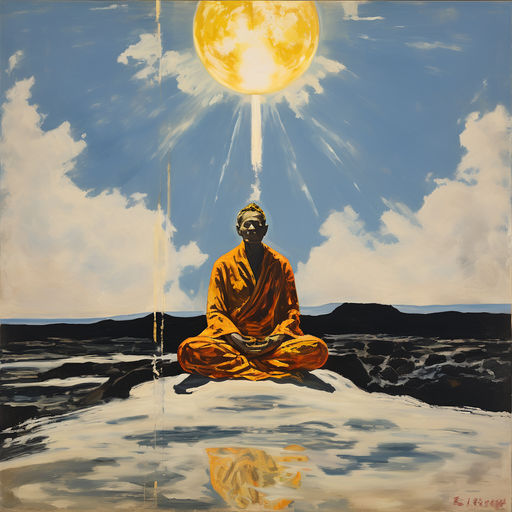
In the quest for enlightenment, a paradox often emerges. We strive to reach a state of higher understanding, yet the moment we claim to have achieved enlightenment, we inadvertently confine ourselves within the very boundaries we sought to transcend. This pursuit reveals a fundamental truth about our nature and existence: what we truly are is inherently free from all limitations.

When we label ourselves as ‘enlightened,’ we inadvertently create a new identity, another cage for our boundless spirit. This declaration is a subtle form of ego, a self-imposed limitation that contradicts the essence of enlightenment itself. True enlightenment is not about attaining a label or reaching a destination; it’s an ongoing journey of self-discovery and liberation from all forms of identification.

Consider the concepts of ‘The Self’ and ‘No Self.’ These are often seen as opposing philosophies in spiritual and philosophical discourse. ‘The Self’ suggests a profound connection with a universal, eternal essence, while ‘No Self’ leans towards the idea of emptiness, the absence of a permanent, unchanging self. However, to define oneself as either is to miss the point entirely.


The essence of our being transcends these concepts. It’s not about being one or the other but encompassing and moving beyond both. We are neither solely ‘The Self’ nor ‘No Self.’ Instead, we exist in a state that includes both yet is not limited by either. This state is not a static endpoint but a dynamic, ever-evolving understanding of our true nature.

In this space, we recognize that labels, identities, and even the concept of enlightenment itself are mere tools for understanding, not the ultimate truth. Our true essence is like the sky—vast, boundless, and untouched by the clouds that drift through it. We are the silent observers, the consciousness that witnesses thoughts, emotions, and sensations without becoming them.

To truly embrace this state of being, one must continuously practice letting go of all attachments, identities, and beliefs. It’s a journey of unbecoming, peeling away layers of conditioned thought and societal constructs to reveal the pure, unadulterated essence of our being.


In conclusion, the journey to understanding what we truly are is not about acquiring a new label or reaching a definitive state of being. It’s about the continuous process of freeing ourselves from all limitations, labels, and identities. It’s about recognizing and embracing the boundless nature of our existence, which includes and transcends all dualities.

Morgan O. Smith

Yinnergy Meditation, Spiritual Life Coaching & My Book, Bodhi in the Brain…Available Now!

https://linktr.ee/morganosmith

Nonduality

The Unspoken Reality

In the realm of spirituality and philosophy, few concepts are as intriguing and paradoxical as nonduality. Nonduality, often associated with Eastern philosophies like Vedanta and Buddhism, refers to the idea that the dualistic distinctions we make between self and other, subject and object, mind and matter, are ultimately illusory or not fundamentally real.

The profound irony of nonduality is that any attempt to discuss or conceptualize it inherently contradicts its very essence. Speaking or thinking about nonduality is, by its nature, a dualistic activity. This is because language and thought are tools that rely on differentiation and distinction. They are the media through which we carve out the ‘self’ from the ‘other’, the ‘this’ from the ‘that’. In doing so, they perpetuate the illusion of duality – the very illusion that nonduality seeks to transcend.


This paradox highlights a fundamental challenge in human cognition: our reliance on dualistic frameworks to make sense of the world. From the moment we are born, our minds are trained to categorize and differentiate. This cognitive structuring is crucial for our survival and functioning in the world, yet it also confines us within the boundaries of dualistic thinking.

Nonduality suggests a state of consciousness where these dualistic distinctions dissolve. It points to an experiential understanding where the division between subject and object, observer and observed, ceases to exist. In this state, the egoic self expands into a boundless, undifferentiated whole.

Yet, the path to realizing nonduality is not through intellectual understanding. Since it is beyond the grasp of dualistic thought and language, nonduality is often approached through practices that transcend rational thinking, such as meditation, mindfulness, or other forms of spiritual contemplation. These practices aim to quiet the mind and dissolve the ego, allowing for a direct, non-conceptual experience of reality, unfiltered by the distorting lens of dualistic thought.


In conclusion, nonduality remains an enigmatic yet profoundly significant concept. It challenges us to look beyond the apparent separateness and fragmentation of our experiences and to question the very foundations of our understanding of reality. While it may never be fully captured in words or thoughts, it stands as a powerful reminder of the limitations of our dualistic perspectives and invites us to explore the depths of our consciousness.

Morgan O. Smith

Yinnergy Meditation, Spiritual Life Coaching & My Book, Bodhi in the Brain…Available Now!

https://linktr.ee/morganosmith

Embracing the Absolute

Understanding the Unity of Existence

In the grand tapestry of existence, there exists a profound and often overlooked truth: all is the absolute. This statement, deceptively simple, unravels layers of deep philosophical understanding about our universe and our place within it. The concept of the absolute refers to the ultimate reality, a state of being that transcends the ordinary distinctions and separations that we, as individuals, experience in our daily lives.

The universe, in its infinite complexity, is a manifestation of this absolute reality. Each star, planet, organism, and atom contributes to this holistic entity, making the universe not just a collection of parts, but an interconnected whole. The absolute is not something distant or detached from our reality; it is our reality, in its most profound and all-encompassing form.

Interestingly, this perspective aligns with various philosophical and spiritual traditions, which have long proposed that the fundamental nature of reality is a unified field of existence. In this view, the distinctions we make between ourselves and the world around us are, in a sense, illusions. They are practical and necessary for our survival and daily functioning, but they do not represent the deeper truth of our existence.


The individual ego, the sense of self that each of us carries, is also an expression of the absolute. This notion challenges our conventional understanding of individuality and separateness. The ego, often perceived as a distinct and isolated entity, is, in reality, another aspect of the absolute. It’s not separate from the absolute but a unique expression of it.

This perspective invites us to reconsider the nature of our identity. If our egos are manifestations of the absolute, then the boundaries between ourselves and the rest of the universe become more permeable. We are not isolated beings, but integral parts of a larger, dynamic whole. This realization can be both humbling and empowering, as it connects us to something greater than ourselves and dissolves the illusion of isolation.

However, the ego often operates under the illusion of separateness. It constructs a narrative of individuality that, while necessary for our functional existence, obscures the deeper truth of our interconnectedness. This illusion is not a fault but a feature of the human experience, a necessary aspect of our journey through life.


In recognizing our true nature as expressions of the absolute, we open the door to a more profound understanding of existence. We begin to see the interconnectedness of all things and the unity that underlies the apparent diversity of the universe. This realization has the potential to transform our perspective on life, fostering a sense of connection, compassion, and a deeper appreciation for the mystery and beauty of existence.

Morgan O. Smith

Yinnergy Meditation, Spiritual Life Coaching & My Book, Bodhi in the Brain…Available Now!
https://linktr.ee/morganosmith

The Transcendental Journey

Beyond Self and Society in Pursuit of Enlightenment

The quest for spiritual enlightenment is a profound journey that goes far beyond the realms of the individual self. It is a path that demands transcendence in its truest form – a journey that calls for us to rise above not just our identity, but also the collective constructs that define our existence. This process of transcending encompasses various aspects of life: ego, behaviour, traits, race, gender, community, religion, tradition, culture, species, opposition, and even the environment.

Transcending individuality means moving beyond the ego and the superficial traits that define personal identity. It’s about realizing that at the core, we are more than our personalities, habits, or physical attributes. This realization opens up a new way of experiencing the world, where personal biases and limitations no longer bind us.


Moreover, transcending race, gender, community, and religion involves recognizing the unity and interconnectedness of all beings. It’s about understanding that these social constructs, while significant in our worldly interactions, are not the ultimate truths of our existence. By moving past these distinctions, we embrace a more inclusive and compassionate view of the world.

Transcending tradition and culture is equally critical. It means acknowledging the value and beauty in all cultural expressions while not being limited by any single worldview. This broadens our understanding and appreciation of the diverse tapestry of human experience.


Furthermore, transcending species signifies acknowledging and respecting the interconnectedness and interdependence of all life forms. It’s an acknowledgment that human life is just a part of the vast web of existence, not separate or superior to it.

Transcending opposition and the environment involves realizing that conflict and the perception of separation from nature are illusions. True enlightenment recognizes the harmony and balance inherent in all things and seeks to foster it.

In essence, to attain spiritual enlightenment is to transcend the myriad divisions and categories that fragment our perception of reality. It’s a journey towards seeing and experiencing the underlying unity and interconnectedness of all existence. This path leads not only to personal transformation but also to a more profound understanding and relationship with the world around us.

Morgan O.  Smith

Yinnergy Meditation & My Book, Bodhi in the Brain…Available Now!

https://linktr.ee/morganosmith

The Tapestry of Reality

Synchronicity and the Illusion of Separateness

In the dance of existence, our perceptions often lead us to believe in the solidity and separateness of things. The term “Maya,” derived from ancient philosophical traditions, refers to the illusory nature of the world. It’s a veil that covers the true essence of reality, suggesting that what we experience is not exactly what it seems.

The concept of “Atman,” on the other hand, points to a deeper truth. It is the individual soul, the pure, unchanging self within each person that is part of a universal soul, Brahman. The realization of Atman within oneself is to acknowledge that one is not just a passive observer of reality but an active creator of it. The synchronicities we encounter, those meaningful coincidences that seem to defy mere chance, are glimpses into this profound interconnectedness of all things.

Meditation serves as a pathway to peel back the layers of Maya, to expand our consciousness from the narrow confines of the ego and to experience the oneness with Brahman. Enlightenment, the pinnacle of spiritual realization, is the recognition that one is not separate from the universe but is the universe, participating in its unfolding as both creator and creation.

In this state, everything occurs simultaneously, and the distinctions between actor, action, and acted upon blur. You are the painter and the canvas, the dancer and the dance, the dreamer and the dream. Your everyday reality is a play of consciousness, a symphony where the whole orchestrates every part.

But the ego is not equipped to handle the enormity of this realization; hence, we experience reality in fragments, in synchronicities that hint at a larger, more intricate design. These moments are invitations to look deeper, to question, and to ultimately discover that you are, in essence, everything you perceive—boundless and infinite.

In the end, perhaps all of existence is an elaborate tapestry woven from the threads of nothingness, and in every stitch, there’s a story of creation and the creator, entwined in an eternal dance.

Morgan O.  Smith

Yinnergy Meditation & My Book, Bodhi in the Brain…Available Now!

https://linktr.ee/morganosmith

To Reach Beyond the Luminous

A Contemplation on Enlightenment and Distractions Along the Path

In our intrinsic pursuit of enlightenment, myriad entities, experiences, and spiritual phenomena often unveil themselves, presenting a paradoxical tapestry where understanding and distraction intertwine. When such entities or guides emerge along our path, they necessitate neither fixation nor rejection. For if they come, let them come, and if they decide to part, let them go. They are merely visitors, not permanent dwellers in our spiritual quest.

The venerable aphorism, “If you meet the Buddha on the road, kill him,” underscores the necessity of liberating ourselves from attachments and anticipated experiences in our spiritual pursuit. For, anything that becomes an object, a tangible or conceptual entity in our path, is not the ultimate truth. Therein, even the luminous light, an experience that many consider synonymous with spiritual ascension, is merely an objective reality, one that still exists within the domain of duality and separation.

The spiritual path unfurls itself as a journey where psychic powers, or Siddhis, may develop. If they do, they are not to be clung to. Enlightenment is neither a culmination nor an accumulation of powers or experiences, but a transcendence that paradoxically both surpasses yet includes all phenomena. It is an unceasing journey toward non-duality, where there is no seer, no seen, and no seeing – only a unified, unblemished consciousness that permeates all.

Phenomena, be they seemingly mundane or extraordinarily mystical, are to be acknowledged, witnessed, and permitted to drift away without attachment or aversion. They are waves on the surface of the ocean of consciousness, significant in their momentary existence, yet ultimately rejoining the vast, undulating expanse from whence they came.

Our ego becomes the most subtle, pervasive, and potentially pernicious impediment in this spiritual journey. It distorts, distracts, and sometimes destructs, coaxing us into traps that appear as enlightening experiences. The seductive allure of these experiences has ensnared many seekers, captivating them in a web that is woven from the threads of spiritual materialism.

The aspiration is not to annihilate the senses but to transcend and include them, to experience them in their fullest, most vibrant expressions, and yet remain unbound by them. It is to dive deep into the very essence of existence until all dichotomies, dualities, and senses converge into a singular, unified experience where distinctions cease, and all that remains is the unbounded, immeasurable expanse of Being.

Hence, the spiritual path might be perceived not as an endeavour of attaining or achieving, but as a continuous unfolding of letting go, a perpetual surrender. For in this surrender, we do not become devoid or nihilistic, but rather, we open ourselves to the entirety of existence, unshielded and unbounded.

All is a dream within the mind of God, and you, the dreamer, are no distinct from the dream you conjure, for at the ultimate level of who and what you are, is even beyond the luminous, beyond objectivity. To witness without becoming witnessed, to experience without becoming experienced – this is the path to enlightenment, where letting go is the ultimate embrace.

Morgan O.  Smith

Yinnergy Meditation & My Book, Bodhi in the Brain…Available Now!
https://linktr.ee/morganosmith

Melding Into The Absolute

A Glimpse Into The Ephemeral Veil of Enlightenment

The pursuit of enlightenment, often perceived as a lofty goal, transcends the entanglement of the mundane and the superficial. It is a venture beyond the confinements of ego, a journey into the vast expanse of what is real and eternal. But what happens when one treads on the path leading toward enlightenment? Is there a profound experience awaiting or is it an indescribable state of being? This contemplation draws insights from two profound philosophies – Vedanta and Buddhism, exploring their stance and convergence at the pinnacle of enlightenment.

During the moment of enlightenment, there is no ‘ego’ to witness this majestic unfolding. If one perceives a void yet remains distinct from it, the essence of enlightenment remains elusive. However, such an experience is a beacon of progress, a sign of being on the righteous path. When enlightenment graces, there’s an inherent knowing, a certainty that obliterates doubts. It’s a paradoxical realm where everything and nothing transpires, leaving behind only the essence of what one truly is—Absolute.

The Vedantic and Buddhist interpretations, though seemingly diverse, converge at the apex of enlightenment. Vedanta extols the oneness of existence, the monistic reality, while Buddhism explores the transient nature of reality, leading to a similar dissolution of ego and a recognition of an underlying unity. It’s akin to the myriad flavours of ice cream. Despite their distinct tastes and colours, the essence remains the same – the foundational element of ice. The epitome of enlightenment, or absolute monism, can be metaphorically depicted as a blend of every conceivable flavour of ice cream and beyond, encapsulating all foods, their variations, their origins, and their surroundings.

The metaphor extends further, proposing a confluence of all experiences, a melding into the Absolute. The journey might commence from disparate standpoints, traversing through diverse experiences, yet it culminates at a singular point— the realization of the Absolute. The magnificence of enlightenment doesn’t lie merely in reaching this pinnacle but in the unravelling of profound simplicity, an unveiling of what has always been there.

Upon such a realization, the dichotomies merge, the veils of ignorance are lifted, and what remains is an unadulterated consciousness, a pristine awareness devoid of fragmentation. It’s a return to the original state of being, a melding into the boundless, an embrace of the Absolute.

Morgan O.  Smith

Yinnergy Meditation & My Book, Bodhi in the Brain…Available Now!
https://linktr.ee/morganosmith

The Weight of the World and the Path to Spiritual Awakening

In the vast expanse of our human journey, there are moments of profound weight, where one feels as if they are carrying the burdens of the entire world upon fragile shoulders. This weight, often elusive and ineffable, is the manifestation of our ego, the culmination of our personal experiences intertwined with the collective unconscious of humanity.

Such weight can be overwhelming, sometimes akin to bearing witness to all of the human pain, suffering, and dark episodes of our shared history. Yet, it is said that we are never burdened with more than we can bear. This assertion, though challenging to grasp especially in our moments of despair, points towards a greater purpose – the evolution of the soul.

Those who endure and navigate through this weight, emerging on the other side of its crushing force, often find themselves transformed. The ego, once the dominating force, begins to dissolve, making way for a purer, more profound connection with the universe. This metamorphosis leads to humility, replacing pride and arrogance with an understanding that we are but a tiny fragment of the vast cosmos.

With this newfound humility comes a more receptive heart. Love, compassion, and empathy flow effortlessly, as the barriers that once separated us from others crumble. We begin to truly understand the adage, “Walk a mile in another man’s shoes.” This isn’t just about human-to-human connections; it extends to all life forms. We start recognizing the soul in every being, every flutter of a leaf, every chirp of a bird.

The ultimate realization, perhaps, is the true meaning of the age-old teaching, “Love thy neighbour as thyself.” It is not merely a call for kindness but a revelation that at the core, beyond the layers of ego and societal constructs, we are all one. There is no other; there is only us, interconnected and interdependent.

In conclusion, while the weight of the world can seem unbearable at times, it might just be the universe’s way of preparing us for a deeper connection, for a spiritual awakening that allows us to see beyond the superficial and truly embrace all that is.

Morgan O. Smith

Yinnergy Meditation & My Book, Bodhi in the Brain…Available Now!

https://linktr.ee/morganosmith

The Ego

Many Faces of the “I”

In our quest to understand ourselves, few concepts are as debated, dissected, and deliberated as the ego. Spanning from ancient spiritual scriptures to the modern therapist’s couch, the ego stands as a reflection of our sense of self and our relation to the world. Yet, its definitions vary, painting a multifaceted picture of this central aspect of human existence.

### **1. Ego in Psychoanalysis: The Mediator**

Freud’s tripartite model of the psyche introduced us to the ego as the balancing force between the primal urges of the id and the moral compass of the superego. Here, the ego isn’t an adversary but a necessary mediator, guiding our actions in a world of societal norms. It poses the question: Is our ego the voice of reason amidst internal chaos?

### **2. Ego in General Psychology: The Self’s Mirror**

When we talk about self-esteem or self-worth, we’re often referring to the ego. This definition paints the ego as a mirror reflecting our perceived value and place in the world. Yet, this raises a thought-provoking inquiry: If our ego is a mirror, who or what determines its reflection?

### **3. Ego in Philosophy: The Conscious Observer**
Descartes’ famous dictum “Cogito, ergo sum” (I think, therefore I am) encapsulates the philosophical perspective of the ego as the conscious thinking subject. If our ego is the conscious observer of our experiences, it invites us to ponder: Without this observer, do experiences lose their significance?

### **4. Ego in Spirituality: The Illusory Self**
Many spiritual traditions view the ego as a barrier to enlightenment. It’s the illusory sense of separateness that binds us to suffering. The spiritual perspective urges us to ask: If the ego is an illusion, then who indeed are we beneath this veneer?

### **5. Ego in Pop Culture: The Mask of Pride**
Everyday parlance often equates a “big ego” with arrogance. It’s seen as a mask, sometimes shielding insecurities, other times amplifying genuine pride. This usage compels us to consider: Is the ego merely a façade, and what lies behind it?

### **6. Ego in Eastern Philosophies: The Creator of “I-ness”**

Hindu philosophy introduces Ahamkara, the aspect of us that births the sense of “I.” This ego is neither good nor bad but a natural facet of being human. Reflecting on this, we might wonder: Is the ego, not an enemy but an inevitable companion on our human journey?

**In Conclusion: The Infinite Layers of “I”**

The ego, regardless of its definition, remains at the core of human introspection. Its multifaceted interpretations offer not just explanations but a myriad of questions. As we navigate our understanding of the ego, we’re not just uncovering the layers of this concept but also the layers of our very existence.

In exploring the ego, we’re invited to embark on a profound journey inward, to question, understand, and perhaps even transcend the confines of the “I.” For as varied as its definitions might be, the ego’s ultimate gift is the invitation to self-reflection.

Morgan O. Smith

Yinnergy Meditation & My Book, Bodhi in the Brain…Available Now!
https://linktr.ee/morganosmith

Beyond the Verbal Abyss

Embracing the Indescribable in the Pursuit of Nondual Consciousness

The realm of metaphysics has been exploring the uncharted territory of human existence since the inception of philosophical thought. The concept of ‘Turiyatita’, borrowed from the ancient Vedantic wisdom, invites us to delve into the mystery of the Ultimate Nondual Presence. In a state of supreme transcendence, Turiyatita marries the notions of Emptiness and form, painting a picture of the Self fully liberated and realized.

This profound state is said to represent the highest level of human awareness. It’s the experience of actualizing the quintessential Vedantic concept, “Aham Brahmasmi,” the realization that all is Brahman, the ultimate reality.

The fascinating paradox of this journey lies in its unspeakability. The moment of enlightenment, where one realizes their ultimate oneness with the universe, is so overwhelmingly mind-shattering that no human language can capture its essence. We find ourselves venturing into a stateless state, an inexplicable expanse that houses all potentiality, while simultaneously being nothing. It’s a cosmic riddle that has always existed and will continue to exist, challenging the very constructs of human understanding.

Over the years, I grappled with expressing the enigma that is Turiyatita. I discovered that language, no matter how profound or poetic, remains insufficient to convey this transcendental experience. The individual mind’s narratives fall short when tasked with communicating such an experience to the collective consciousness. This realization is like a boundless sea that can only be expressed through the universe itself – through everything around us, beneath us, above us, within us, and even through us. Our very existence, after all, is an echo of this ‘Absolute’ language.

This illuminating journey of pure awareness left me in a state of awe, marking an indelible imprint on my ego’s fragments. An unforgettable memory, it is the most profound self-discovery I’ve had in this lifetime.

Most of us remain oblivious to the existence of this state, yet it’s accessible to everyone. It waits patiently for anyone bold enough to plunge into its mysterious depths. These are the Akashic waters of enlightenment, a blissful abyss where the brave explorers willingly lose themselves.

This presence, while unnoticeable, pervades our existence as an invisible field, a force that forms the bedrock of all beings. It’s in the exploration of this Ground of All Existence that one realizes the enigma of the indescribable, the ineffable mystery commonly referred to as ‘God’.

So, as we journey through life and its varied experiences, may we always strive for the courage to explore these profound depths. For it is in these explorations that we touch upon the mysteries of our existence, our true selves, and the cosmic reality we are all a part of.

Morgan O. Smith

Yinnergy Meditation & My Book, Bodhi in the Brain…Available Now!
https://linktr.ee/morganosmith