To See God’s Face

A Glimpse Beyond the Veil

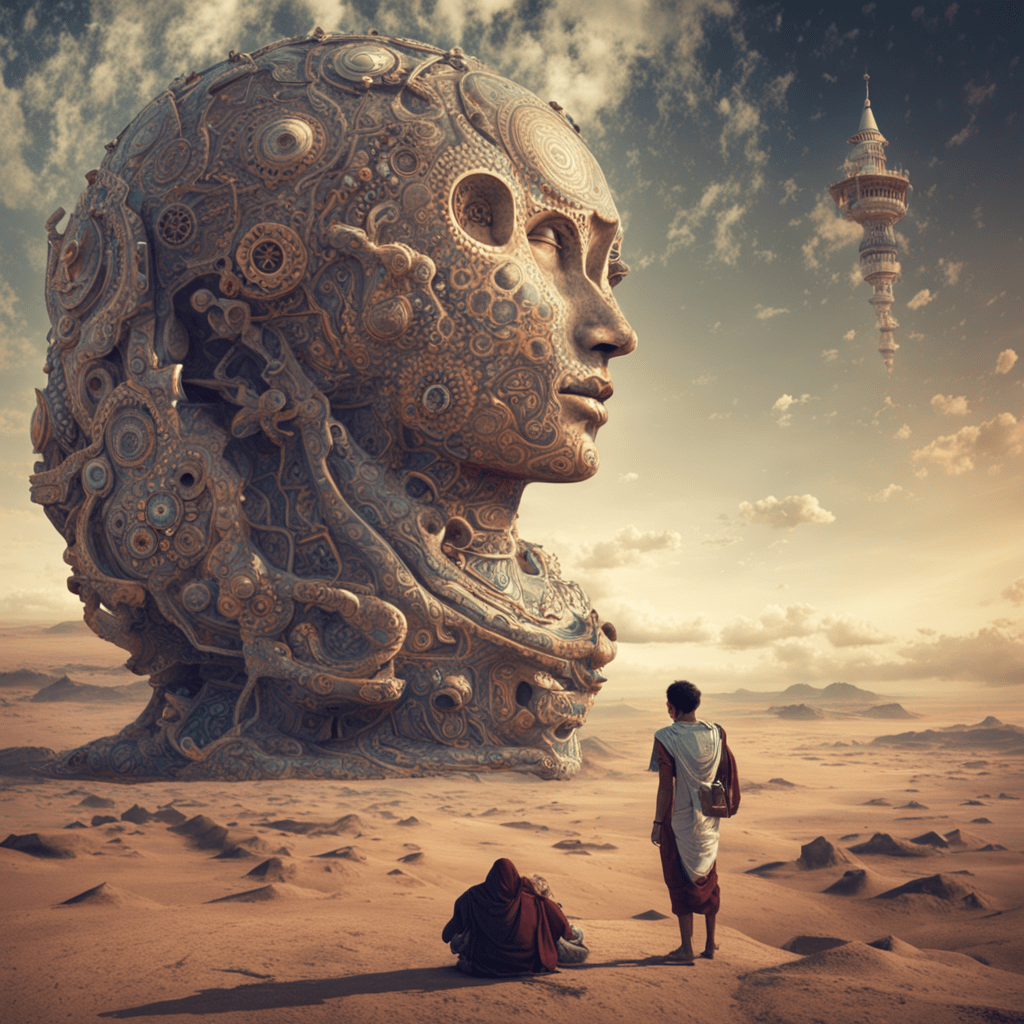
The desire to see the face of God is often spoken of in spiritual traditions, symbolizing the quest to grasp the ultimate truth, touch the divine essence, and witness the Source from which all arises. Yet, many seekers find that the face of God remains elusive. This is not because God hides but because the totality of His expressions cannot be grasped by the human mind until one reaches a state of enlightenment.

What does it mean to see God’s face? Is it a literal vision, or does it represent the merging of self with the Divine? To catch a glimpse of God’s face is to touch the Infinite, even if momentarily. However, the expressions of God—the vastness of His being, the unfolding of all possibilities and manifestations—are incomprehensible to a mind still bound by duality. These expressions are ever-changing, reflecting the dynamic play of creation, destruction, and renewal. Only upon reaching enlightenment, where distinctions dissolve and all is seen as one, does the seeker begin to witness these myriad expressions in their fullness.

Until then, we stand at the threshold, experiencing occasional moments of clarity and divine presence. These glimpses pull us toward deeper understanding, but the full vision, the entire spectrum of God’s expressions, remains veiled. Enlightenment is not simply a state where we “see” more clearly; it is where the very notion of seer and seen dissolves. Only then do we realize that every expression, every nuance of the Divine face, is also our own. The act of witnessing merges into being and all of existence is recognized as the radiant outpouring of the One.

What does this mean for the seeker? The yearning to see the face of God should not be dismissed as a futile chase. It is a sacred impulse. It is the soul’s longing for its source. Yet, one must realize that enlightenment is not an end but a process of continuous unveiling. Until we become still enough, free from the limitations of ego and mind, the Divine will remain a distant and ever-moving horizon. And even upon that horizon, we will see not a singular expression but an infinite number of faces, each revealing another aspect of the cosmic dance.

In the face of God, we encounter not just creation but the unfathomable mystery behind all forms. Enlightenment is the point at which the seeking ends, not because we have seen all there is to see, but because we have become the very essence we sought.

Morgan O. Smith

Yinnergy Meditation, Spiritual Life Coaching & My Book, Bodhi in the Brain…Available Now!

https://linktr.ee/morganosmith

The Myth of Perfection

A Reflection on Human Nature and Spirituality

Perfection is a concept that many aspire to, yet one that remains fundamentally unattainable. The allure of becoming flawless is often reinforced by societal expectations, self-help narratives, and spiritual teachings that promise transcendence over our shortcomings. We yearn for mastery, imagining a state where all undesirable traits have been eradicated and every behaviour aligns with some ideal of human perfection. But is that ever truly possible?

No one is perfect. Not even the most enlightened being on the planet. Let’s use pest control as an example.

No matter how meticulously we maintain our homes or how many pest-control methods we employ, insects will inevitably appear. Some will be caught and eliminated, others will hide and multiply. This relentless cycle mirrors our inner world. Despite all efforts—through therapy, shadow work, psychedelics, or spiritual awakening—no one has found a way to remove every negative tendency permanently. As insects are part of the natural ecosystem, our imperfections are part of being human. Attempts to eliminate all flaws are as futile as trying to rid the entire world of pests.

Each trait or behaviour can be seen as a metaphorical bug. Selling a bug-killing spray or device is like an enlightened teacher selling a pathway to liberation or a self-actualized individual motivating others to reach their highest potential. The promise is not false, but the misconception lies in the belief that the bugs—the flaws—will be eradicated forever. The truth is more nuanced. Much like we can control insects to a certain extent, we can address negative traits, but total elimination is beyond reach.

If you’ve ever been to a home that had one visible roach, you likely made a snap judgment about cleanliness, even if the house was otherwise spotless. Contrast that with spotting an ant, and your reaction might be more forgiving. This response isn’t based on logic but on deeply ingrained conditioning. The same holds for how we judge others. One visible flaw can overshadow countless positive qualities, not because the flaw is inherently worse, but because of how we’ve been conditioned to perceive it.

A self-actualized person can be compared to a meticulous homeowner who manages to keep most of the pests at bay. Their house is mostly clean, orderly, and free of unwanted visitors. Yet, even they know that complete eradication is impossible. An enlightened being, on the other hand, goes beyond this mindset. They see every bug as a part of themselves—each flaw, each undesirable trait, is not separate but an expression of the whole. This broader understanding fosters a deeper acceptance. While they might occasionally choose to kill a bug, it’s done without aversion or judgment. There’s no inner conflict because they see that every bug, every flaw, serves a purpose.

Now the enlightened individual sees everything as perfection. Everything that is considered imperfect is happening perfectly. Everything is divine. Even the most imperfect individual or situation or circumstance. The enlightened recognize that what appears as chaos or dysfunction from a limited perspective is simply the perfect unfolding of a greater, unseen order. A roach-infested home, a seemingly flawed person, or an unwelcome circumstance—all are expressions of a divine play. There is no distinction between beauty and ugliness, perfection and imperfection because all dualities dissolve into the same oneness.

So, when an enlightened being enters a home overrun with insects, they do not recoil or judge. They recognize that their own home could, at any moment, be similarly overtaken. There is no attachment to a pristine space or the opinions of others regarding their environment. By accepting that bugs will always be present, the enlightened suffer less—not because their world is free of pests, but because they are no longer bothered by their existence.

The true wisdom here lies in shifting the focus away from trying to perfect oneself and toward seeing all parts of life—including the messiness, the flaws, and the unwanted bugs—as expressions of the same wholeness. The journey is not about eradicating; it’s about embracing. When we see all that is seemingly imperfect as perfectly divine, we move beyond the struggle and enter a space of true inner peace and freedom.

Morgan O. Smith

Yinnergy Meditation, Spiritual Life Coaching & My Book, Bodhi in the Brain…Available Now!

https://linktr.ee/morganosmith

The Miraculous Nature of Satori and the Beauty of the Mundane

Satori, that sudden flash of insight, is not the kind of experience that can be prepared for or understood through mere intellectual exercise. It arrives unexpectedly, sweeping through consciousness like a cool breeze amid the summer heat. It’s as if all boundaries collapse, leaving only pure awareness. And it’s at that moment you realize—nothing is truly separate.

This fleeting yet profound glimpse into the fabric of reality shifts one’s perception permanently. Suddenly, the noise of daily life quiets. The weight of things that once seemed so important dissolves, revealing a serene clarity always there, patiently waiting. After experiencing Satori, a miraculous paradox unfolds—life doesn’t feel distant or otherworldly. Instead, the mundane becomes extraordinary.

Consider the sensation of holding a cup of tea. Before Satori, you might focus on the cup’s warmth or the taste of the liquid. After Satori, you might find yourself marvelling at the simple act itself. Each sip becomes a universe in motion, rich with presence and deep appreciation. Ordinary moments, once taken for granted, now glow with the same brilliance as those rare flashes of enlightenment.

Satori isn’t about escaping the ordinary; it’s about seeing the divine within it. Whether it’s the rustle of leaves in the wind or the sound of laughter echoing through the air, the smallest details become pathways to the infinite. There is no longer a need to search for meaning elsewhere; everything, as it is, reflects the sacred nature of existence.

The true gift of Satori lies not in the experience itself, but in its ability to transform our relationship with life. It teaches us that miracles aren’t somewhere out there, waiting to be discovered—they are embedded in the fabric of each moment, no matter how small or ordinary.

Suddenly, every breath, every heartbeat, every sensation becomes an invitation to return to that space of awareness. And it’s this quiet reverence for the mundane that truly allows one to live fully, with grace and wonder.

Morgan O. Smith

Yinnergy Meditation, Spiritual Life Coaching & My Book, Bodhi in the Brain…Available Now!

https://linktr.ee/morganosmith

Turiyatitta

The Singularity of All That Is

Turiyatitta, often referred to as the state beyond the fourth, is an experience that defies conventional understanding. While Turiya encompasses the witness state within waking, dreaming, and deep dreamless sleep, Turiyatitta transcends even this. It represents the complete dissolution of the witness, where all states merge into an indivisible, absolute singularity. Here, the boundaries that once defined waking, dreaming, and deep dreamless sleep no longer exist—everything and nothing become one.

In Turiyatitta, consciousness no longer stands apart, observing. The very notion of a witness dissolves into an awareness so expansive and complete that there is nothing left to observe. There is no division between subject and object, no experience of separation because nothing exists outside of this infinite awareness. This state is considered the final stage of enlightenment—where the full nondual awareness of absolute Monism is realized.

Imagine being both everything and nothing at the same time. Not merely perceiving this intellectually, but embodying the paradox in a way that no words can fully express. The divine empty witness, once perceived as separate, fully dissolves within itself. All distinctions—between time and space, self and other—collapse into the infinite. What remains is not emptiness in the typical sense, but a fullness so complete that it transcends all concepts of existence or non-existence.

Turiyatitta feels like the ultimate convergence of all possible experiences into one absolute awareness. It is a state where nothing is hidden, nothing is separate, and there is no need for perception because everything is known in its essence. There is no longer a “seer,” for there is nothing to see. The divine once thought of as a distant force or presence, is realized as the very fabric of existence.


This stage is not about attaining something new but about shedding the final layers of illusion, revealing the inherent truth that has always been. The mind quiets, the heart stills, and what remains is the simple, silent, all-encompassing awareness that is beyond all states, yet contains them all.

Morgan O. Smith

Yinnergy Meditation, Spiritual Life Coaching & My Book, Bodhi in the Brain…Available Now!

https://linktr.ee/morganosmith

Turiya

The Unseen Ground of Consciousness

Turiya, often described as the fourth state of consciousness, stands beyond waking, dreaming, and deep dreamless sleep. What does it feel like to exist within this state? The experience itself cannot be fully captured by language, for Turiya transcends the usual boundaries of perception. It is not merely a state that one “enters” and “leaves”; rather, it is the ground upon which all other states rest.

There’s a subtle, yet profound, recognition that one is not the individual witness, but the infinite awareness in which all phenomena arise and dissolve. In Turiya, the experience is not of observing the states of waking, dreaming, and deep dreamless sleep separately, but of witnessing them as simultaneous expressions of a unified field of consciousness. Here, distinctions lose their meaning—what was once experienced as separate now collapses into a seamless continuum.

This state has often been referred to as the first stage of enlightenment. Yet, even such descriptions fall short. The essence of Turiya is not something “attained” through effort. Instead, it is revealed through the dissolution of identity, a quiet remembrance of one’s true nature.

Imagine an eternal presence where time does not move, where forms arise and fall like waves on the surface of an ocean, yet the ocean itself remains unshaken. Divinity, in this context, is not something external or far-off—it is what you are. The divine becomes aware of itself, witnessing all, yet remaining untouched by the movements within itself. It is existence contemplating its own essence, eternal and ever-present.

The beauty of Turiya is in its simplicity. It does not need complex metaphors to explain itself. It is felt as a continuous hum of being, beyond concepts, thoughts, and emotions—a recognition that everything, including the experiencer, is merely a reflection of the same undivided consciousness.

To experience Turiya is to see the eternal play of life from the perspective of the timeless. It is to understand that the very states we once believed to be separate—waking, dreaming, deep dreamless sleep—are all mere movements within the One.

Morgan O. Smith

Yinnergy Meditation, Spiritual Life Coaching & My Book, Bodhi in the Brain…Available Now!
https://linktr.ee/morganosmith

The Elusive Blind Spot of Enlightenment

A paradox begins to unfold from the moment consciousness takes form and you are born into this world. Enlightenment, often considered the pinnacle of spiritual realization, simultaneously becomes a blind spot. It’s not that enlightenment is absent; rather, it exists so close to you that it evades your direct perception. The act of becoming a being—separate from the whole—creates the veil obscuring what was never lost.

Most people search for this elusive state, hoping to grasp it through teachings, practices, and philosophies. Yet, the search itself can deepen the sense of separation, reinforcing the idea that enlightenment is something external to be found. But what if enlightenment was never something you needed to find? What if it was something you simply needed to stop resisting?

Human existence is an exquisite contradiction. On one hand, the moment you identify as an individual, you begin to experience duality—subject and object, self and other. On the other hand, this identification simultaneously masks the realization that you are already one with everything. Enlightenment is not an external destination; it is the underlying reality that permeates your existence.

The blind spot isn’t due to a lack of spiritual capacity or effort, but the mind’s incessant clinging to the notion of self. The moment you try to achieve enlightenment as a personal goal, it slips further away, like trying to catch a shadow. Perhaps the real journey is not about seeking, but about unlearning. The simplicity of just being, without striving, can often be the most profound realization of all.

What happens when you stop searching? What if you allow yourself to see that enlightenment is not a peak experience to attain, but the constant, ever-present background of awareness that you are, and always have been? This blind spot only remains as long as there is an effort to overcome it. Let go of that effort, and what reveals itself has been present all along—your original nature.

The key lies in the willingness to let go of the need for enlightenment, to surrender the very idea that you are separate from it. Only then does the blind spot dissolve, and the reality of your true self, free from all constructs, comes into clear view.

Morgan O. Smith

Yinnergy Meditation, Spiritual Life Coaching & My Book, Bodhi in the Brain…Available Now!

https://linktr.ee/morganosmith

The Unraveling of the Self

Emotional and Mental Breakdowns During Spiritual Awakening

Introduction

The journey toward spiritual awakening often appears, from the outside, as a serene and enlightened path. Yet, for those who walk it, the experience can be anything but peaceful. Emotional and mental breakdowns are common, and they serve a profound purpose. These breakdowns are not merely unfortunate side effects but are integral to the transformation that takes place during spiritual awakening. Understanding why and how they occur sheds light on the deeply transformative nature of this journey.

The Dissolution of the Ego

At the heart of spiritual awakening lies the dissolution of the ego, the part of us that identifies with our thoughts, emotions, and external identities. The ego forms a protective shell around our innermost being, creating a sense of separation from the world and others. As spiritual awakening progresses, this shell begins to crack and dissolve. The breakdowns that occur during this process are the ego’s desperate attempts to hold onto the illusions it has created.

Emotional turmoil arises as old wounds, suppressed fears, and unresolved traumas surface. These are not new experiences; they are fragments of our psyche that have been buried deep within. The awakening process brings them to the surface, demanding that they be acknowledged, felt, and released. This can manifest as intense sadness, anger, or anxiety, often without a clear trigger. The breakdowns are not a sign of failure but a necessary purging of what no longer serves the soul’s evolution.

Mental Deconstruction

Alongside the emotional upheaval, there is often a mental breakdown that accompanies spiritual awakening. Our minds are accustomed to operating within the framework of duality—right and wrong, good and bad, self and other. As awakening deepens, this framework begins to disintegrate, leading to confusion, disorientation, and a sense of losing touch with reality.

The mind, which has always sought control through understanding and categorizing, now faces the incomprehensible. Concepts that once provided a sense of stability and security—such as time, identity, and purpose—start to unravel. This can feel like madness, as the mind struggles to find footing in a reality that no longer adheres to the rules it once knew.

However, this mental breakdown is a gateway to a higher understanding. It forces the individual to let go of the need to intellectually grasp the vastness of existence and instead invites them to surrender to the mystery of being. What emerges from this surrender is a more expansive awareness that transcends the limitations of the thinking mind.

The Purpose Behind the Breakdown

The emotional and mental breakdowns during spiritual awakening serve a profound purpose. They are not signs of weakness or instability but are essential phases of the journey. These breakdowns break open the rigid structures of the ego and the mind, allowing the true self to emerge. The pain and confusion are catalysts for shedding the old, making way for a new way of being.

In essence, these breakdowns are acts of grace. They strip away the false layers of the self, revealing the underlying essence that is interconnected with all of existence. Through the process of breaking down, one is rebuilt on a foundation of truth, love, and unity.

Navigating the Breakdown

For those experiencing these breakdowns, it’s important to understand that they are temporary and purposeful. Practicing self-compassion and seeking support from others who understand the journey can be invaluable. Meditation, grounding practices, and connecting with nature can also help stabilize the experience. Above all, embracing the breakdown as part of the awakening process allows for a more graceful passage through these intense phases.

When to Seek Extra Support

These breakdowns are not obstacles for most individuals. But there are cases where mental illness could be a factor and needs to be identified and not mistaken for the awakening process. Extra support and seeking professional help in these cases may be needed. They should never be avoided or spiritually bypassed. In some cases, spiritual practices should be avoided altogether, especially if they exacerbate the symptoms or lead to further confusion and distress. Understanding the difference between a spiritual crisis and a mental health issue is crucial, as neglecting the latter can lead to unnecessary suffering and hinder the healing process.

Conclusion

Spiritual awakening is not a gentle process; it is a profound upheaval that shakes the very core of our being. The emotional and mental breakdowns that occur are not obstacles but necessary steps in the dissolution of the old self. By understanding and embracing these breakdowns, one can move through them with greater ease, allowing the transformation they bring to unfold fully. In the end, what emerges from the ashes of the breakdown is a self that is more authentic, whole, and deeply connected to the essence of life itself.

Morgan O. Smith

Yinnergy Meditation, Spiritual Life Coaching & My Book, Bodhi in the Brain…Available Now!

https://linktr.ee/morganosmith

A-Dual to Dual to Nondual

The Evolution of Consciousness

The evolution of consciousness from a-dual to dual to nondual mirrors the profound journey of human development and spiritual awakening. This path reflects the unfolding of awareness from the pure, undifferentiated state of infancy, through the complexities of duality, and ultimately to the profound realization of nonduality.

The A-Dual State: The Innocence of a Newborn

A newborn baby embodies the a-dual state—a condition of pure, undivided awareness. In this state, there is no sense of separation; the infant exists in a realm of unity where distinctions between self and other, subject and object, have not yet formed. The newborn’s consciousness is a reflection of the primal unity of existence, an experience of pure presence and potential.

The Emergence of Duality: The World of Distinctions

As the child grows, the consciousness transitions into the dual state. This is the realm where the distinctions and separations that characterize our daily lives begin to emerge. The child starts to recognize the difference between self and other, experiencing the world as a collection of distinct objects and entities. This dualistic perception is essential for navigating and understanding the complexities of life.

In the dual state, we develop our sense of identity and individuality. We learn to interact with the world, to differentiate between pleasure and pain, success and failure, love and fear. However, this separation can also lead to feelings of isolation, conflict, and a sense of being incomplete.

The Nondual Realization: The Return to Unity

A full spiritual awakening marks the transition from dual to nondual consciousness. This realization transcends the distinctions of duality, revealing the underlying unity of all existence. In the nondual state, the boundaries between self and other dissolve, and we perceive the interconnectedness of all things.

Nondual awareness is the recognition that the multiplicity of forms and phenomena are expressions of a single, boundless reality. It is an experience of profound unity where the apparent separations of duality are seen as illusory. This realization brings a deep sense of peace, compassion, and unconditional love, as we understand that we are part of a greater whole.

Embracing the Journey

The journey from a-dual to dual to nondual is not a linear path but a continuous unfolding of consciousness. It invites us to embrace the innocence of the a-dual state, navigate the complexities of duality, and ultimately awaken to the nondual realization. This journey encourages us to live with mindfulness, recognizing the sacredness in every moment and every experience.

By understanding and embracing this evolutionary process, we can navigate life with greater wisdom and grace. We learn to hold the paradoxes of existence, finding harmony in the interplay of opposites. This path is not about escaping the world but engaging with it more deeply, with an open heart and a clear mind.

The evolution of consciousness from a-dual to dual to nondual offers a profound framework for understanding our spiritual journey. It reminds us that beyond the apparent separations lies a deeper truth—a truth that can transform our perception and inspire us to live with greater compassion, wisdom, and love.

Morgan O. Smith

Yinnergy Meditation, Spiritual Life Coaching & My Book, Bodhi in the Brain…Available Now!

https://linktr.ee/morganosmith

The Dissolution of the “I”

A Journey Beyond Self

In the quiet moments of our existence, we often find ourselves pondering the nature of identity and consciousness. What does it mean to truly know oneself? How can we navigate the complex interplay of ego and essence? These questions have occupied the minds of mystics and philosophers for millennia, yet they remain as relevant today as ever.

At the heart of these inquiries lies a profound realization: the dissolution of the “I.” This moment of enlightenment is not merely an intellectual understanding but a visceral, transformative experience. It is a point where the sense of self, the familiar “I” that anchors our daily lives, dissolves into something far greater and more expansive.

In this state, the boundaries that define our individuality blur and eventually vanish. The distinctions between self and other, inner and outer, become meaningless. This dissolution is not an annihilation but a return to the source—a reabsorption into the universal consciousness from which all things arise.

This experience is often described as a merging with pure awareness, where the perceiver and the perceived become one. It is a space where all dualities collapse, leaving only the pure presence of being. Here, there is no longer a separate observer; the “I” that once clung to its identity dissolves within itself, recognizing that it was never separate from the whole.

Such a realization can be both liberating and disorienting. The dissolution of the “I” challenges our deepest assumptions about who we are and what reality is. It invites us to embrace the paradox that while we appear as individuals, we are simultaneously the entirety of existence experiencing itself. This shift in perception allows for a deeper connection with the world, fostering a sense of unity and compassion that transcends the limited scope of personal concerns.

Yet, this journey is not without its challenges. The ego, with its myriad attachments and identifications, often resists this dissolution. It fears the loss of control, the end of its narrative. But in letting go, we do not lose ourselves; rather, we find our true essence—a boundless, infinite presence that is the very ground of being.

In this realization, life takes on a new dimension. Every moment becomes a manifestation of the infinite, every interaction a dance of the divine. The dissolution of the “I” is not an endpoint but a continuous unfolding, a deepening into the mystery of existence. It is an invitation to live from a place of profound openness and love, to see the world through the eyes of the infinite.

As we navigate this journey, let us remember that the dissolution of the “I” is not an escape from reality but a deeper engagement with it. It is a call to awaken to our true nature and to recognize the sacredness of all life. In this space, we find the freedom to be fully present, fully alive, and fully ourselves—beyond the limitations of the ego, in the infinite expanse of pure being.

Morgan O. Smith

Yinnergy Meditation, Spiritual Life Coaching & My Book, Bodhi in the Brain…Available Now!

https://linktr.ee/morganosmith

The Profound Simplicity of Enlightenment

Transforming Perspective, Not Action

In the spiritual awakening journey, there is a well-known saying: “Before enlightenment, chop wood, carry water. After enlightenment, chop wood, carry water.” This aphorism captures the essence of a profound transformation that occurs not in the realm of actions but in the realm of perception.

Before enlightenment, we engage with the world through a dualistic lens. Wood is simply wood, and water is merely water. Our actions are routine, grounded in the practical necessities of life. We chop wood to build fires, and we carry water to quench our thirst. The world is divided into distinct entities and tasks, each with its purpose and function.

However, with the dawning of enlightenment, a radical shift in perspective occurs. Once seen as separate objects, the wood and water are now perceived as the divine. Every action, whether chopping wood or carrying water, becomes an act of communion with the sacred. The distinction between the doer and the deed dissolves, revealing the inherent unity of all existence.

This newfound vision unveils a profound truth: God is not a distant, separate entity but is every aspect of the universe. The wood we chop, the water we carry, the tools we use, and even the hands that perform these actions are not only expressions of the divine but are the divine. This realization transforms mundane tasks into sacred rituals, imbued with deep reverence, interconnectedness and beyond.


The environment in which these actions take place also becomes a sacred space. The forest where we gather wood, the river from which we draw water, and the air we breathe are all seen as the divine presence. Every element of our surroundings is woven into the fabric of oneness, blurring the lines between the individual and the cosmos.

This shift in perspective does not alter the actions themselves. We still chop wood and carry water, fulfilling the same physical tasks as before. Yet, the awareness that everything is as is infused these actions with a sense of purpose and meaning that transcends the ordinary.

In this enlightened state, the simplicity of life is revealed in its most profound form. Each moment becomes an opportunity to experience the divine, to engage in a continuous dialogue with the universe. The mundane is elevated to the extraordinary, and every action becomes an expression of love and devotion.


Ultimately, enlightenment is not about escaping the world or renouncing our daily responsibilities. It is about transforming our perception, recognizing the sacredness in every aspect of life, and understanding that we are the intricate, divine dance. By embracing this perspective, we find a deeper sense of peace and fulfillment, knowing that every action, no matter how simple, is an act of communion with the divine, as the divine.

Morgan O. Smith

Yinnergy Meditation, Spiritual Life Coaching & My Book, Bodhi in the Brain…Available Now!

https://linktr.ee/morganosmith