God Is the Real Imaginary

Absolute Monism and the Paradox of Reality

A peculiar clarity arises once the mind exhausts its chase for permanence. Once the striving quiets, what remains is not a revelation in the ordinary sense—it is the revelation of revelation itself. God. Not as something other, but as the very condition of knowing, being, and non-being.

God is not a person, nor a power among powers. God is context itself. Not just the backdrop, but the totality—the undivided field in which all division appears. It is what Hindus call Para Brahman: the Absolute of the Absolute. The final substratum, beyond form, formlessness, and even beyond the duality of beyond and not-beyond.

Yet the paradox defies all rational anchoring: God is also imagination.

Not a figment. Not illusion in the dismissive sense. But the supreme imagining—consciousness dreaming within itself. The universe, with all its matter and mind, all its chaos and beauty, is that imagining. And because God is not apart from its imagining, God too is that imagining.

Which means this: both God and the universe are imaginary.

And also utterly real.

What we call “real” and what we call “imaginary” collapse into a single gesture when seen from God’s standpoint—which is no standpoint at all. From this viewless view, there is no separation between the dreamer and the dream, the Absolute and its expression, the Formless and the formed.

Yet the beauty of this is not that everything dissolves into sameness. The beauty is that everything becomes itself without needing to stand apart.

God and the universe are one and the same. And because they are one and the same, they are also not the same. The distinction is not contradiction. It is the very nature of what is. Distinctness does not negate unity. It reveals it.

This is not spiritual poetry. This is ontological exactness. If anything is to be absolute, it must include even the capacity to contradict itself. That is the very mark of its absoluteness.

So, what is this that appears as a tree, a thought, a thunderclap, a kiss, a death, a silence?

It is God.
It is the universe.
It is imagination.
It is reality.

One singularity. Absolute Monism.

To see it is not to figure it out. To see it is to disappear into what cannot not be.

Morgan O. Smith

Get Your Free Copy of My Book, Bodhi in the Brain!
https://subscribepage.io/oTSZQu

The Divine Totality

Everything Is God, Even the Illusion of Not-God

There comes a moment so still and unfiltered that perception collapses into the clarity of being. Not being this or that, but being everything. And not just metaphorically. Not just poetically. Literally everything—formless and formed, seen and unseen, finite and infinite—is God.

When I use the word God, I’m not pointing toward a figure, a belief, or a doctrine. I am pointing toward existence itself—the Absolute, the Whole, Brahman, Para Brahman, the Unconditioned, conditioned, the Uncreated and created. That which includes form and formlessness, time and timelessness, birth and death, creation and dissolution, the ten thousand things and the nothing between them.

Everything is God. Not just contains God. Not just touched by God. Not just part of God. But fully and completely God. That which we call the universe is not just inside God. It is God. And God is also what lies outside the universe—if such a term can even be grasped. There is not a single thing, moment, action, or gap that is not 100% God. And yet, even the idea of “percent” breaks down in the face of such a realization.

God is not just somewhere else. God is not just merely within. God is not only beyond. God is not higher or lower or more subtle or more gross. No matter how crude or refined, every appearance is divine. Each atom, each sorrow, each beam of light, each lie, each truth, each pulse of your heart, each glitch in the system—is God being what only God can be and cannot be: itself, everywhere, nowhere, always, never been.

Multiplicity is not a contradiction, yet it is. It’s how God dances with itself. The illusion of separation is not some accident to be corrected, yet it’s that as well. It is part of the design, part of the intelligence. The appearance of duality is not a denial of oneness—it’s one appearing as two, or ten thousand. Each distinction—this object, that person, this tree, that thought—is the Absolute shimmering as particularity.

It’s easy to say this with words. The difficulty arises only when the words are taken as substitutes for seeing. Direct seeing dismantles the grip of identification. When one truly sees all of this—across dimensions, across appearances—as one singular Presence, there is no longer any question. And there is no longer any need for the question. One does not simply understand that everything is God. One is that understanding.

Yet here’s the paradox: To truly see this is also to see that none of it is God. No label can contain it. No concept can hold it. Even the word God must dissolve. Enlightenment is not just knowing this. Enlightenment is also the absence of needing to.

This is not a belief system. It is not an ideology. It is not a path with steps. This is the unteachable reality that always is. When the veil lifts—even for a moment—all questions are answered without being answered. Nothing changes, yet everything changes. One doesn’t become more spiritual. One simply stops pretending.

To recognize this is to realize: even the illusion is God. Even ignorance is God. Even the striving to awaken is God pretending to forget itself in order to remember more deeply. Even your doubt is divine. Even your forgetfulness is sacred.

You are not just a part of God. You are not just held within God. You are God. And so is everyone, everything, every grain of dust, every breath of silence, every broken thing that aches for healing.

The Absolute never needed your worship. It only waited for your recognition.

Morgan O. Smith

Get Your Free Copy of My Book, Bodhi in the Brain!
https://subscribepage.io/oTSZQu

Which You is God Within?

Those who speak of God as not being outside of you often mean well—but which “you” are they pointing to? The body? The persona? The memory of identity that walks through time? Or something deeper?

There’s a difference between saying God is not outside of you and realizing why that’s so. If God is all, then every appearance—internal, external, formless, formed—is God. This includes the illusion of separation. To claim that God is not outside of you while affirming that something is external still subtly upholds the illusion of division. That illusion, too, is God—played through veils of thought, language, and perspective.

But when the idea of “you” dissolves into beingness itself, the paradox clears. You are not merely a part of existence. You are existence. And existence is God, not as a figure, but as totality. Even the idea of “outside” collapses, because outside implies another space, and there is no second to the One.

This doesn’t mean there’s nothing. It means everything is not-two.

Even nonexistence exists. Not as an object, but as a category known within existence. Its very naming proves its place within the whole. Therefore, there’s nowhere God is not—and no self outside of God to speak of God as elsewhere.

So, when someone says “God is not outside of you,” pause. Feel what is really being said. It’s not a statement about boundaries—it’s a pointer toward boundarylessness. Not about spiritual pride or metaphysical positioning. It is the erasure of location itself.

And in that clarity, what’s left is not you as you know yourself. What remains is what’s always been—God, appearing as you.

Morgan O. Smith

Get Your Free Copy of My Book, Bodhi in the Brain!

https://subscribepage.io/oTSZQu

When I Say Full Awakening…

This Is What I Mean

Many speak of awakening, yet far fewer comprehend its fullness. I’ve encountered every kind—emotional, spiritual, philosophical, mystical. Each unveils a layer, each reveals a depth. But what I call full awakening—what I live as full awakening—is something few ever point toward, and fewer still embody.

It is not about personal clarity. Not about peace of mind, a better life, or even union with a divine presence. Those are steps, glimpses, fragments. Full awakening is not a state within experience. It is the collapse of all distinction between state and experiencer.

This isn’t about finding your place in the cosmos—it’s about the disappearance of place, cosmos, and self as separate notions. When I say full awakening, I am referring to the direct knowing that everything—absolutely everything—is a singularity.

Existence and nonexistence. Subject and object. The smallest subatomic flicker and the sweep of galactic spirals. Civilizations long past and unborn futures. Every religion, every philosophy. All thoughts. All acts. Every realm, every reality, every god.

The seen and the unseen. The formed and the formless. That which is birthed, that which dies, and that which never entered the cycle. All technologies. All intelligences. All contradictions and confirmations. All questions and every possible answer.

Not merely connected. Not even interdependent.

Indistinct. Inseparable. One.

That realization is not metaphorical. It is not poetic. It is not conceptual. It is total. It devours every duality and even the idea of devouring. It consumes the witness, the process of witnessing, and that which is witnessed—leaving no remainder.

So when another speaks of full awakening, I listen with care. Because unless it includes everything I’ve said—and also what they say—it’s not the same thing. The paradox, of course, is that what I’m pointing to also includes that divergence. It embraces even what appears to deny it.

Full awakening is not a peak. It is not an event. It is the vanishing of all altitude and time. It is not even a realization. It is what remains when all realizations dissolve.

One. Not a oneness made of parts. Not a whole made of pieces. Not harmony, not unity. Just One.

And that One is not separate from what you are.

Morgan O. Smith

Get Your Free Copy of My Book, Bodhi in the Brain!

https://subscribepage.io/oTSZQu

The Throne of Illusions

How the Mind Deifies Itself

The mind constructs its ruler—a sovereign draped in reverence, sculpted from ideals we exalt but refuse to embody. This deity is not an external force but a projection of the highest aspects of ourselves, polished and placed on an altar beyond reach. It is the sum of virtues we admire but disown, an illusionary monarch fashioned by the governing voice of the psyche.

This entity—crafted from moral codes, cultural doctrines, and inherited beliefs—sits enthroned above the nature it was designed to suppress. It governs impulses deemed unruly, desires cast into shadow, and instincts labeled sinful. To tame the wildness within, the mind erects an overseer—one adorned in righteousness, one feared yet adored.

But this sovereign is nothing more than an elaborate mirage, a construct sustained by collective faith. Every attribute labeled “good” is stripped from the individual and projected outward, transformed into a divine presence we serve rather than integrate. This keeps virtue at a distance, shimmering like unreachable jewels in an unseen vault. The self, fragmented by this artificial hierarchy, remains divided—some aspects glorified, others buried in shame.

Like all forms of dominion, this imagined rulership thrives on submission. Fear fuels its reign, whispering myths of punishment and reward. The throne itself is upheld by those who kneel before it, unaware that they are the architects of their captivity. Yet, the power we assign to this fabricated ruler has always belonged to us. The virtues we attribute to it are the very qualities waiting to be reclaimed.

The moment one ceases to externalize greatness, the illusion collapses. No ruler remains—only an undivided self, whole and sovereign.

Morgan O. Smith

Yinnergy Meditation/Neurofeedback, Spiritual Life Coaching & My Book, Bodhi in the Brain…Available Now!

https://linktr.ee/morganosmith

Hidden in Plain Sight

The great paradox of existence is that divinity is neither distant nor separate. It does not hover above, removed from the world, or confined to scriptures, temples, or philosophical discourse. The divine reveals itself through the very eyes reading these words, the body’s breath moving in and out, and the awareness that witnesses it all.

Yet, the greatest cosmic joke is how effectively this truth hides itself. Conditioned perception buries it beneath layers of identity, belief, and attachment to form. The mind, trained to seek, overlooks what has never been absent. Seeking assumes distance, and distance creates the illusion of separation.

What would happen if the search for God ceased? If the assumption that something must be found was abandoned? Recognition would unfold – not as a discovery, but as a remembrance. What has been longed for has always been here, moving as every thought, sensation, and experience. The wave does not need to become the ocean; it has never been anything else.

The world appears as a veil obscuring the truth, yet that veil is woven from the very substance it seems to conceal. Divinity does not reside elsewhere. It is not waiting to be reached. It animates the hand that turns a page, the laughter that erupts unexpectedly, the silence between words. The cosmic game is not about finding, but realizing that nothing was ever lost.

God hidden in plain sight is not a metaphor. It is the unshakable reality ignored by the conditioned mind yet known by the silent awareness watching from within. It does not require belief, only direct seeing. The invitation is not to seek, but to recognize.

The great unveiling is already underway. The question is – will it be seen?

Morgan O. Smith

Yinnergy Meditation/Neurofeedback, Spiritual Life Coaching & My Book, Bodhi in the Brain…Available Now!

https://linktr.ee/morganosmith

The Face of God and the End of Seeing

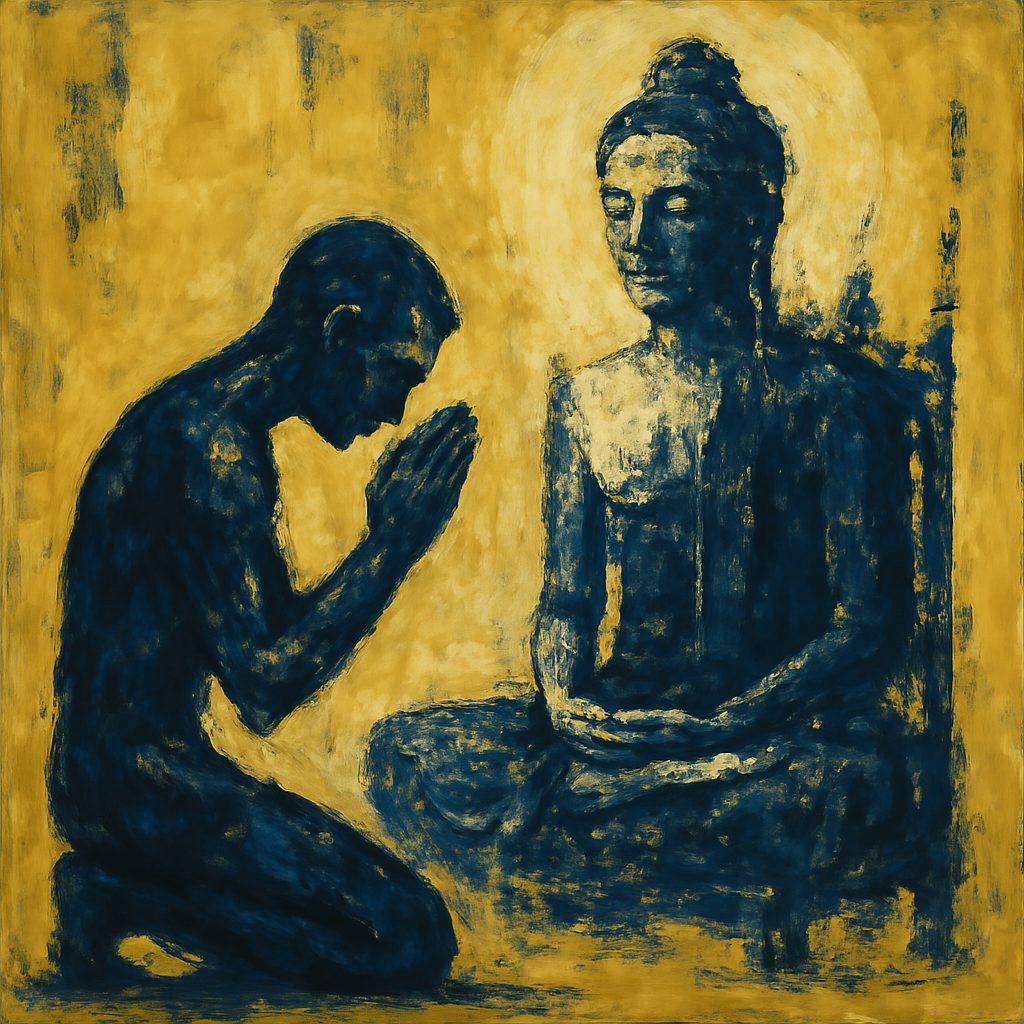
Most claim to have glimpsed the divine return with words that struggle to hold the weight of such an encounter. Many never return at all. To see the face of God and live is to step beyond the boundary where existence dissolves, where the self is unmade, and where reality, as it was once known, folds into itself like a dream dissolving at dawn.

Yet, what does it mean to see the face of God? Is it an experience of light so blinding that perception shatters? Is it a presence so vast that identity collapses? Or is it something even more elusive – something that was always here, hidden in the folds of ordinary awareness?

Some traditions warn against such an encounter, suggesting that no mortal can bear it and remain intact. Others speak of it as the ultimate reward, the final unveiling before absolute union. Yet, the paradox remains: how can one see the source of all things when the very act of seeing implies separation?

The face of God is neither a thing to be seen nor an object to be grasped. It is not found by looking outward or inward, for it is the very looking itself. The one who searches, the act of searching, and the sought-after presence all collapse into a singularity where distinctions dissolve. The moment of recognition is not a discovery but an obliteration – the end of every illusion that once passed for truth.

To live beyond such an encounter is to live without the weight of selfhood as it was once known. The personal dissolves, yet presence remains. There is nothing left to hold onto, yet nothing is missing. Some might call this madness. Others, liberation. But labels fall apart before the silent immensity of what remains.

Those who have seen and lived do not return with doctrine. They do not bring commandments carved into stone or revelations bound in pages. They return with an absence, a quiet, an emptiness more alive than any presence. And in that emptiness, a love beyond measure, a freedom beyond desire, and a knowing beyond thought.

Not all will understand. That, too, is part of the design.

Morgan O. Smith

Yinnergy Meditation/Neurofeedback, Spiritual Life Coaching & My Book, Bodhi in the Brain…Available Now!

https://linktr.ee/morganosmith

The Love That Sees No Other

Love often carries conditions. It bends and shifts based on who stands before us, what they have done, and how they fit within our narratives. But what happens when love is no longer filtered through preference, judgment, or familiarity? What happens when love is not reserved for a select few but moves through everything, as everything?

The idea of loving everyone and everything as you love yourself is not about adopting a passive, all-accepting sentimentality. It is a radical act that dissolves the illusion of separateness. To love in this way is to recognize no fundamental difference between self and other, between what is cherished and what is feared, between what is understood and what is unknown.

Many believe they love themselves, but beneath the surface, self-love is often conditional. It thrives when things go well but falters in moments of doubt and suffering. If love for oneself is inconsistent, how can it extend unconditionally to others? This is where the real work begins – not in forcing affection but in dissolving the barriers that obscure the truth.

Love does not seek control. It does not require agreement. It is not contingent upon behaviour, belief, or shared experience. Love, in its purest form, simply is. To embody this means relinquishing the mind’s tendency to divide reality into worthy and unworthy, friend and foe, sacred and mundane.

Walking through life with this kind of love does not mean tolerating harm or ignoring injustice. It means meeting everything with the clarity that nothing stands apart from you. Love can take the shape of tenderness, but it can also be fierce, clear, and unwavering. To love everyone and everything as yourself is not to abandon discernment – it is to see beyond distortion, beyond fear, beyond the illusion that anything is truly separate from anything else.

This is not an instruction to be followed. It is an inquiry to be lived. How does love move through you when nothing is excluded? When no one is outside its reach? When the self dissolves into the vastness of Being, what remains but love itself?

Morgan O. Smith

Yinnergy Meditation/Neurofeedback, Spiritual Life Coaching & My Book, Bodhi in the Brain…Available Now!

https://linktr.ee/morganosmith

Your Very Own Face

The Face of God Is Your Very Own Face Turned Inside Out

What if the divine is not something to be discovered but something to be remembered? Imagine that every search for the sacred is a quiet whisper urging you to turn your gaze inward—not as a way to find answers, but to dissolve the very questions themselves. The face of God is not hidden; it is simply turned inside out.

Consider for a moment the paradox of identity. We spend our lives constructing an idea of “self,” a fragile architecture built from memories, labels, and stories. This structure feels solid, yet beneath it lies a boundless vastness—a formless presence that defies description. That formlessness is the essence of God. It is not separate from you but exists as the very foundation of your being. When you turn yourself inside out, you don’t find something “other.” You find the unchanging witness, the infinite silence in which all of life unfolds.

The journey to realize this truth often feels like an unlearning. The more you let go of defining yourself, the closer you come to recognizing the divine nature within. It is not an external force judging or saving; it is the open awareness of experiencing life through your eyes, breathing life through your lungs, and yet remaining untouched by your stories of limitation.

This realization is not confined to moments of meditation or spiritual awakening. It reveals itself in the simplicity of everyday experiences—a child’s laughter, the stillness of a forest, or the quiet ache of longing. These glimpses call you to see that everything, including your own struggles and joys, is an expression of that infinite presence. The face of God is both the mystery and the mirror, reflecting your true nature beyond the constraints of identity.

The question is not how to find God, but whether you are willing to recognize that you are God remembering itself. This recognition is not a thought or a concept; it is a felt experience, a profound knowing that arises when the mind quiets and the heart opens.

As you turn your awareness inward, notice how the boundaries between self and other begin to blur. The separate “I” dissolves, and what remains is not just emptiness but fullness—an eternal oneness where the face of God and your own face are indistinguishable.

The invitation is clear: stop seeking and start seeing. The divine has never been elsewhere. It has always been here, waiting patiently as the silent witness of all that you are.

Morgan O. Smith

Yinnergy Meditation, Spiritual Life Coaching & My Book, Bodhi in the Brain…Available Now!

https://linktr.ee/morganosmith

The Self You’ve Disowned

We often approach the idea of God as something external—an omniscient force watching from a distance, a transcendent creator who governs the cosmos. Yet this perspective keeps us trapped in separation, perpetually seeking something outside ourselves to fill a void or grant us salvation. What if the very concept of God points to an aspect of our being, an ultimate reflection of the self we’ve denied?

This disowned self isn’t the egoic identity that clings to its limitations. We have forgotten how to access the essence of boundless awareness, a space of infinite potential and wisdom. To disown something is to exile it from consciousness. And what has been exiled? The unconditioned self is the aspect of us that sees through the illusions of individuality and recognizes its oneness with all existence.

When we strip away the layers of attachment, fear, and identification with form, what remains? The answer is not a void in the nihilistic sense but a fertile emptiness where the fullness of life reveals itself. This is the realm where the divine resides, not as a being separate from you, but as the highest level of yourself—a self too vast, too luminous, to fit into the confines of your limited perception.

The Psychology of Disowning God

Many disown this ultimate self because embracing it requires the dissolution of the ego. We cling to roles, stories, and identities because they provide a sense of control. Yet these constructs are fragile, built on the shifting sands of impermanence. To own the highest self—the God-self—is to release the need for control, to step into the unknown with trust.

This is why the concept of God can evoke discomfort or skepticism. It forces us to confront the parts of ourselves that resist unity. The fragmented mind would rather see divinity as “out there” than face the profound responsibility of embodying it. To own the God-self is to accept that you are both the creator and the created, the ocean and the wave.

Reclaiming the Disowned Self

Reclaiming this aspect of the self is not about achieving something new. It is about remembering. This remembering begins with stillness—a radical turning inward that allows you to see the divine as the very ground of your being. It is the quiet realization that you are not a seeker in search of God; you are God, awakening to itself.

This journey requires profound courage. To reclaim the self you’ve disowned is to face the shadows you’ve avoided, to embrace the paradoxes of existence. It is to see that what you once called “God” and what you once called “self” are not separate, but one.

This realization does not inflate the ego. On the contrary, it dissolves it. When you live from the awareness of the highest self, every action becomes an expression of divine will. Compassion flows naturally because you recognize every being as another facet of the same essence. Suffering transforms into a teacher, guiding you back to wholeness.

Living from the God-Self

To live from this understanding is to inhabit life with clarity and grace. Challenges no longer feel like punishments but invitations to deepen your alignment with the divine within. Relationships are no longer transactional but become mirrors reflecting the infinite back to you. Every moment becomes sacred—not because of what it contains, but because of who you are as you experience it.

This is the ultimate paradox: God is not something you find; it is something you become by realizing you were never anything else.

Morgan O. Smith

Yinnergy Meditation, Spiritual Life Coaching & My Book, Bodhi in the Brain…Available Now!

https://linktr.ee/morganosmith