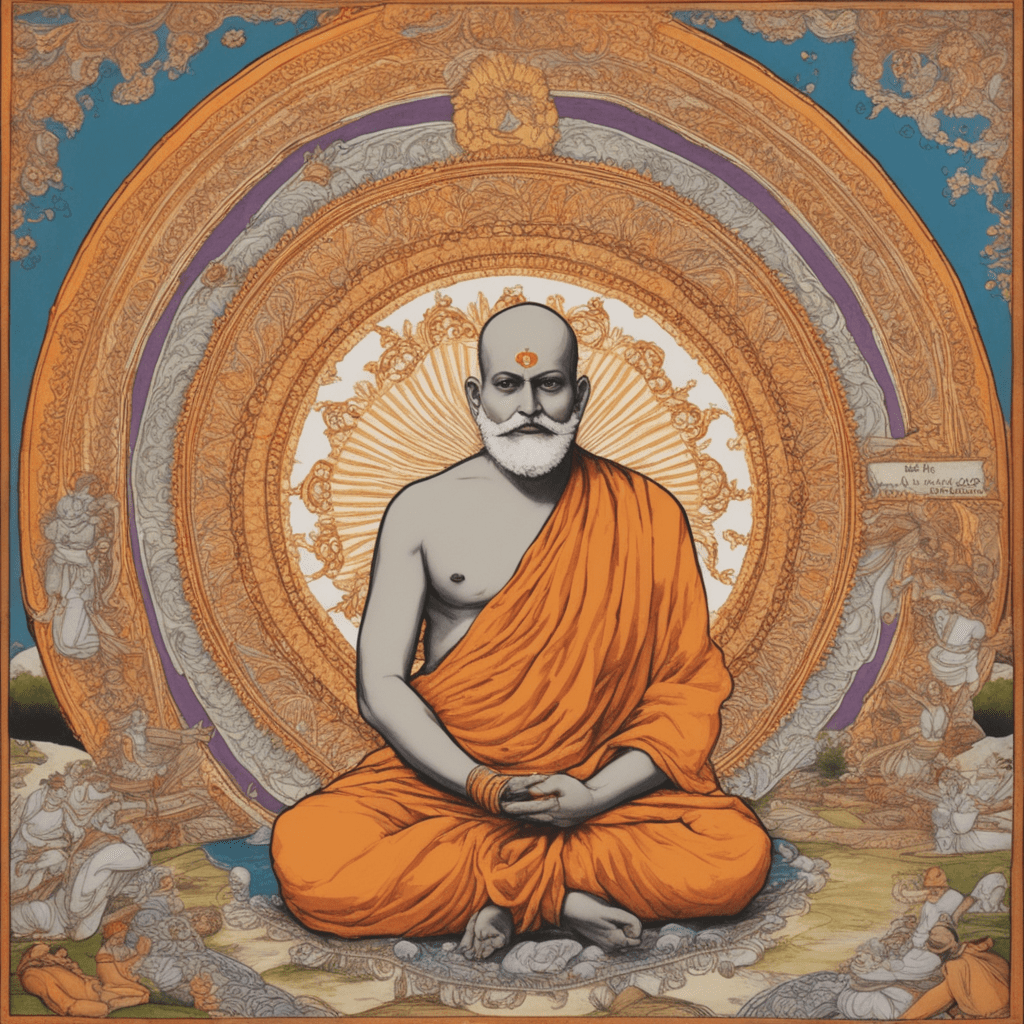
Absolute Monism

Unraveling the Tapestry of Oneness

The vast universe, with its manifold entities and infinite complexities, often bewilders human minds. Philosophers and thinkers from time immemorial have grappled with questions about the nature of existence and the ultimate reality. One profound idea that surfaces recurrently is that of Absolute Monism: the belief that beneath the apparent multiplicity, there is but one undivided reality. Let’s take a deeper look into this captivating worldview.

### A Universe from One Thread


At the heart of Absolute Monism lies the assertion that all differences and diversities we perceive are mere illusions. This assertion may seem contradictory to our daily experiences. After all, isn’t the world teeming with diversity?

Yet, this is where Eastern and Western philosophies converge. Ancient Hindu scriptures speak of *Brahman* as the ultimate, undifferentiated reality. The Hindu philosophy of Advaita Vedanta encapsulates this belief by stating that the world’s multiplicity, driven by *Maya*, is an illusion. Meanwhile, in the West, the philosopher Spinoza proposed that God and Nature are two names for the same reality, implying a singular, infinite substance. These ideas, separated by continents, come together to champion a singular reality beneath the apparent diversity.

### Seeing Beyond the Illusion

The concept of illusion is integral to understanding monism. In life, appearances can often be deceiving. A mirage in the desert, a rainbow after the rain, and even our reflection in the water are all illusions. If such simple things can deceive our senses, might it be possible that our entire perception of diverse reality is similarly mistaken?

*Mysticism* has been one avenue through which individuals across cultures have described experiences consistent with Absolute Monism. The interconnectedness of all things, a theme found in the tapestry of monism, speaks to the heart, nudging us to see beyond divisions and differences.

### Implications for Modern Times

If Absolute Monism holds that all is one, then what does this mean for us in the present age, surrounded by divisive forces and fragmented views?

Firstly, on an ethical plane, it implies that harm inflicted upon one is harm to the entirety. This perspective could drastically alter how we approach interpersonal relationships, environmental concerns, and global crises. If we truly internalize this philosophy, then every act of kindness and harm has far-reaching consequences.

Secondly, it brings to the fore the importance of self-realization. In many monistic traditions, the realization of this singular truth is the end goal, bringing about an end to suffering.

Lastly, it sparks curiosity about the nature of our universe. With advancements in modern physics and cosmology, we find theories that echo monistic thoughts. The Big Bang, for instance, suggests that everything we see, touch, and experience emerges from a singular point.

### Embracing Diversity within Unity

Absolute Monism does not negate the value of diversity. Rather, it calls for a deeper understanding. Imagine a tapestry. Up close, one can see the myriad of colours, textures, and patterns. But from a distance, it’s one cohesive artwork. Similarly, monism asks us to appreciate the individual threads while recognizing the grand design.

In an age teeming with division, perhaps the idea of Absolute Monism can be the bridge that reminds us of our interconnectedness. As we stand at the cusp of profound global challenges, this ancient philosophy might just hold the key to a unified, harmonious future.


Embracing the ideas of Absolute Monism requires introspection and openness. Whether you fully resonate with its tenets or not, it undoubtedly serves as a beacon, guiding us toward unity, understanding, and profound interconnectedness.

Morgan O. Smith

Yinnergy Meditation & My Book, Bodhi in the Brain…Available Now!
https://linktr.ee/morganosmith

Nonduality

Delving into the First Ten Meanings

**Introduction:**   
The term ‘nonduality’ has ancient roots, spanning across spiritual, philosophical, and scientific landscapes. Its depth is immense, often challenging the linguistic boundaries we’ve set. In this first of a three-part series, we’ll explore the initial ten meanings of nonduality.

**1. The Interconnectedness of All Things:** 
 
Everything in existence is interwoven, suggesting a universe that functions as one organism. This hints at a cosmic web where every action ripples across the vast expanse of existence.

**2. The Unbroken Wholeness of Existence:**   
No part of the universe is truly separate. We’re all fragments of an unbroken wholeness, seamlessly flowing into one another.

**3. Beyond the Concepts of Subject and Object:** 
 
In true realization, the perceived barrier between the observer and the observed fades, inviting a unified experience.

**4. Absence of Separation Between Self and Other:**   

The ego-driven distinction between “me” and “you” is an illusion. At our core, we arise from the same source.

**5. Reality Undivided by Conceptual Distinctions:**   

Our minds love categorizing, but reality, in its pure form, remains undisturbed by these conceptual labels.

**6. The Ground of Being Where Opposites Merge:**   

Contradictions and polarities find their reconciliation in this primordial ground, pointing towards a harmonious existence.

**7. A State Where Observer and Observed are One:** 
 
Pure awareness doesn’t differentiate. In moments of profound insight, the duality of perceiver and perceived collapses.

**8. The Essence That Remains When Duality Dissolves:**   
When the mind’s dualistic tendencies dissolve, what remains is pure, undifferentiated essence.

**9. The Primordial Nature of Consciousness:** 
 
Consciousness is the foundational fabric from which all dualities emerge and into which they dissolve.

**10. A Unified Field Transcending Dualistic Notions:**   
Beyond the quantum and cosmic scales, there might exist a unified field that transcends our dualistic understanding of reality.

**Conclusion:**   
These initial ten meanings provide a gateway into the vast landscape of nonduality. They beckon us to question our perceptions, beliefs, and understandings of the universe and our place in it.

Morgan O. Smith

Yinnergy Meditation & My Book, Bodhi in the Brain…Available Now!

https://linktr.ee/morganosmith

The Cosmic Symphony

Embracing the Process

In the grand tapestry of the universe, every thread is intricately woven to craft a masterpiece. The ebb and flow of life, its joys and sorrows, its peaks and troughs, are all deliberate strokes of an artist’s brush. We, as participants in this cosmic dance, often wonder if things are truly happening as they should. And if we were to delve deeper into the nature of existence, we might find that everything indeed is unfolding just as it was meant to.

Have you ever caught yourself amidst a moment of contemplation, thinking about the choices you’ve made or the path you’ve walked? What if every decision, every hesitation, every triumphant leap was not just a product of your will but was predestined to occur? This thought might be overwhelming, but it offers a comforting embrace. It suggests that there’s a meticulous design in the seeming chaos around us.

At the heart of this realization lies the concept that you are both the cause and the effect. Imagine a pond – you are the pebble that causes the ripple, and simultaneously, you are the waves that radiate outward. Your actions, thoughts, and emotions all have consequences that shape the universe, just as the universe, in turn, shapes you.

Now, some might question, “What of free will? Do we not possess the agency to shape our destiny?” This is where the paradox of existence comes into play. Our free will is an essential part of the universe’s design. It’s not an either-or situation; it’s a harmonious blend of fate and choice. Our choices, even when they seem entirely spontaneous or defiant, are the universe expressing itself. And that expression, in its entirety, is perfection.

But what if we doubt? What if we find it hard to trust this process? Well, even that skepticism is a part of the plan. It’s through questioning that we often find clarity. Through doubt, we often find faith. And through resistance, we often find our true path.

In the vastness of the cosmos, it’s easy to feel small, to feel like our existence is but a fleeting moment. Yet, when we embrace the idea that every moment, every emotion, every challenge, and triumph is as it should be, we recognize our infinite significance. We become co-authors of the universe’s story, and we begin to trust not just the process but ourselves within it.

So the next time you find yourself in contemplation, remember: that everything is happening perfectly. You are both the artist and the canvas, the song and the singer, the cause and the effect. Embrace your role in the cosmic dance and know that every step, misstep, twirl, or pause is a note in the symphony of existence.

Morgan O. Smith

Yinnergy Meditation & My Book, Bodhi in the Brain…Available Now!
https://linktr.ee/morganosmith

The Weight of the World and the Path to Spiritual Awakening

In the vast expanse of our human journey, there are moments of profound weight, where one feels as if they are carrying the burdens of the entire world upon fragile shoulders. This weight, often elusive and ineffable, is the manifestation of our ego, the culmination of our personal experiences intertwined with the collective unconscious of humanity.

Such weight can be overwhelming, sometimes akin to bearing witness to all of the human pain, suffering, and dark episodes of our shared history. Yet, it is said that we are never burdened with more than we can bear. This assertion, though challenging to grasp especially in our moments of despair, points towards a greater purpose – the evolution of the soul.

Those who endure and navigate through this weight, emerging on the other side of its crushing force, often find themselves transformed. The ego, once the dominating force, begins to dissolve, making way for a purer, more profound connection with the universe. This metamorphosis leads to humility, replacing pride and arrogance with an understanding that we are but a tiny fragment of the vast cosmos.

With this newfound humility comes a more receptive heart. Love, compassion, and empathy flow effortlessly, as the barriers that once separated us from others crumble. We begin to truly understand the adage, “Walk a mile in another man’s shoes.” This isn’t just about human-to-human connections; it extends to all life forms. We start recognizing the soul in every being, every flutter of a leaf, every chirp of a bird.

The ultimate realization, perhaps, is the true meaning of the age-old teaching, “Love thy neighbour as thyself.” It is not merely a call for kindness but a revelation that at the core, beyond the layers of ego and societal constructs, we are all one. There is no other; there is only us, interconnected and interdependent.

In conclusion, while the weight of the world can seem unbearable at times, it might just be the universe’s way of preparing us for a deeper connection, for a spiritual awakening that allows us to see beyond the superficial and truly embrace all that is.

Morgan O. Smith

Yinnergy Meditation & My Book, Bodhi in the Brain…Available Now!
https://linktr.ee/morganosmith

Horizontal and Vertical Nonduality

A Dance Between the Manifest and the Formless

Nonduality, a term often tossed around in philosophical and spiritual circles, is frequently misunderstood or oversimplified. But a deeper dive into its nuances, especially the concepts of horizontal and vertical nonduality, offers a rich tapestry of understanding that challenges our perception of reality. So, let’s embark on a journey between these two dimensions of experience.

**Horizontal Nonduality: A Symphony of Connection**

In the cacophony of life, amidst the myriad of forms, species, and people, there lies a silent song of unity. This is the realm of horizontal nonduality, where everything, regardless of its outer appearance, dances to the same rhythm, made of the same substance or essence.

This perspective is akin to viewing a vast ocean. On the surface, we see waves of various sizes and shapes crashing and retreating. They seem separate, each with its own identity. However, dive a little deeper, and one quickly realizes that all waves are part of the same vast body of water. Similarly, horizontal nonduality emphasizes the interconnectedness of all beings, revealing that the distinctions we observe are mere waves on the surface of a more profound unity.

**Vertical Nonduality: The Abyss of the Absolute**

Beyond the bustling dance of life and form, there lies an infinite silence, a void, a realm untouched by time and space. This is the territory of vertical nonduality. It speaks of an experience that transcends our worldly understanding, pointing towards an absolute reality that’s formless, timeless, and spaceless.

If horizontal nonduality is about recognizing the unity of the ocean’s waves, vertical nonduality is about plunging into the depths, where the concept of a wave doesn’t even exist. It’s about the direct realization that one’s true essence is beyond the ephemeral play of forms.

**Integrating the Two: A Holistic Dance**

While it may seem like these two dimensions stand at odds, a truly profound understanding of nonduality weaves them together in a harmonious dance. It’s neither about negating the beauty and diversity of the world (horizontal) nor about solely transcending it (vertical). Instead, it’s about holding both in a delicate balance.

Imagine living in a world where you can marvel at the beauty of individual snowflakes while being deeply rooted in the knowledge that they all share the same watery essence. This balance provides a holistic lens, allowing us to engage with the world with depth, compassion, and wisdom.

In conclusion, the dance between horizontal and vertical nonduality offers not just a philosophical perspective, but a transformative way of engaging with life. By understanding and integrating both these dimensions, we open ourselves to a richer, more profound experience of reality, where the play of forms and the formless essence coexist in a beautiful, harmonious symphony.

Morgan O. Smith

Yinnergy Meditation & My Book, Bodhi in the Brain…Available Now!

https://linktr.ee/morganosmith

The Quest for Ultimate Love

Embracing All of Existence

In the whirlwind of our modern lives, we often find ourselves in search of meaning, connection, and purpose. Among the most profound and enduring of human desires is the quest for love. But what if we were to redefine what love means to us? What if we were to aspire for the highest form of love – one that encompasses all sentient and non-sentient beings?

**Sentient Beings: A Conscious Connection**

When we think of love, our minds often gravitate towards the sentient – our family, friends, pets, and even strangers. These are beings with consciousness, feelings, and experiences. To love them means to understand them, to empathize with their pain, joy, and struggles. It means to extend compassion even when it’s challenging, to forgive even when hurt, and to be there even in silence. Loving sentient beings is to recognize the spark of life that we share, the thread of existence that connects us.

**Non-Sentient Beings: Beyond The Obvious**

On the other hand, loving non-sentient beings may seem a tad more abstract. How do we love a rock, a gust of wind, or a droplet of water? It’s about cherishing the interwoven tapestry of life. Every element, no matter how inanimate it might seem, plays an essential role in our existence. By loving non-sentient entities, we are acknowledging the importance of everything around us. We are recognizing that even the seemingly insignificant has its place in the cosmos.

**The Interconnectedness of All Things**

Loving both sentient and non-sentient beings brings to light an essential truth about existence – everything is interconnected. Nothing exists in isolation. The air we breathe, the water we drink, the ground we walk upon – all of it sustains us. Similarly, our actions, thoughts, and feelings reverberate through the vast web of life. By directing love towards every facet of existence, we are nourishing this web, strengthening our bond with the universe.

**Why Ultimate Love Should Be Our Life’s Goal**

Embracing ultimate love isn’t just about affection. It’s a conscious choice to see the world in its entirety, to appreciate the grandeur of existence, and to foster a deep sense of gratitude. This expansive perspective shifts our priorities, deepens our connections, and fills our lives with purpose.

As we journey through life, aiming for this boundless love ensures that we leave no stone unturned, and no heart untouched. The pursuit of ultimate love becomes a path to enlightenment, a journey toward understanding the true nature of existence.

In conclusion, to love all sentient and non-sentient beings with all our hearts is to experience the universe in its totality. It’s a clarion call to recognize the divine in the mundane and to elevate our human experience to a cosmic dance of love and connection. This, indeed, should be the goal of life. For in this love, we find not just the meaning of existence, but also its ultimate celebration.

Morgan O. Smith

Yinnergy Meditation & My Book, Bodhi in the Brain…Available Now!

https://linktr.ee/morganosmith

Agape

Embracing Universal Love for All of Creation

Introduction

In a world rife with division, turmoil, and individualism, the concept of Agape, or universal love, emerges as a beacon of hope and harmony. Rooted in various philosophical, spiritual, and religious traditions, Agape transcends borders, biases, and barriers, inviting us to embrace a love that binds all of creation. This blog post delves into the profound essence of Agape, its significance, and how it calls us toward a greater realization of our interconnectedness.

What is Agape?

Agape, often translated as “universal love” or “divine love,” represents a love that goes beyond the personal, emotional, or conditional. It’s a selfless love, free from judgment, that recognizes the inherent value and interconnectedness of all beings.

The Roots of Agape

The concept of Agape can be traced back to various traditions:

– **Christianity**: In Christian theology, Agape is the highest form of love, mirroring God’s unconditional love for humanity.
– **Buddhism**: Concepts like Metta (loving-kindness) reflect universal compassion and love for all sentient beings.
– **Hinduism**: Bhakti, the devotional love for the Divine, can be seen as a form of Agape that transcends worldly distinctions.

Agape in Everyday Life

The beauty of Agape is that it’s not confined to mystical experiences; it applies to our daily interactions. How can we embody Agape in our lives?

– **Seeing Beyond Differences**: Agape challenges us to recognize the common humanity in each other, regardless of race, religion, or nationality.
– **Cultivating Compassion**: Agape invites us to feel empathy for others’ suffering and respond with kindness and understanding.
– **Living Selflessly**: Embracing Agape means letting go of ego, self-interest, and judgment, allowing love to flow freely.

Agape and the Environment

Agape is not limited to human relationships. It extends to our relationship with nature and the environment. Recognizing the sacredness in all forms of life fosters respect and stewardship for the Earth.

Conclusion: The Transformative Power of Agape


Agape is more than a philosophical concept or mystical state; it’s a way of being. It calls us to expand our hearts, to love without conditions, to see the Divine in all, and to recognize our profound interconnectedness.

The journey toward Agape is not just a personal transformation; it’s a collective awakening. It heals, unites, and elevates our existence, turning love from a mere emotion into a universal principle that guides our lives.

In a world that often feels fragmented, the embrace of Agape offers a path toward wholeness and harmony. It’s not just a love for one another; it’s a love for all of creation.

As we contemplate Agape, we are invited to ponder: What would our world look like if we all lived with such love? How would it transform our relationships, our communities, and our very essence?

The answers to these questions may lie in the very heart of Agape, waiting for us to discover, embrace, and embody this universal love.

Morgan O. Smith

Yinnergy Meditation & My Book, Bodhi in the Brain…Available Now!
https://linktr.ee/morganosmith

Embracing Anatta and Sunyata

A Buddhist Exploration of Spiritual Enlightenment

In the rich and intricate fabric of Buddhist philosophy, two profound concepts stand out: anatta, or the principle of no-self, and sunyata, or the notion of emptiness. These ideas challenge our conventional understanding of self and reality, offering a transformative path to spiritual enlightenment.

This blog post delves into the fascinating journey of embracing anatta and sunyata and what changes might occur in a person as a result.

Anatta: The Principle of No-Self

Anatta challenges the notion of a fixed and permanent self, a radical idea that has profound implications on how we perceive ourselves and the world. Upon realizing anatta, an individual may undergo the following transformations:

– **Loss of Attachment to Self-Identity**: Labels, roles, and personal narratives lose their grip, allowing for a more fluid and adaptable understanding of self.
– **Decrease in Ego-Driven Desires**: The pursuit of personal gain or recognition may fade, replaced by selfless compassion and loving-kindness.
– **Deepened Interconnectedness with Others**: Seeing beyond the illusion of separate selves fosters a profound connection with all beings.

Sunyata: Embracing the Emptiness

Sunyata refers to the empty nature of all phenomena, a state where things are devoid of inherent existence. The realization of sunyata leads to:

– **Transcending Dualities**: Ordinary distinctions such as good and bad, self and other, become irrelevant, replaced by an all-encompassing view of reality.
– **Detachment from Material Pursuits**: Recognizing the empty nature of material things may lead to a detachment from worldly desires and a more mindful way of living.
– **Harmony with the Present Moment**: Seeing things as they are, empty of inherent existence, nurtures a profound connection with the present moment.

The Journey Toward Enlightenment


Understanding anatta and sunyata is not an intellectual exercise but a profound experiential realization. The individual may engage in various practices such as meditation, mindfulness, and ethical living to cultivate this understanding.

The Impact on Relationships and Society

Embracing these principles fosters compassion, empathy, and altruism, reshaping relationships and offering a model of social harmony. It moves us towards a society rooted in wisdom and compassion, rather than division and selfishness.

Conclusion

The realization of anatta and sunyata is a transformative and enlightening experience that shifts our perception of self and reality. It dissolves the barriers that separate us and leads to a more compassionate and interconnected way of living.

In a world filled with complexity and conflict, these age-old Buddhist principles offer timeless wisdom and a path to inner peace. They invite us to let go of rigid self-identities and material pursuits, to see beyond the surface, and to embrace a more profound and holistic view of existence.

May the teachings of Anatta and Sunyata guide us towards a more awakened and compassionate life, where we recognize the interconnectedness of all beings and live in harmony with ourselves and the world.

Morgan O. Smith

Yinnergy Meditation & My Book, Bodhi in the Brain…Available Now!

https://linktr.ee/morganosmith

Bridging Quantum Realms and Turiyatita

The Web of Interconnection

In the intricate and mystifying world of quantum mechanics, one phenomenon stands out as particularly thought-provoking: quantum entanglement. It’s a concept that defies our everyday logic, connecting particles across vast distances in such a way that the state of one instantly influences the state of the other. This interconnectedness, existing beyond space and time, might find an unlikely companion in an ancient spiritual concept: turiyatita, the attainment of spiritual enlightenment.

The Interconnected Universe

Quantum entanglement illustrates how, at the fundamental level, all things in the universe are interconnected. This idea resonates with spiritual teachings across cultures that speak of the oneness of existence and the interconnectedness of all life. In Indian philosophy, turiyatita represents a state of consciousness that transcends the conventional realms of waking, dreaming, deep sleep, and even the transcendental state known as turiya. It’s a state of realization that everything is part of a singular divine essence.

Could these two concepts, one rooted in the cutting-edge science of quantum physics and the other in ancient spiritual wisdom, have something to say to each other?

A Metaphor for Enlightenment


Quantum entanglement could be seen as a metaphor for the experience of spiritual enlightenment. The entangled particles, seemingly separate but inherently connected, might symbolize how everything in existence is part of the same cosmic dance. Likewise, the experience of turiyatita transcends the illusion of separateness, revealing an underlying unity.

In this metaphorical sense, the realization of enlightenment could be likened to experiencing the world in its entangled state, where divisions melt away and a profound interconnectedness is revealed.

A Dance of Mystery

Yet, the relationship between quantum entanglement and turiyatita is more than a simple analogy. Both concepts challenge our conventional understanding of reality. They both hint at a world far more complex and interconnected than our ordinary senses can perceive.

Is it possible that these two ideas, one from the realm of science and the other from the domain of spirituality, are glimpses of the same underlying truth? Is there a hidden dance of connection that plays out both in the microscopic world of quantum particles and the expansive world of human consciousness?

Conclusion

The connection between quantum entanglement and turiyatita may be speculative and metaphorical, but it invites us to ponder the profound mysteries of existence. It’s a reminder that the world is far more complex and beautiful than we often realize and that science and spirituality, seemingly disparate, might have something profound to say to each other.

This dance of connection between the physical and the metaphysical invites us to explore, wonder, and perhaps even transcend our conventional understanding of reality. It’s a poetic reminder that we are all interconnected, in ways that both science and spirituality continue to explore and celebrate.

Morgan O. Smith

Yinnergy Meditation & My Book, Bodhi in the Brain…Available Now!
https://linktr.ee/morganosmith

The Cosmic Symphony

Rethinking the Chain of Events

In the realm of philosophy, we often view the universe as a logical sequence of events where causes lead to effects, neatly arranging our reality into an orderly timeline. This classical cause-and-effect paradigm has long governed the way we think about the nature of existence. But what if we looked at this differently? What if cause and effect were more than just a linear progression from past to present to future?

## A Symphony of Causation

Imagine a universe where everything is in a constant state of becoming and dissolving, a universe where all causes are effects and all effects are causes. In this intricate web, each cause is simultaneously an effect, and each effect is a cause. A seemingly inconsequential event could trigger a chain reaction of unforeseeable consequences, while a major event could ripple back through time, shaping the past.

## The Non-Linear Universe

The idea that the future affects the present, and the present affects the past, is a profound shift from our linear understanding. It challenges our perception of time and the very nature of existence. This philosophical perspective acknowledges that the universe is not a static entity but a dynamic and ever-changing process, where creation and destruction happen at every moment.

### Creation and Destruction at Every Moment

In this paradigm, the universe is in a continuous process of creation and destruction, breathing life into every possibility and then allowing it to dissolve back into the cosmic fabric. This perspective invites us to consider our individual lives and events not as isolated occurrences but as part of an interconnected dance that shapes the whole universe.

Imagine a world where our actions are not merely consequences of past decisions but active participants in creating the future and reshaping the past. How would we act if we knew that every choice, every action, and every thought is both a cause and an effect in a never-ending cycle?

## Conclusion: An Invitation to a Deeper Understanding

By embracing this novel perspective of cause and effect, we can begin to see ourselves not as separate entities but as integral parts of a grand cosmic dance. This view challenges our conventional understanding, urging us to contemplate the dynamic, interconnected nature of existence.

As we ponder the nature of cause and effect, recognizing the interconnectedness of all things, we might find new insights into our place in the universe, our responsibility for our actions, and our potential to shape reality in ways we never thought possible.

The universe is not something that merely happens to us; we are active participants in its unfolding. As we move, so does the universe, and in that dance, we find our existence intertwined with everything else. It is a thought-provoking view that invites us to see ourselves and the universe in a new and profound light.

Morgan O. Smith

Yinnergy Meditation & My Book, Bodhi in the Brain…Available Now!

https://linktr.ee/morganosmith