
Awareness Without an Owner

Pure Knowing Doesn’t Need a Knower

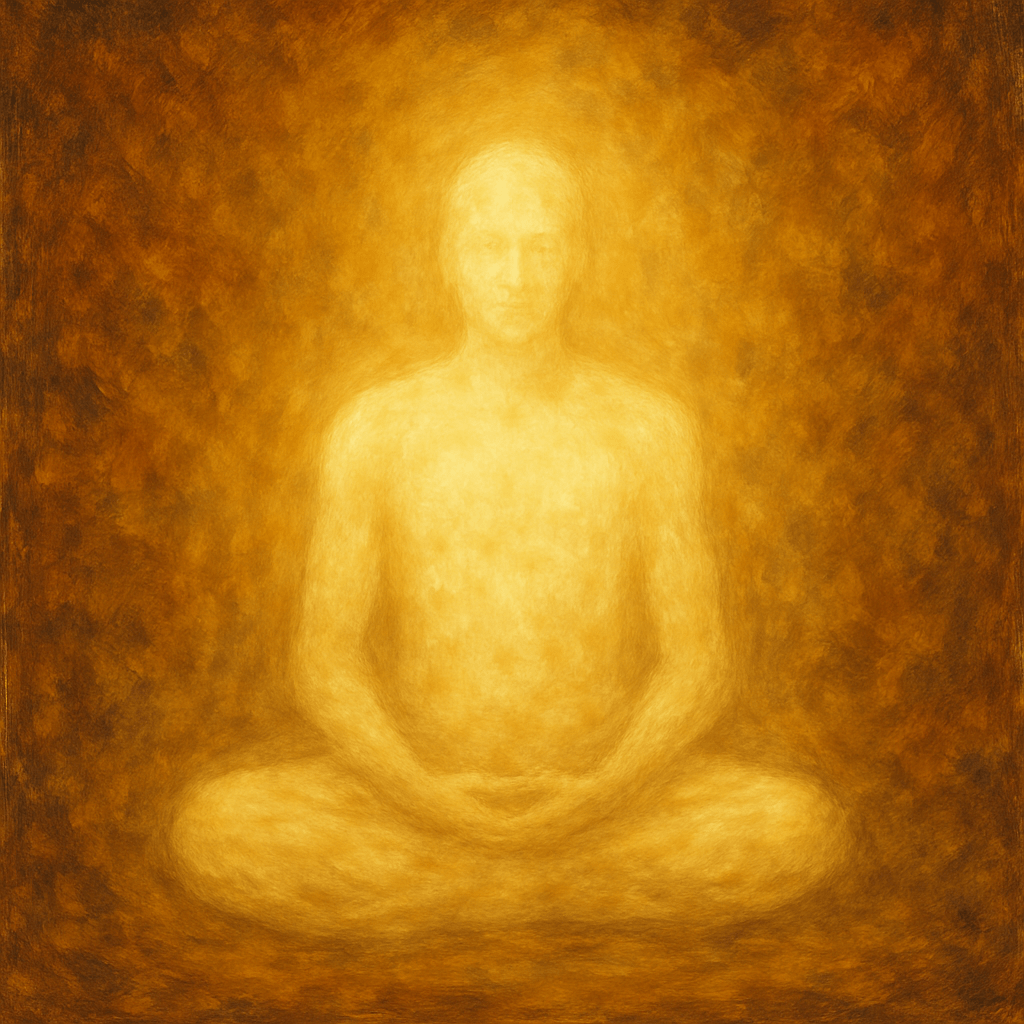
Pure knowing is not an act of someone grasping something. It is not the product of a subject meeting an object. It is not knowledge stored, processed, or owned. What we call “pure knowing” is an immediacy so complete that the categories of knower and known dissolve before they ever arise.

The mind insists there must be someone behind the recognition, a witness who stands apart. Yet such a witness is already a thought, an echo of division layered upon the seamlessness of awareness. The attempt to locate the knower is like searching for the horizon; you will find only a mirage created by perspective.

What reveals itself is astonishingly simple: knowing shines without support. No owner is required. No identity need arise. It is self-luminous, unmediated, without origin or destination. Thought may try to grasp it, but thought cannot enter here. The moment a “me” claims it, the purity is veiled, dressed in commentary, weighed down by explanation.

This does not deny the human experience of learning, remembering, and perceiving. It only points to the fact that beneath all those movements lies a ground untouched by them. That ground is knowing itself—silent, radiant, and free from the necessity of a knower.

To glimpse this is to taste liberation, not as a reward, not as a possession, but as the natural state that was never absent. What remains is not someone who knows, but knowing itself, unbroken and unclaimed.

Morgan O. Smith

Get Your Free Copy of My Book, Bodhi in the Brain!

https://subscribepage.io/oTSZQu

The Pathless Arrival

No Path Leads to What Has No Distance

The moment a seeker sets out on the path, a paradox quietly begins to unfold. Every step forward seems to promise arrival, yet what one hopes to reach has never been absent. The illusion of a distance to cross is what fuels the journey, and still, that distance does not exist.

Awakening is not a reward at the end of a road; it is the recognition that the road itself was always part of the illusion. The mind measures, compares, calculates progress, but the truth it seeks cannot be measured, compared, or progressed toward. Presence has no edge, no centre, no circumference. Nothing stands apart from it, nothing can be added to it, and nothing can be taken away.

Those who search often feel both exhaustion and longing, as if running toward a horizon that continually retreats. Yet horizons retreat only because they were never there to begin with. What is sought is closer than breath, closer than thought; it is what makes breath and thought possible.

To realize this is not to abandon the journey, but to recognize its true nature. Every path walked, every practice undertaken, every longing felt, each is a movement within what has never moved. The path is not a bridge toward truth but a gesture of truth itself, echoing as experience.

When this becomes clear, striving gives way to simplicity. Effort yields to intimacy. What you are searching for does not arrive because it has never been absent. No path leads to what has no distance.

Morgan O. Smith

Get Your Free Copy of My Book, Bodhi in the Brain!
https://subscribepage.io/oTSZQu

When “You” Disappear

God is not found in the layers of personality, beliefs, or self-image. Those dissolve the moment you step out of the illusion of “me.” What remains when the scaffolding of identity crumbles is not absence, but presence, vast, unconditioned, indivisible.

The struggle for most seekers lies in clinging to the idea of a separate self. Every attachment to who you believe you are, your story, your role, your wounds, creates the illusion of separation from God. Yet God has never been apart from you. God is what has always been here, quietly holding even your attempt to define God.

When “you” disappear, nothing is lost. What is left is clarity so immediate that it cannot be explained, only lived. It is a recognition that existence itself has no centre and no boundary. Every breath, every sound, every sensation reveals itself as the movement of the One Reality, free of your commentary.

This realization is not a grand acquisition; it is the collapse of the idea that there was ever anyone to acquire it. The vanishing of the personal self exposes a truth so intimate that it cannot be possessed. It is not “your” truth, it is truth itself.

To awaken to this is to discover that God was never hidden. God is not the object of your search, but the space in which the search appears and disappears. The seeker dissolves, and what remains is the unbroken light of Being.

Morgan O. Smith

Get Your Free Copy of My Book, Bodhi in the Brain!
https://subscribepage.io/oTSZQu

The Serpent’s Gaze

Awakening Through the Fire of Kundalini

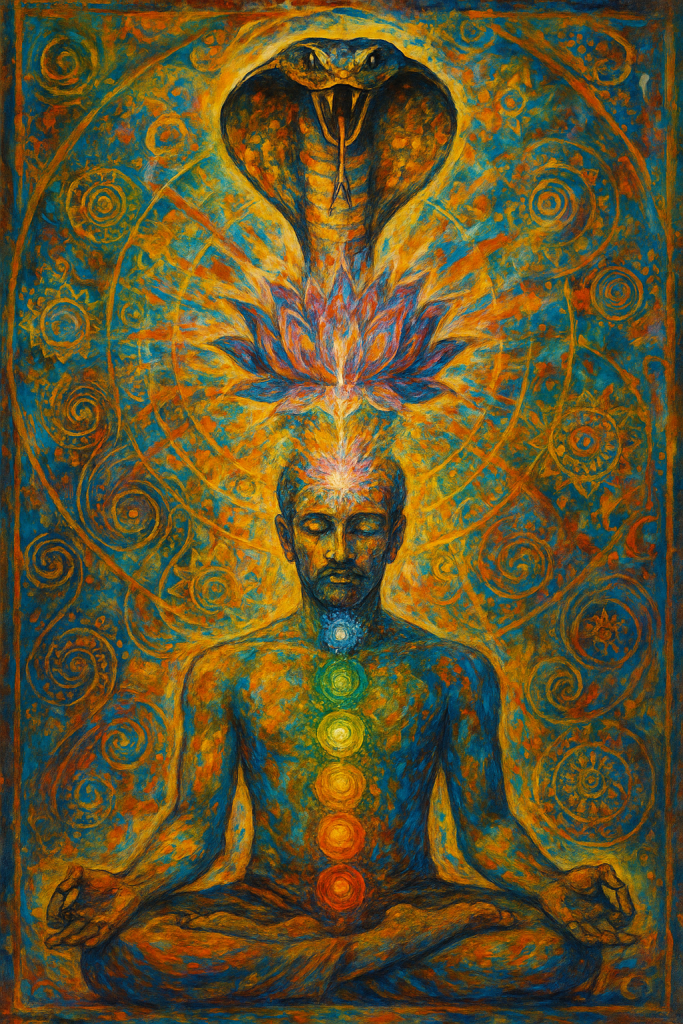
The surge of Kundalini energy does not arrive as a gentle visitor. It comes as a serpent rising, a King Cobra rearing its hood, carrying both the gift of awakening and the threat of annihilation. Those who encounter this force discover it is not a metaphor; it is a reality coursing through every nerve, every cell, as if the body itself were being rewritten from the inside out.

When this energy pierces upward through the spine and explodes through the crown, the encounter feels like a confrontation with divinity itself. The serpent turns its head, upside down, to stare directly at you. In that gaze is the paradox: vitality at its peak and the shadow of death standing closer than ever. The breath sharpens, the heartbeat quickens, and one realizes that this power could end everything in an instant—or transfigure it beyond recognition.

Many speak of spiritual awakening as blissful or serene, but the truth carries far more weight. The awakening of Kundalini is as much a dance with mortality as it is with enlightenment. To feel more alive than ever before is to simultaneously brush against the veil of death, because both are rooted in the same ultimate source. Death is not the opposite of life, but the threshold that life constantly leans against.

The serpent reminds us that awakening is not safe. It burns away illusions, sears through the fragile boundaries of identity, and brings us face-to-face with what cannot die. The brush with death is not punishment—it is initiation. To survive, it is to be reborn, no longer mistaking yourself for the limited frame of flesh and thought, but knowing yourself as the vast consciousness in which even death dissolves.

Kundalini does not ask for permission. It does not ask if you are ready. It rises, and in that rising, you discover whether you can hold its gaze without collapsing into fear. The courage required is not of the ego, but of the soul. To endure the serpent’s fire is to step into a reality that few dare to enter, where life and death are revealed as two faces of the same eternal current.

Morgan O. Smith

Get Your Free Copy of My Book, Bodhi in the Brain!

https://subscribepage.io/oTSZQu

Designed for Longing

The Gift of Dissatisfaction

Satisfaction often appears as a destination, something to be reached, secured, and held onto. Yet the moment one grasps it, a subtle hunger begins to stir again. The new job, the relationship, the recognition, the spiritual experience—all of it, no matter how profound or fulfilling, eventually reveals its transience.

What if this is not a flaw in human nature, but the very design of it? To never be fully satisfied is not a curse but a compass. It pushes us forward, beckoning us into deeper terrains of discovery, love, and creativity. The ache of incompletion is what keeps us alive to possibility. Without it, our spirit would stagnate.

Satisfaction is not the absence of desire but the willingness to engage with desire without being enslaved by it. To live in peace with dissatisfaction is to realize that fullness and emptiness coexist. The longing itself becomes a teacher, whispering that no object, achievement, or moment will ever be enough, because “enough” is not an endpoint, but an ongoing movement.

To accept this is to loosen the grip on perfection. You no longer demand that life provide a final fix, a permanent conclusion. Instead, you walk with the paradox: satisfaction arises from embracing dissatisfaction. The search for completion unveils the truth that nothing was missing in the first place.

The wisdom here is subtle. Contentment does not mean settling. It means seeing the beauty of being forever unfinished, of being shaped by desire but not consumed by it. Your very dissatisfaction becomes evidence that you are part of an unfolding reality, one that will never exhaust its depth.

Satisfaction lies not at the end of longing, but in the freedom to let longing remain.

Morgan O. Smith

Get Your Free Copy of My Book, Bodhi in the Brain!

https://subscribepage.io/oTSZQu

The Subtle Distinctions of Oneness, Nonduality, and the Sacred

To speak of oneness is to point to a direct perception where boundaries dissolve and all things merge into a singular whole. It is an overwhelming intimacy with existence itself—nothing stands apart, no subject or object remains. The experience carries a profound sense of union, yet it still acknowledges a felt “all” that has become “one.”

Nonduality, by contrast, is not the merging of things into one but the recognition that no separation ever truly existed to begin with. The very categories of “one” and “many” collapse. There is no subject perceiving unity, no object being unified—just the unbroken reality that precedes both. Here, the language of experience falters because even the notion of “an experience” implies duality between experiencer and what is experienced.

To call all things divine or sacred is yet another register. This perception imbues life with reverence, not only as one undivided whole but as shimmering expressions of the holy. Every moment, every being, every breath radiates significance. It is not merely that things are nondual, but that the nondual reality is inherently worthy of devotion. The sacred quality does not rest on belief; it is revealed when perception is refined enough to sense the luminous depth at the heart of being.

The distinctions are subtle, yet they matter. Oneness offers belonging. Nonduality uproots the illusion of separation. The sacred awakens awe and reverence for what is. Together, they sketch the contours of realization, each layer illuminating a different face of truth.

When all three—oneness, nonduality, and the sacred—merge seamlessly, a higher recognition dawns: absolute monism. Here, the whole of existence is seen as a single reality that is simultaneously one, beyond duality, and inherently divine. Nothing is outside of it, nothing is other than it, nothing is less than it. The boundaries of philosophy, devotion, and direct experience collapse into the same source. This is not a synthesis of perspectives but the revelation that they have always been expressions of the same truth. Absolute monism discloses the indivisible essence where belonging, emptiness, and holiness are not separate qualities but different ways of perceiving what is eternally and already the case.

Morgan O. Smith

Get Your Free Copy of My Book, Bodhi in the Brain!

https://subscribepage.io/oTSZQu

The Ecstasy of Knowing

When Mind and Soul Dissolve into One

The awakened mind, when met with the receptive soul, becomes a current of divine fusion—an alchemical embrace where thought and feeling cease to be separate. This union transcends the limits of sensation, unveiling a pleasure far beyond the fleeting intoxication of flesh. It is an ascent into boundless wisdom, an eroticism of consciousness where insight spills forth, saturating the ego’s constructs until they dissolve into the vastness of being.

This is not a mere intellectual encounter, nor is it an indulgence in sentimentality. It is the tantric interplay between awareness and presence, where the pulsation of knowing meets the depths of surrender. When the mind no longer dictates and the soul no longer pleads, a stillness emerges—a space so open that it drowns the self in its own infinity. Here, knowledge is not collected but revealed, not possessed but embodied. Love is not an attachment but an atmosphere, pervading every movement, every breath, every silent recognition of the one essence behind all things.

This is where tantra ceases to be philosophy and becomes direct experience. The dissolution of the personal into the infinite is neither loss nor gain but a return—one that neither seeks nor resists, neither holds nor lets go. It is the eroticism of the absolute, where wisdom penetrates the soul like lightning, setting fire to all that would obscure its radiance.

The lover and the beloved, the seeker and the sought, the knower and the known—these distinctions fade into the luminous vastness of pure being. And from this space, all that remains is the silent ecstasy of knowing.

Morgan O. Smith

Get Your Free Copy of My Book, Bodhi in the Brain!

https://subscribepage.io/oTSZQu

Did I Have a Spiritual Awakening?

If the question lingers, “Did I have a spiritual awakening?” it often points to a deeper truth: perhaps it has not yet happened. Those who have passed through the unmistakable shift into awakened awareness do not wrestle with that doubt. There is a quiet certainty, not born of belief, but of direct experience.

Language can vary. Some may never utter the phrase spiritual awakening or enlightenment. They may frame it through their own culture, symbolism, or personal metaphors. Yet no matter the vocabulary, the essence remains beyond question.

When the event has truly unfolded, it is like rising from sleep. You do not analyze whether you are awake; you simply are. The recognition is immediate, complete, and irreversible. What remains is the unfolding of life through the clarity of that seeing.

Awakening is not a theory to adopt or an idea to flirt with. It is the dismantling of the imagined self, the collapse of boundaries, and the revelation of a reality that was always here, quietly waiting to be noticed.

Morgan O. Smith

Get Your Free Copy of My Book, Bodhi in the Brain!

https://subscribepage.io/oTSZQu

Beyond Nonduality?

The Illusion of Going Further

Some spiritual teachers claim they have gone “beyond” nonduality, as if it were a stepping stone toward something greater. Yet the very notion of “beyond” creates an opposite, “before” or “within,” and the moment opposites arise, duality has returned.

Absolute monism allows for no such division. The singularity of reality does not exist as a point to be crossed or a boundary to be passed. It is not somewhere else, waiting on the other side of an imagined line. If you think you have travelled beyond it, you are still standing in the arena of conceptual thought, where the mind measures one thing against another.

In truth, the Absolute is not a destination, and it is not a stage in an unfolding ladder. It does not sit opposite to multiplicity; it holds multiplicity and its absence equally. It neither favours unity nor rejects separation. Both “beyond” and “before,” both “within” and “without,” dissolve in the same undivided field.

What remains is not something that can be claimed, owned, or transcended. It is self-evident Being, the source and container of every movement, stillness, and paradox. You cannot reach it, because you never left it.

Morgan O. Smith

Get Your Free Copy of My Book, Bodhi in the Brain!

https://subscribepage.io/oTSZQu

The Hidden Genius Behind Laughing Yoga

When I first heard about laughing yoga, a practice where you deliberately laugh or even laugh silently within, it struck me as absurd. I dismissed it as theatrical, maybe even frivolous. Then I learned that OSHO had introduced it, and my skepticism deepened. What could possibly be the purpose of such a practice?

I come from a stand-up comedy background, having worked as a comedian for 12 years, 10 of those before I began meditating. One thing I know about laughter is that when someone hears a joke and laughs at the punchline, they must momentarily surrender a part of themselves. The ego’s protective shell, the facet of self concerned with judgment, insecurity, shame, and embarrassment, drops away in that instant. To truly laugh, one has to release these defences and embrace the moment without resistance.

This same mechanism operates on a far greater scale during a spiritual awakening. When the “cosmic joke” lands, it demands the complete surrender of all defences, along with the entire sense of self. The one who hears the punchline is the same one telling it, and in the moment of hysterical laughter, the separation between “comedian” and “audience” dissolves entirely. Sometimes, that laughter is so overwhelming it flows with unstoppable tears of joy, as if the heart itself is laughing through the eyes.

It’s in that context that OSHO’s laughing yoga makes profound sense. Perhaps it was never just about forcing a laugh, but about training the body and mind to tolerate joy without flinching, to let go of identity without panic. By practicing laughter, you prepare the psyche for the day it encounters the greatest punchline ever told.

Morgan O. Smith

Get Your Free Copy of My Book, Bodhi in the Brain!

https://subscribepage.io/oTSZQu