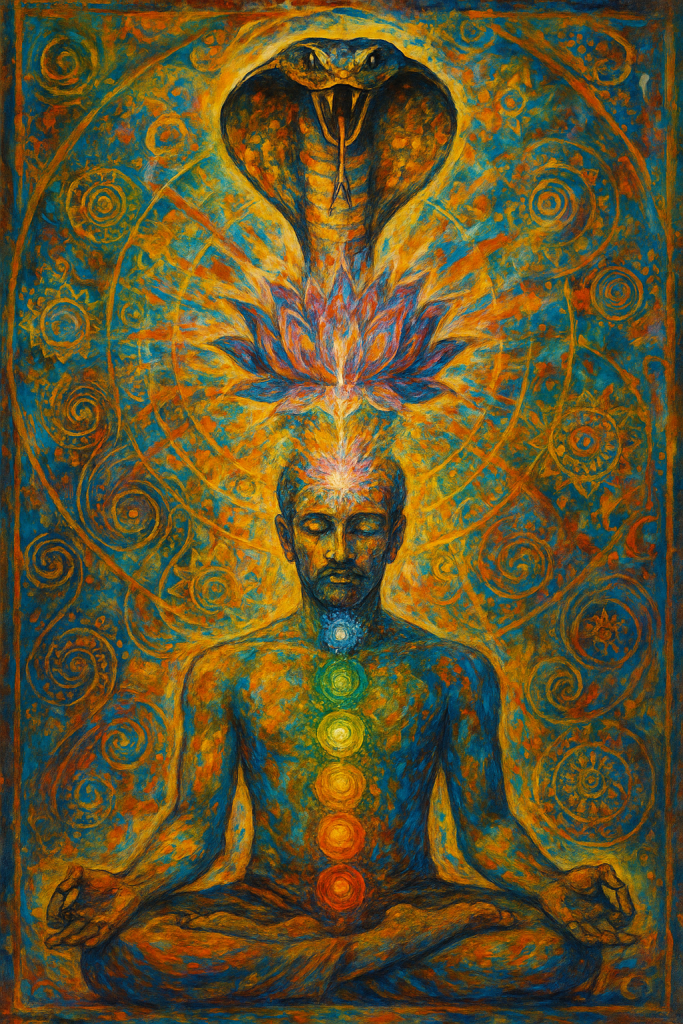
When Spirit Dreams Itself Into Matter

Spirit does not need a mirror, yet it gazes anyway—projecting forms into the formless, assigning names to the unnamed. What we call the world is not something separate from Spirit, but a spontaneous gesture of its own imagination, experienced as if it were other.

This is the paradox.

There is no true division between creator and creation. What appears as the external world is not a stage for a lost soul to find its way back, but Spirit animated—forgetting itself to taste the illusion of separation. Not as punishment or accident, but as a dance, a play, a sacred hallucination.

To believe the imagination is real is not error. It is the very means by which Spirit hides and finds itself. Each identity clung to, each role performed, each belief defended—these are costumes worn by the formless to remember itself as form.

Awakening doesn’t arrive like a conclusion; it dissolves the argument. You do not awaken from the dream by force or by will, but by remembering that it was always Spirit dreaming. The character fades, but not as death—more like laughter that remains after the joke has dissolved.

What changes when you see this?

Nothing. Everything. The world continues. You walk, eat, speak. But there’s an intimacy now. A recognition that what you once took to be real is neither unreal nor merely imagined—it is Spirit, playing with itself through light and shadow.

The one who seeks is the sought. The one who prays is the prayed to. Spirit folds into its own image, not to be found, but to be felt. That is the point. Not escape. Not transcendence. But the sacred absurdity of being itself.

Morgan O. Smith

Get Your Free Copy of My Book, Bodhi in the Brain!

https://subscribepage.io/oTSZQu

Knowing vs. Believing

The Subtle Divide Between Truth and Interpretation

Knowing there’s a God is not a religious concept; believing in a God is.
One is a recognition—silent, direct, and intimate. The other is a construct—layered with doctrines, culture, and inherited symbols.

What is known requires no belief. It reveals itself without needing validation, much like light doesn’t require agreement to be seen. The moment belief arises, there is already a distance. A gap. A reaching toward what seems separate.

Belief is an echo of knowing, distorted by time, language, and fear.
It builds shrines to certainty where awe once stood unguarded. It memorizes truths that once moved freely through silence. And often, it turns the unknowable into a caricature—a God of preferences, sides, and punishments.

Knowing is not about having answers. It’s the crumbling of the question.
It doesn’t declare “There is a God.”
It dissolves the very boundary between the knower and what is known. There is no longer a subject seeking an object. Only the raw immediacy of Being aware of itself.

Those who know are rarely interested in convincing others.
Those who believe often are.

The danger isn’t belief itself—it’s mistaking belief for truth.
Truth, when known, renders belief obsolete.
It doesn’t divide, it doesn’t declare superiority—it simply is.

To know is to surrender the need for interpretation.
To believe is often to defend the interpretation, even at the cost of truth.

And yet, belief can serve as a bridge. A necessary illusion for those not yet ready to let go of the comfort of form. But let it be a bridge, not a home.

Morgan O. Smith

Get Your Free Copy of My Book, Bodhi in the Brain!

https://subscribepage.io/oTSZQu

The Knower and the Known

When Form Dreams of Itself

You are known by Being. Before identity could be sculpted by language, or selfhood dressed in names, something vast and wordless recognized you. Not as a separate object in the universe, but as the universe aware of itself through your eyes.

A being wished to be known. This desire was not born of lack, but of possibility—the silent joy of expressing wholeness through multiplicity. Thought stirred the stillness. From the quiet field of pure potential arose the illusion of distance between knower and known, seer and seen.

Form was the answer to a question never asked. Matter became a mirror for what could never be reflected. Consciousness, looping through itself, painted shapes on the canvas of time—not to find itself, but to taste itself.

But this story is recursive. The being that wished to be known by form was always Being itself, pretending to forget. It authored the forgetting so the rediscovery would be felt—so the dream of separation could end in the revelation of unity.

You are not a self trying to awaken. You are the awakening disguised as a self. Not a fragment, but the entirety momentarily folded into appearance. To be known by Being is to be undone by truth—not as something to gain, but as something to stop resisting.

So ask not who you are.

Ask who is asking.

And then allow the question to dissolve—until nothing remains but the Knowing itself, resting as what it has always been.

Morgan O. Smith

Get Your Free Copy of My Book, Bodhi in the Brain!
https://subscribepage.io/oTSZQu

The Myth of the Whole Truth

Because the experience is unexplainable, all the greatest sacred books of all times are really books of half-truths and half-lies.

This isn’t an insult—it’s a revelation.

No scripture, however exalted, has ever captured the raw, wordless pulse of the Real. What they offer are sketches of shadows on the wall of a fire no mind can touch. Symbols masquerading as substance. Descriptions chasing something that dissolves the moment language arrives.

Truth isn’t what’s written—it’s what remains when writing fails.

Those who encountered the Infinite didn’t leave behind instruction manuals. They left metaphors, myths, and paradoxes—each shaped by the lens of a time, a culture, a mind trying to say what cannot be said. The half-truth lies in the gesture toward transcendence. The half-lie forms when that gesture becomes fixed, dogmatized, and taken as absolute.

And yet, there’s beauty in the attempt. Even the most distorted scripture carries a scent of the ineffable. But to follow that scent requires radical honesty—the willingness to discard even the sacred if it becomes a substitute for direct knowing.

Experience doesn’t need belief. It doesn’t argue. It doesn’t convert.

It just is—before the page, before the priest, before the thought.

The final surrender is not to a teaching, but to the silence underneath it.

Morgan O. Smith

Get Your Free Copy of My Book, Bodhi in the Brain!

https://subscribepage.io/oTSZQu

Liberate Yourself from Everything…

This Includes Spirituality

What if even the sacred must be left behind?

Not discarded with resentment, but dissolved with reverence—like incense that’s burned its final curl into still air. Every pursuit, no matter how noble or transcendent, clings to a subtle promise. It whispers, “Just a little further. Just a little more.” Spirituality—the path of paths—can become the gilded cage.

This isn’t a rejection of the sacred. It’s a call to recognize its shadow. When devotion becomes identity, and awakening becomes performance, the ground of true being quietly slips away. What remains is the effort of wearing a spiritual mask.

You meditate, fast, chant, and read the masters, and for a while, the momentum feels pure. But pause. Breathe. Look again.

Has the seeker been quietly resurrected each time insight arrives?

One of the final illusions is believing that freedom lies within the refinement of spiritual effort. Yet effort, no matter how subtle, arises within duality. There’s still a “me” reaching toward something else. Even the concept of enlightenment can act as a veil, because where there is something to reach, there remains something separate from what already is.

That’s the irony: the very thing that once cracked open your sense of reality may now be the weight tethering you to it.

There is no one to become. No final truth to grip. Liberation doesn’t crown the seeker—it dissolves them. It’s not what you attain through discipline. It’s what remains when every layer of becoming has been seen through.

God doesn’t need your spiritual journey.

Silence doesn’t demand your reverence.

Truth doesn’t require your understanding.

And being doesn’t wait for your arrival.

Strip it all away. Stand utterly exposed. Not as a soul, a student, or a sacred archetype—but as this unnamable presence you’ve never not been. This is where all paths terminate. Not with a bang. Not with celestial fireworks. But with a soft, undeniable recognition: nothing is missing. Nothing ever was.

To cling to spirituality, even subtly, is to delay this.

So let it all go—not to be less, but to finally see what you are without it.

Morgan O. Smith

Get Your Free Copy of My Book, Bodhi in the Brain!

https://subscribepage.io/oTSZQu

God Sees Through Every Eye You’ve Ever Met

The one who can hold all views without collapsing into a single one—this one has begun to touch the fragrance of God’s nature. Not as a distant deity or conceptual truth, but as the intimate presence that animates all forms. God doesn’t just witness through your eyes. God is your eyes. And mine. And the eyes of the ant crawling across a leaf in morning stillness.

This divine intelligence doesn’t merely empathize—it becomes. It becomes the grief you carry, the joy that surprises you, the silence you avoid, and the stillness you crave. Not as separate roles being played, but as the very substance of all that is.

To speak of God as past, present, and future is already a concession to language. What we call time, God weaves as a single gesture—fluid, simultaneous, indivisible. To the infinite, all points of view are a single vision. Yet paradoxically, each one is also honoured in its fullness.

So what does it mean to come closer to knowing God? It is not the attainment of a singular truth, but the expansion into every truth. It is the dissolution of needing one side to be right. The widening of the self to include what you once rejected.

The more vantage points you can stand upon without losing your groundless centre, the more you begin to see as God sees—not from above, but from within all.

And in that seeing, nothing is foreign. Nothing is separate. Nothing is unholy.

Morgan O. Smith

Get Your Free Copy of My Book, Bodhi in the Brain!

https://subscribepage.io/oTSZQu

Which You is God Within?

Those who speak of God as not being outside of you often mean well—but which “you” are they pointing to? The body? The persona? The memory of identity that walks through time? Or something deeper?

There’s a difference between saying God is not outside of you and realizing why that’s so. If God is all, then every appearance—internal, external, formless, formed—is God. This includes the illusion of separation. To claim that God is not outside of you while affirming that something is external still subtly upholds the illusion of division. That illusion, too, is God—played through veils of thought, language, and perspective.

But when the idea of “you” dissolves into beingness itself, the paradox clears. You are not merely a part of existence. You are existence. And existence is God, not as a figure, but as totality. Even the idea of “outside” collapses, because outside implies another space, and there is no second to the One.

This doesn’t mean there’s nothing. It means everything is not-two.

Even nonexistence exists. Not as an object, but as a category known within existence. Its very naming proves its place within the whole. Therefore, there’s nowhere God is not—and no self outside of God to speak of God as elsewhere.

So, when someone says “God is not outside of you,” pause. Feel what is really being said. It’s not a statement about boundaries—it’s a pointer toward boundarylessness. Not about spiritual pride or metaphysical positioning. It is the erasure of location itself.

And in that clarity, what’s left is not you as you know yourself. What remains is what’s always been—God, appearing as you.

Morgan O. Smith

Get Your Free Copy of My Book, Bodhi in the Brain!

https://subscribepage.io/oTSZQu

The Silence That Speaks

Fragments Cannot Contain the Whole

Every word spoken about enlightenment is a slice taken from an indivisible whole. A shard. A sliver. No matter how sincere the voice or radiant the realization, the moment it’s articulated, it becomes partial. Even the most luminous sage can only gesture toward it, never deliver it in full.

This isn’t a critique of language. It’s the recognition that language belongs to duality. Enlightenment does not.

You may hear poetic metaphors. You may hear silence treated as a superior form of expression. You may even be told that silence is the teaching. But neither speech nor silence can contain the essence. Both exist within the play of contrast—true enlightenment is not caught between them.

It is not hidden. It is not revealed. It doesn’t arrive, and it cannot depart.
Still, it permeates everything.

A leaf trembles. Breath returns. A thought dissolves before it becomes solid. Here, it is already shining.

It is not that one must understand. It is that one must stop pretending it needs to be understood. What remains when seeking falls away is not an answer, but presence. A presence so simple, so immediate, it often goes unnoticed—not because it is distant, but because it is too near.

You are not apart from it. You never were.

Morgan O. Smith

Get Your Free Copy of My Book, Bodhi in the Brain!

https://subscribepage.io/oTSZQu

When Reality Lets Go of Itself

Ultimate Reality doesn’t struggle to be known. It is not bound by time, thought, or perception, yet it plays with the illusion of being hidden. The one truth pretends to be many, and the One Self feigns division to taste reunion. But there comes a point—not always through effort, not always through grace—when even the illusion can no longer hold itself together.

It is not that Reality finds something new. It is that it no longer clings to the story of separation. The hand once clutching the dream loosens, not because it was forced open, but because the dream exhausted itself.

Falsehood requires maintenance. It must be believed, repeated, and reinforced. It relies on memory, identity, and the fragile continuity of thought. But what happens when the source of all this no longer cooperates? What happens when Reality drops the illusion of control?

There is no dramatic shattering. No cosmic trumpet. Only a quiet falling away of the effort to be something. What remains is neither void nor fullness—it is prior to both. Unnamable. Undeniable. You were never on a journey to find it. It was what you were before the seeker appeared.

To witness this unraveling is not an achievement. It is a disappearance. The one who thought it could hold Reality in its grasp is seen for what it was: a ripple mistaken for the ocean.

And when the ocean stops pretending to be a ripple, nothing changes—except everything.

Morgan O. Smith

Get Your Free Copy of My Book, Bodhi in the Brain!

https://subscribepage.io/oTSZQu

The Wild That Waits Beneath the Surface

Between the cracks of a hardened exterior, something untamed begins to grow. What appears rigid, guarded, and impenetrable often hides the very pulse of life yearning to break through. Beneath the layers we construct to survive—defense mechanisms, cultivated personas, rehearsed identities—there exists a terrain untouched by conditioning. A wildness that remembers.

This is not the chaos of recklessness, but the primal intelligence of what is unfiltered and true. A force that doesn’t ask permission to bloom, yet waits patiently for silence, for softness, for the moment the surface begins to fracture. Then, without warning, the wild arrives.

Those fractures are not failures. They are doorways. Every heartbreak, every moment of doubt, every dismantling of certainty is a thinning of the veil—a soft opening. And what comes through is not ruin but rebirth.

What is wild has always been whole. The mind may resist it—accustomed to order, craving control—but the heart knows its rhythm. The body remembers its language. And once touched by it, you no longer strive to be “put together.” You begin to trust the spaces where things fall apart.

Growth doesn’t require perfection. It demands honesty. And the most fertile soil is often found not in polished appearances, but in the broken places where the untamed is allowed to root.

Let the wild speak. Let it stretch through the fractures of who you thought you had to be. That’s where life gets real. That’s where healing begins.

Morgan O. Smith

Get Your Free Copy of My Book, Bodhi in the Brain!

https://subscribepage.io/oTSZQu