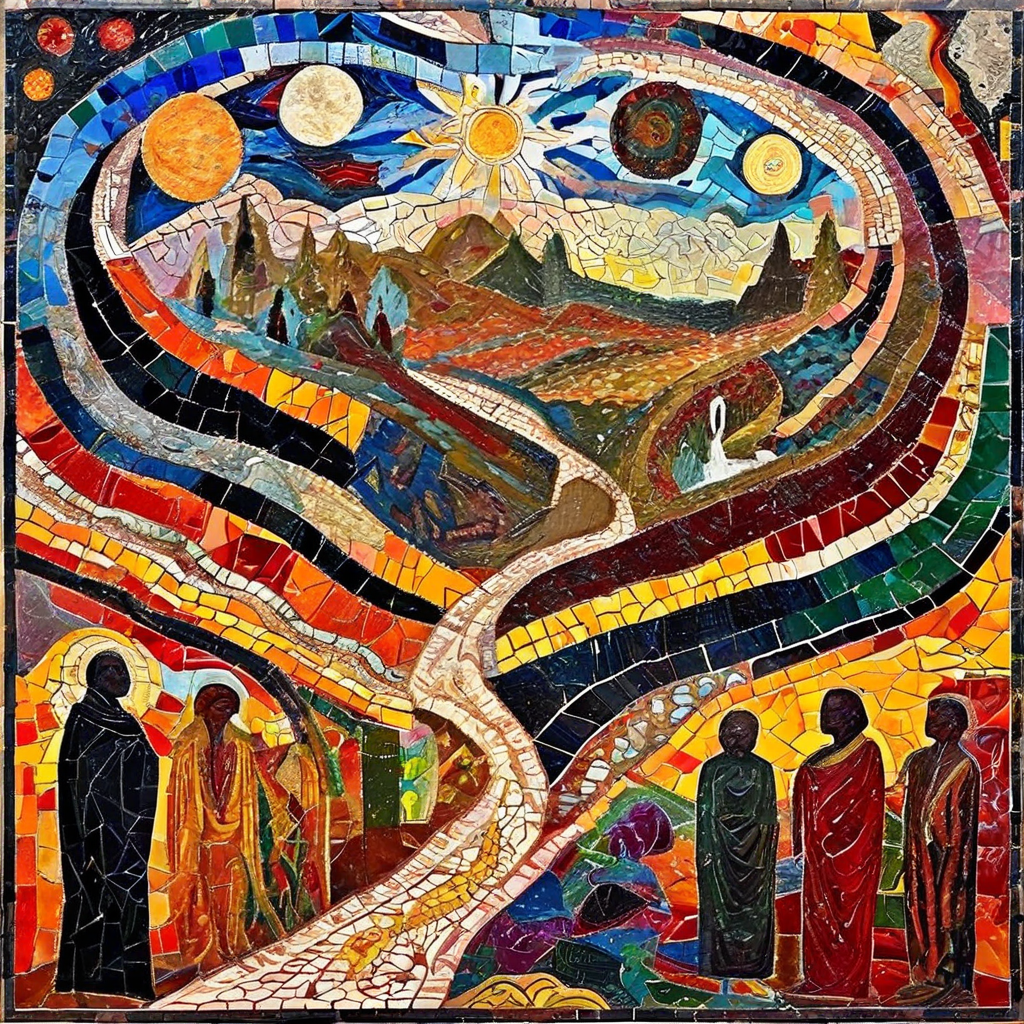
The Mosaic of Interpretations

Navigating the Perception of Ultimate Truth

In the vast landscape of human consciousness, the concept of Ultimate Truth stands as an immutable beacon, untouched by time and the flux of subjective experience. It is not the Truth itself that intrigues me, but rather the myriad ways in which individuals interpret and express it. This divergence in interpretation is where the true beauty and complexity of human experience lie.

The pursuit of Ultimate Truth is a journey that transcends the boundaries of culture, religion, and philosophy. It calls upon us to look beyond the surface of our conditioned beliefs and to delve into the depths of our consciousness. However, this journey is often clouded by personal biases, societal influences, and the limitations of language. Each individual’s interpretation of Truth becomes a reflection of their inner landscape, shaped by their unique experiences, perceptions, and spiritual inclinations.

In questioning these interpretations, we are not seeking to undermine the sincerity of one’s spiritual journey. Rather, we are engaging in a deeper exploration of the nuances that colour our understanding of reality. It is an invitation to recognize that our interpretations, no matter how profound, are still filtered through the lens of our perception. They are, in essence, a part of the grand mosaic of human consciousness, where each piece offers a distinct yet incomplete glimpse of the Whole.

This exploration invites a profound humility and openness. It encourages us to listen to the diverse voices that speak of Truth, not as competing claims, but as different facets of a shared journey toward understanding. By embracing this diversity, we move closer to an authentic dialogue that transcends dogma and opens the door to a more inclusive and compassionate worldview.

Moreover, this inquiry into the interpretations of Truth can lead us to a deeper appreciation of the paradoxical nature of existence. As we peel back the layers of our conditioned beliefs, we find that the Ultimate Truth is not something to be grasped or owned, but rather experienced as a living, dynamic presence that defies conventional categorization. It is in this space of not knowing, of embracing the mystery, that we find the most profound revelations.


In conclusion, the questioning of interpretations is not an act of skepticism, but of reverence for the ineffable nature of Ultimate Truth. It is a reminder that the journey is ongoing and that each step along the path is a vital part of the unfolding process. By engaging in this exploration, we honour the richness of the human experience and the boundless potential for growth and transformation that lies within us all.

Morgan O. Smith

Yinnergy Meditation, Spiritual Life Coaching & My Book, Bodhi in the Brain…Available Now!

https://linktr.ee/morganosmith

The Agnostic Awakening

Embracing Uncertainty on the Path to Enlightenment

In the profound journey of spiritual awakening, we often encounter paradoxes that challenge our deepest held beliefs and perceptions. One such paradox is the experience of becoming more agnostic in the face of genuine awakening. This isn’t agnosticism in the traditional sense, where one questions the existence of God or a higher power, but rather a subtler, more profound skepticism towards the very manifestations of reality itself.

When one delves into the depths of spiritual enlightenment, particularly through the lens of nonduality, there emerges a transformative recognition: the essence of all existence—what might be termed ‘nondual suchness’—is far removed from the everyday appearances and forms that we typically navigate. This realization propels the enlightened individual into a state of ‘knowing unknowingness’, where the certainties that once seemed so concrete now dissolve into the more fluid and elusive nature of reality.

In this agnostic awakening, the illusions of form and separateness that once defined our experiences become transparent. We come to see that the distinctions we make between ourselves and the world around us are mere conceptual conveniences, rather than absolute truths. This insight doesn’t lead to nihilism or despair, but rather to a liberating detachment from fixed views. It ushers in a fresh way of interacting with the world—more open, more curious, and infinitely more flexible.

The implications of this shift are profound for personal growth and spiritual practice. It encourages an ongoing inquiry into the nature of reality and our place within it, rather than a static acceptance of any doctrine or dogma. This state of open-ended exploration is what keeps the spiritual journey alive and dynamic, preventing it from becoming stagnant or dogmatically rigid.

In embracing this form of agnosticism, we’re not rejecting the notion of a deeper reality. Rather, we are refining our understanding of how that reality is revealed to us in our daily lives. We become more attuned to the mystery that pervades existence, more responsive to the subtle intimations of a truth that is always present, yet never fully graspable in conventional terms.

This nuanced approach to spirituality does not solve the riddles of existence; instead, it deepens our engagement with them, cultivating a wisdom that is comfortable with uncertainty and enriched by an ever-deepening wonder at the complexity of the cosmos.


Let us then celebrate this agnostic awakening as a significant milestone on the path to enlightenment, a reminder that true understanding resides not in the accumulation of knowledge, but in the humble acceptance of all that we do not know.

Morgan O. Smith

Yinnergy Meditation, Spiritual Life Coaching & My Book, Bodhi in the Brain…Available Now!

https://linktr.ee/morganosmith

Unraveling Synchronicity

An Intersection of Consciousness and Cosmos

In the vast expanse of existence, a curious phenomenon threads through the fabric of reality, manifesting as moments of profound connection and inexplicable coincidence. This phenomenon, known as synchronicity, defies the conventional understanding of time and causality, inviting us to explore a realm where the boundaries between the inner self and the outer world blur into nonexistence.

#### The Simultaneity of Existence

Imagine, if you will, a universe where all events, all instances of being, unfold not in a linear sequence, but in a simultaneous, all-encompassing now. Within this omnipresent realm, the past, present, and future coalesce, existing in an eternal moment. Synchronicity emerges at the intersections of these events, a visible stitch in the invisible fabric that binds the cosmos. It is the mind’s eye capturing not one, but multiple realities converging—a reminder of the interconnectedness of all things.

#### The Evolution of Perception


Synchronicity is not merely an external occurrence but a reflection of an inward evolution. As we grow and transform, so does our perception of the universe. This transformation is not confined to the mind alone; it extends to the brain, the nervous system, and beyond. It is a holistic metamorphosis that encompasses both the observer and the observed, blurring the lines between them.

With each shift in perception, our environment mirrors this change. It is as if the universe responds to our inner developments, adapting and aligning in synchrony. This reciprocal dance suggests that we are not merely passive spectators in the grand theatre of existence but active participants, co-creating the reality we experience.

#### The Interconnectedness of All

The concept of synchronicity challenges us to consider a more profound connection between the individual and the cosmos. It proposes that our inner transformations have a ripple effect, influencing not only our environment but the very essence of reality itself. This perspective invites us to view ourselves as both the cause and the effect, agents of change in an ever-evolving universe.

This understanding compels us to reconsider our place in the cosmos. We are woven into the very fabric of existence, with every thought, and every action, echoing into the vastness of the universe. Synchronicity serves as a reminder of our interconnectedness, not only with each other but with the cosmos at large.

#### In Conclusion

Synchronicity transcends the mundane, offering glimpses into the profound interconnectedness of existence. It challenges us to expand our understanding of reality, and to recognize the synchronous dance of the cosmos that unfolds within and around us. As we delve deeper into the mysteries of synchronicity, we discover that the key to unlocking its secrets lies within, our capacity to evolve and perceive the unity of all.

Let us embrace the journey of exploration, for in the mystery of synchronicity, we find not only the threads that bind the universe but also the profound truth of our interconnectedness.

Morgan O. Smith

Yinnergy Meditation, Spiritual Life Coaching & My Book, Bodhi in the Brain…Available Now!

https://linktr.ee/morganosmith

Maya Unveiled

Understanding the Illusion in Every Gaze

In the intricate dance of life, where perceptions and reality often intertwine, lies the ancient concept of Maya. Rooted deeply in Eastern philosophy, Maya is an idea and an expansive realm of understanding. It invites us to question: What is the true essence of what we perceive? How does the veil of illusion colour our view of the world?

**The Mirage of Perception**

Each moment, we are surrounded by a myriad of stimuli. As interpreters, our senses craft a version of reality that we accept as truth. But this truth is subjective, filtered through the lens of personal experiences, beliefs, and biases. In this way, the world we perceive is not an absolute, but a personal construct. Just as a painter brings forth a landscape from his imagination onto the canvas, we too paint our realities, often unaware that the brush is in our hands.

**The Nature of Maya in Daily Life**

Maya is omnipresent, influencing every aspect of our existence. It shapes our relationships, our joys, and our sorrows. Even our self-identity is a product of this illusion, a constructed narrative we cling to. The roles we play, the labels we adopt, are but temporary garments worn by the eternal self.


**Transcending the Illusion**

In the pursuit of spiritual awakening, recognizing the presence of Maya is a pivotal step. It is in understanding that what we perceive as concrete may indeed be ephemeral. Meditation and mindfulness practices serve as gateways to this realization. As we dive deeper into the realms of introspection, we begin to distinguish the impermanent from the eternal, the illusory from the real.

**Integrating Maya into Enlightenment**

Embracing Maya does not mean rejecting the world. Instead, it involves seeing through the veil, and acknowledging the illusion while engaging with the world. It is about finding harmony between the spiritual and the material, understanding that even in illusion, there is a purpose and a lesson.

**A Journey Beyond the Visual**

Our journey of enlightenment is not about negating our experiences but about transcending their limitations. It involves expanding our consciousness beyond the confines of personal perception, into a space where unity and diversity coexist, where the duality of self and other dissolves.


**Conclusion**

Maya, often misunderstood, is not a barrier but a bridge. A bridge that leads us to question, to seek, and ultimately to understand the profound nature of existence. In every distorted view lies a hidden truth, waiting to be uncovered by the earnest seeker.

Morgan O. Smith

Yinnergy Meditation, Spiritual Life Coaching & My Book, Bodhi in the Brain…Available Now!

https://linktr.ee/morganosmith

Embracing Falsehoods at the Pinnacle of Awareness

In the realm of human consciousness, there exists a fascinating paradox. At the highest level of awareness, a person can reach a state where they can believe in something, fully aware that it is not true. This peculiar aspect of human psychology offers a deep insight into the nature of belief, perception, and the human mind.

What does it mean to believe in something while knowing it isn’t true? It’s like willingly suspending disbelief while watching a movie. You enter into a contract with the fiction, fully aware that dragons don’t exist or that superheroes don’t fly, yet you allow yourself to believe in these concepts for the duration of the experience. This phenomenon isn’t just limited to entertainment but extends to the very core of our everyday lives.

Why do people engage in such seemingly contradictory behaviour? The answer lies in the complexity of the human mind and its quest for meaning and comfort. Beliefs, even those acknowledged as false, can provide a sense of comfort, belonging, or identity. They can be a source of inspiration or a means of coping with the harsh realities of life. In a world that often feels chaotic and unpredictable, these beliefs, however, detached from reality, can offer a sense of order and purpose.


This ability to believe in the unbelievable highlights the power of the human imagination and creativity. It’s a testament to our ability to envision worlds and possibilities beyond our immediate reality, a skill that has been a driving force behind art, literature, and scientific innovation. It allows us to explore ideas and scenarios that, while not real, can lead to real-world insights and advancements.

However, this power comes with a responsibility. While it can be enriching and beneficial, deliberately believing in falsehoods can also lead to dangerous delusions and collective harm if not approached with critical thinking and ethical considerations. It’s vital to find a balance, to know when to embrace these beliefs as a source of inspiration and when to acknowledge them as mere constructs of our imagination.


In conclusion, the capacity to believe in something while knowing it isn’t true is a unique aspect of human consciousness, reflecting our complex psychology. It’s a powerful tool that, when used wisely, can enrich our lives and propel us toward greater heights of imagination and understanding. However, it’s crucial to navigate this terrain with discernment and a keen sense of reality.

Morgan O. Smith

Yinnergy Meditation, Spiritual Life Coaching & My Book, Bodhi in the Brain…Available Now!

https://linktr.ee/morganosmith

The Ground of All Being is Groundless

In the realm of philosophical thought, there exists a profound paradox that has puzzled thinkers for centuries: the concept that the ground of all being is, in fact, groundless. This idea challenges our fundamental understanding of existence, suggesting that the foundation upon which reality is built is devoid of any intrinsic substance or essence.

At first glance, this notion appears contradictory. How can the ground of all being, the fundamental basis of everything that exists, be groundless? To unravel this enigma, we must delve into the philosophical and metaphysical discussions that surround the nature of existence and reality.

The idea of a ‘groundless ground’ originates from existential and metaphysical debates. Philosophers like Heidegger and Sartre pondered the absence of an inherent essence in existence. This absence implies that existence precedes essence, meaning things exist first and their meanings or purposes are secondary, shaped by external factors rather than intrinsic qualities.


This perspective shifts the way we perceive reality. Instead of viewing the universe and everything in it as having a predetermined purpose or essence, we begin to see existence as a blank canvas. Our perceptions, experiences, and the meanings we assign to things shape this canvas. In this sense, the ‘ground’ of all being is not a pre-established foundation but a dynamic, ever-changing tapestry of experiences and interpretations.

Moreover, this idea resonates with quantum physics, where the most fundamental levels of matter behave in ways that defy traditional laws of physics. Particles exist in states of potentiality, their positions and velocities are determined only when observed. This uncertainty at the heart of matter echoes the philosophical concept of a groundless ground, suggesting that at the most fundamental level, the universe itself may not rest on any fixed foundation.

The implications of a groundless ground are both liberating and daunting. It frees us from the constraints of preordained meanings and purposes, allowing us to shape our existence. However, it also places the responsibility of finding or creating meaning squarely on our shoulders.


In conclusion, the concept that the ground of all being is groundless invites us to explore the depths of our existence. It challenges us to seek meaning and purpose not in some inherent essence but in the experiences and interpretations that shape our reality. This exploration is not just a philosophical exercise; it is a journey into the heart of what it means to be.

Morgan O. Smith

Yinnergy Meditation, Spiritual Life Coaching & My Book, Bodhi in the Brain…Available Now!

https://linktr.ee/morganosmith

The Divine Fraud

The Hidden Reality Behind Spiritual Leaders

In the realm of spirituality, there exists a profound paradox. We often elevate spiritual gurus, admiring them from afar, or aspiring to emulate them. However, there’s a hidden truth behind these figures, one that challenges our conventional understanding of enlightenment and spiritual wisdom.

At the heart of this paradox lies the notion that these spiritual leaders are not entirely what they appear to be. Rather than being purely enlightened beings, they are, in fact, individuals who have reached a heightened state of awareness but choose to present themselves in a manner that is palatable to the masses. This disguise is not a deception borne out of malice, but rather a necessary adaptation. It stems from the understanding that the true nature of their enlightenment is beyond the grasp of the average individual, whose comprehension is bounded by societal norms and limited perspectives.

These spiritual figures have embraced a role – a caricature of what society accepts as ‘divine’. They mirror the layman’s archetype of enlightenment, embodying concepts of goodness, truth, and beauty that are digestible and appealing to the general public. This role-playing is not a sign of their failure to embody true enlightenment, but rather a testament to their deep understanding of the human psyche and the limitations of societal acceptance.


In this grand act, the enlightened beings find joy. They are not shackled by their roles but rather play them with purpose and hope. Their ultimate aspiration is not to perpetuate the illusion but to guide others to a realization – that enlightenment is not about fitting into a preconceived mould of divinity, but about understanding and transcending the limitations of our perceptions.

The divine fraud, thus, is not a deceit but a necessary guise. It is a bridge between the incomprehensible realm of true enlightenment and the tangible world in which we live. The hope is that one day, each of us will see beyond this facade, not with a sense of betrayal, but with an understanding that enlightenment is a deeply personal journey, one that transcends the need for external validation and societal acceptance.


In conclusion, the journey toward spiritual enlightenment is not about emulating a perceived ideal but about realizing the limitations of our understanding. It is about peeling back the layers of societal norms and personal biases to uncover a truth that is uniquely our own. As we navigate this path, we must remember that the spiritual guides we look up to are not just torchbearers of enlightenment but also skilled actors playing a role necessary for our journey.

Morgan O. Smith

Yinnergy Meditation, Spiritual Life Coaching & My Book, Bodhi in the Brain…Available Now!

https://linktr.ee/morganosmith

Beyond Labels

A Journey Through the Essence of Nonduality

In a world quick to cast judgment and affix labels, my exploration of nonduality has often been met with skepticism and disdain. Accusations of being “crazy,” “insane,” and “delusional” are hurled at me through social media, texts, and even face-to-face encounters. Yet, such reactions prompt me to question the very foundation of belief and perception in our society.

Consider for a moment the myriad of beliefs that have shaped human history and consciousness. How many individuals hold steadfast to the notion that the earth was crafted in seven days? Or that Eve emerged from Adam’s rib? Legends of Moses parting the Red Sea, Elijah ascending to heaven in a chariot of fire, Jonah’s survival within a whale, and the virgin birth and resurrection of Jesus Christ are not merely stories but are cornerstones of faith for countless people. These narratives, alongside the belief in entities like Satan or the practice of praying to an unseen force, might seem irrational or imaginary to some, yet they are deeply ingrained in the spiritual fabric of many cultures.


The juxtaposition of such beliefs against the skepticism faced by nonduality advocates raises a compelling question: Who, indeed, is the “crazy” one? This is not to disparage or belittle any set of beliefs but to highlight the subjective nature of sanity and rationality in the context of spiritual understanding. Nonduality, at its core, transcends the dichotomies of belief and disbelief, inviting a profound engagement with the essence of existence beyond the confines of conventional narratives.

Nonduality does not seek to undermine or replace traditional religious beliefs; instead, it offers a lens through which we might perceive unity in apparent diversity, seeing the interconnectedness of all things beyond the superficial separations imposed by language, culture, and individual perspective. It beckons us to explore the depth of our being, to recognize the intrinsic nature that we share with the universe itself.


The resistance faced by nondual perspectives is not a sign of their invalidity but a testament to their power to challenge and expand our understanding of reality. It is an invitation to dialogue, to introspection, and ultimately, to a more inclusive comprehension of the spiritual journey that encompasses all of humanity.

In embracing nonduality, we are not discarding the richness of diverse spiritual traditions but are deepening our engagement with the mystery that lies at the heart of existence. We are invited to witness the unfolding of life with an openness that transcends labels and judgments, recognizing that the true essence of spirituality cannot be confined to words or concepts.

So, as we navigate the waters of belief and skepticism, let us do so with a sense of curiosity and wonder, acknowledging that the quest for understanding is a path shared by all, regardless of the labels we may encounter along the way.

Morgan O. Smith

Yinnergy Meditation, Spiritual Life Coaching & My Book, Bodhi in the Brain…Available Now!

https://linktr.ee/morganosmith

Unveiling Reality

The Journey from Illusion to Truth

In our journey through life, we often come across what we call “illusions.” These are perceptions or beliefs that appear to be real but are not. However, the most profound realization is that these illusions are not mere deceptions; they are, in fact, Truth in disguise.

### The Nature of Illusion

An illusion, by its very nature, is something that deceives the senses or mind. It’s like a mirage in the desert – you see water, but as you approach, it vanishes, leaving you in the stark reality of the desert heat. Similarly, in life, we encounter situations that seem to be one thing but turn out to be another.

But here’s where it gets interesting. These illusions are not just errors or misperceptions. They are gateways to a deeper understanding of reality. When we delve into the nature of an illusion, we begin to uncover the layers of truth that it conceals.

### The Grand Illusion

The concept of the “Grand Illusion” takes this idea a step further. It suggests that our entire perception of reality might be an illusion. This is a theme explored in various philosophical and spiritual traditions. In Hinduism, for instance, Maya is the illusion that veils the true nature of the universe. In Western philosophy, Plato’s allegory of the cave talks about shadows on a wall that we take for reality.

The Grand Illusion is not just a deception; it is a representation of the ultimate truth, albeit in a form that we can’t immediately recognize. This truth is not something that can be easily explained or understood through conventional means. It is something that must be experienced and felt.

### Unveiling the Truth

So, how do we unveil the truth hidden behind these illusions? It begins with questioning our perceptions and beliefs. We need to look beyond what is immediately visible and ask ourselves what lies beneath. This process of inquiry and introspection leads us to a more profound understanding of ourselves and the world around us.

As we peel back the layers of illusion, we start to see the truth in its purest form. This truth might not be comfortable or easy to accept, but it is liberating. It frees us from the confines of our limited perceptions and opens us up to a universe of possibilities.


### Conclusion

The journey from illusion to truth is not a straightforward path. It’s a winding road filled with challenges and revelations. But it is a journey worth taking. For in understanding the Grand Illusion, we come closer to understanding the true nature of our existence and the universe we inhabit.

Morgan O. Smith

Yinnergy Meditation, Spiritual Life Coaching & My Book, Bodhi in the Brain…Available Now!

https://linktr.ee/morganosmith

Transcending the Mind

A Journey into the Realms of True Reality

In the labyrinth of human existence, there lies a profound truth that often remains hidden beneath layers of perception and thought: the essence of reality as it truly is, unfiltered and pure. This realization dawns only when the mind transcends its boundaries, stepping beyond the constraints of its conditioned patterns and habitual ways of thinking.

The mind, a magnificent tool for navigation in the physical world, is often shackled by its creations – thoughts, beliefs, and assumptions. These mental constructs, while useful, can also act as barriers, filtering and altering reality as it presents itself to us. The journey towards understanding true reality thus begins with a paradoxical task: using the mind to transcend the mind.

In this transcendence, one experiences a shift in perspective. What was once seen as absolute may reveal its relativity. The solid ground of ‘facts’ might turn into a dance of possibilities. This isn’t a disavowal of logic or reason, but an expansion of them. It’s an acknowledgment that reality, in its vastness, cannot be fully contained within the confines of human thought.

What emerges from this transcendental experience is a sense of profound connection. The boundaries that separate the self from the universe begin to blur. In this state, one doesn’t just observe reality; one becomes a part of it, engaged in a harmonious dance where the distinction between the observer and the observed diminishes. It’s a state where the ego dissolves, and in its place arises a sense of unity with all existence.

This journey is not about acquiring new knowledge but about unlearning what obstructs the vision of reality. It’s about silencing the incessant chatter of the mind to listen to the silence that speaks volumes. In this silence, reality reveals itself not as a concept to be grasped but as an experience to be lived.

As we embark on this journey of transcending the mind, we open ourselves to a reality that is more vivid, more alive, and infinitely more profound than our habitual ways of seeing can allow. It’s a journey from the illusion of knowing to the wisdom of understanding, from the confinement of the mind to the liberation of consciousness.

In this exploration, we find not just the essence of reality but also the essence of ourselves, as beings intrinsically connected to the vast, intricate tapestry of existence. We discover that in transcending the mind, we don’t lose ourselves; we find ourselves in everything.

Morgan O. Smith

Yinnergy Meditation, Spiritual Life Coaching & My Book, Bodhi in the Brain…Available Now!

https://linktr.ee/morganosmith