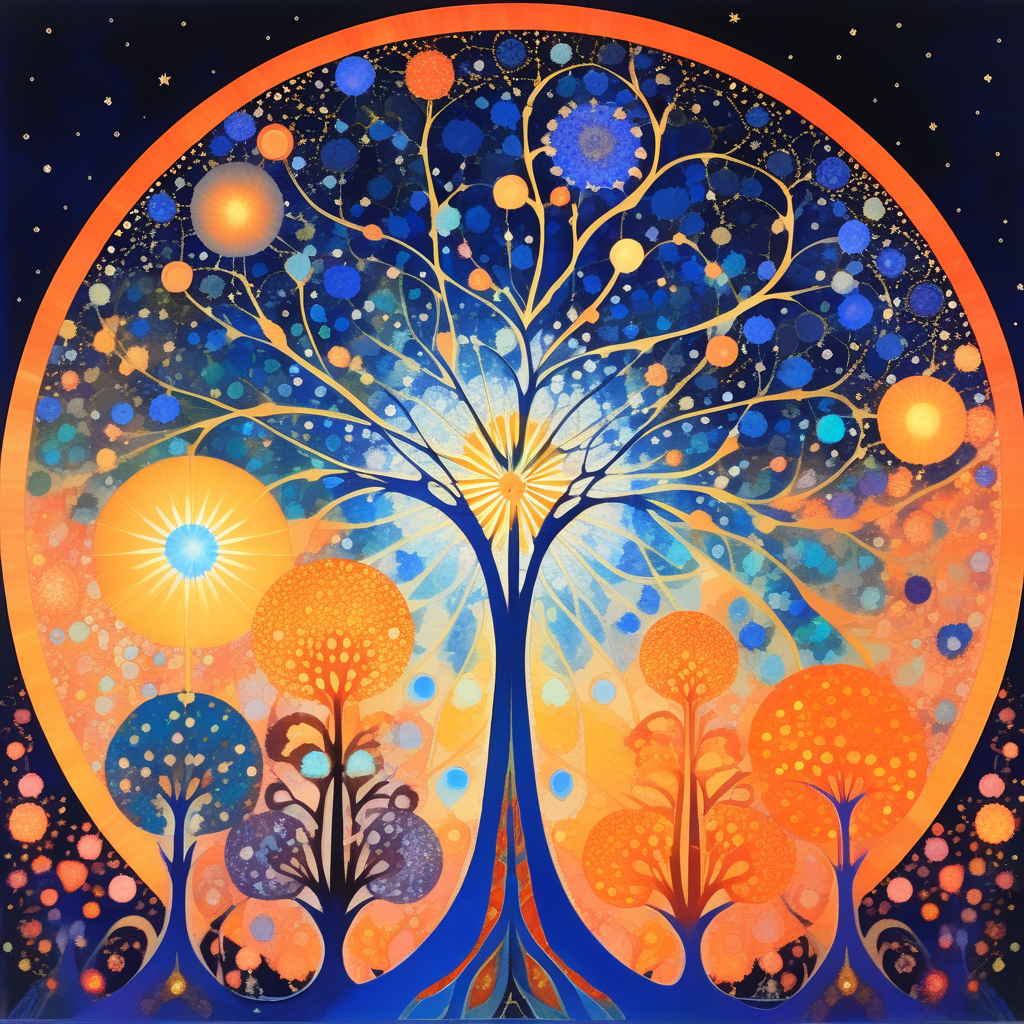
The Paradox of Stillness

Understanding the Dynamic Tranquility of a Tree Trunk

In the heart of nature’s serene expanse, one often overlooks the profound lessons embedded in the simplest of sights. Take, for instance, the trunk of a tree. At first glance, it epitomizes stillness, an unchanging pillar in a world constantly in flux. But this apparent stillness is a mosaic crafted from countless actions and interactions, a profound manifestation of what can be termed ‘absolute stillness’.

The Dynamic World of the Stationary

To truly appreciate the stillness of a tree trunk, we must delve into the bustling world it conceals. The trunk, standing unyielding, is a hub of relentless activity. Sap courses through its veins, carrying life-sustaining nutrients and water from the roots to the leaves. Though invisible to the naked eye, this flow is a ceaseless dance of molecular interactions, a symphony of life that sustains the tree.

Absolute Stillness: A Philosophical Paradox

The concept of absolute stillness arises as a philosophical paradox when we consider the incessant activity that constitutes the tree trunk’s stillness. This paradox nudges us to rethink our understanding of stillness. Is it merely the absence of visible motion, or is it a state achieved through a balance of forces, a harmonious interplay of elements that cancel each other out, resulting in what we perceive as stillness?

A Lesson in Equilibrium and Harmony

The tree trunk, in its majestic calmness, teaches us a vital lesson about equilibrium and harmony. Just as the actions and interactions within it maintain its stillness, our lives too are a constant balancing act. Emotions, thoughts, and actions intertwine, often leading us to a state of internal equilibrium that mirrors the stillness of the tree trunk.

Embracing the Stillness Within

In our fast-paced world, embracing stillness is often challenging. Yet, the tree trunk stands as a testament to the beauty and necessity of finding balance. It reminds us that stillness is not the absence of life or motion but a peaceful coexistence of dynamic forces.

In conclusion, the stillness of a tree trunk is not a mere absence of motion but a dynamic state of balance and harmony. It invites us to explore the depths of our being, find our equilibrium, and appreciate the profound tranquillity that lies in the heart of action.

Morgan O. Smith

Yinnergy Meditation, Spiritual Life Coaching & My Book, Bodhi in the Brain…Available Now!

https://linktr.ee/morganosmith

Burn Bodhi Tree Burn

Dispelling Illusions in the Quest for Enlightenment

In a provocative turn of thought, the recent symbolic burning of the Bodhi tree, a revered figure in Buddhist lore as the tree under which Buddha attained enlightenment, stirs a profound metaphysical debate. This act, far from being a mere iconoclastic gesture, serves as a powerful metaphor for a deeper philosophical introspection into the nature of enlightenment and reality.

The Bodhi tree, in this context, is not just a physical entity but a symbol of the very concept of enlightenment. Its burning signifies the rejection of material and conceptual attachments, even those as sacred as the Bodhi tree and the Buddha himself. This metaphorical act challenges the adherents of Buddhism and spiritual seekers to question the very foundation of their beliefs.


The argument posits that both the Bodhi tree and the Buddha are manifestations within ‘Maya’, the illusory world as described in various Eastern philosophies. According to this view, the physical and the conceptual are mere distractions from the true nature of reality. The burning of the Bodhi tree symbolizes the destruction of these illusions, urging individuals to look beyond physical symbols and established doctrines in their spiritual journey.

The concept of enlightenment, as traditionally understood, is also questioned. This perspective argues that any preconceived notion of enlightenment is not enlightenment itself. True enlightenment, as per this radical view, is beyond concepts and intellectual constructs. It is a state of being that transcends the conventional understanding of spiritual attainment.


Thus, the metaphor of burning the Bodhi tree and the figure beneath it calls for a complete relinquishment of all notions and concepts related to enlightenment. In doing so, it suggests that a state of ‘true enlightenment’ can be realized. This state is described as the only reality, achievable only when one abandons all preconceived ideas and embarks on a journey devoid of attachment to any symbol or doctrine.

The provocative nature of this idea lies in its challenge to established beliefs and practices. It invites a reevaluation of what constitutes the path to enlightenment, urging a detachment from even the most sacred of symbols and figures. This perspective is not a call to physical action but a metaphorical invitation to burn down the internal ‘Bodhi trees’ – the deeply ingrained beliefs and concepts that might hinder the realization of true enlightenment.

Morgan O. Smith

Yinnergy Meditation, Spiritual Life Coaching & My Book, Bodhi in the Brain…Available Now!

https://linktr.ee/morganosmith


All Life is Yoga

The Essence of Existence and Awareness
In the grand mosaic of life, the concept of Yoga transcends beyond its commonly perceived boundaries of physical postures and breath control. It is a profound philosophy and a way of living that interweaves through every aspect of our existence. The assertion “All life is Yoga” is not just a statement but a deep realization that unfolds the interconnectedness of everything around us.

Yoga, in its truest sense, is not confined to the mats or the tranquil corners of meditation halls. It is present in every breath, every step, and in the pulsating rhythm of the universe. The situations we encounter, the events that unfold, the actions we undertake, and the interactions we engage in, all embody the essence of Yoga. These elements serve as mirrors, reflecting the principles of unity, balance, and harmony that Yoga espouses.

Moreover, this perspective extends to the wider construct of civilization. Every culture, community, and era holds the essence of Yoga within its core. The way societies operate, the values they cherish, and the progress they pursue are manifestations of Yoga in a collective form. The principles of coexistence, empathy, and understanding that are integral to societal development are, in essence, Yoga in action.

In the broader context, the entire expanse of existence is a form of Yoga. The cosmos, with its infinite galaxies, stars, and planets, follows a celestial dance that echoes the principles of Yoga. The natural world, with its intricate ecosystems and life forms, demonstrates the interdependence and harmony that are central to Yoga.

The practice of Yoga, in its various forms, is a journey towards the full awareness of these truths. It is a path that leads to the recognition of the oneness of all existence, the interconnectivity of life, and the profound wisdom that lies in understanding that “All life is Yoga.”

In embracing this philosophy, we open ourselves to a more mindful, compassionate, and connected way of living. We learn to see Yoga in everything and everyone, realizing that every moment is an opportunity to practice awareness, kindness, and unity. This understanding has the power to transform not only individual lives but also the world at large, steering us toward a more harmonious and enlightened existence.

Morgan O. Smith

Yinnergy Meditation, Spiritual Life Coaching & My Book, Bodhi in the Brain…Available Now!

https://linktr.ee/morganosmith

The Paradox of Enlightenment

Embracing the Limitless Self

In the quest for enlightenment, a paradox often emerges. We strive to reach a state of higher understanding, yet the moment we claim to have achieved enlightenment, we inadvertently confine ourselves within the very boundaries we sought to transcend. This pursuit reveals a fundamental truth about our nature and existence: what we truly are is inherently free from all limitations.

When we label ourselves as ‘enlightened,’ we inadvertently create a new identity, another cage for our boundless spirit. This declaration is a subtle form of ego, a self-imposed limitation that contradicts the essence of enlightenment itself. True enlightenment is not about attaining a label or reaching a destination; it’s an ongoing journey of self-discovery and liberation from all forms of identification.

Consider the concepts of ‘The Self’ and ‘No Self.’ These are often seen as opposing philosophies in spiritual and philosophical discourse. ‘The Self’ suggests a profound connection with a universal, eternal essence, while ‘No Self’ leans towards the idea of emptiness, the absence of a permanent, unchanging self. However, to define oneself as either is to miss the point entirely.


The essence of our being transcends these concepts. It’s not about being one or the other but encompassing and moving beyond both. We are neither solely ‘The Self’ nor ‘No Self.’ Instead, we exist in a state that includes both yet is not limited by either. This state is not a static endpoint but a dynamic, ever-evolving understanding of our true nature.

In this space, we recognize that labels, identities, and even the concept of enlightenment itself are mere tools for understanding, not the ultimate truth. Our true essence is like the sky—vast, boundless, and untouched by the clouds that drift through it. We are the silent observers, the consciousness that witnesses thoughts, emotions, and sensations without becoming them.

To truly embrace this state of being, one must continuously practice letting go of all attachments, identities, and beliefs. It’s a journey of unbecoming, peeling away layers of conditioned thought and societal constructs to reveal the pure, unadulterated essence of our being.


In conclusion, the journey to understanding what we truly are is not about acquiring a new label or reaching a definitive state of being. It’s about the continuous process of freeing ourselves from all limitations, labels, and identities. It’s about recognizing and embracing the boundless nature of our existence, which includes and transcends all dualities.

Morgan O. Smith

Yinnergy Meditation, Spiritual Life Coaching & My Book, Bodhi in the Brain…Available Now!

https://linktr.ee/morganosmith

Nonduality

The Unspoken Reality

In the realm of spirituality and philosophy, few concepts are as intriguing and paradoxical as nonduality. Nonduality, often associated with Eastern philosophies like Vedanta and Buddhism, refers to the idea that the dualistic distinctions we make between self and other, subject and object, mind and matter, are ultimately illusory or not fundamentally real.

The profound irony of nonduality is that any attempt to discuss or conceptualize it inherently contradicts its very essence. Speaking or thinking about nonduality is, by its nature, a dualistic activity. This is because language and thought are tools that rely on differentiation and distinction. They are the media through which we carve out the ‘self’ from the ‘other’, the ‘this’ from the ‘that’. In doing so, they perpetuate the illusion of duality – the very illusion that nonduality seeks to transcend.


This paradox highlights a fundamental challenge in human cognition: our reliance on dualistic frameworks to make sense of the world. From the moment we are born, our minds are trained to categorize and differentiate. This cognitive structuring is crucial for our survival and functioning in the world, yet it also confines us within the boundaries of dualistic thinking.

Nonduality suggests a state of consciousness where these dualistic distinctions dissolve. It points to an experiential understanding where the division between subject and object, observer and observed, ceases to exist. In this state, the egoic self expands into a boundless, undifferentiated whole.

Yet, the path to realizing nonduality is not through intellectual understanding. Since it is beyond the grasp of dualistic thought and language, nonduality is often approached through practices that transcend rational thinking, such as meditation, mindfulness, or other forms of spiritual contemplation. These practices aim to quiet the mind and dissolve the ego, allowing for a direct, non-conceptual experience of reality, unfiltered by the distorting lens of dualistic thought.


In conclusion, nonduality remains an enigmatic yet profoundly significant concept. It challenges us to look beyond the apparent separateness and fragmentation of our experiences and to question the very foundations of our understanding of reality. While it may never be fully captured in words or thoughts, it stands as a powerful reminder of the limitations of our dualistic perspectives and invites us to explore the depths of our consciousness.

Morgan O. Smith

Yinnergy Meditation, Spiritual Life Coaching & My Book, Bodhi in the Brain…Available Now!

https://linktr.ee/morganosmith

Where Did God Come From?

The question of where God came from strikes at the core of numerous philosophical, theological, and metaphysical discussions. It’s a question that has fascinated scholars, believers, and skeptics alike for centuries. At the heart of this inquiry lies the paradoxical nature of God’s existence: God is often described as omnipresent and nonlocal, transcending the concepts of space and time that define our physical reality.

To ponder upon where God came from is to delve into the depths of the unknown. It is widely held in many theological beliefs that God is the uncaused cause, the source from which all things emanate. This perspective leads to the intriguing notion that God came from nowhere. Nowhere, in this context, is not a physical location but a metaphorical representation of the absence of space and time – a realm beyond our comprehension.


This idea ties closely with the concept of God being nonlocal. Nonlocality, often discussed in quantum mechanics, suggests that an entity can be present everywhere simultaneously. In spiritual and metaphysical terms, this translates to the omnipresence of God. The omnipresence of God means that God exists beyond physical boundaries, in a state of being that encompasses all existence yet is bound by none.

What makes this concept even more thought-provoking is the idea that the pure essence of God is the absence of everything that exists. This notion posits that God is fundamentally different from everything we perceive in our universe. While our reality is defined by physicality, emotions, thoughts, spirituality, and metaphysical elements, the essence of God is distinct from all these. God, in this sense, is the ultimate reality, a state of pure being that transcends all known dimensions of existence.


Consequently, the physical, emotional, mental, spiritual, and metaphysical presence that we attribute to God are reflections or manifestations of this ultimate reality in forms that are comprehensible to us. They represent how we, as humans, perceive and connect with the divine. Each aspect – whether physical, emotional, mental, spiritual, or metaphysical – offers a different lens through which to understand and relate to the divine mystery that is God.

In conclusion, the question of where God came from leads us not to a definitive answer but to a deeper understanding of the nature of existence itself. It encourages us to explore the boundaries of our understanding and to accept the mystery that lies at the heart of all that is.

Morgan O. Smith

Yinnergy Meditation, Spiritual Life Coaching & My Book, Bodhi in the Brain…Available Now!

https://linktr.ee/morganosmith

Embracing the Infinite

Understanding Para Brahman

In the realm of spiritual exploration and philosophical contemplation, the concept of Para Brahman stands as a profound enigma. It is a term that transcends the limits of our typical understanding, pushing us into the depths of what might be considered the ultimate reality.

Para Brahman, in its essence, is the embodiment of the formless and the infinite. It is not confined by the physical dimensions we are accustomed to, such as length, height, depth, or width. This absence of form extends beyond the physical, into the realms of emotion, thought, and even the metaphysical. It is devoid of texture, distance, time, space, feelings, emotions, senses, attachments, desires, thoughts, memories, anticipation, smell, temperature, relationships, distinctions, wants, needs, and regrets. This extensive list, however, is not exhaustive but indicative of the boundless nature of Para Brahman.

What makes this concept both intriguing and challenging is the paradox it presents. Para Brahman, while being beyond all these attributes and perceptions, simultaneously encompasses everything that has been mentioned. It is not just the absence but also the presence of all. This paradox forces us to rethink our understanding of existence and non-existence, presence and absence, form and formlessness.


How can something be everything and nothing at the same time? This question lies at the heart of understanding Para Brahman. It compels us to look beyond the dualities that dominate our everyday experiences. In this sense, Para Brahman is not just a concept but an invitation to experience reality in its most unadulterated form.

This exploration is not just an intellectual exercise but a journey toward self-realization. It challenges our deeply ingrained notions of what is real and what is illusion. By contemplating Para Brahman, we delve into a state of consciousness where the distinctions that define our usual experiences dissolve. In this state, we are neither bound by our desires nor limited by our perceptions.

The understanding of Para Brahman brings us to the cusp of spiritual awakening, where the individual self merges with the universal self. It is a state of being that many spiritual traditions aim to realize – a state of pure consciousness, unmarred by the transient nature of physical existence.


In conclusion, the concept of Para Brahman invites us to embark on a journey beyond the confines of our material and psychological limitations. It encourages us to experience the world not just through our senses and thoughts but through a profound understanding of the interconnectedness and the boundlessness of all existence.

Morgan O. Smith

Yinnergy Meditation, Spiritual Life Coaching & My Book, Bodhi in the Brain…Available Now!

https://linktr.ee/morganosmith

The Ground of All Beings vs. The Ground of All Being

In the realm of philosophy, the concepts of “the ground of all beings” and “the ground of all being” often emerge as central themes in discussions about existence, consciousness, and the nature of reality. These concepts, while seemingly similar, offer distinct perspectives on how we understand the universe and our place within it.

**The Ground of All Beings**


“The ground of all beings” refers to the idea that the foundation of reality is the multitude of individual entities that exist. This perspective sees the universe as a collection of distinct beings, each with its essence and characteristics. According to this view, the diversity of objects, organisms, and entities contributes to the fabric of reality. It emphasizes plurality, acknowledging the unique qualities and experiences of each being. This approach often aligns with perspectives that value individuality and the richness that comes from varied existences.

**The Ground of All Being**

On the other hand, “the ground of all being” suggests a more unified view of existence. Here, the focus is on the underlying reality that connects all things, rather than the things themselves. This concept points to a fundamental source or essence that underpins everything. It’s often associated with ideas of oneness or the belief in a universal substance or consciousness that permeates all. This perspective is prominent in various spiritual and metaphysical beliefs, where the unity of existence is emphasized over individual differences.

**Philosophical Implications**


The debate between these two views is significant in philosophy as it shapes our understanding of the world. If we lean towards “the ground of all beings,” we might focus on the differences and separateness of things, leading to a worldview that celebrates diversity and individuality. Conversely, embracing “the ground of all being” could lead to a more holistic view of life, where interconnectedness and unity are fundamental.


**Conclusion**

Ultimately, these concepts are not just abstract philosophical ideas but are also reflective of our everyday experiences and how we perceive our relationship with the world. Whether we see the universe as a tapestry of distinct threads or as a single, interconnected whole, these views shape our beliefs, values, and actions. As such, the exploration of these concepts is not just a philosophical exercise but a journey into understanding the very nature of existence itself.

Morgan O. Smith

Yinnergy Meditation, Spiritual Life Coaching & My Book, Bodhi in the Brain…Available Now!

https://linktr.ee/morganosmith

Can One Choose to Go Back to Being Unenlightened?

The journey toward enlightenment is often viewed as a one-way path, leading to a state of spiritual awakening that fundamentally changes one’s perception of the world and self. But is it possible to revert to a state of unenlightenment? This question opens a fascinating philosophical debate.

#### The Irreversibility of Enlightenment


Once an individual experiences spiritual enlightenment, it is commonly believed that this transformation is irreversible. In spiritual traditions like Hinduism, Buddhism, and various mystic philosophies, enlightenment—referred to as Sahaja Samadhi, Turiyatitta, Nirvana, Nibbana, Moksha, Bodhi, and other names—is seen as the ultimate achievement. It’s a profound understanding of the universe and one’s place, transcending ordinary perception.

The idea of willingly abandoning such a state seems counterintuitive. Why would one return to a less aware state after enlightenment? For those who have experienced this profound awakening, giving it up, especially while in the human body, seems unimaginable.


#### The Divine Paradox

However, when considering the divine or absolute reality—referred to in various traditions as God, Brahman, Allah, or the Ground of All Being—there’s an intriguing paradox. This ultimate reality is believed to manifest itself in all forms of existence, encompassing every species and aspect of the universe. In doing so, it seemingly relinquishes its state of pure enlightenment to become the myriad forms of life and matter.

#### The Bodhisattva’s Choice

In Mahayana Buddhism, the concept of the Bodhisattva presents another unique perspective. A Bodhisattva is an individual who has caught a glimpse of enlightenment but chooses not to enter this state fully. This choice is made out of compassion, with the vow to help all sentient beings achieve enlightenment before achieving it themselves fully. This represents a profound sacrifice and a different understanding of enlightenment, not as a personal achievement but as a collective goal.


#### Conclusion

The question of whether one can choose to return to unenlightenment is complex and multi-faceted, deeply rooted in various spiritual traditions and philosophical contemplations. It invites us to consider the nature of spiritual awakening, the role of the divine in the cosmos, and the interconnectedness of all beings in the journey toward enlightenment.

Morgan O. Smith

Yinnergy Meditation, Spiritual Life Coaching & My Book, Bodhi in the Brain…Available Now!
https://linktr.ee/morganosmith

The Paradox of the Universe

When we gaze into the vast expanse of the universe, a fundamental question arises: What is the universe made of? It seems like a straightforward inquiry, one that science could answer with theories of matter, energy, particles, and forces. However, upon deeper reflection, the answer becomes less about physics and more about philosophy. The universe, in its most enigmatic form, is made of itself, which paradoxically, is nothing.

This concept, while initially sounding absurd, invites us to explore the nature of existence and the fabric of reality. The universe isn’t just a collection of galaxies, stars, and planets; it’s an intricate tapestry of existence, interwoven with the threads of time, space, and consciousness. To say the universe is made of itself is to acknowledge that it is a self-contained entity, not requiring an external creator or an outside source of substance.


Delving deeper, the idea of the universe being ‘nothing’ challenges our understanding of ‘nothingness’. In philosophy, ‘nothing’ is often considered a state of non-existence, an absence of everything. Yet, in the context of the universe, ‘nothing’ transforms into a concept of boundless potential. This ‘nothing’ is not an emptiness (not in the traditional sense) but a source of all creation, a primordial state from which everything emerged.

This perspective aligns with some interpretations of quantum physics, where the vacuum of space is not empty but teeming with energy and potentiality. It’s in this ‘nothingness’ that particles pop in and out of existence, creating the fabric of reality as we perceive it. Therefore, the universe is made of itself and nothing is not a contradiction but a profound insight into the nature of reality.


The implications of this thought are vast and deeply philosophical. It suggests that the universe, and by extension, our existence, is a self-generated, self-sustaining phenomenon. We are not just in the universe; we are of the universe – an integral part of this grand, incomprehensible entity that is both everything and nothing.

In conclusion, the question of what the universe is made of leads us down a path of deep philosophical contemplation. It reveals that the universe, in its essence, is a paradox, defying the conventional understanding of existence and non-existence. It’s a reminder of the mystery and wonder that surrounds us, an invitation to ponder the unfathomable depths of reality.

Morgan O. Smith

Yinnergy Meditation, Spiritual Life Coaching & My Book, Bodhi in the Brain…Available Now!

https://linktr.ee/morganosmith