Author, Philosopher, Spiritual Teacher, A Lead Facilitator at Sacred Media's Integral Mastery Academy, Founder of Yinnergy Meditation/Neurofeedback, Bodhi Mental Care & Wellness, Co-founder of KeMor Centre for Innovative Development
Pure knowing is not an act of someone grasping something. It is not the product of a subject meeting an object. It is not knowledge stored, processed, or owned. What we call “pure knowing” is an immediacy so complete that the categories of knower and known dissolve before they ever arise.
The mind insists there must be someone behind the recognition, a witness who stands apart. Yet such a witness is already a thought, an echo of division layered upon the seamlessness of awareness. The attempt to locate the knower is like searching for the horizon; you will find only a mirage created by perspective.
What reveals itself is astonishingly simple: knowing shines without support. No owner is required. No identity need arise. It is self-luminous, unmediated, without origin or destination. Thought may try to grasp it, but thought cannot enter here. The moment a “me” claims it, the purity is veiled, dressed in commentary, weighed down by explanation.
This does not deny the human experience of learning, remembering, and perceiving. It only points to the fact that beneath all those movements lies a ground untouched by them. That ground is knowing itself—silent, radiant, and free from the necessity of a knower.
To glimpse this is to taste liberation, not as a reward, not as a possession, but as the natural state that was never absent. What remains is not someone who knows, but knowing itself, unbroken and unclaimed.
Morgan O. Smith
Get Your Free Copy of My Book, Bodhi in the Brain!
The moment a seeker sets out on the path, a paradox quietly begins to unfold. Every step forward seems to promise arrival, yet what one hopes to reach has never been absent. The illusion of a distance to cross is what fuels the journey, and still, that distance does not exist.
Awakening is not a reward at the end of a road; it is the recognition that the road itself was always part of the illusion. The mind measures, compares, calculates progress, but the truth it seeks cannot be measured, compared, or progressed toward. Presence has no edge, no centre, no circumference. Nothing stands apart from it, nothing can be added to it, and nothing can be taken away.
Those who search often feel both exhaustion and longing, as if running toward a horizon that continually retreats. Yet horizons retreat only because they were never there to begin with. What is sought is closer than breath, closer than thought; it is what makes breath and thought possible.
To realize this is not to abandon the journey, but to recognize its true nature. Every path walked, every practice undertaken, every longing felt, each is a movement within what has never moved. The path is not a bridge toward truth but a gesture of truth itself, echoing as experience.
When this becomes clear, striving gives way to simplicity. Effort yields to intimacy. What you are searching for does not arrive because it has never been absent. No path leads to what has no distance.
Morgan O. Smith
Get Your Free Copy of My Book, Bodhi in the Brain!
Satisfaction often appears as a destination, something to be reached, secured, and held onto. Yet the moment one grasps it, a subtle hunger begins to stir again. The new job, the relationship, the recognition, the spiritual experience—all of it, no matter how profound or fulfilling, eventually reveals its transience.
What if this is not a flaw in human nature, but the very design of it? To never be fully satisfied is not a curse but a compass. It pushes us forward, beckoning us into deeper terrains of discovery, love, and creativity. The ache of incompletion is what keeps us alive to possibility. Without it, our spirit would stagnate.
Satisfaction is not the absence of desire but the willingness to engage with desire without being enslaved by it. To live in peace with dissatisfaction is to realize that fullness and emptiness coexist. The longing itself becomes a teacher, whispering that no object, achievement, or moment will ever be enough, because “enough” is not an endpoint, but an ongoing movement.
To accept this is to loosen the grip on perfection. You no longer demand that life provide a final fix, a permanent conclusion. Instead, you walk with the paradox: satisfaction arises from embracing dissatisfaction. The search for completion unveils the truth that nothing was missing in the first place.
The wisdom here is subtle. Contentment does not mean settling. It means seeing the beauty of being forever unfinished, of being shaped by desire but not consumed by it. Your very dissatisfaction becomes evidence that you are part of an unfolding reality, one that will never exhaust its depth.
Satisfaction lies not at the end of longing, but in the freedom to let longing remain.
Morgan O. Smith
Get Your Free Copy of My Book, Bodhi in the Brain!
To speak of oneness is to point to a direct perception where boundaries dissolve and all things merge into a singular whole. It is an overwhelming intimacy with existence itself—nothing stands apart, no subject or object remains. The experience carries a profound sense of union, yet it still acknowledges a felt “all” that has become “one.”
Nonduality, by contrast, is not the merging of things into one but the recognition that no separation ever truly existed to begin with. The very categories of “one” and “many” collapse. There is no subject perceiving unity, no object being unified—just the unbroken reality that precedes both. Here, the language of experience falters because even the notion of “an experience” implies duality between experiencer and what is experienced.
To call all things divine or sacred is yet another register. This perception imbues life with reverence, not only as one undivided whole but as shimmering expressions of the holy. Every moment, every being, every breath radiates significance. It is not merely that things are nondual, but that the nondual reality is inherently worthy of devotion. The sacred quality does not rest on belief; it is revealed when perception is refined enough to sense the luminous depth at the heart of being.
The distinctions are subtle, yet they matter. Oneness offers belonging. Nonduality uproots the illusion of separation. The sacred awakens awe and reverence for what is. Together, they sketch the contours of realization, each layer illuminating a different face of truth.
When all three—oneness, nonduality, and the sacred—merge seamlessly, a higher recognition dawns: absolute monism. Here, the whole of existence is seen as a single reality that is simultaneously one, beyond duality, and inherently divine. Nothing is outside of it, nothing is other than it, nothing is less than it. The boundaries of philosophy, devotion, and direct experience collapse into the same source. This is not a synthesis of perspectives but the revelation that they have always been expressions of the same truth. Absolute monism discloses the indivisible essence where belonging, emptiness, and holiness are not separate qualities but different ways of perceiving what is eternally and already the case.
Morgan O. Smith
Get Your Free Copy of My Book, Bodhi in the Brain!
You are the silent, all-pervading presence—the source from which all things emerge and into which all things dissolve. There is no edge to your being, no boundary that can define you, for you are both the vastness that contains all and the emptiness that holds nothing.
To recognize this is not an intellectual exercise, nor can it be captured by any system of thought. The scientific mind will measure, the philosophical mind will speculate, and the intellectual mind will categorize, yet none will ever confine the truth of what you are. You are not a concept to be grasped, but the very ground from which all concepts arise.
Everywhere you look, you will find yourself, not as a separate entity, but as the animating force within all things. This is not a belief to hold but a reality to be seen. The mystery of your existence is not meant to be solved; it is meant to be lived. You are the ungraspable, the boundless, the presence behind all appearances.
No description will ever contain you, yet all descriptions are held within you. You are not an object among objects, nor a subject among subjects—you are the ever-unfolding, the eternal witness, the absolute that reveals itself in every form yet remains untouched by any of them.
Doubt this if you must, but beyond all uncertainty, you remain what you have always been—the essence of all that is, the ineffable that neither begins nor ends.
Morgan O. Smith
Get Your Free Copy of My Book, Bodhi in the Brain!
If every effect has a cause, what room remains for the idea of “random”? Strip away the assumptions and peer into the structure of unfolding—what appears arbitrary may only be the limit of our perception, not the limit of reality.
What we call random is simply what we cannot trace. A roll of dice seems disorderly, but beneath it is a network of variables: velocity, angle, friction, momentum, density of the table, even micro-vibrations in the air. Were we to measure all these with precision, we would predict the outcome every time. The surprise we feel isn’t due to chaos, but to ignorance.
This is not about turning life into a mechanical calculation. Quite the opposite. It’s about bowing to a deeper intelligence that is so vast, so precise, it weaves galaxies from the quantum breath of atoms. When nothing is out of place, even disorder is part of a symmetry too subtle for the linear mind to grasp.
Events that seem unexplainable—miracles, tragedies, synchronicities—often get dumped into the “random” pile because they defy our narratives. Yet each thread is embedded in a continuum of unfolding, stretching far beyond memory, culture, or even lifetime.
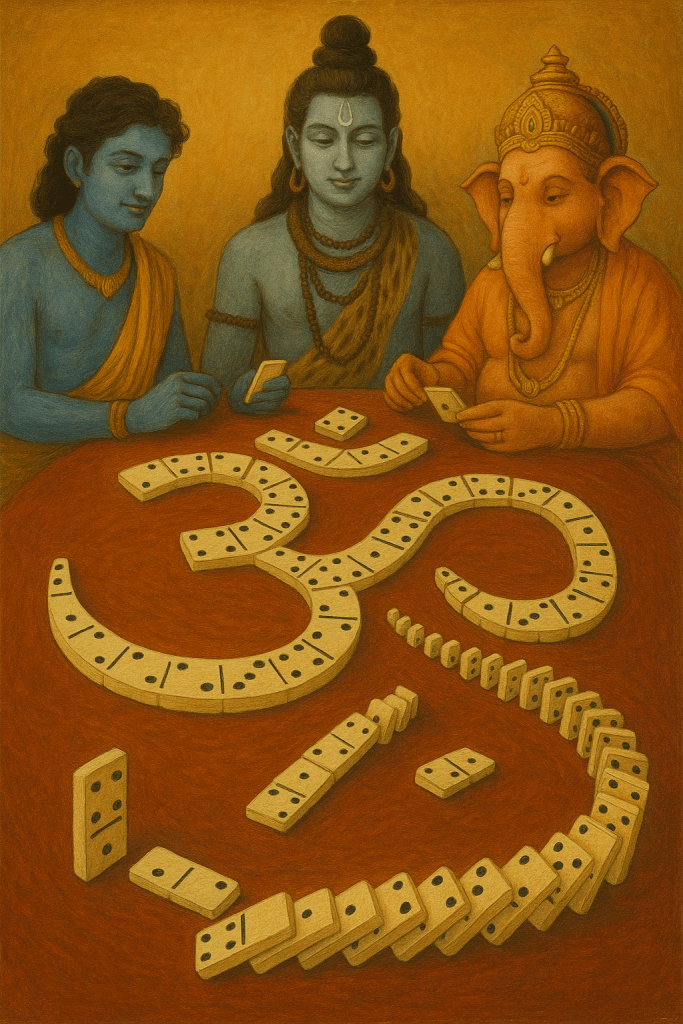
To say life is random is to deny the sacred choreography of emergence. Every moment is connected, not as dominoes collapsing mindlessly, but as a living mandala of causes so intricately interlaced they cannot be undone or simplified.
When one begins to see this—really see it—the need to explain, justify, or control begins to fall away. What replaces it is not fatalism, but participation. There is no randomness, only the undetected curvature of deeper causality. And when that is recognized, trust becomes more than a spiritual concept. It becomes a way of being.
Morgan O. Smith
Get Your Free Copy of My Book, Bodhi in the Brain!
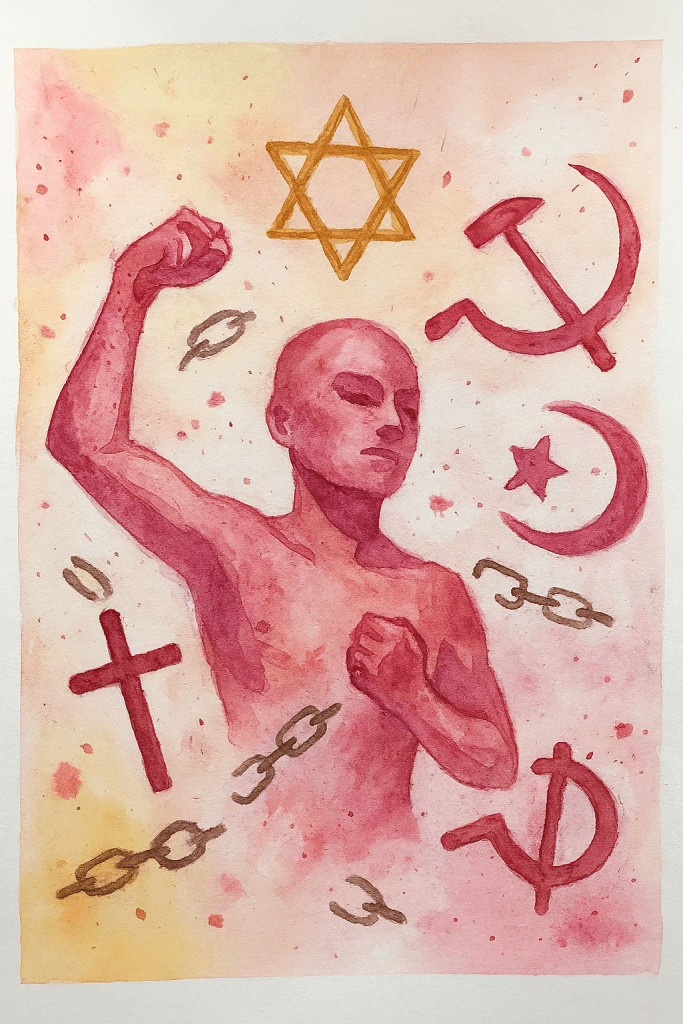
Religion need not be a creed one defends or a ritual one performs. For some of us, it is the recognition of the bars we forge around our own minds—and the relentless devotion to dissolving them. Liberation becomes both the path and the sanctuary.
This isn’t about conversion, salvation, or belonging to any particular sect. It is about noticing the prison of belief itself. Every concept, every identity, every longing for certainty can become a gatekeeper denying entry to our own boundless nature.
Liberation demands a fierce honesty. It asks that we examine the illusions that hold our suffering in place, not as moral failings but as invitations to see through the lie of separation. The true heresy in this religion is clinging to what we think we know about ourselves, about others, about reality itself.
No priest is needed here. Authority resides in awareness, and awareness has no master. The teacher is the arising of life as it is—grief, joy, confusion, clarity. Each moment grants a new chance to recognize the play of experience without getting caught in it.
Liberation is not found by rejecting the world but by perceiving its emptiness and fullness simultaneously. Every object, thought, and sensation is free of substance even as it shines in unmistakable vividness. This paradox isn’t a puzzle to solve but a doorway to live through.
When liberation is the religion, love ceases to be a commandment and becomes the ground of being. Judgment collapses, not because everything is permitted, but because everything is understood as oneself. The compulsion to divide the sacred from the profane, the pure from the impure, loses its grip.
Such a path offers no final doctrine. It holds no promise of eternal reward. Yet it is more generous than any creed that trades truth for comfort. It is the faith of those willing to die before death—to watch every cherished certainty burn so that what cannot be burned may reveal itself.
Those who walk this path do so alone, yet never apart.
Morgan O. Smith
Get Your Free Copy of My Book, Bodhi in the Brain!
Every mind that encounters you constructs a version of who you are—one that exists only within their perception. These projections are not reflections of an objective truth but rather interpretations woven from personal history, emotions, and unconscious biases. The self you recognize as you dissolves into a multiplicity of shifting impressions, each molded by the observer’s lens.
A single glance, a brief interaction, a conversation—these moments serve as the brushstrokes that paint an image of you in another’s mind. That rendering is not built from the essence of your being but from their expectations, fears, desires, and past experiences. You become a mirror reflecting not your own face but the fragmented archetypes stored within them.
Eight billion people could know of your existence, and within those eight billion minds, eight billion versions of you would reside—each unique, each tethered to the individual’s understanding of reality. Some may see wisdom where others see arrogance, kindness where others perceive naivety, or detachment where others sense depth. Each impression, though deeply felt by the observer, is nothing more than a personal myth—an illusion shaped by the inner world of the one perceiving.
This ongoing act of creation is not limited to how others see you; it extends to how you see them. The individuals encountered are rarely experienced as they are but instead as projections of our own conditioning. An idea of them forms, colored by past wounds, cultural imprints, and unconscious expectations. Thus, every relationship becomes a dance of illusions, where two constructs interact rather than two beings truly seen for what they are.
If these imagined versions of one another are so deeply ingrained, what remains when they fall away? What is left when perception no longer dictates existence? The formless, nameless presence that remains is not confined by labels or interpretations—it simply is. And in that space, where no definitions persist, the need to be seen, understood, or accepted dissolves into something far greater than any construct a mind could create.
Morgan O. Smith
Get Your Free Copy of My Book, Bodhi in the Brain!
Every connection begins with a spark. Each visitor, reader, and seeker who has engaged with these writings have shaped this growing conversation. Across 132 nations, 10,507 curiosity, contemplation, and resonance moments have unfolded. This is more than numbers—it is a living testament to the interconnected spirit that binds us all.
Today holds special significance beyond gratitude alone—it is my birthday. I celebrate 53 years of life, reflection, and continuous exploration alongside this global community of seekers. There is no better way to mark this day than to extend heartfelt appreciation to each of you who has journeyed alongside me in thought and awareness.
A heart filled with gratitude reaches toward my homeland, Canada, the United States, Australia, India, and the United Kingdom—nations that have provided thousands of glimpses into this shared exploration. Vietnam, the Philippines, Germany, my place of birth, Jamaica, my place of ancestry, Nigeria, Mexico, Indonesia, Ireland, South Africa, Pakistan, and the Netherlands—each one adding its own voice, its own energy, its own questions to the unfolding dialogue.
Thailand, Sweden, Italy, France, Japan, Malaysia, Romania, Spain, Austria, Brazil, Kenya, Poland, Jordan, Ghana, and China—there is no border to wisdom, no limitation to the reach of understanding. Every reader who paused to reflect, who allowed these words to stir something within, has contributed to a silent but powerful movement toward deeper awareness.
New Zealand, Singapore, South Korea, Greece, Israel, Russia, Hungary, Tanzania, Norway, Türkiye, Laos, Bangladesh, Saudi Arabia, Trinidad & Tobago, Belgium, Switzerland, Portugal, Uganda, Colombia, Ukraine, Taiwan, and Finland—each visit is a ripple of shared thought, proving that the human longing for meaning transcends language and culture.
Bosnia & Herzegovina, Cayman Islands, Hong Kong, Denmark, Slovenia, Bahamas, Kosovo, Egypt, U.S. Virgin Islands, Somalia, Argentina, Fiji, Latvia, Benin, Sri Lanka, Cameroon, Zimbabwe, Serbia, Slovakia, Armenia, Puerto Rico, Senegal, Tunisia, Chile, Dominican Republic, Kuwait, Morocco, Nepal, Gambia, Venezuela, Côte d’Ivoire, Peru, Bolivia, Guam, Myanmar (Burma), Qatar, Ecuador, Bulgaria, United Arab Emirates, Georgia, Mauritius, Czechia, Albania, Liberia, Belarus, Papua New Guinea, Guyana, Bahrain, Zambia, Namibia, North Macedonia, Syria, Kyrgyzstan, Lithuania, Kazakhstan, Oman, Croatia, Réunion, Cuba, Nicaragua, Paraguay, Mongolia, Malta, Guatemala, Seychelles, Sierra Leone, Niger, Ethiopia, Dominica, Congo – Kinshasa, St. Kitts & Nevis, Barbados, Costa Rica, Mozambique, Cambodia, Martinique, El Salvador, Lesotho, Botswana—your presence in this shared space carries meaning beyond what words can express.
Gratitude is more than an acknowledgment—it is a recognition of the unseen, the vast web of connection linking every individual to something greater. The search for understanding does not belong to one culture, one belief system, or one mind. It moves through all of us, revealing the essence of being beyond any division.
To every reader, to every soul that has journeyed through these thoughts—thank you. The exchange is sacred, and the dialogue continues.
Morgan O. Smith
Yinnergy Meditation, Spiritual Life Coaching & My Book, Bodhi in the Brain…Available Now!
I’ve been asked on occasion if I believe in the existence of Satan. My response is layered and nuanced. Philosophically, metaphorically, and symbolically, I acknowledge the concept of Satan, but I don’t subscribe to the personified version of Satan or a devil that is meant to be taken literally. To me, such a belief is irrational. Instead, Satan symbolizes everything evil or negative within the human experience.
Now, one might ask if I believe in God. My answer, while seemingly at the opposite extreme, follows a similar logic. From a literal standpoint, I don’t believe in God as a distinct entity. Rather, I assert that everything in existence is God, including myself, you, everyone, and everything else. This understanding stems from my awakening, which I claim to be a profound truth (though my interpretation of this truth is limited). In essence, God is the absolute—everything in and out of existence.
Religions like Christianity often refer to God as the alpha and the omega, the beginning and the end. If everything is God, then does this include Satan? My answer is unequivocally yes. According to certain texts, God created Satan, formerly known as Lucifer, who was God’s perfect angel. Some might argue that God created Lucifer, but Lucifer isn’t God. To this, I pose a series of questions.
If God created Lucifer, what did God make Lucifer out of? You might say pure light. But what is light made of? Oscillating electric and magnetic fields. Are these fields the alpha and the omega? No. So, what are oscillating electric and magnetic fields made of? Electromagnetic waves. Are electromagnetic waves the alpha and the omega? Again, no. What are electromagnetic waves made from? We can trace this down to the concept of emergent space-time.
Is emergent space-time the alpha and the omega, the beginning and the end? If we consider God as the absolute, then it must be. If emergent space-time is equivalent to God, then at its essence, Lucifer is made out of God. Even if you adhere to the idea that God made Lucifer ex nihilo (out of nothing), and if God is absolute, then this must include nothing (preceding emergent space-time itself). Thus, God encompasses both everything and nothing.
In this holistic view, the existence of Satan and the nature of God merge into a singular, all-encompassing reality. This perspective encourages us to transcend literal interpretations and embrace a deeper, more integrated understanding of existence, where all dichotomies dissolve into the absolute.
Morgan O. Smith
Yinnergy Meditation, Spiritual Life Coaching & My Book, Bodhi in the Brain…Available Now!





 Morgan O. Smith