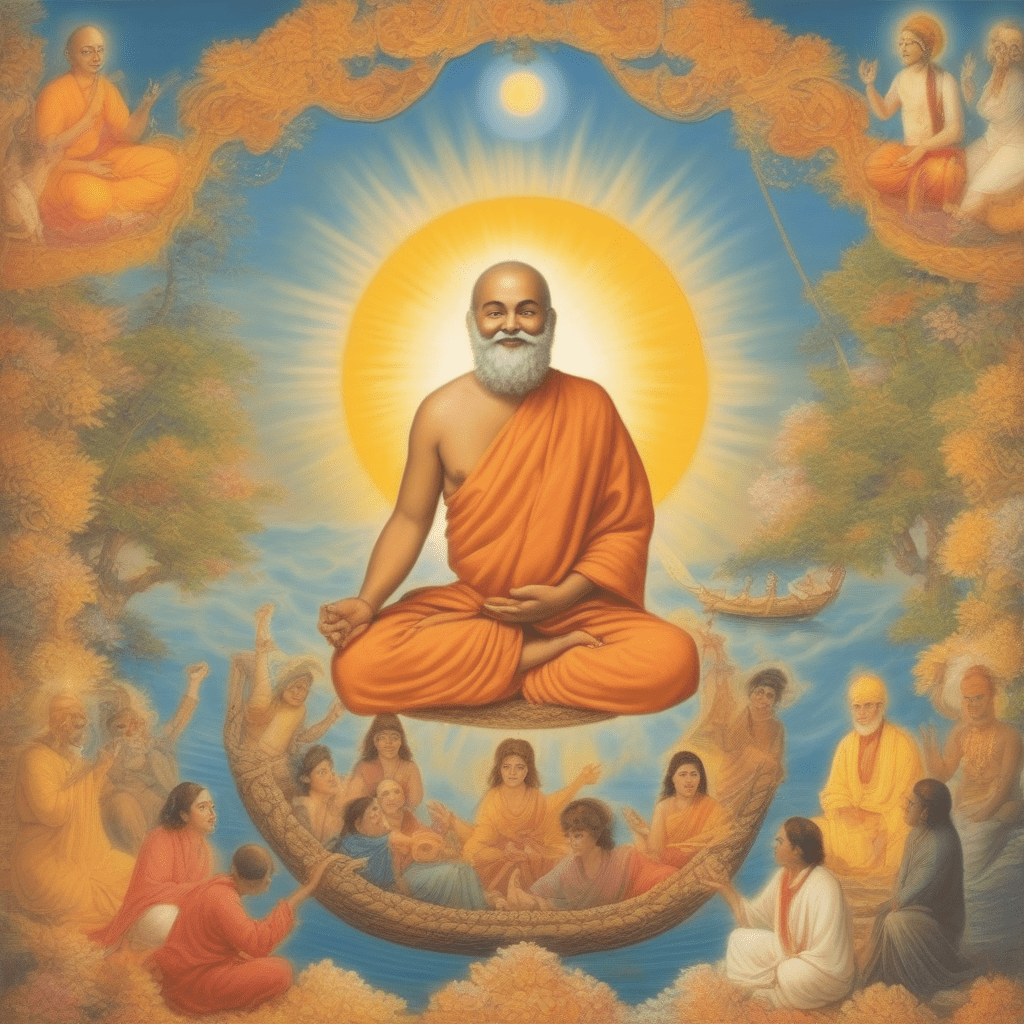
Navigating the Depths

Nonduality vs. Absolute Monism

In the intricate tapestry of philosophical thought, two concepts often emerge as profound and perplexing: Nonduality and Absolute Monism. These philosophical gems, though seemingly similar, hold distinct perspectives on the nature of existence and the universe.

**Nonduality: The Unity of Existence**

Nonduality, a term often associated with Eastern philosophies, particularly Advaita Vedanta, posits a fundamental principle: reality is one, and the perception of duality or separation is illusory. It suggests that what we experience as separate entities – ourselves, others, and the world around us – are not distinct, but part of a unified whole. The philosophy of Nonduality encourages us to transcend this illusion, to realize that at the core of our being, we are not separate from the universe but one with it.


**Absolute Monism: The Dance of Oneness and Multiplicity**

Absolute Monism, on the other hand, takes a slightly different approach. While it agrees with the principle of oneness, it also acknowledges the existence of multiplicity. This philosophy, as I interpret it, embraces the paradoxes of existence: one and not two, two and not one, one and two, two and one, one within two, two within one, yet simultaneously neither one nor two. It reflects a deeper understanding of the cosmos as a dynamic interplay of unity and diversity, where the singular and the plural coexist in a harmonious yet complex relationship.

**The Interplay and Implications**

The discussion of Nonduality versus Absolute Monism is not just a theoretical exercise but has profound practical implications. In Nonduality, the path to enlightenment or understanding involves the realization of oneness, leading to a sense of peace and connectedness with all. In Absolute Monism, the journey is about embracing and understanding the complexity and paradox of existence, leading to a deep appreciation of life’s multifaceted nature.

Both philosophies, in their essence, guide us toward a greater understanding of our place in the universe. They invite us to look beyond the superficial and to question the very nature of reality.
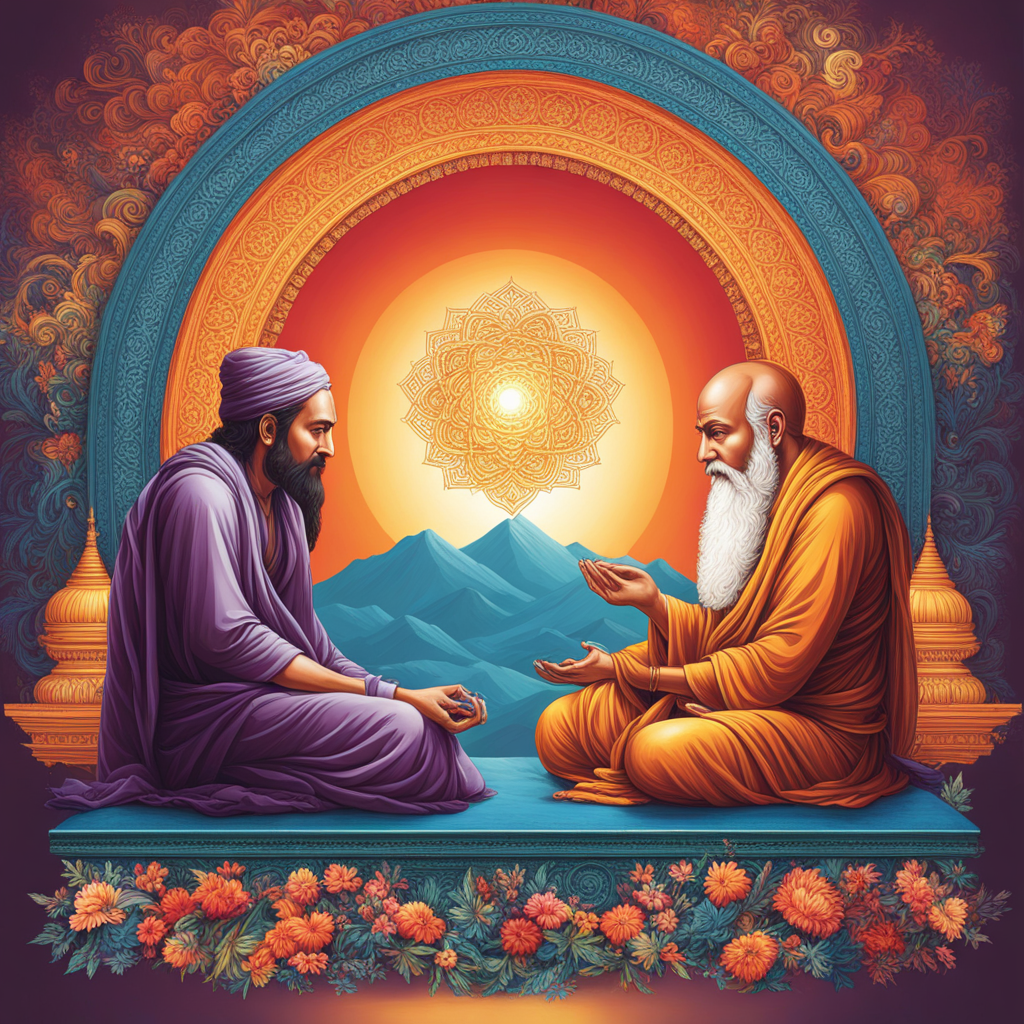

**Conclusion: A Journey of Understanding**

In the end, whether one leans towards Nonduality or Absolute Monism, the journey is one of deep introspection and understanding. It’s about peeling back the layers of what we perceive and understanding the deeper truths of our existence. As we delve into these philosophies, we find not just answers, but also a greater appreciation for the questions themselves.

Morgan O. Smith

Yinnergy Meditation & My Book, Bodhi in the Brain…Available Now!
https://linktr.ee/morganosmith

Embracing the Paradox of Nonduality

Beyond Cherry-Picking Reality

In pursuing spiritual understanding, the concept of nonduality presents a profound paradox. This philosophy, deeply rooted in various traditions, asserts that reality is an undivided whole, transcending the usual distinctions we make between self and other, here and there, or this and that. Nonduality suggests that these separations are illusions, conceptual divisions in the seamless fabric of existence.

However, a common pitfall in approaching nonduality is what could be termed “cherry-picking.” This is where one selectively embraces aspects of nonduality that appeal to them, while conveniently discarding others. It’s akin to admiring the beauty of a rose while ignoring its thorns. Yet, true nonduality, as a concept, includes and transcends all there is. It encompasses every aspect of existence, leaving nothing out, yet paradoxically, it also transcends everything we can conceive or perceive.


The crux of understanding nonduality lies in its experiential realization. Unlike concepts that can be learned from books or teachings, nonduality must be directly experienced to be truly known. This direct experience often defies language and intellectual comprehension. It’s a state of being where the boundaries that separate the self from the universe dissolve, revealing a fundamental unity.

This direct experience of nonduality often comes in fleeting moments of profound insight or deep meditation. In these moments, the constructs of the mind fall away, and what remains is a sense of oneness with all that is. This experience can be both exhilarating and disorienting, as it challenges the most fundamental beliefs about ourselves and the world.


The journey to nondual realization is, therefore, not about acquiring new knowledge but about unlearning – letting go of the deeply ingrained patterns of thought that keep us locked in the illusion of separateness. It’s a process of deconstruction, where one sheds layers of conditioned thinking to reveal the underlying unity of existence.

In embracing nonduality, one must be wary of the temptation to cherry-pick. The whole of existence, with its beauty and brutality, its joy and suffering, is included in the nondual understanding. Nothing is excluded, yet everything is transcended. This paradox is at the heart of nonduality – a reminder that the ultimate truth lies beyond the grasp of our usual ways of thinking and perceiving.

In conclusion, nonduality offers a radical perspective that challenges our conventional understanding of reality. It invites us to look beyond our selective perceptions and embrace the totality of existence. While its true essence can only be known through direct experience, the journey toward this realization can transform our understanding of ourselves and the world.

 Morgan O.  Smith

Yinnergy Meditation & My Book, Bodhi in the Brain…Available Now!
https://linktr.ee/morganosmith

The Tapestry of Reality

Synchronicity and the Illusion of Separateness

In the dance of existence, our perceptions often lead us to believe in the solidity and separateness of things. The term “Maya,” derived from ancient philosophical traditions, refers to the illusory nature of the world. It’s a veil that covers the true essence of reality, suggesting that what we experience is not exactly what it seems.

The concept of “Atman,” on the other hand, points to a deeper truth. It is the individual soul, the pure, unchanging self within each person that is part of a universal soul, Brahman. The realization of Atman within oneself is to acknowledge that one is not just a passive observer of reality but an active creator of it. The synchronicities we encounter, those meaningful coincidences that seem to defy mere chance, are glimpses into this profound interconnectedness of all things.

Meditation serves as a pathway to peel back the layers of Maya, to expand our consciousness from the narrow confines of the ego and to experience the oneness with Brahman. Enlightenment, the pinnacle of spiritual realization, is the recognition that one is not separate from the universe but is the universe, participating in its unfolding as both creator and creation.

In this state, everything occurs simultaneously, and the distinctions between actor, action, and acted upon blur. You are the painter and the canvas, the dancer and the dance, the dreamer and the dream. Your everyday reality is a play of consciousness, a symphony where the whole orchestrates every part.

But the ego is not equipped to handle the enormity of this realization; hence, we experience reality in fragments, in synchronicities that hint at a larger, more intricate design. These moments are invitations to look deeper, to question, and to ultimately discover that you are, in essence, everything you perceive—boundless and infinite.

In the end, perhaps all of existence is an elaborate tapestry woven from the threads of nothingness, and in every stitch, there’s a story of creation and the creator, entwined in an eternal dance.

Morgan O.  Smith

Yinnergy Meditation & My Book, Bodhi in the Brain…Available Now!
https://linktr.ee/morganosmith

Understanding God

A Tapestry of Perspectives

The quest to understand and comprehend the Divine has been a central theme across all human cultures and epochs, a pursuit that intertwines with our very essence. To fathom God is to reach into the depths of our consciousness and the cosmos alike, embarking on a journey that stretches the fabric of our understanding. Every culture, every religion, and every individual offers a unique lens through which we can view the Infinite, like a multifaceted gem reflecting a spectrum of light.

From the analytical philosopher dissecting arguments for God’s existence to the mystic experiencing an ineffable union with the divine, the panorama of understanding is vast. The philosopher seeks to tame the transcendent with logic, while the mystic relinquishes the grasp of reason for the embrace of the ineffable. Both, however, are moved by a shared sense of wonder and an insatiable thirst for the ultimate truth.

The theologian pores over ancient texts, seeking to understand God through the prism of religious doctrine. At the same time, the scientist looks to the natural world for signs of intelligent design and purpose. Where the theologian finds solace in faith, the scientist finds awe in the elegance of the universe’s laws. Their paths may differ, but their horizon is the same: to make sense of the Great Mystery that envelops our existence.

In the diversity of human experience, we find a common thread: the recognition of a reality greater than ourselves that calls to us, challenging us to grow in wisdom and compassion. The devout may experience God through service and love, embodying the divine through acts of kindness and mercy. Meanwhile, the skeptic keeps the conversation alive, ensuring that our understanding remains dynamic and open to new insights.

To comprehend God from all human perspectives is to accept that our individual experiences are threads in a larger tapestry. Each thread adds colour and texture to the whole, and while no single perspective can capture the entirety of the Divine, together they create a richer, more inclusive picture.

The journey to understand God is ultimately a journey into the human heart and mind. It is a quest that calls us to transcend our limited perspectives, learn from each other, and grow beyond our imagined boundaries. In the symphony of human understanding, each voice has a part to play, and it is only through the harmony of our combined voices that we may inch closer to the divine harmony that orchestrates the universe.

Morgan O.  Smith

Yinnergy Meditation & My Book, Bodhi in the Brain…Available Now!

https://linktr.ee/morganosmith

Illumination of the Soul

Spiritual Enlightenment and Moksha

As seekers on the path of inner wisdom, we often encounter the concepts of spiritual enlightenment and moksha. Both are beacons that promise to guide us out of the darkness of ignorance, yet they are not the same.

Spiritual Enlightenment is a term that has found its roots in the West, heavily influenced by the philosophies and meditative practices of the East. It implies an awakening to a reality that transcends our ordinary experience of self and the universe. The enlightened being sees the interconnectivity of all life, perceives the illusion of the ego, and often experiences profound peace and understanding of the present moment. It’s an expansive realization of consciousness, often accompanied by a deep compassion for all beings.

Moksha, on the other hand, is a Sanskrit word that originates from ancient Indian philosophy and is integral to spiritual traditions like Hinduism, Buddhism, and Jainism. Moksha goes beyond the realization of interconnectedness; it represents the ultimate release from the cycle of birth, death, and rebirth — the wheel of samsara. It is not merely an enlightenment of the mind but a liberation of the soul from the karmic ties that bind it to the physical plane.

The distinction lies in their ultimate goals and the pathways to reach them. Spiritual enlightenment is often seen as a milestone, a significant spiritual awakening that may happen time and again, deepening one’s insight and wisdom. Moksha, however, is the final destination — a state of eternal bliss and cessation of all suffering.

To consider enlightenment and moksha is to dance with the profound mysteries of existence. Are they two different peaks or simply different paths up the same mountain? Perhaps the journey is less about the distinctions and more about the profound transformation each individual undergoes in their quest for the ultimate truth.

In our modern age, where the material often overshadows the spiritual, revisiting these ancient concepts might offer a lens to reevaluate our lives purpose. Whether we seek enlightenment or moksha, the essence of our search is a testament to the human spirit’s unyielding quest for the absolute.

And so, we continue to explore, meditate, and live virtuously, with the hope that whether through enlightenment or moksha, we may all find our way to that which we most deeply yearn for — peace, understanding, and liberation.

Morgan O.  Smith

Yinnergy Meditation & My Book, Bodhi in the Brain…Available Now!

https://linktr.ee/morganosmith

Illuminating the Mind

The Dual Paths of Enlightenment and Spiritual Awakening

The quest for Enlightenment has been the pinnacle of human aspiration in various domains—intellectual, ethical, and spiritual. At the heart of this quest lies the promise of awakening, a transformative experience that propels an individual beyond the ordinary perception of existence. Yet, despite the shared terminology, Enlightenment and Spiritual Enlightenment diverge on fundamental grounds, embodying distinct trajectories in the pursuit of truth and self-realization.

Enlightenment, in its classic Western sense, refers to the age of reason that dawned in the 17th and 18th centuries. This period was marked by a surge in philosophical thinking, scientific discovery, and the push for political and individual freedoms. It was an era where human intellect, armed with skepticism and inquiry, sought to dispel the shadows of ignorance and dogma. The Enlightenment’s legacy is one of empowered rationality, urging humanity to harness knowledge as the light to guide society toward progress and civilization.

In contrast, Spiritual Enlightenment is an Eastern siren call that echoes through the annals of various religious and metaphysical traditions. It is not merely an expansion of knowledge but a profound transformation of consciousness. Spiritual Enlightenment implies an experiential realization of oneness with the ultimate reality. It is often depicted as the dissolution of the individual ego, a leap into the boundless ocean of divine essence, which exists beyond the material plane and the constructs of intellectual thought.

The distinction between these two is as significant as it is subtle. The Enlightenment champions the mind’s ability to question, to deduce, and to construct, seeking freedom from external tyranny. Meanwhile, Spiritual Enlightenment seeks liberation from the internal chains of desire, ego, and illusion, focusing on transcending the self rather than actualizing it.

One could argue that the paths are not mutually exclusive but are rather complementary. The enlightened mind that questions and reasons can pave the way for a deeper spiritual quest by clearing the underbrush of superstition and prejudice. Conversely, a spiritually awakened soul may view the dance of creation with a profound sense of peace and interconnectedness, bringing a compassionate perspective to the rational world.

In a broader sense, both forms of enlightenment are beacons of human aspiration. Whether it is the light of reason or the glow of spiritual wisdom, each seeks to illuminate the human experience profoundly. It is perhaps in the convergence of these paths that one may find the truest sense of enlightenment—a holistic awakening that marries the mind’s brilliance with the heart’s intuitive depths.

In conclusion, while the Enlightenment speaks to the power of human intellect and the value of empirical truth, Spiritual Enlightenment invites us to explore the mystical depths of our being and the universe. Together, they form a bidirectional odyssey of enlightenment that continues to inspire and challenge humanity to rise above its primal origins and embrace a more illuminated state of existence.

Morgan O.  Smith

Yinnergy Meditation & My Book, Bodhi in the Brain…Available Now!

https://linktr.ee/morganosmith

Satcitananda

The Voyage from Happiness to Bliss

In the pursuit of well-being, human beings have often conflated happiness with bliss, treating them as interchangeable states. However, the ancient concept of Satcitananda, a Sanskrit term embodying the essence of ultimate reality offers a profound distinction between these two.

Happiness is a fleeting emotion, a reaction to external stimuli, tethered to the temporal and the material. It is as changeable as the weather, reliant on circumstances, people, possessions, and places. Happiness is the surface-level response to life’s favourable events and acquisitions, tied to the sensory and the transient.

Bliss, or Ananda, in contrast, represents a state beyond the physical or emotional. It is not contingent on the external but is the intrinsic nature of being, untouched by the vicissitudes of life’s ever-changing landscape. Bliss is the deep, unshakable contentment that comes not from what happens to us but from what we are at our core. It is a realization of one’s true nature, a state of being where one exists in complete harmony with the universe.

Satcitananda breaks down into ‘Sat’, ‘Chit’, and ‘Ananda’. ‘Sat’ refers to truth or existence itself, ‘Chit’ to consciousness or knowledge, and ‘Ananda’ to bliss. These are not mere attributes but the very fabric of the ultimate reality, the Brahman. To realize Satcitananda is to awaken to the truth that our own deepest self is not separate from this reality.

The journey from happiness to bliss is a transformational process of expanding one’s understanding from the finite to the infinite, from a state of doing to a state of being. Where happiness might be thought of as a single note in a symphony, bliss is the symphony itself. It is the silent space between notes, as integral to the music as the sound, offering a depth that is both immanent and transcendent.

To chase happiness is to chase the shadows of what we believe we lack, while to embrace bliss is to step into the light of our divine nature, which lacks nothing. It is a shift from seeking satisfaction from the external world to discovering the inexhaustible joy within.

In Satcitananda, one finds the key to unlocking a truth that spiritual traditions have whispered for millennia: that what we seek outside has always been within. As we navigate the shifting tides of life, the realization that we are not merely chasing fleeting happiness but are embodiments of eternal bliss can transform our entire way of being.

Thus, Satcitananda is not merely a philosophical concept; it is an invitation to a way of life, a reminder that beneath the ephemeral dance of happiness and sorrow lies a profound peace and joy, waiting to be realized.

Morgan O.  Smith

Yinnergy Meditation & My Book, Bodhi in the Brain…Available Now!
https://linktr.ee/morganosmith

The Liberation in Letting Go

Emptiness, Ignorance, and Identity

In a world incessantly clamouring with the din of possession, certainty, and self-promotion, the mantra “Embracing emptiness, cherishing ignorance, surrendering identity” arrives like a whisper from another realm. It calls on us to consider the counterintuitive notion that there is profound freedom and wisdom to be found in the very things we are conditioned to avoid.

**Embracing Emptiness**

Emptiness often conjures a sense of lack, yet in many Eastern philosophies, it is a profound concept, pregnant with possibilities. To embrace emptiness is not to fall into the void, but rather to make space for the new, the unforeseen, the life-affirming. It is the fertile ground of being from which all things spring and to which they return. In the spaciousness of emptiness, we find the flexibility and resilience to move with life’s undulating rhythms.

**Cherishing Ignorance**

Cherishing ignorance may seem antithetical in our knowledge-driven society. However, this is not an advocacy for willful naivete, but a reverence for the acknowledgment of our limitations. Socrates’ declaration of wisdom beginning with the admission of one’s ignorance holds here. Cherishing our not-knowing is an invitation to perennial learning, to the humility that keeps the mind supple, and the heart open to the mystery that is existence.

**Surrendering Identity**

Our identities, the personas we cultivate and present to the world, are often elaborate constructs grounded in who we think we should be or who we want others to believe we are. To surrender this identity is to strip away the superfluous and encounter the authentic self, the self not defined by accolades or attributes, but existing in simple beingness. This surrender is not a loss but a homecoming, a release from the exhausting endeavour of upholding our masks.

In combining these three tenets—emptiness, ignorance, and identity—we approach a way of living that is at once liberating and grounding. It invites a life lived with open hands, where attachment is a choice rather than a compulsion, and authenticity guides our interactions.

As we contemplate this mantra, we might find ourselves stepping into a flow of existence that is less about accumulation and more about experience, less about certainty and more about exploration, less about being someone and more about being part of something greater.

The journey toward embracing this wisdom is counter-cultural. It moves against the grain of our societal norms, urging us to let go of what we cling to most tightly. Yet, the promise it holds is nothing short of transformational—freedom from the self-imposed prisons of material excess, intellectual rigidity, and egoic constraint.

In this space, we find that emptiness is fullness, ignorance is wisdom, and surrender is power. And so, we continue to explore, with hearts wide open to the vastness of the unknown.

Morgan O.  Smith

Yinnergy Meditation & My Book, Bodhi in the Brain…Available Now!

https://linktr.ee/morganosmith

Mirrors of the Self

Seeing the Divine in All

In the vast expanse of existence, each entity and every moment is a reflective surface, giving us a glimpse of our deepest selves. When we peer into the world, what we encounter is not just matter arranged in space but a mosaic of mirrors, each offering a unique reflection of who we are. The idea that everything we perceive is a reflection of our face is not just a poetic sentiment but a profound philosophical proposition that invites introspection about the nature of self and the universe.

The reflections we see are not literal but abstract, distilling our essence in the myriad forms and phenomena around us. This abstraction is where the beauty of perception lies; it is a canvas where the mind can project its inner workings—its hopes, fears, and dreams. The world outside becomes a screen for the drama of the self to unfold, the grand play of consciousness where every actor wears a mask that resembles something within us.

In this grand reflection, if we are to see the face of God, then it must be understood that this divine visage is not an entity separate from us but interwoven into our being. The divine reflection is the totality of the cosmos itself, a unity where every face is indeed an aspect of a greater countenance. If we are made in the image of the divine, as many traditions suggest, then it follows that the divine is also made in the countless images reflected to us.

Every interaction, every glance at nature, every piece of art, and every human invention is a facet of this divine reflection. We are constantly in dialogue with the divine through the medium of our experiences. In recognizing this, we might come to treat each moment with reverence, understanding that in the act of observation, we are participating in a sacred exchange.

As we walk through the world, let us consider that the beauty, the ugliness, the sublime, and the mundane are all part of the same tapestry, woven with threads of the divine. It is not just in the extraordinary that we can glimpse the face of God, but in the ordinary, the overlooked, and the understated. By recognizing the divine reflections in all that we encounter, we open ourselves to a more profound sense of connection and purpose.

In the end, the philosophy that everything is a reflection of our face does not isolate us in solipsism but connects us to a greater whole. It offers a vision of unity, where the self is not an isolated entity but a vibrant echo of the universe, a reflection of the divine face in the mirror of existence.

Morgan O.  Smith

Yinnergy Meditation & My Book, Bodhi in the Brain…Available Now!

https://linktr.ee/morganosmith

The Infinite Self

Time Travel and the Nondualistic Journey Within

In the silence that stretches between thoughts, in the space that houses the cosmos, there exists a philosophy that stretches the bounds of conventional understanding—nondualism. It’s an ancient perspective that posits a simple, yet profound truth: all of existence, the myriad forms and vacuous voids, the dance of particles and the march of time, are expressions of a singular, unified reality. You are not a mere participant in the universe; you are the universe itself, experiencing itself endlessly.

Consider the concept of time travel, a staple of science fiction and a tantalizing possibility for the human imagination. Time, from a nondual standpoint, is not a river that flows from past to future, nor a serpent that eats its tail in an eternal loop. It is a dimension of existence that is inseparable from you. You are time, as much as you are matter, energy, thought, and consciousness. If you could traverse the temporal plane, to cavort in the gardens of Babylon or witness the birth of a star eons from now, would you be visiting foreign lands or would you be exploring the contours of your boundless self?

By recognizing time as an aspect of the self, the idea of time travel takes on a new dimension. It becomes a metaphor for self-exploration and self-understanding. Each journey back to the past can be viewed as an introspective dive into our collective memory, our shared history, and the unconscious mind. Moving forward, then, is an imaginative leap into potential futures, the realm of dreams, hopes, and the unmanifested aspects of the self.

This perspective invites a radical shift in consciousness. The anxieties of the past and the uncertainties of the future are not separate from the present moment; they are all-encompassing and present within the now that is perpetually experienced. Every moment is an act of creation, a reconfiguration of the universe, a reinterpretation of the self. Through the lens of nondualism, time travel becomes a poetic expression of the human desire to know the self fully, to experience all facets of being, and to embrace the ultimate unity of existence.

If we can see ourselves in the stars and the stones, in the ebbs and flows of civilizations and the silent growth of a seedling, then perhaps the ultimate journey does not require us to break the physical bonds of time but to transcend the psychological barriers that prevent us from seeing the unity of all things. In doing so, we might find that every step we take, every choice we make, and every path we walk or leave untrodden, is an exploration of the infinite self.

As you ponder this unity, this grand tapestry of existence where you are both the weaver and the thread, the observer and the observed, consider what destinations you might seek within the boundless realms of your being. What would you discover in the recesses of millennia past, and what futures could you paint with the brush of your current intentions and actions? The voyage of time is but a journey within, and every moment is a destination waiting to be understood.

Morgan O.  Smith

Yinnergy Meditation & My Book, Bodhi in the Brain…Available Now!
https://linktr.ee/morganosmith