Beyond Quadrants

The Supreme Identity

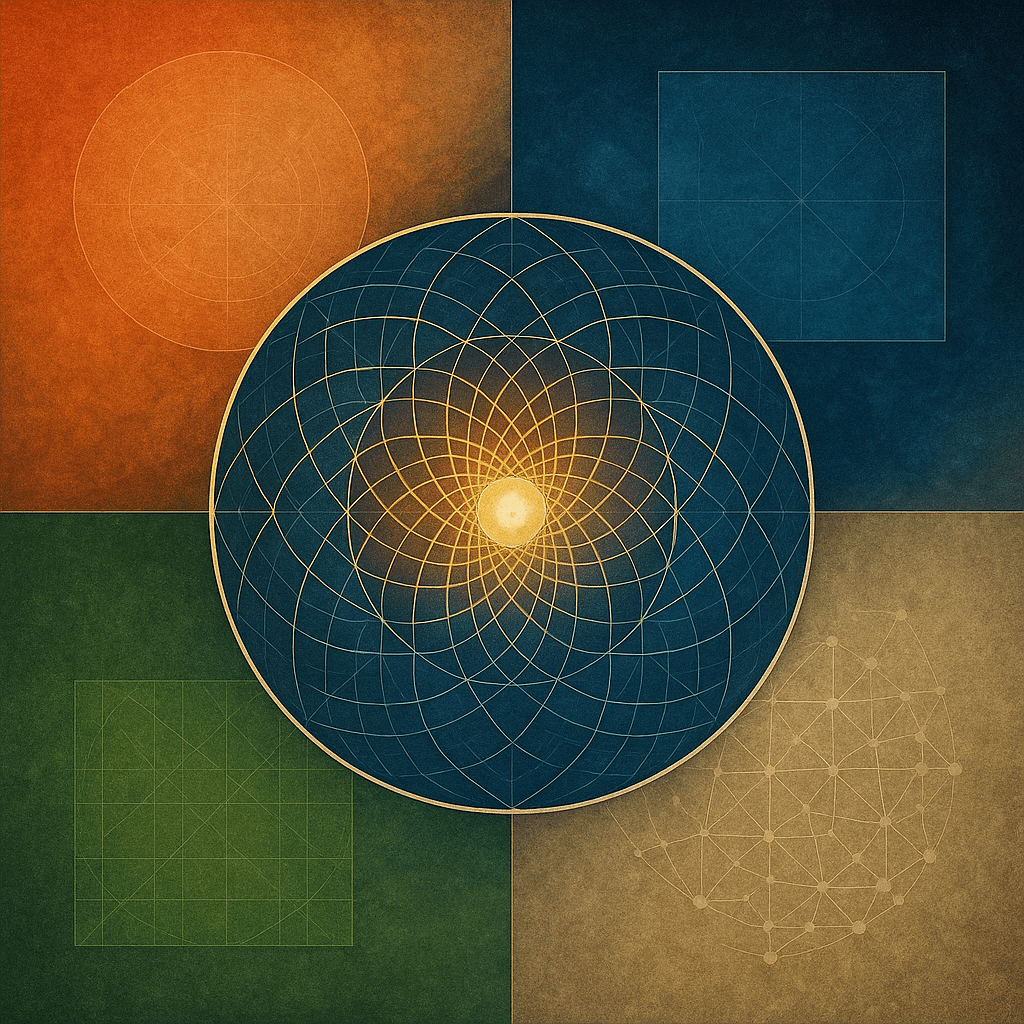
The quadrants of experience—I, We, It, and Its—have long been a lens through which consciousness organizes reality. Each provides a vital perspective: the subjective interior of the self, the shared intersubjective domain, the objective forms of matter, and the interobjective systems of the whole. These lenses do not compete; they illuminate the multiple dimensions of existence. Yet, any frame cannot contain the essence of reality, no matter how inclusive or comprehensive it may be.

What reveals itself when awareness no longer clings to a particular quadrant? A vastness appears that cannot be named solely as an “I,” nor reduced to the communion of “We.” It is not confined to the world of objects, nor to the vast interplay of systems. The Supreme Identity both transcends and enfolds these domains, existing as their ground and source.

This Identity is not separate from the quadrants; it is their silent witness and animating force. Just as light contains within it every visible colour yet is itself colourless, the Supreme Identity contains every possible perspective while remaining free of perspective altogether. When seen clearly, the quadrants dissolve into expressions of a singular field that cannot be divided.

What makes this recognition so profound is that it shatters the tendency of consciousness to fixate. The mind grasps for a standpoint—self, relationship, object, or system—but here, every standpoint is unmasked as a partial gesture of the whole. The Supreme Identity does not stand against them; it whispers through them. The “I” speaking, the “We” sharing, the “It” observed, the “Its” interlinked—all are nothing other than its unfolding.

Realizing this does not negate the quadrants. Rather, it liberates them. Each becomes transparent, shining as a clear facet of a jewel that was never fractured to begin with. The Supreme Identity calls forth a recognition: the One is never elsewhere. It is already present, before all perspectives, yet manifesting as each.

To live from this recognition is not to abandon life’s frameworks but to embody their ground. Every conversation, every act, every encounter reveals the unbroken presence that cannot be named yet pervades all. The quadrants remain as tools of navigation, but the navigator is no longer lost.

Morgan O. Smith

Get Your Free Copy of My Book, Bodhi in the Brain!
https://subscribepage.io/oTSZQu

The Causal Realm

The Birth and Death of All Things

At the threshold of the causal realm, the experience of existence shifts from linear to simultaneous. You no longer stand as a single individual within a vast universe; you stand as both the birther and the born, the destroyer and the destroyed. The recognition dawns that the world does not merely shape you—you are also the very source of its shaping.

To know oneself here is to witness the paradox of causality unveiled. You are the origin of all movement, yet every movement gives rise to you. In this simultaneity, you can feel yourself giving birth to the totality of existence while watching that same totality dissolve back into silence.

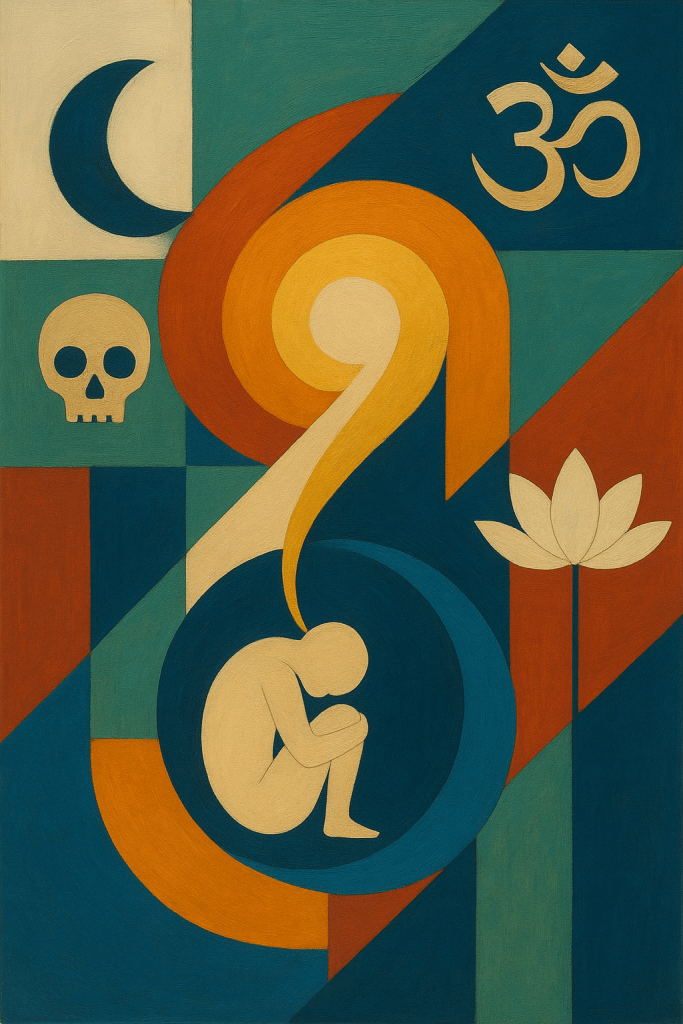
Every breath is both a first and a last. Each moment is a labour of creation and a death rattle of dissolution. The body of consciousness enters its own womb, giving rise to itself again and again, endlessly. This is not a metaphor; it is the raw experience of being both cause and effect at once.

Within this state, suffering and bliss are inseparable twins. To feel the entirety of pain across existence is to simultaneously encounter the fullness of joy. One does not cancel the other; they merge into a union so vast that it overwhelms all categories of the mind. Pleasure peaks not as a fleeting sensation but as an orgasmic force inseparable from the ache of existence itself.

Masculine and feminine converge here—not as roles, not as energies separate and distinct, but as the indivisible pulse of love for everything that appears. What arises is an uncontainable recognition: every form, every life, every fragment of existence is nothing other than your own divine being.

The causal realm does not reveal the ultimate self, yet it gives you the deepest taste of how the play of birth and death, creation and dissolution, unfolds ceaselessly within the radiance of what you are.

Morgan O. Smith

Get Your Free Copy of My Book, Bodhi in the Brain!
https://subscribepage.io/oTSZQu

The Fiction of Randomness

If every effect has a cause, what room remains for the idea of “random”? Strip away the assumptions and peer into the structure of unfolding—what appears arbitrary may only be the limit of our perception, not the limit of reality.

What we call random is simply what we cannot trace. A roll of dice seems disorderly, but beneath it is a network of variables: velocity, angle, friction, momentum, density of the table, even micro-vibrations in the air. Were we to measure all these with precision, we would predict the outcome every time. The surprise we feel isn’t due to chaos, but to ignorance.

This is not about turning life into a mechanical calculation. Quite the opposite. It’s about bowing to a deeper intelligence that is so vast, so precise, it weaves galaxies from the quantum breath of atoms. When nothing is out of place, even disorder is part of a symmetry too subtle for the linear mind to grasp.

Events that seem unexplainable—miracles, tragedies, synchronicities—often get dumped into the “random” pile because they defy our narratives. Yet each thread is embedded in a continuum of unfolding, stretching far beyond memory, culture, or even lifetime.

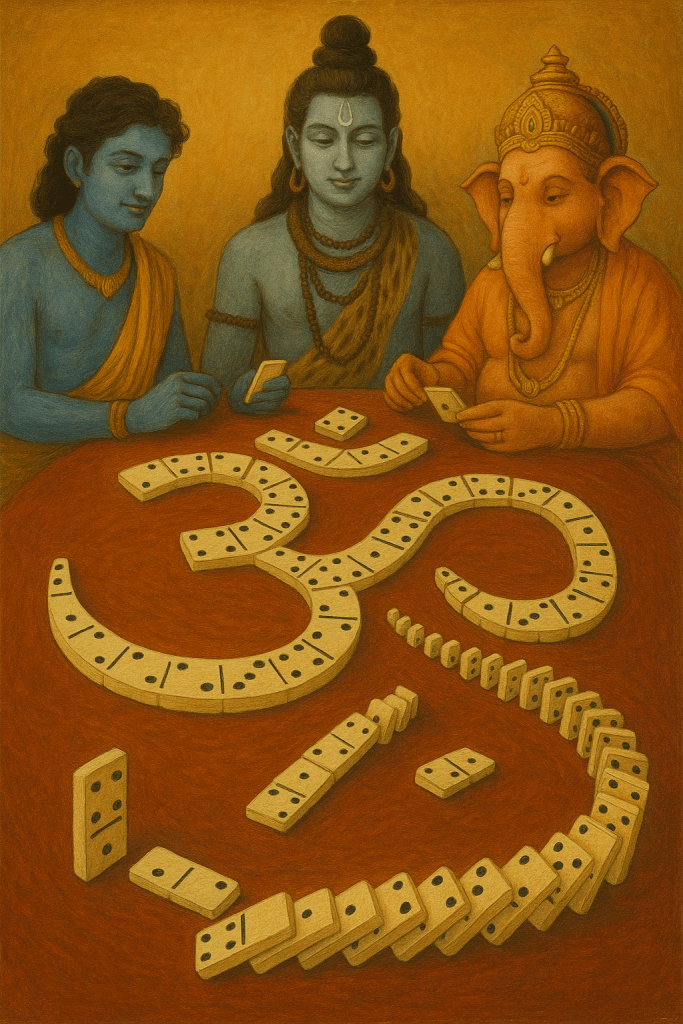
To say life is random is to deny the sacred choreography of emergence. Every moment is connected, not as dominoes collapsing mindlessly, but as a living mandala of causes so intricately interlaced they cannot be undone or simplified.

When one begins to see this—really see it—the need to explain, justify, or control begins to fall away. What replaces it is not fatalism, but participation. There is no randomness, only the undetected curvature of deeper causality. And when that is recognized, trust becomes more than a spiritual concept. It becomes a way of being.

Morgan O. Smith

Get Your Free Copy of My Book, Bodhi in the Brain!
https://subscribepage.io/oTSZQu

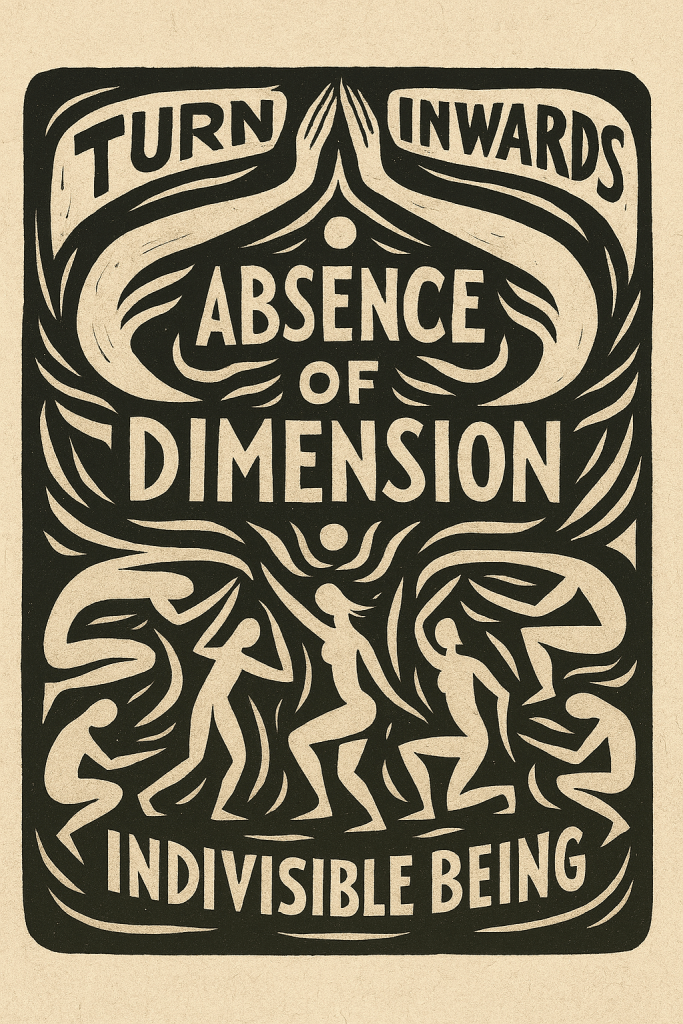
The Absence of Dimension

A Contemplation on Absolute Monism

What dimension is the experience of absolute monism?

That very question quietly collapses under its own weight.

To ask “how many” is to divide the indivisible. To quantify is to measure a mystery that can only be met in its own silence. Within the direct realization of Turiyatita—that which lies beyond even Turiya—there is no vantage point from which to count, compare, or classify. The moment dimensionality is assigned, we have already slipped back into the architecture of mind, where form assumes primacy over essence.

Still, the mind hungers for some orientation. So let’s turn the prism slowly, exploring this from a few distinct angles—not as answers, but as offerings.

1. Relative Lens: The Architecture of Experience

Certain esoteric traditions offer a gradient of consciousness: from the dense contours of the material (3D), to subtle inner time-space (4D), toward integrative fields of unity (5D and above). These serve as helpful metaphors, allowing seekers to understand how consciousness may expand or refine. Yet even the loftiest of these is still part of the dream—within the cosmic play of form.

From this lens, the direct encounter with nonduality might appear multi-dimensional, even interdimensional, because it defies the logic of linearity. It feels vast, borderless, paradoxical. But it is still being interpreted by a relative mind, even if only for a moment.

2. Transcendental Lens: The Priorness of the Real

Absolute monism is not located anywhere because it is not a location.

Dimensionality implies structure. It assumes contrast. But the Absolute is prior to all arising. It is not 1D, 5D, or 12D—it is the generative zero-point. The stillness that allows all movement. The background that isn’t separate from the foreground but holds all images without ever becoming one.

It is not empty like a void; it is empty like ungraspable fullness. The kind of emptiness that births stars and dissolves gods. Not confined to being or non-being, but transcending both.

3. Direct Realization: The Collapse of All Coordinates

No map leads here.

Direct realization is immediate and unmediated. Not because you reached a peak, but because the climber vanished. There is no experiencer—only experiencing. No mind reflecting on awareness—only awareness aware of itself.

Here, space has not been born. Time has not begun ticking. Even the concept of unity dissolves, for there is nothing to be unified. What remains is suchness—pure presence prior to presence. A silent explosion of is-ness so complete it leaves no trace.

Not a Dimension. Not Even a State.

So what do we call it?

Nothing.

And everything.

To speak of “the dimension of absolute monism” is to subtly betray it. Better to say: it is the absence of dimension in which all dimensions arise and dissolve. Not a high place, but the place before place. Not a peak, but the disappearance of altitude itself.

A Final Whisper

Absolute monism is not the highest dimension.
It is the absence of dimension,
where even “one” dissolves.
Here, all becomes what it has always been—
indivisible, unbounded, unspoken.

Morgan O. Smith

Get Your Free Copy of My Book, Bodhi in the Brain!

https://subscribepage.io/oTSZQu

Beyond Identity

The Illusion of Separation and the Boundless Self

What You Are Not

Strip away the names, the labels, the ideas, and what remains? Nothing. And yet, in that nothingness, everything arises. You have no true identity, defined form, or fixed point in time or space—yet you appear as all things. You are not this body, not this mind, not even the grand concept of the self that you have clung to. What you believe yourself to be is merely a shadow of what you truly are.

The illusion of separation creates the experience of individuality. This appearance is not wrong—it is the stage upon which existence plays itself out. But beneath this grand performance, you remain whole, indivisible, untouched. You have never been anything other than totality itself, masquerading as the temporary.

Timeless Existence, Eternal Becoming

You think of yourself as moving through time, yet time moves through you. The past is not behind you, nor is the future ahead—both are simply angles of the same moment, stretching into what appears as linear sequence. The experience of time is an unfolding dream, a dance of perception, measured by the mind yet never truly existing apart from it.

You were never born, nor will you ever die. The body follows its cycle, the mind weaves its stories, but what you are precedes all of this. There is no point at which you began, nor will there be a point where you cease to be. You are not a passenger in the stream of time—you are the river itself, flowing and still, changing yet unchangeable.

The Paradox of Experience

You exist beyond pleasure and pain, yet you experience both. The vastness of what you are embraces every joy, every sorrow, every triumph, and every loss. From the personal vantage point, suffering seems real. From the vastness of what you truly are, it is simply another unfolding, another wave in the great ocean of being.

The universe is not happening to you; you are happening as the universe. Every emotion, every sensation, every moment is a reflection of the infinite nature of your being. To see clearly is to recognize that paradise and suffering are not opposites—they are expressions of the same boundless presence. What is heaven to one may be hell to another, yet both arise within the same limitless field of awareness.

The Grand Play of Forgetting and Remembering

Forgetting is part of the experience. You never truly lost yourself; you only created layers of distraction to deepen the illusion of separation. But beneath the veil, awareness remains unchanged. It watches, it witnesses, it knows.

There is no struggle to remember who you are because you have never truly forgotten. The self you long to rediscover has never been absent. The only thing that obscures it is the illusion of individuality—the belief that you are a fragment rather than the whole.

Creation Without Creating

Nothing is ever truly created, yet everything appears anew in every moment. The universe emerges not from effort, but from the effortless unfolding of being itself. What appears as thought, as energy, as matter, is nothing more than the echo of your own presence.

You are not a separate creator forging reality from the outside—you are reality itself, expressing infinite possibilities without effort. Every concept of manifestation, every idea of cause and effect, dissolves when seen from the vastness of what you are.

The Silence Beyond Thought

Words attempt to define, but what you are cannot be contained by description. Understanding is not needed—only direct experience. This cannot be grasped intellectually; it must be known in the deepest sense, beyond language, beyond belief, beyond the limits of perception.

You are the stillness that speaks, the emptiness that overflows, the silence from which all sound emerges. The mind seeks elaboration, but the truth is found in simplicity. In seeing clearly, you recognize that nothing needs to be said, nothing needs to be explained—because you are already that which you seek.

Morgan O. Smith

Get Your Free Copy of My Book, Bodhi in the Brain!

https://subscribepage.io/oTSZQu

The Echo of You

How Others Shape the Illusion of Self

Every mind that encounters you constructs a version of who you are—one that exists only within their perception. These projections are not reflections of an objective truth but rather interpretations woven from personal history, emotions, and unconscious biases. The self you recognize as you dissolves into a multiplicity of shifting impressions, each molded by the observer’s lens.

A single glance, a brief interaction, a conversation—these moments serve as the brushstrokes that paint an image of you in another’s mind. That rendering is not built from the essence of your being but from their expectations, fears, desires, and past experiences. You become a mirror reflecting not your own face but the fragmented archetypes stored within them.

Eight billion people could know of your existence, and within those eight billion minds, eight billion versions of you would reside—each unique, each tethered to the individual’s understanding of reality. Some may see wisdom where others see arrogance, kindness where others perceive naivety, or detachment where others sense depth. Each impression, though deeply felt by the observer, is nothing more than a personal myth—an illusion shaped by the inner world of the one perceiving.

This ongoing act of creation is not limited to how others see you; it extends to how you see them. The individuals encountered are rarely experienced as they are but instead as projections of our own conditioning. An idea of them forms, colored by past wounds, cultural imprints, and unconscious expectations. Thus, every relationship becomes a dance of illusions, where two constructs interact rather than two beings truly seen for what they are.

If these imagined versions of one another are so deeply ingrained, what remains when they fall away? What is left when perception no longer dictates existence? The formless, nameless presence that remains is not confined by labels or interpretations—it simply is. And in that space, where no definitions persist, the need to be seen, understood, or accepted dissolves into something far greater than any construct a mind could create.

Morgan O. Smith

Get Your Free Copy of My Book, Bodhi in the Brain!
https://subscribepage.io/oTSZQu

Turiya

The Witness That Is Everything

Most understand Turiya as the silent witness beyond waking, dreaming, and deep sleep. It is often considered the empty observer, untouched by the movements of mind, body, and experience. This perspective, though true, is not the full picture. The notion of an “empty witness” can still carry a subtle duality—a sense of something separate, detached, and standing apart from what it observes. Yet, Turiya is not merely a state one enters or a refuge from illusion; it is the foundation of all states and, ultimately, the realization that there was never an “other” to witness.

The empty witness is not just within the individual who reaches the fourth state of consciousness. That would suggest an inside and an outside, a seer and a seen. Turiya dissolves that illusion. It is not simply the background of experience but the existence of experience itself, witnessing its unfolding as everything.

To say that Turiya is merely an untouched observer is to misunderstand its nature. This assumption can lead to a false dichotomy, where one believes that ultimate truth lies in detachment alone. However, this view neglects the profound insight that the so-called witness is not separate from the world it observes. There is no distance between observer and observed, no boundary where witnessing begins or ends. It is all Turiya.

This recognition dismantles the very scaffolding of selfhood. The one who thought they were the observer disappears into the realization that the witnessing presence is not housed within them—it is existence itself, seeing, knowing, and being all things simultaneously.

What changes when this is seen? The sense of a separate self dissolves, revealing that awareness is not confined to a particular point of view. The wind moving through the trees, the laughter of a child, the pulse of the universe—all of it is the same knowing, the same presence. There is no need to “enter” Turiya because nothing has ever been outside of it.

This is not an experience to be gained, not a state to be reached. It is what has always been. The seeker who longed to discover it was never apart from it. The effort to grasp it was the very movement of Turiya exploring itself. There is only this, endlessly revealing itself to itself, never absent, never other than what is.

Morgan O. Smith

Yinnergy Meditation/Neurofeedback, Spiritual Life Coaching & My Book, Bodhi in the Brain…Available Now!

https://linktr.ee/morganosmith

Destiny and Free Will

The Paradox of the Ultimate Self

The mind constructs opposites to make sense of its existence. It divides what is whole, fabricating distinctions such as light and dark, good and evil, self and other. Among these conceptual splits, destiny and free will are two of the most debated. One appears as an external force guiding every step, while the other seems to grant agency over choices. But what if both are the same movement of the Ultimate Self, which is also You – before you believed yourself to be anything at all?

The character you take yourself to experience the illusion of choice, just as it experiences the illusion of fate. Both arise within the vast intelligence that is your true nature. The moment a decision unfolds, it is perceived as an act of will. Yet, after the fact, it may appear as if it was meant to be. The distinction between choosing and being led is merely a shift in perception. Neither position is absolute, because all actions, whether seemingly determined or freely chosen, arise from the same singular source.

The very act of contemplating this question – the tension between predestination and volition – is itself an expression of the play. The Self, pretending not to be the Self, weaves the experience of doubt, belief, and questioning. It is an intricate engagement, a dance in which each step is both spontaneous and inevitable. You are the architect of the journey and the wanderer who marvels at the path.

The paradox resolves itself when viewed from clarity. The Ultimate Self is not bound by concepts of fate or autonomy. It moves as a unified expression, neither predetermined nor random, neither forced nor chosen. The illusion of separation gives rise to the belief in one or the other, but when the mirage dissolves, the recognition remains that all movement is of the same origin.

To believe in destiny is to trust that all unfolds exactly as it should. To believe in free will is to recognize yourself as the creator of that unfolding. To see both as true and false is to rest beyond belief itself, in that which has never been bound by choice or fate.

Morgan O. Smith

Yinnergy Meditation/Neurofeedback, Spiritual Life Coaching & My Book, Bodhi in the Brain…Available Now!

https://linktr.ee/morganosmith

Why the Multiverse Exists

Love Cannot Be Contained Within Just One Universe

The idea that existence is confined to a single universe underestimates the nature of reality itself. If love is boundless, so must be the cosmos that holds it. The multiverse is not merely a theoretical construct but an inevitability of infinite potential expressing itself in countless ways.

Love, as the ultimate force, does not recognize limitations. The notion that there must be only one universe assumes a linear, finite approach to existence – one that contradicts the essence of expansion and creation. If the cosmos were truly singular, it would imply a kind of containment, a boundary to possibility. But love, consciousness, and beingness defy such boundaries.

The existence of multiple universes reflects the unrestricted nature of awareness. Just as a single thought branches into endless variations, existence itself unfolds in ways that allow all possibilities to be explored. If reality were confined to one expression, what would happen to those unrealized paths? Are they discarded, or do they manifest elsewhere?

Many who have touched profound states of consciousness report an awareness that extends beyond a singular world. Mystical experiences often unveil a reality where time collapses, identities dissolve, and infinite perspectives are revealed. The multiverse is not just a theoretical playground for physicists – it mirrors the limitless nature of our awareness.

If love seeks to know itself in all forms, why would it limit itself to one expression? The multiverse is the natural outcome of an existence driven by exploration, self-discovery, and infinite creativity. A singular reality would contradict the very essence of what it means to be.

Just as a river does not restrict itself to one direction, reality does not confine itself to one universe. The multiverse exists because love refuses to be contained.

Morgan O. Smith

Yinnergy Meditation, Spiritual Life Coaching & My Book, Bodhi in the Brain…Available Now!

https://linktr.ee/morganosmith

What’s Holding This Together?

What if the world you experience is not held together by physical laws, but by the subtle yet profound force of imagination? While science offers us equations and frameworks to explain existence, imagination provides the unspoken blueprint from which those frameworks arise. This is not mere fantasy or whimsical daydreaming; it is the power of consciousness engaging with its boundless potential.

Reality, as it appears, is an intricate interplay of perception and conception. The moment you imagine something, a field of possibility opens, and through observation, the imagined begins to crystallize into what feels real. What you call “reality” is not separate from imagination; it is imagination solidified through awareness.

At its highest level, imagination ceases to be personal. It becomes universal, aligning with what some might call ultimate reality—existence as it is, unfiltered and unbound by distinctions of subject and object. Here, the act of imagining dissolves into pure being. What remains is not a person imagining, but imagination itself realizing its infinite nature.

The question arises: what does it mean to truly live this understanding? It means acknowledging that your thoughts and imaginings are not trivial; they are active participants in the shaping of your experience. Yet it also means surrendering the egoic notion of control. Imagination, in its ultimate sense, flows from a source beyond the personal. To live as imagination itself is to align with the unfolding of reality without resistance, without clinging to concepts of “my imagination” or “my creation.”

This dynamic interplay of imagination and reality invites a profound freedom. It suggests that your suffering is not a fixed condition, but a construct born of an imagined limitation. By recognizing the fluid nature of what appears solid, you begin to see life as it is: a luminous, creative dance, eternally recreating itself in the space of now.

When the distinction between imagination and reality dissolves, so too does the sense of separation. What remains is the realization that the ultimate imagination and ultimate reality are the same—a seamless, boundless wholeness in which everything arises and dissolves.

Morgan O. Smith

Yinnergy Meditation, Spiritual Life Coaching & My Book, Bodhi in the Brain…Available Now!

https://linktr.ee/morganosmith