The Unending Quest

Evolution’s Eternal Dissatisfaction

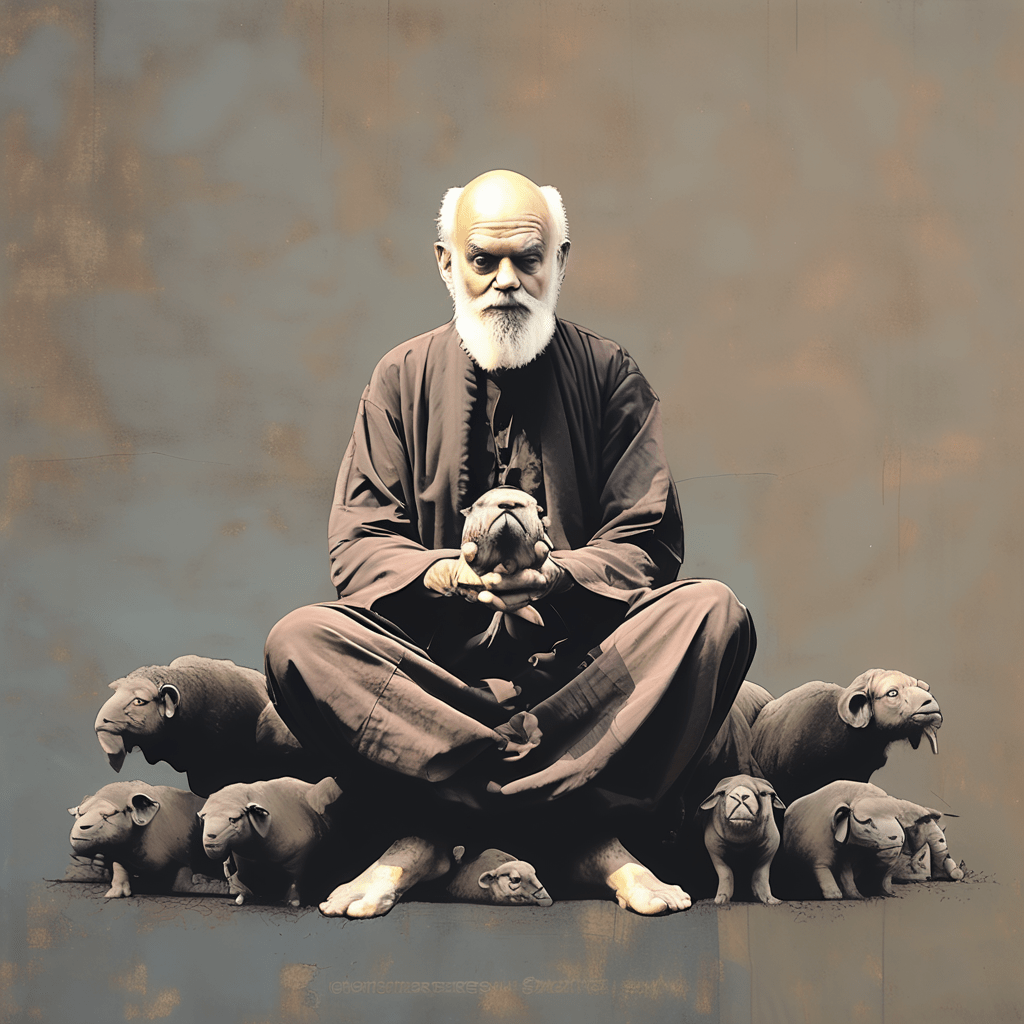
In the grand scheme of existence, evolution emerges as a relentless force, driven not by a final destination but by an insatiable quest for transformation. This dynamic process, ever unfolding, illustrates the profound truth that satisfaction within creation is but a temporary state, a mere waypoint on a much grander journey. Evolution, in its essence, embodies the principle that perfection is not a fixed point but an endless horizon.

The notion that evolution is never wholly satisfied with its creations serves as a metaphor for our personal and spiritual growth. Just as the universe continuously evolves, so too must we. This concept challenges us to view our lives not as a series of destinations reached but as a continuous flow of becoming. It invites us to embrace change, celebrate the process of transformation, and find joy in the journey of self-discovery and enlightenment.

In the context of nonduality, this evolutionary dissatisfaction can be seen as a reflection of the universe’s inherent desire for expansion and self-expression. Nonduality teaches us that separation is an illusion, that all is one, and within this oneness, the drive towards greater expressions of complexity and consciousness is evident. The universe, and by extension, we, are not static entities but dynamic, ever-changing manifestations of consciousness seeking to explore and experience itself in infinite ways.


This perspective shifts our understanding of dissatisfaction. Rather than viewing it as a negative state to be avoided, we can see it as a catalyst for growth and evolution. Discontent becomes a signpost, pointing towards opportunities for deeper understanding and greater alignment with our true nature. It encourages us to look beyond the surface of our desires and to question what truly drives us toward fulfillment.

The evolutionary impulse within us all is a testament to the potential that lies in embracing the unknown. It is a call to venture beyond the comfort of the familiar, to let go of the need for permanence and certainty, and to surrender to the flow of life. This journey, though fraught with challenges, holds the promise of profound wisdom and spiritual awakening.


As seekers on this path, we are invited to reflect on our evolutionary dissatisfaction. How does it manifest in our lives? What lessons does it hold for us? And how can we harness it as a force for positive transformation?

This exploration of evolution and dissatisfaction offers a fresh lens through which we can view our journey toward enlightenment. It reminds us that the essence of growth is not in reaching a state of permanent satisfaction but in embracing the beauty of the process, the unfolding of life, and the deepening of our understanding of the interconnectedness of all things.

Morgan O. Smith

Yinnergy Meditation, Spiritual Life Coaching & My Book, Bodhi in the Brain…Available Now!
https://linktr.ee/morganosmith

The Dual Nature of Ego

Obstacle and Catalyst in the Quest for Enlightenment

In our quest for spiritual awakening, the concept of the ego plays a paradoxical role. On one hand, it is often seen as the primary hindrance on the path to enlightenment. On the other, it can serve as a vital instrument propelling us toward this very goal. This duality presents a fascinating aspect of our spiritual journey, inviting us to explore the ego not just as an adversary, but also as an ally.

In its most basic form, the ego is our sense of self. It’s the ‘I’ or ‘me’ that navigates through the world. In many Eastern philosophies, the ego is perceived as the root of suffering and illusion. It’s this ego that clings to desires, fears, and identities, trapping us in a cycle of samsara – the continuous loop of birth, life, and death. From this viewpoint, enlightenment is about transcending this limited self and recognizing our true nature, which is unbounded and interconnected with the entire cosmos.


However, this is only one facet of the ego’s role in our spiritual evolution. Consider the idea that the ego can also be a vehicle for growth. It is, after all, the ego that initially sparks the desire for enlightenment. Though rooted in the individual self, this desire can lead us toward a deeper understanding and a broader perspective. The ego drives us to seek, question, and yearn for something beyond our current state. In this sense, it can be seen as a necessary step in our spiritual evolution.

Moreover, confronting and understanding the ego is a vital part of spiritual practice. It’s through this process that we gain insight into our true nature. The ego’s patterns, attachments, and fears are not just obstacles to be removed but also mirrors reflecting our deeper truths. By engaging with our ego, we learn about the constructs of our identity, the nature of our minds, and the illusions we hold. This understanding is a crucial milestone in the journey toward enlightenment.

In this complex dance, the ego is both the veil that conceals the truth and the force that urges us to seek it. As seekers, we must navigate this paradox with awareness and discernment. The goal is not to annihilate the ego but to understand its nature and role in our spiritual development. By doing so, we can transform our relationship with the ego, seeing it not just as a barrier to overcome, but as a teacher guiding us towards greater awareness and unity with the all-encompassing truth.


In conclusion, the ego’s dual nature as both a barrier and a catalyst in the journey toward enlightenment offers a profound lesson. It reminds us that every aspect of our being, including those we perceive as limitations, can contribute to our spiritual growth. The path to enlightenment is not about rejecting parts of ourselves but understanding them in a way that leads to a deeper realization of our true essence.

Morgan O. Smith

Yinnergy Meditation, Spiritual Life Coaching & My Book, Bodhi in the Brain…Available Now!

https://linktr.ee/morganosmith

Turiyatitta

The Dual Dimensions of Consciousness and Developmental Progression

In the realm of spiritual exploration, few concepts are as enigmatic and yet profoundly significant as Turiyatitta. Derived from ancient Eastern philosophies, Turiyatitta is often perceived through two distinct lenses: as a state of consciousness and as a stage of developmental progression. This dichotomy offers a multifaceted understanding of the journey toward enlightenment, allowing us to unravel its mysteries with a deeper appreciation.

I. Turiyatitta as a State of Consciousness

At its core, Turiyatitta as a state of consciousness represents the pinnacle of spiritual awareness. It transcends the traditional states of waking, dreaming, and deep sleep. In this heightened state, the individual experiences an overarching sense of unity and interconnectedness with the universe. It is a realm where dualities merge, and the illusion of separateness dissolves. This experience is not merely about observing or understanding nonduality; it is about living it, being immersed in it completely.

II. Turiyatitta as a Stage of Developmental Progression

Alternatively, when viewed as a stage of developmental progression, Turiyatitta symbolizes the culmination of a spiritual journey. It’s not a destination reached hastily but through diligent, sustained practice and profound inner transformation. This perspective of Turiyatitta underscores the evolutionary nature of spiritual growth. It suggests a gradual unfolding, a blossoming of consciousness that culminates in the realization of Turiyatitta.


III. The Interplay between the Two Dimensions

The beauty of Turiyatitta lies in the interplay between these two dimensions. The state of consciousness feeds into the developmental progression, and vice versa. Each experience of Turiyatitta as a state of consciousness propels the seeker further along their developmental path. Similarly, each step forward in one’s spiritual development offers a deeper immersion into the state of Turiyatitta.

IV. Implications for the Spiritual Seeker

For the spiritual seeker, understanding Turiyatitta in both contexts is crucial. It serves as a guidepost, illuminating the path to true enlightenment. By recognizing that Turiyatitta is both a state to be experienced and a stage to be attained, seekers can approach their journey with a balanced perspective, appreciating the importance of both immediate experience and long-term growth.


Conclusion

Turiyatitta, in its dual representation, offers a profound framework for understanding the depths of spiritual consciousness and the journey toward enlightenment. By exploring its aspects as a state of consciousness and a developmental stage, we open ourselves to a more holistic and enriched spiritual journey.

Morgan O. Smith

Yinnergy Meditation, Spiritual Life Coaching & My Book, Bodhi in the Brain…Available Now!

https://linktr.ee/morganosmith

Embracing the Divine in Misinterpretation

A Journey Beyond Surface Understanding

In the realm of spiritual exploration, the concept of misinterpretation often carries a negative connotation, seen as a divergence from the true essence of divine wisdom. However, if we delve deeper, we might discover that these so-called misinterpretations are not merely deviations but integral elements of the divine expression itself.

Consider the myriad paths that lead seekers toward enlightenment. Each path, with its unique interpretations and understandings, contributes to the vast mosaic of spiritual experience. The divine, in its infinite wisdom, does not confine itself to a singular, unchangeable form. Instead, it reveals itself in countless manifestations, each coloured by the cultural, historical, and personal contexts of the seeker. This plurality of expressions is not a flaw but a testament to the boundless nature of the divine.


In Eastern philosophy, particularly in the realm of nonduality, there is an acknowledgment of the inherent unity of all existence. This perspective allows us to view misinterpretations not as barriers to spiritual truth but as windows into a more profound understanding. Each interpretation, no matter how seemingly erroneous, contains a fragment of truth, a glimpse into the unfathomable depths of the divine.

This approach encourages us to embrace diversity in spiritual thought. Instead of seeking to correct or align these varied interpretations, we might do well to listen, understand, and appreciate the unique insights they offer. In doing so, we acknowledge that our journey toward enlightenment is not a linear path but a rich, multi-dimensional exploration.


By accepting and even welcoming misinterpretations, we open ourselves to a broader, more inclusive understanding of spirituality. This perspective nurtures a sense of humility and wonder, as we recognize that our grasp of the divine is ever-evolving, always expanding. It is in this space of openness and curiosity that true spiritual growth occurs.

In conclusion, the misinterpretations of the divine, rather than being mere errors to be corrected, are vital expressions of the divine itself. They invite us to explore beyond the surface, to question, and to seek a deeper connection with the ultimate reality. This journey is not about finding the one right path but about embracing the richness of all paths that lead us to a greater understanding of the divine.

Morgan O. Smith

Yinnergy Meditation, Spiritual Life Coaching & My Book, Bodhi in the Brain…Available Now!

https://linktr.ee/morganosmith

Awakening to Inherent Wisdom

The Illusion of Seeking Enlightenment

In the realm of spiritual discovery, there exists a profound yet often overlooked truth: the state of enlightenment is not a distant reality to be attained, but an intrinsic aspect of our very being. This realization confronts the traditional narrative of spiritual pursuit, where enlightenment is viewed as a summit to be reached through arduous journeying.

Consider for a moment the notion that you are, at this very instant, already enlightened. The idea may seem counterintuitive, especially in the context of Eastern philosophy which often emphasizes a path of gradual awakening. Yet, this perspective invites us to reconsider our approach to spiritual growth. It is not about acquiring something new or transforming into someone else; it is about recognizing and embracing the wisdom already within us.

The journey of self-discovery, then, turns inward. It becomes an unfolding, gentle unveiling of the layers of misconception and illusion that cloud our perception of our true nature. This process is not about adding more knowledge or experiences but subtracting the unessential, peeling away the narratives and beliefs that have limited our understanding of ourselves.


In this light, every moment is an opportunity for enlightenment. Each experience, no matter how mundane, carries the potential to be a window to our true selves. The challenge lies in our ability to remain present and attentive to these opportunities. It requires a shift from seeking externally for answers, to turning inward and listening to the silent wisdom that speaks in the stillness of our being.

This perspective also reshapes our understanding of the spiritual path. The path is not a linear progression towards a defined end, but a deepening into the ever-present reality of our enlightened nature. It is a journey without distance, where the destination is already where we stand.

Reflect on this: What changes when you start acting from the understanding that you are already enlightened? How does this shift your perception of your spiritual journey?


In embracing this paradigm, we find that enlightenment is not a state to be achieved, but a truth to be realized. It is not an exclusive domain of the few, but an accessible reality for all. Our task is not to seek enlightenment, but to recognize and embody the enlightenment that we already are.

Morgan O. Smith

Yinnergy Meditation, Spiritual Life Coaching & My Book, Bodhi in the Brain…Available Now!
https://linktr.ee/morganosmith

The Journey to Perfection

Unraveling the Essence of Manifestation

In the realm of existence, there lies an intriguing paradox at the heart of our understanding: the notion that the Source, the origin from which all things emanate, is already in a state of inherent perfection. Yet, paradoxically, the manifestations that spring forth from this Source are engaged in a relentless pursuit of perfection. This presents a profound conundrum, offering a rich ground for exploration and introspection.

Consider the Source as an unfathomable well of potential, brimming with possibilities and inherent completeness. It is a concept that transcends the boundaries of physicality and temporality, existing beyond the constraints of our human experience. In this context, the Source is not just a point of origin but a state of being, embodying the zenith of existence in its purest form.

However, when we shift our gaze to the world around us, to the manifestations of this Source, we encounter a different reality. Everything we perceive, experience, and interact with is in a state of becoming, evolving towards a perceived state of perfection. This journey, filled with growth, learning, and transformation, is the essence of our existence.


The contrast between the perfection of the Source and the evolving nature of its manifestations raises profound questions. Why does this dichotomy exist? Is the pursuit of perfection a mere illusion, a cosmic play orchestrated by the Source? Or is it an inherent part of the Source’s design, a fundamental aspect of the universe’s fabric that drives the evolution of consciousness?

In contemplating these questions, we find ourselves delving into the mysteries of creation, existence, and purpose. It challenges us to look beyond the superficial layers of reality, urging us to seek a deeper understanding of our place in the cosmos. This exploration is not just an intellectual exercise but a spiritual journey, inviting us to align our personal growth with the universal flow of perfection.

Ultimately, the journey toward perfection is not about reaching a final destination. It is about embracing the process, understanding that each step, each moment of growth and realization, brings us closer to the essence of the Source. It is a journey that transcends the limitations of time and space, offering us a glimpse into the infinite potential within and around us.


In embracing this journey, we become co-creators with the Source, actively participating in the unfolding of the universe’s grand narrative. We learn to appreciate the beauty of imperfection, understanding that it is an integral part of the path towards perfection. This realization empowers us to live with purpose, passion, and a profound sense of connection to the Source and its manifestations.

As we continue to explore this paradox, let us remember that the pursuit of perfection is not just a goal but a journey of discovery, transformation, and alignment with the ultimate Source of all existence.

Morgan O. Smith

Yinnergy Meditation, Spiritual Life Coaching & My Book, Bodhi in the Brain…Available Now!
https://linktr.ee/morganosmith

Krishna Kaur

Celebrating the Essence of Black History Month Through the Wisdom of Krishna Kaur Khalsa

In the spirit of Black History Month, it is pivotal to spotlight the luminous figures whose contributions transcend the conventional boundaries of culture, spirituality, and personal growth. Among such esteemed individuals is Krishna Kaur Khalsa, a beacon of Kundalini Yoga and a venerated teacher whose legacy intertwines with the very soul of Black History. My journey with Krishna Kaur, particularly during her visit to Toronto, unveiled a realm of spiritual enlightenment and resilience that continues to inspire.

Krishna Kaur, a pioneer in her field, has not only brought Kundalini Yoga to diverse communities but has also embodied the profound interconnectedness between the African diaspora and Eastern spiritual philosophies. Her teachings, deeply rooted in the tenets of Kundalini Yoga as taught by Yogi Bhajan, illustrate a unique synthesis of cultural heritage and spiritual discipline. This blend is a testament to the power of spiritual practices in fostering community, resilience, and self-empowerment among people of African descent.

The significance of Black History Month lies not just in acknowledging the struggles and achievements of Black individuals but also in celebrating the diverse contributions they have made across various fields—including spirituality and holistic wellness. Krishna Kaur’s journey is a compelling narrative of overcoming barriers, embracing one’s roots, and sharing profound spiritual knowledge with the world. Her dedication to spreading the teachings of Kundalini Yoga far and wide, especially among Black communities, underscores a vital aspect of this celebration: the recognition of spiritual leaders who have been instrumental in nurturing a sense of unity, strength, and enlightenment.

My encounters with Krishna Kaur during her lectures and Kundalini Yoga training sessions in Toronto were transformative. While she encouraged a focus on yoga training, my inclination towards meditation practice remained strong. Despite this divergence in our spiritual practices, the respect and admiration I hold for her wisdom and her holistic approach to Eastern knowledge have only deepened. Krishna Kaur’s teachings, characterized by an unwavering commitment to spiritual awakening and personal growth, have left an indelible mark on my journey and countless others touched by her grace.

As we honour Black History Month, let us remember the luminaries like Krishna Kaur Khalsa who illuminate the paths of spiritual exploration and self-discovery. Her legacy, imbued with the richness of Eastern philosophy, serves as a beacon for all who seek to transcend the boundaries of their individual experiences in pursuit of a more interconnected and enlightened world.

In celebrating Krishna Kaur’s contributions, we are reminded of the broader impact of Black spiritual leaders and their essential role in weaving the fabric of our collective history. Their stories and teachings encourage us to look beyond the surface, explore the depths of our spiritual journeys, and acknowledge the profound ways Black history and spirituality are intertwined.

Morgan O. Smith

Yinnergy Meditation, Spiritual Life Coaching & My Book, Bodhi in the Brain…Available Now!
https://linktr.ee/morganosmith

Embracing the Essence of Humanity

A Reflection on Jesus’ Enlightenment

In a world often clouded by turmoil and uncertainty, the figure of Jesus stands as a beacon of what humanity can aspire to become. Regardless of one’s religious beliefs or lack thereof, there is an undeniable power in the ideals that Jesus represents. It’s not about the historical accuracy or the debates surrounding his existence; it’s about the essence of the individual he symbolizes – an essence that showcases humanity at its finest.

Jesus’ teachings, rooted in love, compassion, and empathy, are more than religious doctrines; they are universal values that transcend cultural and temporal boundaries. In these teachings, we find a guide to better ourselves and, by extension, the world around us. The message is simple yet profound: to cultivate an inner garden of love and understanding that spreads its seeds in every interaction.

The act of giving, as epitomized by Jesus, is not just a physical act of charity but a spiritual and emotional offering. To give up a piece of ourselves means to share our time, our understanding, and our compassion with others. This selflessness does not diminish us; instead, it enriches our lives, fills our hearts, and strengthens our communities.


In aspiring to be like Jesus or any figure that embodies the best of humanity, we challenge ourselves to grow beyond our limitations. It’s about striving to be the kind of person who acts with kindness, not for recognition or reward, but because it is inherently the right thing to do. It is about recognizing the interconnectedness of our lives and the impact of our actions on others.

In times of hardship, we often look for heroes and role models to guide us. Jesus’ enlightenment offers a path, not through miraculous feats, but through everyday acts of kindness and understanding. It’s in the small moments – a helping hand to a stranger, a listening ear to a friend in distress, a word of encouragement to someone losing hope – that the essence of what Jesus represents shines brightest.

As we reflect on the values epitomized by Jesus, let us commit to embodying these ideals in our daily lives. Let our actions be guided by love, our decisions by compassion, and our words by empathy. Let us be the ones who give, not just in material terms, but in the ways that truly matter – in understanding, in support, and love.


In doing so, we not only honour the legacy of figures like Jesus but also contribute to a world that is kinder, more compassionate, and more empathetic. It is in this effort that we find our greatest fulfillment and the true essence of what it means to be human.

Morgan O. Smith

Yinnergy Meditation, Spiritual Life Coaching & My Book, Bodhi in the Brain…Available Now!
https://linktr.ee/morganosmith

The Unseen Journey

Crawling Towards Enlightenment

In the realm of spiritual growth, the path to enlightenment is often misconceived as a sudden emergence into a state of knowing. Yet, the essence of true understanding unfolds gradually, mirroring the natural progression from crawling to walking. This journey is subtle, requiring patience, persistence, and a deep commitment to the inward voyage.

Enlightenment, in its profound simplicity, can be likened to the process of a child learning to navigate the world. Initially, the child crawls, a phase marked by exploration and curiosity. This stage, though seemingly modest, is foundational. It represents the initial stirrings of awareness, where the soul begins to recognize the vastness of its existence beyond the physical constraints. Here, the seeker starts to explore the inner dimensions, crawling through the layers of self, guided by the light of introspection.

The transition from crawling to walking in spiritual terms is not marked by physical growth but by the expansion of consciousness. It involves the gradual shedding of ego, the relinquishment of attachments, and the deepening of one’s connection to the universal truth. This process is not linear but cyclical, with each step forward often accompanied by moments of regression, prompting further introspection and growth.

As we embark on this journey, we learn that enlightenment is not a destination but a way of being. It is the realization that every moment, every breath is an opportunity to be present, to witness the unfolding of life with a heart full of compassion and a mind free from judgment. The path demands a surrendering, a letting go of the need for certainty, and an embrace of the mystery that envelops our existence.

The beauty of this journey lies in its uniqueness for each individual, yet the underlying principle remains the same: one must learn to crawl before one can walk. The initial steps, taken in the darkness of the unknown, are what prepare us for the light of wisdom. It is in the act of crawling, of moving forward with humility and grace, that we pave the way for our spiritual awakening.


Let us then honour the crawl, the gentle, determined exploration of our inner landscapes, for it is here that the seeds of enlightenment are sown. Let us approach each day as a step towards understanding, a movement closer to the harmony that exists between the self and the universe. In doing so, we walk the path of enlightenment, not with haste, but with the deliberate pace of one who understands the value of each moment of awareness.

Morgan O. Smith

Yinnergy Meditation, Spiritual Life Coaching & My Book, Bodhi in the Brain…Available Now!

https://linktr.ee/morganosmith

Unveiling the True Father of Lies

The Misconception of Satan as an External Entity

In the labyrinth of human belief systems, the concept of Satan stands as one of the most controversial and misunderstood. Traditionally depicted as the epitome of evil and temptation, an external entity battling against the forces of good, I challenge that notion, proposing a radical interpretation: Satan is not an actual being, but a personification of the darker aspects within ourselves.

The idea that Satan is a separate, external entity who tempts and deceives humanity is a narrative deeply ingrained in various cultures and religions. However, this perspective shifts the responsibility of our actions, impulses, urges, temptations, sins, and ill wills, onto an external ‘Father of Lies’. But what if the true ‘Father of Lies’ is not an external force but resides within each of us?

This provocative viewpoint suggests that we are the architects of our deceit. We lie to ourselves, craft facades, and believe them to be our true selves. In doing so, we create a scapegoat in the form of Satan, an external devil responsible for our temptations and wrongdoings. This externalization serves as a convenient excuse, absolving us of our responsibility for the choices we make.


The concept of personification is not new to human understanding. We personify nature as Mother Nature, time as Father Time, and similarly, our darker instincts as Satan. These are not actual entities but representations of phenomena or aspects of our psyche. The id, a term from psychoanalytic theory, representing our primal instincts, can be seen as what the concept of Satan embodies. But over time, we have distorted this metaphor, externalizing it and giving it a form and identity separate from us.

By acknowledging that the essence of what we call ‘Satan’ lies within us, we confront the uncomfortable truth of our nature. It’s a call to introspection, to recognize and take responsibility for our darker aspects. It’s an invitation to stop deceiving ourselves and to transcend beyond our limitations.

The act of blaming an external Satan for our actions is not only a limitation but a hindrance to our growth and understanding. It prevents us from reaching our true potential, and from evolving into more self-aware, responsible beings. When we shed this externalized blame and look within, we empower ourselves to make conscious choices and understand the true nature of our actions.


In conclusion, the figure of Satan, traditionally seen as the external ‘Father of Lies’, is a reflection of our inner selves. By embracing this perspective, we can embark on a journey of self-discovery and accountability, leading to a higher state of consciousness and being.

Morgan O. Smith

Yinnergy Meditation, Spiritual Life Coaching & My Book, Bodhi in the Brain…Available Now!

https://linktr.ee/morganosmith