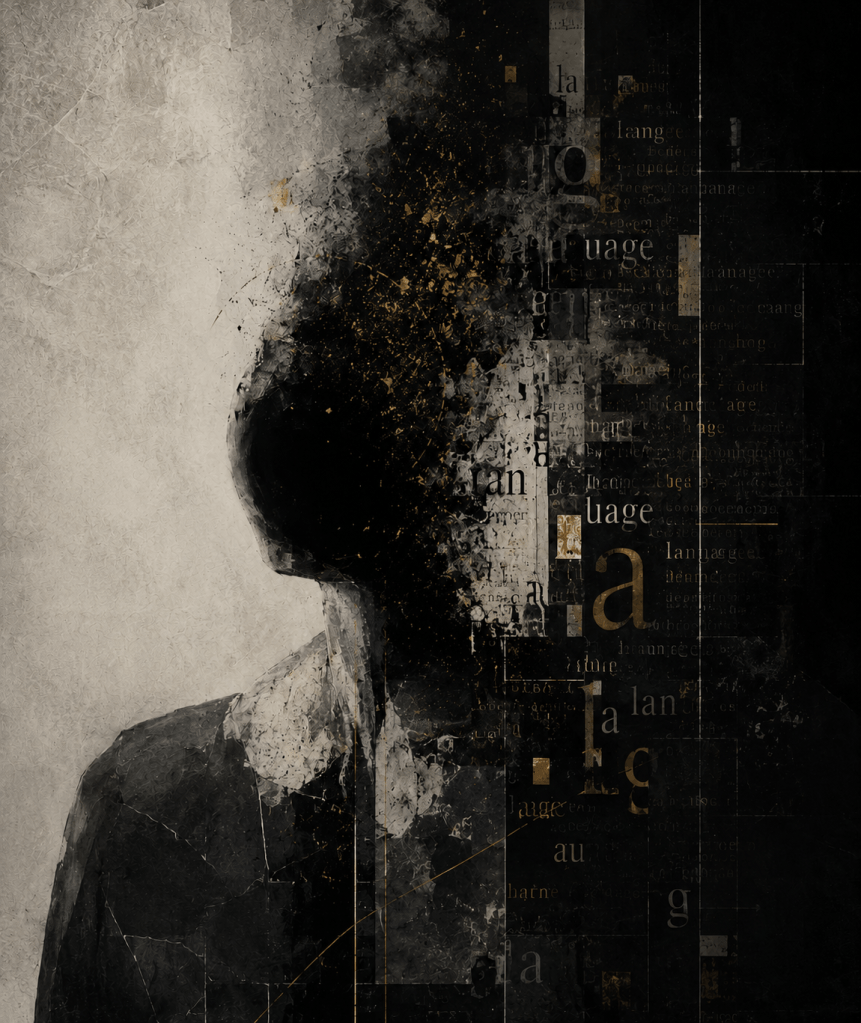
The Nameless Cannot Fit Inside Language

The strangest paradox of human existence is that we rely on language to understand reality while the deepest parts of reality seem to exist beyond language entirely.

A word can ignite a war, resurrect a forgotten memory, or make a stranger weep. Entire civilizations rise from shared symbols and stories. Human beings navigate life through names, categories, and explanations so constantly that description begins to feel indistinguishable from reality itself.

Yet the moment experience becomes truly immediate — raw grief, overwhelming beauty, profound stillness, unconditional love — words begin to fracture around its edges. Something essential escapes translation.

Every word depends upon distinction. Language functions by separating one thing from another so the mind can navigate experience. Light becomes different from darkness. Self becomes different from other. Beginning becomes different from ending.

But what happens when reality is encountered prior to division?

Ordinary language begins to fail.

Mystics throughout history arrived at the same dilemma. Whatever they discovered could not be fully translated into thought. Some called it God. Others called it emptiness, Brahman, Tao, pure awareness, or the Absolute. Different names emerged across cultures and centuries, yet every label pointed beyond itself.

A map drawn in ash cannot contain the wildfire itself.

A person can spend decades studying spiritual systems, memorizing sacred texts, and refining belief structures while never directly encountering what the words attempt to reveal. Language can guide attention, but it cannot substitute for realization.

This becomes especially clear during profound states of meditation or radical presence. Thought slows. Internal narration weakens. Identity loosens its grip. Experience no longer feels divided into observer and observed. Something vast and immediate remains, yet the mind struggles to explain it afterward.

Silence suddenly carries more honesty than explanation.

Not because truth is irrational, but because reality appears prior to conceptual separation. Words emerge afterward as echoes attempting to describe what cannot fully become an object of thought.

The mind naturally resists this insight. Human beings seek stability through conclusions. Definitions create psychological structure. Naming something creates the feeling of control over it. This tendency explains why religious institutions, philosophical systems, and ideological movements often become rigid.

But reality itself remains fluid and immeasurable.

Attempts to imprison the infinite within language eventually collapse into contradiction. God is described as both personal and impersonal. Emptiness becomes fullness. Enlightenment appears both ordinary and transcendent. Opposites dissolve because language was designed to organize division, not indivisibility.

Zen masters understood this deeply. Some answered spiritual questions with silence. Others responded with paradox, laughter, or seemingly irrational statements meant to loosen attachment to concepts. Their aim was not confusion for its own sake, but direct seeing.

A sunset does not need philosophy to radiate beauty. Love does not require intellectual agreement to be felt.

Reality arrives before commentary.

Perhaps this is why awakening often feels less like gaining knowledge and more like recognizing what has always been here beneath mental noise. The search softens because the seeker realizes what was being sought was never absent.

Words may continue afterward. Teaching may continue. Yet something fundamental changes. Language becomes symbolic rather than absolute. Concepts become tools rather than prisons mistaken for truth.

The nameless remains untouched behind every sentence.

Silent. Boundless. Uncontained.

Morgan O. Smith
https://linktr.ee/morganosmith

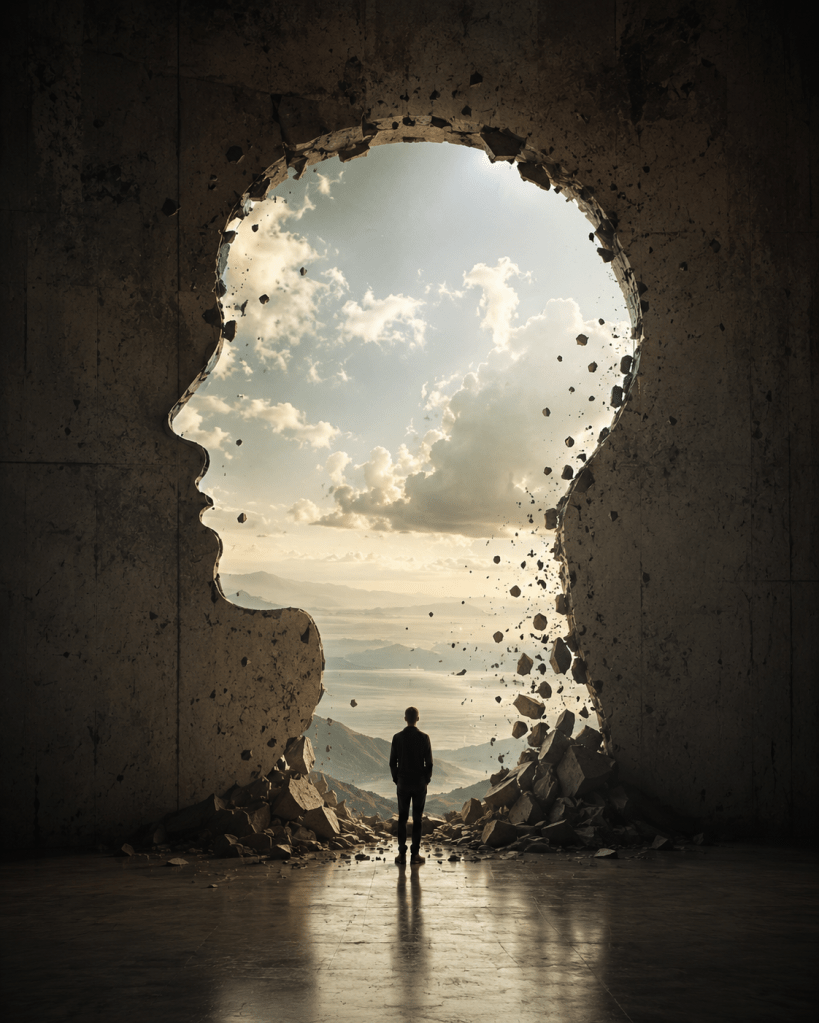
No Definition Can Hold the Infinite Whole

Human beings are addicted to definition.

We define nations, identities, emotions, philosophies, and even the boundaries of the cosmos itself. The mind survives through categorization. Without labels, ordinary navigation becomes difficult. Language organizes perception into manageable fragments, allowing consciousness to interpret experience through patterns and distinctions.

Yet something extraordinary happens when the mind attempts to define the infinite.

It fails.

Not because the infinite is irrational, but because definition itself depends upon limitation. To define something means to separate it from what it is not. A tree is not the sky. Water is not stone. The body is not the chair. Every definition creates borders.

The infinite has no border.

This creates a profound paradox. The moment the infinite is defined, it becomes psychologically reduced into an object of thought rather than the living totality from which thought itself emerges.

People speak about God, consciousness, enlightenment, emptiness, Brahman, Tao, or ultimate reality as though these words contain what they point toward. But words are symbols, not the living actuality itself. A menu is not a meal. A map is not the terrain. Spiritual language often becomes mistaken for realization.

Concepts can inspire awakening.
They cannot replace it.

A person may memorize every sacred text ever written and still remain trapped within mental abstraction. Another person may sit silently beneath a tree, beyond philosophy and doctrine, and directly encounter a depth untouched by conceptual thought.

Reality does not require intellectual permission to exist.

The mind struggles with this because it seeks stability through certainty. Certainty creates psychological comfort. Ambiguity threatens identity. This is why people cling to rigid ideologies, religious systems, or philosophical conclusions. Definitions provide the illusion of control over existence.

But existence refuses confinement.

Life continuously overflows the structures created to contain it. Every scientific breakthrough revises older assumptions. Every spiritual revelation dissolves previous certainty. Every profound mystical experience shatters the mental boundaries once believed to be absolute.

The infinite remains untouched by every framework attempting to grasp it.

Ancient sages understood this deeply. Lao Tzu opened the Tao Te Ching by warning that the Tao which can be spoken is not the eternal Tao. Advaita Vedanta points toward neti neti — “not this, not that” — stripping away every conceptual identification. Zen dismantles attachment to intellectual understanding through direct experience and paradox.

These traditions are not anti-intellectual.
They simply recognize the limits of conceptual thought.

Thought is a tool. A remarkable one. But a tool should not be mistaken for the source of reality itself.

Awareness exists before thought comments on it.

Silence exists before language interprets it.

Being exists before identity claims ownership over it.

This recognition changes the entire spiritual journey. Seeking shifts from accumulating beliefs to dissolving false certainty. One no longer attempts to imprison truth inside definitions but instead becomes available to direct experience without resistance.

The infinite cannot be possessed mentally because the mind itself appears within the infinite.

A wave cannot contain the ocean from which it rises.

Perhaps this is why the deepest realizations often arrive with humility rather than triumph. The closer one moves toward ultimate reality, the more obvious it becomes that existence exceeds every philosophical system ever created.

No final sentence survives there.

Only openness.
Only presence.
Only this immeasurable reality appearing as everything.

Morgan O. Smith

Embracing the Moment of Nondual Suchness

Beyond the Realm of Experience

In the intricate journey of understanding consciousness and existence, we often stumble upon a profound concept: the moment of nondual suchness. This concept, deeply rooted in Eastern philosophies, especially in Zen Buddhism, transcends the conventional boundaries of experience and knowledge. It presents a paradox that challenges our fundamental understanding of reality: at the moment of nondual suchness, direct experience cannot be experienced.

What does this mean, and why is it significant? To explore this, we must delve into the nature of nonduality. Nonduality refers to a state of consciousness where the distinction between the subject and object dissolves. It is a realization that there is no ‘me’ separate from the rest of existence. In this state, the usual dualistic framework of perceiver and perceived, experiencer and experienced, falls away.

This leads us to the crux: if there is no separation between the experiencer and the experience, can we truly say that an experience is happening? The moment of nondual suchness suggests that in its purest form, experience transcends the dichotomy of subject and object. You do not experience the moment; you become the moment. There is no ‘you’ observing, feeling, or thinking about the experience; there is just the undifferentiated reality of what is.


This notion can be controversial and thought-provoking because it contradicts our everyday experience where we are constantly distinguishing ourselves from our experiences. We are taught to value our perceptions, emotions, and thoughts as what defines us. Yet, the concept of nondual suchness invites us to consider a state of being where these personal distinctions are not just irrelevant, but nonexistent.

Why is this perspective important? It encourages a radical shift in how we perceive ourselves and the world around us. It challenges us to let go of our habitual patterns of thought, our constant categorization, and our deep-seated need to analyze and differentiate. By contemplating nondual suchness, we open ourselves to a more holistic understanding of existence, one that is not confined by the limits of individual perspective.

In practical terms, embracing this concept can lead to a profound sense of peace and connectedness. When the illusion of separateness falls away, so do the conflicts and struggles born from it. What remains is a state of pure being, unburdened by the complexities of dualistic thinking.


To conclude, the moment of nondual suchness presents a radical and transformative viewpoint that challenges our conventional understanding of experience. It invites us to question the very nature of our existence and to explore a realm of consciousness beyond the limitations of individual perception.

Morgan O. Smith

Yinnergy Meditation, Spiritual Life Coaching & My Book, Bodhi in the Brain…Available Now!

https://linktr.ee/morganosmith

At the Moment of Spiritual Enlightenment

Becoming the Understood

We journey through life seeking understanding, but how often do we pause and reflect on the nature of that understanding itself? Is understanding merely an intellectual achievement, or is it something more profound, something that fundamentally transforms us?

### Becoming Through Understanding

The idea that at the moment of spiritual enlightenment one becomes what they understand is rooted in ancient philosophies and spiritual traditions. When one truly understands a concept or truth, it’s not just a matter of grasping it intellectually. It’s about embodying that truth. The realization and the realizer merge into one.

Consider the Zen Buddhist concept of *satori*, an instant when one attains sudden enlightenment. In that moment, there’s no distinction between the self and the universe. The person does not merely understand unity; they *become* unity.

### The Depth of Knowing

The difference between intellectual knowledge and spiritual knowledge can be thought of as the difference between knowing about water and being submerged in it. You can study water, read about its chemical properties, and understand its role in the ecosystem, but it’s entirely different to dive into an ocean and feel the water surrounding you, to become one with that element.

This kind of immersive understanding is transformative. It shapes the core of our being, changes our perception, and reshapes our interactions with the world.

### From Being to Becoming

The real beauty of this idea lies in its transformative potential. Once we grasp that true understanding leads to becoming, our entire approach to learning and growth shifts. We stop being passive consumers of knowledge and instead strive for deep, transformative insights. We no longer learn just for the sake of knowing, but for the sake of becoming.

### The Limitless Potential of Enlightenment

Every moment of spiritual enlightenment is a doorway. It offers an invitation, not just to understand the cosmos, but to become an intrinsic part of it. To recognize that in truly knowing love, we become love; in truly knowing peace, we become peace.

It’s a journey without a final destination because the universe, in all its vastness, is ever-evolving, and ever-expanding. And as we continue to understand, we continue to become, forever part of the cosmic dance.

In conclusion, at the moment of spiritual enlightenment, understanding and identity merge. This is not just an esoteric concept but a call to action. To dive deep into understanding, to let go of superficialities, and to let every truth we uncover reshape our very essence. For in the dance of enlightenment, to understand is to become.

Morgan O. Smith

Yinnergy Meditation & My Book, Bodhi in the Brain…Available Now!

https://linktr.ee/morganosmith

The Timeless Universe

A Journey into the Eternal Now

As humans, we are fundamentally tethered to the concept of time. We perceive our lives as an unceasing flow of moments, an endless river cascading from the mountains of the past into the oceans of the future. But what if we could untether ourselves from this chronology, detaching from the past and the future to dwell in an “eternal now”? This concept might seem paradoxical, even inconceivable, yet it offers a fascinating vista of our understanding of reality.

First, we must address the elephant in the room: Can we truly conceptualize a universe without time? The removal of time from our universe plunges us into the depths of a reality where the progression of events ceases. In this static universe, everything exists in an unending present state, with no evolution or motion since these phenomena require time to define their existence.

Yet, the concept of an “eternal now” still implies a temporal dimension. In other words, to speak of an ‘eternal’ now, we inadvertently evoke the notion of time. Herein lies the paradox: while we yearn for a grasp on the timeless, our very language and cognition are steeped in the temporal.

So, what does it mean to experience this “eternal now”? We find an enlightening perspective in the Zen Buddhist concept of “satori”. Satori represents a sudden awakening, an immersion in the present moment that is so profound that it transcends time. This experience of enlightenment unveils a reality where past and future merge into a single, timeless instant. In satori, one perceives reality unfettered by the usual constraints of time or even individual self.

Despite its paradoxical nature, the exploration of an “eternal now” serves as an intellectual and philosophical exercise that tests the boundaries of our understanding. It underscores the limitations of our human comprehension, reminding us of the extraordinary mystery that is our universe.

Dwelling in the “eternal now” is a concept that nudges us to revisit our accepted notions about time and reality. It invites us to question whether our perception of linear time, with its forward march from the past to the future, is the only possible way to experience the universe.

Could there be other forms of reality, other universes perhaps, where time as we know it does not exist? Or could our very perception of time be an illusion, a cognitive construct born out of necessity? In the vast cosmos, are we just temporal beings trying to make sense of a timeless existence?

We might not be able to fully answer these questions, yet in asking them, we expand our intellectual horizons and deepen our understanding of the universe. In this exploration, perhaps we may even inch closer to experiencing a taste of the enigmatic “eternal now”.

Morgan O. Smith

Yinnergy Meditation & My Book, Bodhi in the Brain…Available Now!

https://linktr.ee/morganosmith