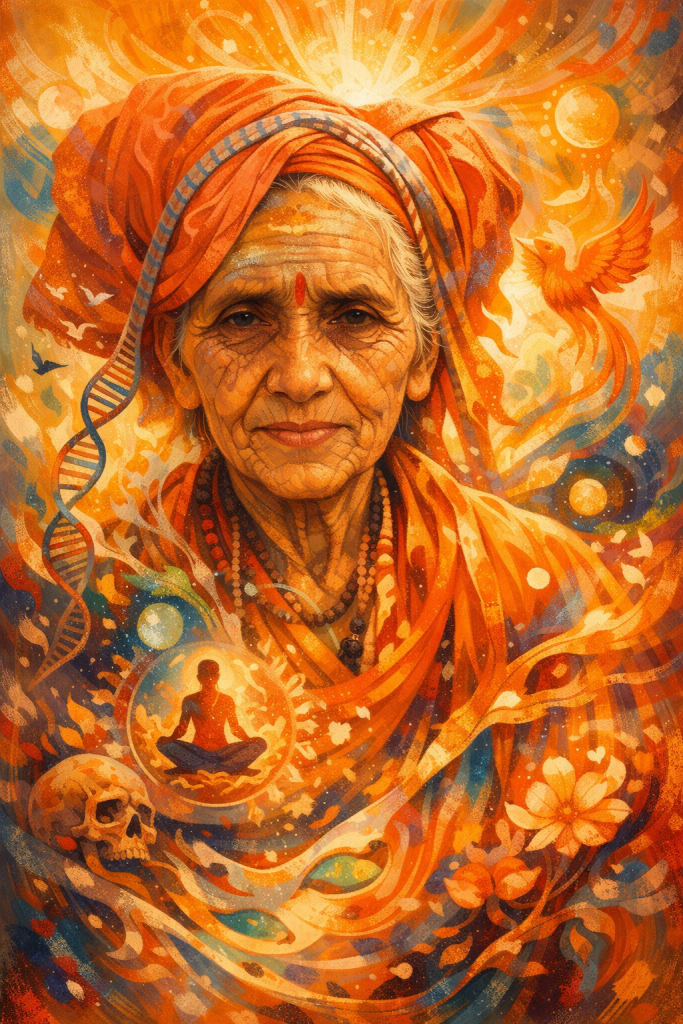
Evolution is not a mechanism operating on the sidelines of existence. It is existence unfolding itself.
What we call species, stars, civilizations, identities—these are gestures within a single, restless current. The river does not evolve because of what flows within it. The river is the flowing. Likewise, evolution is not something life does. It is what life is.
Birth, death, and rebirth appear as events in time, yet they are movements within a larger continuity that never begins and never concludes. A body forms. A body dissolves. Patterns reorganize. Consciousness shifts perspective. The wheel turns, not because something is trapped, but because turning is the expression of its nature.
This turning is named samsara.
Samsara is often framed as bondage, a cycle to escape. Yet who is bound? The forms are bound to change. The identities are bound to dissolve. The narratives are bound to fracture. But the underlying vitality—the raw fact of being—remains untouched by the rise and fall of its own expressions.
Here lies the paradox: the same movement that appears as entanglement is also freedom.
Moksha is not found outside the cycle. It is not a reward waiting at the end of repetition. Liberation is present as the very openness in which repetition occurs. The wave may crash, reform, and crash again, but water is never confined by the shape it temporarily assumes.
Evolution births forms and dissolves them. It experiments through biology, culture, thought, and self-awareness. It creates the seeker and the path. It invents philosophies about progress and enlightenment. Then it outgrows them. Then it reinvents them.
Every collapse is also a refinement.
Every ending is also a clarification.
The living whole is not striving toward perfection. It is exploring possibility. What appears as suffering is often the friction of transformation. Structures resist their own impermanence. Systems cling to stability. Identities defend continuity. Yet change is not violence; it is revelation.
Look closely and another layer becomes visible: evolution itself is not separate from what it evolves. The sculptor and the sculpture are the same movement. The cosmos is not building something other than itself. It is discovering its own depth through contrast.
Freedom and bondage coexist because the dance requires both tension and release.
A human life embodies this paradox intimately. You are shaped by memory, conditioning, language, and biology. You are also the spacious awareness within which those forces arise. Bound as a personality. Free as presence. Caught in stories. Unmoved as the field in which stories appear.
Samsara is the play of differentiation.
Moksha is the recognition that nothing has ever been outside the whole.
Evolution, then, is not merely survival or adaptation. It is the continuous unveiling of what was never absent. It moves from matter to mind, from instinct to reflection, from fragmentation to integration—not to escape itself, but to experience itself more fully.
Birth and death are punctuation marks in an unbroken sentence.
Rebirth is not only literal or metaphysical. Every shift in understanding is a rebirth. Every relinquished identity is a small death. Every expansion of compassion is an evolutionary leap that leaves no fossil record, yet alters the interior landscape of the world.
This living totality is not trapped in its cycles. It is expressing through them.
The wheel turns. The centre remains still.
Both are true at once.
Morgan O. Smith
 Morgan O. Smith