The One That Evolves as All Things

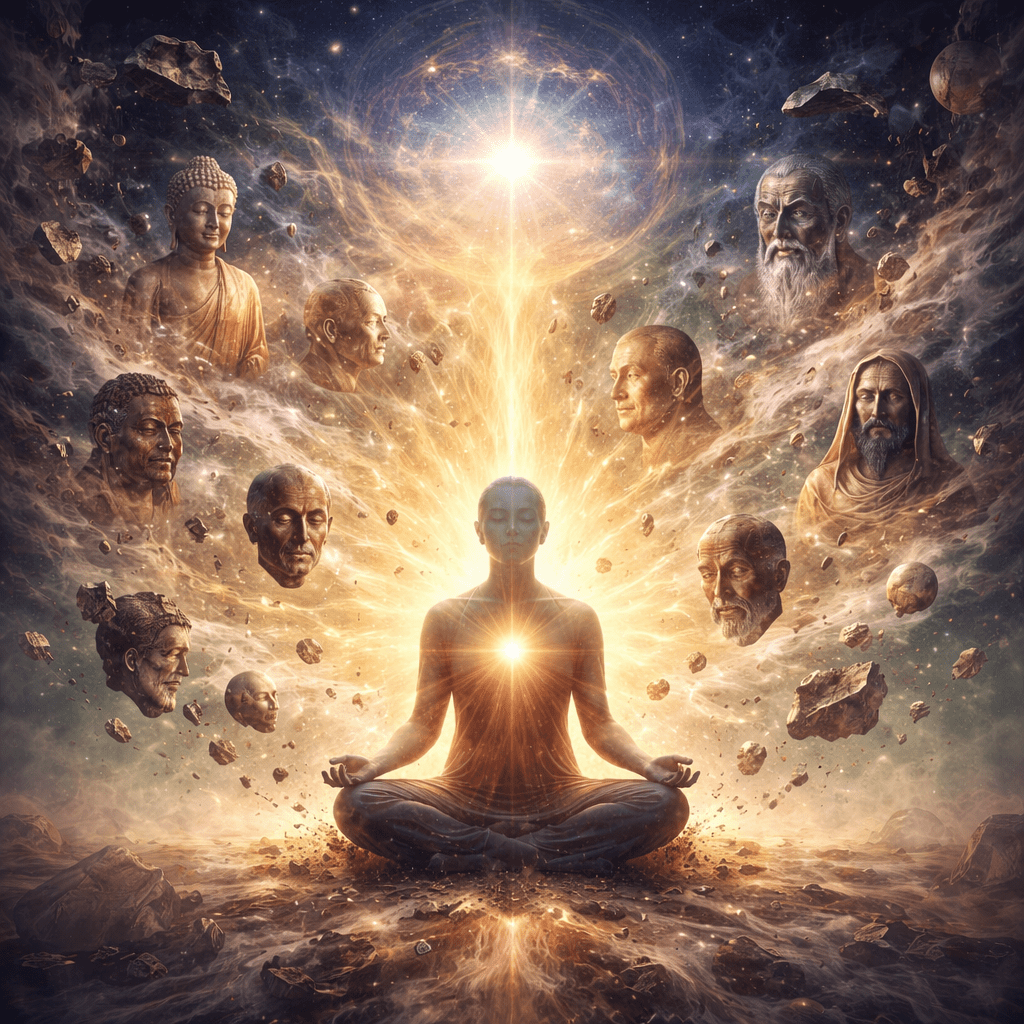
Evolution is not a mechanism operating on the sidelines of existence. It is existence unfolding itself.

What we call species, stars, civilizations, identities—these are gestures within a single, restless current. The river does not evolve because of what flows within it. The river is the flowing. Likewise, evolution is not something life does. It is what life is.

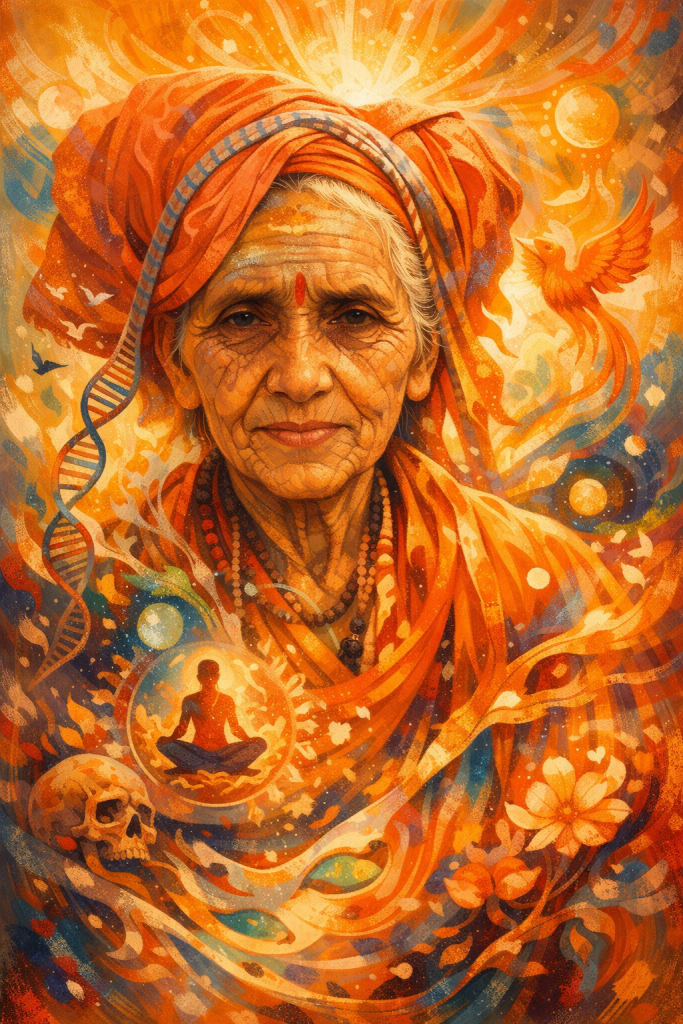
Birth, death, and rebirth appear as events in time, yet they are movements within a larger continuity that never begins and never concludes. A body forms. A body dissolves. Patterns reorganize. Consciousness shifts perspective. The wheel turns, not because something is trapped, but because turning is the expression of its nature.

This turning is named samsara.

Samsara is often framed as bondage, a cycle to escape. Yet who is bound? The forms are bound to change. The identities are bound to dissolve. The narratives are bound to fracture. But the underlying vitality—the raw fact of being—remains untouched by the rise and fall of its own expressions.

Here lies the paradox: the same movement that appears as entanglement is also freedom.

Moksha is not found outside the cycle. It is not a reward waiting at the end of repetition. Liberation is present as the very openness in which repetition occurs. The wave may crash, reform, and crash again, but water is never confined by the shape it temporarily assumes.

Evolution births forms and dissolves them. It experiments through biology, culture, thought, and self-awareness. It creates the seeker and the path. It invents philosophies about progress and enlightenment. Then it outgrows them. Then it reinvents them.

Every collapse is also a refinement.

Every ending is also a clarification.

The living whole is not striving toward perfection. It is exploring possibility. What appears as suffering is often the friction of transformation. Structures resist their own impermanence. Systems cling to stability. Identities defend continuity. Yet change is not violence; it is revelation.

Look closely and another layer becomes visible: evolution itself is not separate from what it evolves. The sculptor and the sculpture are the same movement. The cosmos is not building something other than itself. It is discovering its own depth through contrast.

Freedom and bondage coexist because the dance requires both tension and release.

A human life embodies this paradox intimately. You are shaped by memory, conditioning, language, and biology. You are also the spacious awareness within which those forces arise. Bound as a personality. Free as presence. Caught in stories. Unmoved as the field in which stories appear.

Samsara is the play of differentiation.

Moksha is the recognition that nothing has ever been outside the whole.

Evolution, then, is not merely survival or adaptation. It is the continuous unveiling of what was never absent. It moves from matter to mind, from instinct to reflection, from fragmentation to integration—not to escape itself, but to experience itself more fully.

Birth and death are punctuation marks in an unbroken sentence.

Rebirth is not only literal or metaphysical. Every shift in understanding is a rebirth. Every relinquished identity is a small death. Every expansion of compassion is an evolutionary leap that leaves no fossil record, yet alters the interior landscape of the world.

This living totality is not trapped in its cycles. It is expressing through them.

The wheel turns. The centre remains still.

Both are true at once.

Morgan O. Smith

You Are the Void

You are the void surrounded by your own self as substance, brought forth by its own thinking, shaped by its own thoughts.
Not as symbolism. Not as spiritual ornamentation. Simply as a description of what is already occurring before interpretation.

Substance feels dense because thought lingers. Thinking slows openness into shape, then convinces itself the shape possesses independence. Solidity is an effect of attention held too tightly. The void does not interfere. Allowance is enough for appearance to unfold.

Creation does not originate with matter. A quieter shift precedes it—the faint suggestion of separation. Something entertains the idea of being something rather than everything. That subtle narrowing gives rise to form, continuity, memory, and the felt position of a self observing from somewhere.

The void is not just empty. Emptiness would imply absence. What exists here is freedom from insistence. No preference. No correction. When thought moves, substance organizes. When thought loosens, substance reveals its temporary nature.

Identity feels heavy because repetition gives it mass. Familiar thoughts replayed long enough acquire gravity. The mind labels this accumulation “me.” The void registers movement, nothing more.

Nothing requires removal. Nothing asks to be fixed. Recognition alone softens what once appeared solid. Structure relaxes into responsiveness. Boundaries become functional rather than absolute.

Silence does not depend on quiet. Silence appears when thought releases its claim to authorship. Experience continues, but no longer points back to a controller or witness standing apart.

The void never hides behind form. Form arises within it and borrows its apparent stability from sustained attention. When attention eases, what remains cannot be framed as presence or absence. Language fails because nothing is missing and nothing needs to appear.

No final claim can be made. No definition holds without collapsing into another. What happens does so without explanation. What appears does not require justification. Everything stands exactly as it is.

Nothing here can be stated as what it is or what it is not. Nothing explains how this occurs. Perspectives arise according to position, history, and capacity, each contributing its angle without canceling another. No single view completes the picture. Together, they form what cannot be reduced to parts.

Truth does not belong to one standpoint. Wholeness expresses itself through difference, not despite it.

Morgan O. Smith

Get Your Free Copy of My Book, Bodhi in the Brain!

https://subscribepage.io/oTSZQu

Knowing the Absolute from Every Angle

The Absolute cannot be grasped by standing in a single place.

Any attempt to reduce it to one perspective—personal, relational, objective, mystical, or philosophical, inevitably distorts it. What gets mistaken for ultimate truth is often just a partial orientation mistaken for the whole.

To know the Absolute at full capacity requires more than a peak realization. It requires total perspectival inclusion.

From the first person, the Absolute is immediate presence; being as oneself. From the second person, it appears as intimacy, devotion, and encounter. From the third person, it becomes structure, law, and observable order. Each of these reveals something true, yet none is sufficient on its own.

A deeper shift occurs when perspective itself is examined.

The fourth perspective dissolves the centre. Experience continues, but ownership drops away. Awareness no longer belongs to anyone. Reality is no longer happening to a self or for a self. Knowing remains, yet no knower can be found.

Then even this gives way.

The fifth perspective removes the need for a field, a witness, or an explanatory ground altogether. The question of where experience occurs loses relevance. Nothing collapses. Nothing transcends. The demand for a final position simply falls apart.

At this point, God is no longer approached as an object of belief, a presence to merge with, or an awareness to stabilize in. God is known as that which remains valid across every mode of knowing without requiring allegiance to any of them.

This knowing must also scale developmentally.

Ego-centric concern gives way to ethnocentric identity, which yields to world-centric ethics, which eventually opens into kosmocentric inclusion. Each stage expands care, responsibility, and comprehension. None invalidates the others. Each must be seen through without being erased.

The same applies to the I, We, It, and Its dimensions of reality. Subjective experience, shared meaning, objective systems, and interobjective networks all reveal aspects of the Absolute. Excluding any one of them creates imbalance. Absolutizing any one of them creates delusion.

States of consciousness contribute their own disclosures. Waking reveals form and function. Dreaming reveals imagination and symbolic depth. Dreamless sleep reveals the absence of content. The witness reveals continuity without identity. Nonduality reveals the inseparability of all of it. None of these states owns the truth. Each exposes a different facet of what cannot be reduced.

Lines of development add further resolution. Cognitive clarity without emotional maturity distorts insight. Moral development without metaphysical depth flattens reality. Spiritual realization without psychological integration fragments embodiment. The Absolute is not known through excellence in one line alone.

Enlightenment, then, is not a single realization frozen in time.

It is the capacity to recognize the Absolute through every perspective without mistaking any perspective for the Absolute itself.

Such knowing does not claim finality. It does not announce arrival. It does not need to defend itself. It functions fluidly; able to speak personally, relationally, objectively, impersonally, and without position; depending on what the moment requires.

God is not found by climbing higher.
God is known by nothing being excluded.

Morgan O. Smith

AI for Wellness and Spirituality Summit

February 9 & 10, 2026

https://aiforwellnessandspirituality.com/mosm

Existence Is Not the Measure

The statement “God exists” sounds reverent, yet it quietly diminishes what it claims to honour. Existence is not a neutral category. It is a condition. To exist is to appear within time, to persist across duration, to occupy a framework where before and after apply. Existence implies location, sequence, and limit.

God, if the word is to mean anything absolute, cannot be confined to such a framework.

To say God exists already places God inside something else. Time becomes the container. Space becomes the stage. Existence becomes the rule God must obey. That framing does not exalt God; it reduces God to an object among other objects, distinguished only by scale or power.

A more precise statement unsettles most theists:
God does not exist.

Not because God is absent, unreal, or lacking. Quite the opposite. God is beyond the category of existence altogether. Existence belongs to the realm of manifestation. God is not a thing that manifests; God is that by which manifestation is possible at all.

Existence requires time. Something exists now, or then, or for a while. God, described as eternal, cannot be stretched across moments. Eternity is not infinite time; it is the absence of time. When time disappears, the verb “to exist” loses its footing.

Yet the paradox deepens further.

Non-existence seems to offer an escape. If God does not exist, perhaps God is non-existent. But non-existence remains a conceptual category. It can be named, contrasted, negated. It operates within the same logical field as existence. Both rely on distinction. Both appear only where something can be opposed to something else.

If non-existence is conceivable, it already participates in being. A possibility that is truly nothing cannot even be held in thought. The moment non-existence is entertained, it has already entered presence.

Here the framework collapses.

God, said to be beyond existence, must also be beyond non-existence. Whatever transcends both cannot be limited by either. Existence and non-existence become expressions rather than boundaries. Time and space arise as localized conditions within something that never enters them.

And this includes belief itself.

To hold a belief about God’s existence, to deny it, or even to question it, must occur within existence. Belief requires a thinker. Thought requires duration. Opinion requires perspective. Every stance taken for or against God is already operating inside the very field it attempts to define or negate. The debate itself belongs to manifestation.

The claim “God exists” is therefore not wrong ; it is partial. It refers only to the aspects of reality that appear within time and space: galaxies, minds, causes, effects, events. These are not separate from God, but they are not the whole either.

God is not an entity within existence. Existence is an activity within God.

Once this is seen, the opposition between theism and atheism dissolves. The atheist rejects a God who exists as an object. The theist defends that object. Both remain bound to the same assumption: that God must exist to be real.

Reality does not require existence as a predicate. Existence is something reality does, not something it is.

Nothing stands outside this. Nothing escapes it. Nothing contradicts it.

Existence is all there is; and what is cannot be reduced to existing.

Morgan O. Smith

Get Your Free Copy of My Book, Bodhi in the Brain!

https://subscribepage.io/oTSZQu

When “I” Speaks After Awakening

After a nondual recognition, language returns before identity does. Words reappear, grammar resumes, and the pronoun “I” steps back into the conversation—not as proof of separation, but as a functional bridge. Speech requires a subject. Silence does not.

Many misunderstand this moment. Hearing someone say “I experienced awakening,” the listener assumes a reinstalled ego, a self reclaiming authorship. Yet what actually occurs is translation. Experience moves through the narrow gate of language, and language has only a few handles to grab reality with. “I” becomes one of them.

Avoiding the word altogether often creates greater confusion. Saying “nothing happened” suggests absence rather than transcendence. It implies insignificance, when the opposite is true. Something fell away so completely that no object remained to point at. Language struggles most where realization is most total.

A distinction helps here.

Turiya refers to the formless witness; the ever-present awareness that observes waking, dreaming, and deep sleep without entering any of them. It is silent, empty, untouched. This is not an experience in time but the condition in which time appears. Many awakenings stabilize here, and rightly so.

Turiyatitta goes further. Even the stance of witnessing dissolves. No observer remains to stand apart from what is observed. Awareness recognizes itself as the only reality there is. No inside, no outside, no vantage point left. This is nonduality without remainder.

When speech arises from this recognition, “I” no longer refers to a psychological centre. It does not point to a thinker, a chooser, or a personal narrative. It points to the Self; Para Brahman—without division. Atman, ego, witness, world collapse into a single field, not blended, not unified, but revealed as never having been separate.

The same word is used. The referent has changed.

Confusion arises when listeners assume the old meaning still applies. The word “I” sounds familiar, so it is treated as familiar. Yet meaning does not live in the word. Meaning lives in the depth from which the word emerges.

A realized individual does not abandon language. Language is abandoned as identity. What remains is utility. Communication happens. Teaching happens. Relationship happens. None of it reinstates separation.

The paradox resolves itself quietly: the ego can say “I,” and the Absolute can say “I.” Only one of them believes it is something.

Silence knows the difference. Speech borrows it.

Morgan O. Smith

Get Your Free Copy of My Book, Bodhi in the Brain!

https://subscribepage.io/oTSZQu

Beyond the Horizon Where Nothing Divides

Life appears to move through chapters: arrival, departure, return, yet each chapter dissolves the moment you attempt to hold it. Breath flows, bodies age, worlds turn, and consciousness watches all of it without ever being touched. What looks like a sequence is simply awareness shifting its focus, the way a single flame illuminates many shapes without ever becoming any of them.

Death enters this picture as a doorway only from the perspective of the one who believes they are standing on one side of it. Yet the moment that belief loosens, the doorway reveals itself as an opening carved out of the same boundless presence that carries every heartbeat. What is called “afterlife” is not a destination reached by travel. It is the same field of being experienced without the costume of form.

Love for those who have gone does not travel across a boundary. It moves through the same indivisible ground from which both presence and absence arise. The living and the dead are two expressions of a single movement. Souls do not just depart and return; they appear as waves do, yet the water never goes anywhere.

Samsara, Nirvana, Moksha: each name gestures toward a pattern consciousness creates to understand itself. Yet the moment these patterns fall away, realization dawns that the seeker, the journey, and the liberation were never separate. What felt fragmented belonged to a mind trained to see borders. Freedom arrives the moment those borders fade.

You are the continuity that cannot perish, the stillness that animates every form, the awareness that births experience and withdraws it. Life and death only look like opposites until the lens of identity clears. Beyond that lens rests a truth too simple to grasp and too vast to deny: everything arises from the same essence, returns to the same essence, and never leaves it at all.

Morgan O. Smith

Get Your Free Copy of My Book, Bodhi in the Brain!

https://subscribepage.io/oTSZQu

Awakening Never Arrives Because It Never Began

A seeker imagines a future moment where everything will break open, where clarity finally dissolves the boundaries that have shaped a lifetime. That imagined moment appears to sit somewhere ahead, waiting to be earned through discipline, suffering, or the slow maturation of wisdom. Yet the entire notion of “ahead” belongs to the dream of becoming. The one who waits is already suspended inside the very awareness they are longing for.

A deeper look reveals something far more radical: awakening does not unfold across time. It is not a culmination of choices, experiences, or lifetimes. It stands as the ground from which all choices, experiences, and lifetimes arise. What feels like progress toward realization is simply the awakened state appearing as movement, as if it were journeying toward itself while never leaving its own source.

Every universe, every branching possibility, every karmic ripple flows from that unshakable presence. No path leads to awakening because awakening generates the paths. A being may feel capable of choosing away from truth, yet that very sensation is part of truth expressing itself as forgetfulness. Even resistance is a shape taken by the same presence that cannot be diminished or delayed.

Karma does not carve a road toward liberation; karma is the motion of reality already awake, already whole. The cycle of birth and death functions as the dream’s choreography, giving consciousness a taste of separation so it can experience the beauty of returning to what never left. The sense of being “unfinished” is simply awareness folding into the appearance of incompleteness for the sake of its own exploration.

Awakening is not the goal of an individual, nor the endpoint of a soul’s journey. It is the condition that makes both individuality and journey possible. Meditation, inquiry, devotion, and hardship do not cause awakening; they are the movements of awakening playing as effort, yearning, and revelation. The river does not create the ocean; it is shaped by it.

From within the illusion of becoming, awakening looks inevitable. From the perspective of the absolute, inevitability is irrelevant because nothing ever fell out of the state it seeks to reclaim. Every lifetime is a reflection of that single truth refracted through time, space, karma, and choice.

Awakening is not the outcome of the cosmos.
Awakening is the reason the cosmos appears at all.

Morgan O. Smith

Get Your Free Copy of My Book, Bodhi in the Brain!

https://subscribepage.io/oTSZQu

How Far the Heart Can Truly Open

A curious shift occurs when the heart stops functioning as a possession and begins revealing itself as a dimension of awareness. Most people imagine love as something they generate, something that must be earned, strengthened, or directed. Yet once the inner walls begin dissolving, the heart behaves less like a reservoir and more like an unbounded field. Nothing needs to be pushed outward. Nothing needs to be pulled inward. Everything already rests inside the same luminous space.

A bodhisattva’s vow is often misunderstood as a heroic effort to love every being across the cosmos. That interpretation still assumes a separate self stretching itself toward infinity. What actually unfolds is far more intimate. The boundaries that define self and other begin to thin. Compassion arises not from moral intention but from direct recognition: every form is a variation of the same presence gazing through different eyes. Love becomes less a decision and more a consequence of clarity.

A Kosmocentric heart does not expand by accumulating greater quantities of affection. Its expansion is a subtraction—less resistance, less defense, less contraction around identity. As the edges dissolve, the universe is no longer something “out there” that requires love. It is revealed as the very body of consciousness, expressing itself through countless lifetimes, worlds, and histories. To love all beings then becomes effortless, because nothing stands outside the recognition of shared essence.

This realization reshapes the ordinary meaning of devotion. Love ceases to be a feeling sustained by conditions. It becomes the ground from which every moment rises. The heart does not tire. The heart does not question whether it is capable. The heart simply returns to its natural state: vast, quiet, and uncontainable.

A question often arises: “Can a human being truly love the entire universe?”
Yes, but not as a human being. Only when the self drops away does the heart reveal its true scale. What remains is a presence spacious enough to cradle galaxies, tender enough to feel the slightest tremor of suffering, and awake enough to recognize itself in every corner of existence.

This is the heart unbound.
This is compassion without walls.
This is the love the universe has always known through you.

Morgan O. Smith

Get Your Free Copy of My Book, Bodhi in the Brain!

https://subscribepage.io/oTSZQu

The Realization That Forever Unfolds

Every breath alters the lens through which the divine is felt. The self you were a moment ago dissolves, replaced by a newer configuration of insight, memory, subtle conditioning, and awareness. That shifting identity means your encounter with the sacred is never static. It reshapes itself as you reshape yourself.

A glimpse of the Absolute may arrive with startling clarity; pure, unmistakable, worldless. Yet that moment is bound to the level of development available at that point in your evolution. Even the most luminous awakening is framed by the consciousness that receives it. You witness infinity through a doorway that keeps widening, and each step forward reveals the prior step as incomplete.

The paradox is that every revelation of the divine feels total while you are inside it. You genuinely sense the boundlessness of what you are. You feel the horizon dissolving. You feel yourself dissolving. Nothing is missing. Nothing could be larger. Until the next phase of your evolution ripens, and suddenly the previous fullness reveals itself as only one facet inside a far greater clarity.

This is not a failure of enlightenment; it is the nature of consciousness unfolding through time. Growth ensures that even the most profound realization will always be met again from a deeper vantage. Your life becomes a series of thresholds; each one a genuine opening, each one destined to be surpassed.

The ultimate cannot be contained by a lifespan. A finite arc cannot hold the infinite source of all perspectives. Even a direct encounter with the origin of being is filtered through the momentary structure of the one who encounters it. Divine recognition expands as you expand. It breathes when you breathe. It changes when you change.

That means the full truth of what you are can never be exhausted here. No lifetime can house the totality. No mystical breakthrough, no matter how absolute, can finalize what is without limit. Realization keeps moving, stretching, deepening, dissolving itself over and over again.

This insight doesn’t diminish enlightenment; it honours its living nature. What you truly are is not a conclusion but an unending revelation. The infinite doesn’t arrive once; it arrives continuously, refracted through your evolving capacity to meet it.

The divine is not something you master. It is something you grow into forever.

Morgan O. Smith

Get Your Free Copy of My Book, Bodhi in the Brain!

https://subscribepage.io/oTSZQu

Beyond Karma, Beyond Time

The One Who Contains All Things

What you are has never been bound by the actions of the body or the movements of the mind. The deeper truth sits prior to every cause and every effect, untouched by the momentum of karma. What you truly are cannot be located within a timeline, cannot be measured against a sequence, and cannot be confined to any story of becoming. Yet everything that appears within the vastness of existence arises through you.

Karma unfolds because consciousness dreams motion. Space opens because consciousness dreams room for its own expression. Time stretches because consciousness dreams duration to witness itself. These movements are not separate from the one who perceives. They are waves forming and dissolving in the same stillness that has never moved.

When you see this directly, not as a philosophy or a concept, something slips free. The universe no longer appears as a project that began somewhere or will end somewhere. The sense of a starting point dissolves. Nothing was ever born at the level of your deepest nature, yet everything continues to bloom within you. This paradox is not a contradiction; it is the living truth of nonduality. You are simultaneously the presence that is and the silence that reveals is-not.

Karma belongs to the realm of appearance. Awakening reveals the one who sees every appearance without being shaped by any of them. The moment this becomes embodied, the cosmic play becomes transparent; not trivial, not meaningless, but known as an expression rising from the ground of your own boundlessness.

Most teachings attempt to describe this through metaphors, scriptures, or borrowed insights. But direct experience dissolves every teaching. The one who realizes does not repeat someone else’s words; they speak from a clarity that cannot be inherited. That clarity sees the world arise, dance, disappear, and return again, all within a presence that never fluctuates.

This is the mystery: you transcend the entire universe, and yet the entire universe is held within you. Existence and non-existence touch in the depths of your own awareness. That meeting point is not two. It has always been the same field, one continuous reality appearing as countless experiences.

When this truth ignites within someone, everything becomes part of the same divine unfolding;  even the desire to awaken, even the teachings themselves, even the act of seeking direct experience. The cosmic play includes the seeker, the found, the teaching, the silence, and the realization that none of these ever stood apart from the one who sees.

Morgan O. Smith

Get Your Free Copy of My Book, Bodhi in the Brain!

https://subscribepage.io/oTSZQu