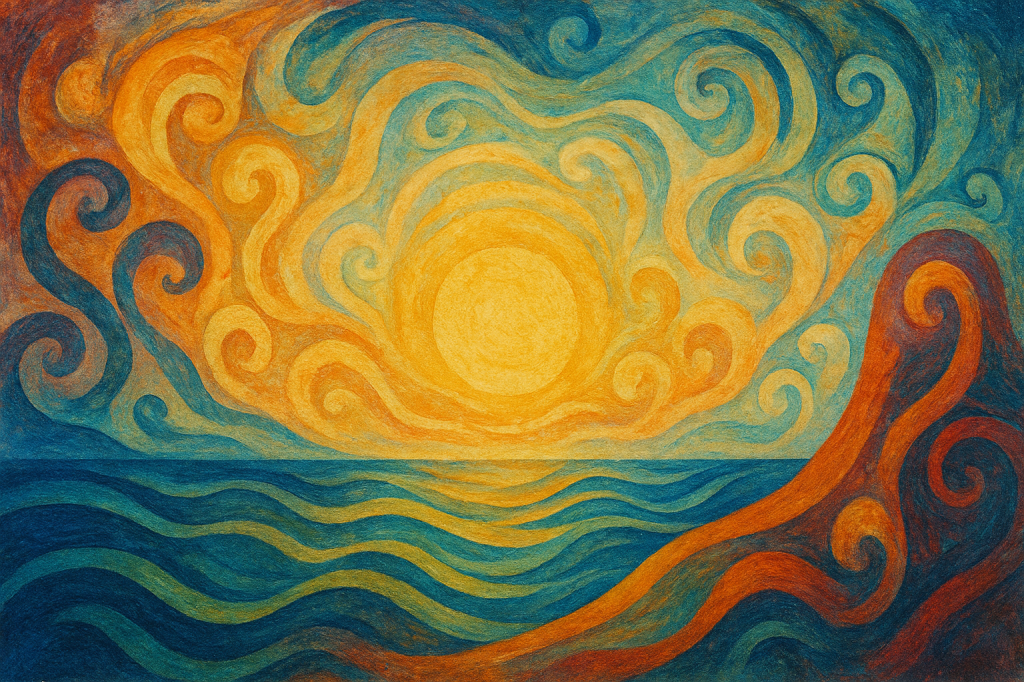
Becoming Compassion

Most people think of compassion as a quality you choose to exercise: you decide to be kind, you decide to forgive, you decide to care. This is true at the surface, but beneath those layers exists a spectrum that reveals compassion in its many shades, beginning as a survival instinct and flowering into something beyond human conception.

Compassion first shows itself as biology. A mother tending to her child, a tribe defending its members, even an animal protecting its young. Survival demands it. Yet, as consciousness expands, compassion takes new shapes. We move from caring for “me and mine,” to protecting “us and ours,” to embracing all of humanity as worthy of care. Beyond this lies the recognition that all of life, every creature, every tree, every ecosystem, calls for reverence. Compassion no longer belongs to just people, but to the living Earth itself.

At a certain depth of awakening, compassion is not about effort at all. It does not come from a moral rule, a spiritual practice, or even an intentional choice. It radiates naturally, like sunlight. One sees the inseparability of self and other. Helping you is helping me, and helping me is helping you. The old distinction collapses.

This is where the spectrum ends, or perhaps where it dissolves. Compassion and its opposite no longer stand as polarities. Cruelty and kindness, neglect and care, are revealed as movements of the same indivisible Reality. From this recognition, one cannot merely be compassionate. One becomes Compassion itself; capital “C.” It is not something you perform; it is what you are.

This Compassion does not choose sides, does not measure worth, does not seek reward. It flows freely, even when it appears as silence, even when it includes suffering, even when it looks like its own opposite. The heart of reality is Compassion without preference. To live from that space is not to practice compassion; it is to be it.

Morgan O. Smith

Get Your Free Copy of My Book, Bodhi in the Brain!

https://subscribepage.io/oTSZQu

Walking Beyond the Self

Expanding the Horizons of Perspective

Most human conflict is rooted in the inability to step outside the narrow confines of the self. We tend to move through the world tethered to a singular point of view, unable to grasp that reality shifts depending on who is looking. Perspective is not fixed; it unfolds in layers, from the egocentric stance of “me and mine,” through the ethnocentric loyalty of “us and ours,” into the broader realms of worldcentric care for humanity, and ultimately the kosmocentric embrace of all beings and existence itself.

When our awareness stops at the egocentric, we see others only as extensions of ourselves; or worse, as threats to what we hold dear. At the ethnocentric level, we expand slightly, but compassion remains conditional, bounded by tribe, religion, race, or nation. Yet the real flowering of human consciousness emerges once we realize that every being, regardless of sex, class, culture, or creed, carries within them a mirror of our own existence.

To recognize yourself in another is not simply an ethical exercise; it is an ontological revelation. The more deeply you understand that the same fears, desires, and vulnerabilities pulse through all lives, the less room remains for judgment. Hatred fades not because you suppress it, but because understanding transforms it. Even the figure we call “devil” becomes less monstrous when we glimpse the fractured angel hidden inside.

Imagine what collective life would feel like if this capacity for expanded perspective became the norm rather than the exception. Entire systems of oppression, exploitation, and alienation would dissolve under the weight of genuine empathy. Politics would no longer be about “sides” but about solutions; communities would no longer divide over difference but celebrate the very diversity that teaches us new ways of being human.

To walk in anyone’s shoes is more than a metaphor. It is the necessary step toward becoming fully human. The journey from ego to cosmos is not only possible, it is imperative. The future depends not on technological advancement alone, but on whether we can evolve into beings capable of holding multiple perspectives at once, anchored in compassion and guided by wisdom.

Morgan O. Smith

Get Your Free Copy of My Book, Bodhi in the Brain!

https://subscribepage.io/oTSZQu

The Serpent’s Gaze

Awakening Through the Fire of Kundalini

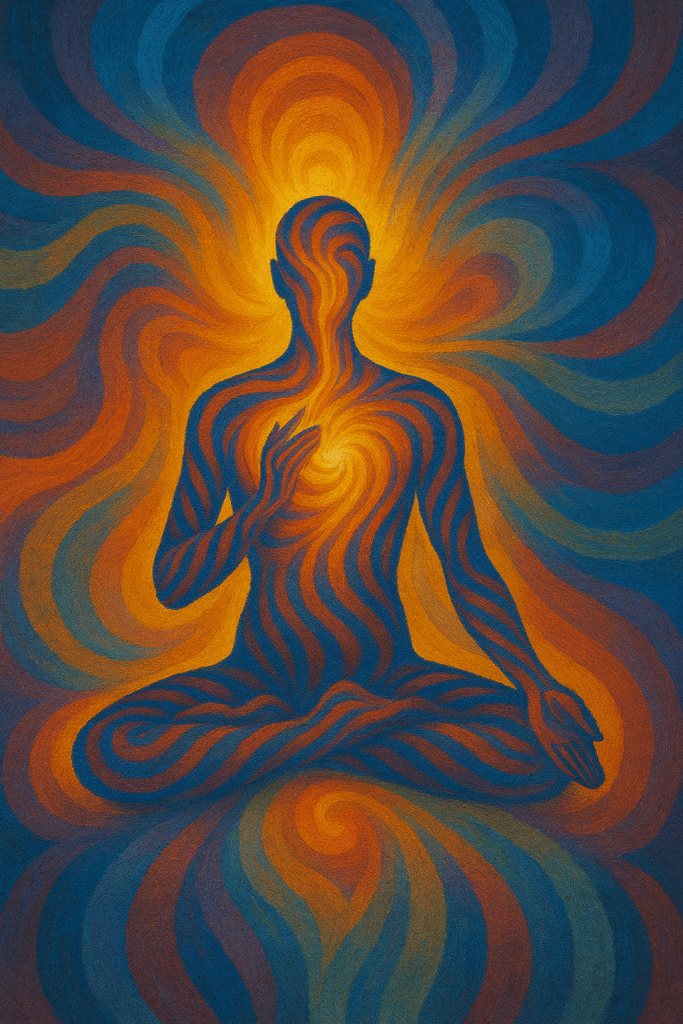
The surge of Kundalini energy does not arrive as a gentle visitor. It comes as a serpent rising, a King Cobra rearing its hood, carrying both the gift of awakening and the threat of annihilation. Those who encounter this force discover it is not a metaphor; it is a reality coursing through every nerve, every cell, as if the body itself were being rewritten from the inside out.

When this energy pierces upward through the spine and explodes through the crown, the encounter feels like a confrontation with divinity itself. The serpent turns its head, upside down, to stare directly at you. In that gaze is the paradox: vitality at its peak and the shadow of death standing closer than ever. The breath sharpens, the heartbeat quickens, and one realizes that this power could end everything in an instant—or transfigure it beyond recognition.

Many speak of spiritual awakening as blissful or serene, but the truth carries far more weight. The awakening of Kundalini is as much a dance with mortality as it is with enlightenment. To feel more alive than ever before is to simultaneously brush against the veil of death, because both are rooted in the same ultimate source. Death is not the opposite of life, but the threshold that life constantly leans against.

The serpent reminds us that awakening is not safe. It burns away illusions, sears through the fragile boundaries of identity, and brings us face-to-face with what cannot die. The brush with death is not punishment—it is initiation. To survive, it is to be reborn, no longer mistaking yourself for the limited frame of flesh and thought, but knowing yourself as the vast consciousness in which even death dissolves.

Kundalini does not ask for permission. It does not ask if you are ready. It rises, and in that rising, you discover whether you can hold its gaze without collapsing into fear. The courage required is not of the ego, but of the soul. To endure the serpent’s fire is to step into a reality that few dare to enter, where life and death are revealed as two faces of the same eternal current.

Morgan O. Smith

Get Your Free Copy of My Book, Bodhi in the Brain!
https://subscribepage.io/oTSZQu

The Subtle Distinctions of Oneness, Nonduality, and the Sacred

To speak of oneness is to point to a direct perception where boundaries dissolve and all things merge into a singular whole. It is an overwhelming intimacy with existence itself—nothing stands apart, no subject or object remains. The experience carries a profound sense of union, yet it still acknowledges a felt “all” that has become “one.”

Nonduality, by contrast, is not the merging of things into one but the recognition that no separation ever truly existed to begin with. The very categories of “one” and “many” collapse. There is no subject perceiving unity, no object being unified—just the unbroken reality that precedes both. Here, the language of experience falters because even the notion of “an experience” implies duality between experiencer and what is experienced.

To call all things divine or sacred is yet another register. This perception imbues life with reverence, not only as one undivided whole but as shimmering expressions of the holy. Every moment, every being, every breath radiates significance. It is not merely that things are nondual, but that the nondual reality is inherently worthy of devotion. The sacred quality does not rest on belief; it is revealed when perception is refined enough to sense the luminous depth at the heart of being.

The distinctions are subtle, yet they matter. Oneness offers belonging. Nonduality uproots the illusion of separation. The sacred awakens awe and reverence for what is. Together, they sketch the contours of realization, each layer illuminating a different face of truth.

When all three—oneness, nonduality, and the sacred—merge seamlessly, a higher recognition dawns: absolute monism. Here, the whole of existence is seen as a single reality that is simultaneously one, beyond duality, and inherently divine. Nothing is outside of it, nothing is other than it, nothing is less than it. The boundaries of philosophy, devotion, and direct experience collapse into the same source. This is not a synthesis of perspectives but the revelation that they have always been expressions of the same truth. Absolute monism discloses the indivisible essence where belonging, emptiness, and holiness are not separate qualities but different ways of perceiving what is eternally and already the case.

Morgan O. Smith

Get Your Free Copy of My Book, Bodhi in the Brain!

https://subscribepage.io/oTSZQu

The Ecstasy of Knowing

When Mind and Soul Dissolve into One

The awakened mind, when met with the receptive soul, becomes a current of divine fusion—an alchemical embrace where thought and feeling cease to be separate. This union transcends the limits of sensation, unveiling a pleasure far beyond the fleeting intoxication of flesh. It is an ascent into boundless wisdom, an eroticism of consciousness where insight spills forth, saturating the ego’s constructs until they dissolve into the vastness of being.

This is not a mere intellectual encounter, nor is it an indulgence in sentimentality. It is the tantric interplay between awareness and presence, where the pulsation of knowing meets the depths of surrender. When the mind no longer dictates and the soul no longer pleads, a stillness emerges—a space so open that it drowns the self in its own infinity. Here, knowledge is not collected but revealed, not possessed but embodied. Love is not an attachment but an atmosphere, pervading every movement, every breath, every silent recognition of the one essence behind all things.

This is where tantra ceases to be philosophy and becomes direct experience. The dissolution of the personal into the infinite is neither loss nor gain but a return—one that neither seeks nor resists, neither holds nor lets go. It is the eroticism of the absolute, where wisdom penetrates the soul like lightning, setting fire to all that would obscure its radiance.

The lover and the beloved, the seeker and the sought, the knower and the known—these distinctions fade into the luminous vastness of pure being. And from this space, all that remains is the silent ecstasy of knowing.

Morgan O. Smith

Get Your Free Copy of My Book, Bodhi in the Brain!

https://subscribepage.io/oTSZQu

The Architecture of the Ideal

Why the Myth Matters More Than the Man

Whether Jesus walked the earth or not is irrelevant to me. I am less concerned with the historicity of a man than I am with the utility of what he represents. Jesus is a technology. So is the Buddha. So is Krishna. These aren’t merely personalities from the past; they are structured mechanisms—living blueprints—for the cultivation of inner transformation and the evolution of civilization.

They function like algorithms for awakening, coded into the myths and memories of culture, waiting to be activated. Each offers a symbol-set, a behavioral protocol, an ethical framework, and a psychological mirror. Whether or not they existed, they exist. Their presence in the collective psyche is undeniable, and their effect, observable.

Civilizations have risen around these templates. Wars have been fought in their names, yes—but so have peace movements been born, arts been inspired, and lives reoriented toward compassion, surrender, and truth. These are not minor outcomes. These are pivotal shifts in the trajectory of human consciousness.

When a society lacks mythic technologies, it spirals. When the sacred is reduced to opinion or dismissed entirely, a vacuum forms. And into that vacuum pours the lesser gods of the day—greed, algorithmic manipulation, ego-as-brand. The sacred figures stand not because they are flawless historical beings, but because they point beyond history. They are fingers, pointing not to the past, but to what is possible—personally, collectively, cosmically.

To see Jesus as a technology is to acknowledge the architecture of possibility. To understand the Buddha as a psychological operating system is to awaken to what it means to be truly sane. Whether temporary or permanent, these peak states—compassion without condition, awareness without center, love without lack—are doorways we are meant to pass through, again and again, until their impermanence no longer discourages us, but refines us.

Maybe they were fictionalized. Maybe they were real. Doesn’t matter. They were necessary. They remain necessary. Because without the fiction of perfection, how would we recognize the direction of our ascent?

Morgan O. Smith

Get Your Free Copy of My Book, Bodhi in the Brain!

https://subscribepage.io/oTSZQu

Once Enlightened… Your Problems Have Just Begun

The illusion is that awakening is the end of the road. That the moment the self dissolves, suffering bows out, and the curtain falls. But what if that moment is not an arrival, but a beginning?

Before awakening, the ego fights battles it believes are personal. After awakening, the battlefield is not smaller—it’s vaster, quieter, and infinitely more subtle. The old problems—desire, fear, control—don’t disappear. They shape-shift. They clothe themselves in spiritual garments and reintroduce themselves as paradoxes: “Should I speak, or is silence more aligned?” “Is this surrender or passivity?” “Am I still pretending there’s a me who can do or not do?”

No one warns you that after the clouds part, the sun may burn.

Liberation is not the end of pain. It’s the end of avoidance. One no longer flinches. One no longer hides. You feel fully raw, exposed, without anesthesia. And still, you sit. Still, you breathe. Still, you bow.

You now see with clarity what others can’t. You watch the mechanisms of ego turning behind the eyes of those you love, and the weight of compassion grows heavier, not lighter. You begin to weep for the world—not out of despair, but from a reverence so deep it bends your knees.

Once you’ve seen through the illusion of self, the world becomes impossibly intimate. Every leaf becomes your body. Every scream, your own. Every cruelty, a mirror reflecting the exact frequency of your forgotten selves. There is no refuge. There is only recognition.

You don’t get to leave the world. You return to it—with your skin ripped open, your boundaries gone, and your heart unarmored. Enlightenment doesn’t make you untouchable. It makes you unable to turn away.

There are no medals for realization. No applause for dissolving. No reward for merging with the absolute. What you get, instead, is a silence that never leaves you. A love so vast it terrifies the small mind. A clarity that strips you of every comfortable lie.

And you carry it.

Not as a badge.
As a burden.
As a blessing.
As a vow.

You walk through the world invisible, but more alive than ever. And your problems—they don’t vanish. They deepen. They purify. They sanctify.

Not because you are broken.

But now, you are whole.

Morgan O. Smith

Get Your Free Copy of My Book, Bodhi in the Brain!
https://subscribepage.io/oTSZQu

The Root of Choice

True Free Will and the Causal Realm

Most speak of choice as if it lives at the surface, where preference, fear, habit, and desire jostle for control. But what if true free will does not arise there at all? What if it exists at the root, before thought forms into options, before “I want” emerges to justify itself?

This root is the causal realm: the source of all motion, where intention is not split from manifestation. It is not personal will in the usual sense—no ego negotiating with life to get what it wants. Instead, it is pure causality aware of itself, setting everything in motion without conflict or division.

At the surface, people speak of freedom as the power to choose between alternatives. Yet these alternatives are already conditioned. They are branches of a tree whose root has already determined their growth. To speak of freedom at the stem while ignoring the root is to mistake effect for cause.

However, the paradox reveals itself when one sees no real division between root and stem. The freedom to choose at the surface becomes genuine only when it is recognized as the expression of the root itself. Every choice becomes the revelation of causality. There is no separate chooser apart from the choosing.

This is what lies beyond the ego’s belief in control. The ego claims “I choose” without realizing that its very claim is already part of the causality it denies. True free will is not the assertion of control over life but the recognition that you are life itself choosing, moving, unfolding.

To see this is to dissolve the illusion of separation. Responsibility is no longer a burden but realization: the root chooses through you, as you. There is no conflict left. Choice becomes transparent, ego falls away, and causality shines unbroken.

This is freedom—not as license, not as negotiation, but as total alignment with the source of all that arises.

Morgan O. Smith

Get Your Free Copy of My Book, Bodhi in the Brain!
https://subscribepage.io/oTSZQu

My Religion Is Liberation

Religion need not be a creed one defends or a ritual one performs. For some of us, it is the recognition of the bars we forge around our own minds—and the relentless devotion to dissolving them. Liberation becomes both the path and the sanctuary.

This isn’t about conversion, salvation, or belonging to any particular sect. It is about noticing the prison of belief itself. Every concept, every identity, every longing for certainty can become a gatekeeper denying entry to our own boundless nature.

Liberation demands a fierce honesty. It asks that we examine the illusions that hold our suffering in place, not as moral failings but as invitations to see through the lie of separation. The true heresy in this religion is clinging to what we think we know about ourselves, about others, about reality itself.

No priest is needed here. Authority resides in awareness, and awareness has no master. The teacher is the arising of life as it is—grief, joy, confusion, clarity. Each moment grants a new chance to recognize the play of experience without getting caught in it.

Liberation is not found by rejecting the world but by perceiving its emptiness and fullness simultaneously. Every object, thought, and sensation is free of substance even as it shines in unmistakable vividness. This paradox isn’t a puzzle to solve but a doorway to live through.

When liberation is the religion, love ceases to be a commandment and becomes the ground of being. Judgment collapses, not because everything is permitted, but because everything is understood as oneself. The compulsion to divide the sacred from the profane, the pure from the impure, loses its grip.

Such a path offers no final doctrine. It holds no promise of eternal reward. Yet it is more generous than any creed that trades truth for comfort. It is the faith of those willing to die before death—to watch every cherished certainty burn so that what cannot be burned may reveal itself.

Those who walk this path do so alone, yet never apart.

Morgan O. Smith

Get Your Free Copy of My Book, Bodhi in the Brain!

https://subscribepage.io/oTSZQu

God Is the Real Imaginary

Absolute Monism and the Paradox of Reality

A peculiar clarity arises once the mind exhausts its chase for permanence. Once the striving quiets, what remains is not a revelation in the ordinary sense—it is the revelation of revelation itself. God. Not as something other, but as the very condition of knowing, being, and non-being.

God is not a person, nor a power among powers. God is context itself. Not just the backdrop, but the totality—the undivided field in which all division appears. It is what Hindus call Para Brahman: the Absolute of the Absolute. The final substratum, beyond form, formlessness, and even beyond the duality of beyond and not-beyond.

Yet the paradox defies all rational anchoring: God is also imagination.

Not a figment. Not illusion in the dismissive sense. But the supreme imagining—consciousness dreaming within itself. The universe, with all its matter and mind, all its chaos and beauty, is that imagining. And because God is not apart from its imagining, God too is that imagining.

Which means this: both God and the universe are imaginary.

And also utterly real.

What we call “real” and what we call “imaginary” collapse into a single gesture when seen from God’s standpoint—which is no standpoint at all. From this viewless view, there is no separation between the dreamer and the dream, the Absolute and its expression, the Formless and the formed.

Yet the beauty of this is not that everything dissolves into sameness. The beauty is that everything becomes itself without needing to stand apart.

God and the universe are one and the same. And because they are one and the same, they are also not the same. The distinction is not contradiction. It is the very nature of what is. Distinctness does not negate unity. It reveals it.

This is not spiritual poetry. This is ontological exactness. If anything is to be absolute, it must include even the capacity to contradict itself. That is the very mark of its absoluteness.

So, what is this that appears as a tree, a thought, a thunderclap, a kiss, a death, a silence?

It is God.
It is the universe.
It is imagination.
It is reality.

One singularity. Absolute Monism.

To see it is not to figure it out. To see it is to disappear into what cannot not be.

Morgan O. Smith

Get Your Free Copy of My Book, Bodhi in the Brain!

https://subscribepage.io/oTSZQu